We research everything we recommend. When you buy through our links, we may earn a commission. Learn more

Buying guide · 10 min read · Updated October 2, 2026

6 Best Non Ducted RV Air Conditioner in 2026: A Practical RV Guide

Six non-ducted RV air conditioner options compared on BTU, heat pump or cooling-only, noise from 43 dB and 12V or 115V power, plus a Dometic box.

Bowen HigginsBy Bowen HigginsRV Editor at RV Gear Lab6 products comparedSpec-sheet researched

At a glance

Our top picks

Open the ceiling of most travel trailers and you find a big square distribution box under the roof air conditioner. That box spreads cool air across the cabin through its own vents, with no ductwork running through the ceiling. This is called a non-ducted system, and it is the most common layout in towables because it is simple, light and cheap to install. When the original unit fails after a decade of sun and vibration, a non-ducted replacement is usually the easiest swap: unbolt the old shroud, lift the unit off the roof and set a new one in the same cut-out.

The decision starts with a match, not a feature. The roof opening must be the standard size, the unit must work with the existing ceiling box or come with its own and the power supply must suit the way you camp. After that come capacity in BTU, whether the unit also heats, how loud it is inside and how much current it draws on startup. An air conditioner that suits a big rig on shore power can overwhelm a small generator or a modest battery bank, so electrical fit deserves as much attention as cooling numbers.

The six picks cover the range. The FOGATTI 16K is a non-ducted heat pump with a 14.25 inch cut-out and a 43 dB rating. The RecPro 15K is a heat pump that works ducted or non-ducted. The LAOFINA 18,000 BTU is the largest and also the most affordable high-capacity unit. The RecPro 13.5K is a cooling-only unit. The EROMMY is a 12V DC unit for vans and small campers. The Dometic Air Distribution Box is an accessory, not an air conditioner, and suits existing Dometic installs.

We evaluated each unit on BTU capacity, heating ability, stated noise, power type, installation fit and price, using manufacturer specs and the issues owners report. The verdicts below rest on documented specifications and the weight of owner reports. Before ordering, measure your roof opening, note whether your ceiling uses a ducted or non-ducted setup and check the amp rating of your generator or shore connection, since these three facts decide whether any unit on this page is a straight swap. A unit that arrives and does not fit is expensive to return, since roof air conditioners are heavy and bulky and carriers often add large freight charges.

RV Gear Lab field notes

The Rig Fit Check

Start with the job
FOGATTI RV AC Unit 16K BTU leads this shortlist for Large non-ducted rig. Use that fit as a reference point, then compare the alternatives against your own space and workload.
Specs that separate the picks
The first details to compare are 16K non-ducted heat pump, 15K heat pump, 18,000 BTU heat pump. Confirm the exact model and included components before ordering.
Trade-off to plan for
Not for ducted systems

Before you buy

What Matters Before You Choose a Non Ducted RV Air Conditioner

Key buying criteria so you get the right fit the first time.

  1. 01

    BTU capacity

    BTU measures how much heat a unit removes per hour, and a higher number cools a larger space faster. Too little capacity runs constantly and never catches up on hot days, while too much can cycle on and off and leave the air damp. Compare the stated BTU in the title with your rig's length and sun exposure, and remember that a bigger unit also draws more current. Shade, window area, insulation and how often the door opens all change the real load, so a rig parked in full sun needs more margin than one under trees.

  2. 02

    Heat pump or cooling only

    A heat pump can cool and heat, while a cooling-only unit just cools. For spring and fall camping, a heat pump can take the chill off without burning propane. Look for the words heat pump in the title, and check the minimum outdoor temperature the unit works in, since heat pumps lose strength as the air gets colder.

  3. 03

    Noise level in decibels

    Decibels measure loudness, and every few decibels is a noticeable change in a small cabin. A 43 dB rating is much quieter than 59.7 dB, and it matters for sleep and conversation. Look for the stated indoor noise rating in the listing, and read buyer feedback to see whether the real sound includes compressor rumble or vibration. Mounting also matters, since a loose roof gasket or a poorly tightened shroud can add rattles that the decibel number does not capture.

  4. 04

    Power requirements and amp draw

    An AC unit has a running load and a higher startup surge. A 115V unit needs shore power or a generator that can handle that surge, while a 12V DC unit runs from a battery bank. Look for the running amps and the voltage in the listing, and check them against your generator rating or inverter capacity before buying. If the listing gives only watts, divide by the voltage to estimate amps, and leave headroom for other loads like a microwave or a converter charging the batteries.

  5. 05

    Roof cut-out and duct style

    Most roof openings are 14.25 inches square, and a unit that matches saves cutting. Ducted units use ceiling ducts, and non-ducted units use a distribution box. Measure your opening and look in your ceiling to identify the type, then compare with the product description to make sure the unit and the box are compatible.

  6. 06

    Extras and controls

    A wireless remote, an LED display, auto swing airflow and a UV-resistant shroud all add comfort or durability. The shroud takes years of sun, and a cheap one can crack. Check which extras are included in the listing, and see whether the controls are in the ceiling box or on a remote. A model that needs a specific thermostat or control board can add a surprise cost, so read the compatibility notes before you commit.

Our standards

Why You Can Trust RV Gear Lab

At RV Gear Lab, we compare products based on rig fit and power or hookup compatibility, verified specifications, usability, setup requirements, weight, durability, and real-world trade-offs. We do not rank products purely on marketing claims or commission rates.

We have not personally tested every product listed. Where hands-on testing is not available, recommendations are based on verified manufacturer specifications, product documentation, use-case fit, and comparative research.

How we review RV gear →

Detailed reviews

The 6 best non ducted rv air conditioner, explained

01

Best Overall · 1 of 6

FOGATTI RV AC Unit 16K BTU

FOGATTI RV AC Unit 16K BTU
  • 16K non-ducted heat pump
  • 418 CFM, 43dB
  • 14.25 inch cut-out
Check price on Amazon for FOGATTI RV AC Unit 16K BTU (opens in a new tab)
Best for: Large non-ducted rig

Our take

This is the pick for owners of a large non-ducted rig who want the quietest, strongest heat pump in the lineup.

Why it made the shortlist

The FOGATTI 16K RV AC Unit is a non-ducted heat pump with a dual-motor, triple-fan system that delivers 418 CFM at 43 dB. It fits a standard 14.25 inch roof cut-out without modifications, so it drops into the opening left by most older units. It costs $1,299.99, the highest price of the six, and leads the group for airflow and low noise.

Against the RecPro 15K below it, the FOGATTI puts out a stated 418 CFM and runs at 43 dB, quieter than the 55.4 dB listed for the RecPro. The extra capacity of 16K BTU gives more room for hot afternoons, and the heat pump handles cool mornings without a separate heater. The standard cut-out size means no roof surgery.

It suits families who sleep through the afternoon heat, full-timers in warm climates and anyone who values low noise inside a small cabin.

What works

  • Fits standard roof cut-out
  • Strong 418 CFM airflow

Watch out for

  • Not for ducted systems
02
Best for: Ducted or non-ducted

Our take

This is the pick for off-grid, solar and generator setups, and for owners who are not sure which duct style their rig uses.

Why it made the shortlist

The RecPro RV 15K AC Heat Pump works in either ducted or non-ducted setups at 110 to 120V, with a low amp draw and a 55.4 dB operation rating. The shroud is made from UV-resistant plastic, and the unit is white. It costs $1,254.95, about $45 less than the FOGATTI.

Against the FOGATTI above it, the RecPro offers the freedom to run either duct style, which matters if you may rebuild your ceiling or buy a used rig with an unknown setup. Its low amp draw helps on limited power.

It suits fifth wheels, travel trailers and anyone who may change the ceiling layout in a later renovation.

What works

  • UV-resistant plastic
  • Works ducted or non-ducted
  • Low amp draw

Watch out for

  • Not the quietest here
The catch
Against the LAOFINA below it, the RecPro comes in at a lower capacity of 15K, with a stated low draw that suits smaller generators.
03
Best for: 18,000 BTU

Our take

This is the pick for large rigs in hot climates where capacity matters and budget is limited.

Why it made the shortlist

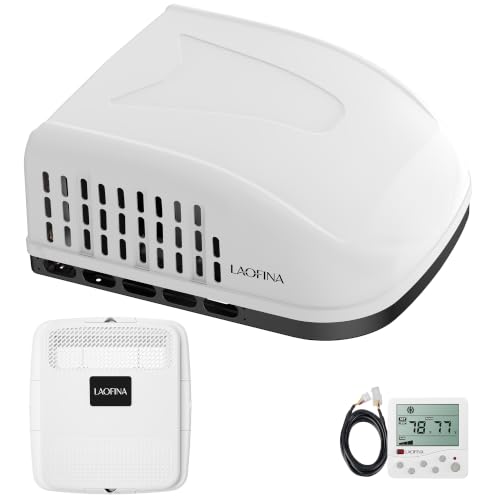
The LAOFINA RV Air Conditioner is an 18,000 BTU rooftop heat pump rated for 50 dB operation, using both 115V AC and 12V DC connections. It is the largest-capacity unit in the group, and it costs $859.00, about $395 less than the RecPro 15K heat pump.

Against the RecPro 15K above it, the LAOFINA adds 3,000 BTU of stated capacity and costs far less, with a quieter listed rating of 50 dB. Against the RecPro 13.5K below it, the LAOFINA offers more cooling, a heat pump for shoulder-season warmth and a price that is $100 lower.

It suits buyers who want the most BTU for the money, owners with generous shore power and campers who want a heat pump without paying flagship prices.

What works

  • Rooftop unit
  • Heat pump included

Watch out for

  • Needs 115V AC and 12V DC
  • Higher amp draw
04
Best for: Standard trailer

Our take

RecPro 13.5K Non-Ducted RV Air Conditioner is the better fit when standard trailer.

Why it made the shortlist

Operation is listed at 59.7 dB, and the shroud uses UV-resistant plastic. It costs $959.95.

Against the LAOFINA above it, the RecPro 13.5K gives up heating and capacity, and it adds a wireless remote and display. Against the EROMMY below it, the RecPro offers 13.5K BTU on a standard rooftop mount with 115V power, which is the typical arrangement for a stock travel trailer. The low amp draw keeps generator load manageable.

What works

  • Non-ducted install
  • Low amp draw
  • Wireless remote and LED display

Watch out for

  • Cooling only
  • Louder than heat pump units
05
EROMMY 12V DC RV Air Conditioner
  • 12V DC, 10,000 BTU
  • 49dB indoor noise
  • Auto swing airflow
Check price on Amazon for EROMMY 12V DC RV Air Conditioner (opens in a new tab)
Best for: 12V battery

Our take

This is the pick for vans, small campers and off-grid builds with a large battery bank and solar.

Why it made the shortlist

The EROMMY 12V DC RV Air Conditioner is a 10,000 BTU rooftop unit rated at 49 dB indoors, with an LED light and auto swing airflow. It uses a brushless fan, a brushless blower and a rotary compressor in a copper tube evaporator design. It costs $469.99, roughly half the price of the RecPro 13.5K.

Against the RecPro 13.5K above it, the EROMMY runs on 12 volts, which means it works from a battery bank without an inverter or a generator. The auto swing airflow spreads cool air across a small space, and the 49 dB rating is quiet for its size.

It suits owners who want cooling without a generator and anyone who sleeps in a small cabin where 10,000 BTU is enough.

What works

  • Brushless fan and blower
  • LED light and auto swing

Watch out for

  • Smaller capacity
  • Needs a large battery bank
The catch
Against the full-size units, it offers a smaller footprint suited to vans and compact campers.
06

Best Accessory · 6 of 6

Dometic Air Distribution Box

Best for: Existing Dometic installs

Our take

Dometic Air Distribution Box makes the shortlist because pairs with Dometic units.

Why it made the shortlist

The Dometic Air Distribution Box is a ceiling control and distribution kit made for Dometic air conditioners with manual control. It is designed for non-ducted applications and has a universal fit for compatible Dometic units. It costs $163.98, the lowest price of the six.

Unlike the other five picks, this is an accessory, not an air conditioner, so it belongs in the guide for owners who already have a Dometic roof unit. It slots into a compatible Dometic unit, and the manual control keeps the wiring simple. Compared with a full unit that costs hundreds more, replacing the box restores airflow and control at a fraction of the cost.

What works

  • Pairs with Dometic units
  • Universal fit
  • Manual control

Watch out for

  • Not an air conditioner
  • Needs a compatible Dometic unit

Methodology

How We Built This Shortlist

Each pick was assessed across 5 criteria weighted for real-world use.

01

Capacity and heating

BTU capacity decides how well a unit cools. We compared the 18,000 BTU LAOFINA, the 16K FOGATTI, the 15K RecPro heat pump, the 13.5K RecPro cooling-only unit and the 10,000 BTU EROMMY, and we noted which models also heat.

02

Noise and airflow

A loud unit makes a small cabin tiring. We compared the stated 43 dB on the FOGATTI, 49 dB on the EROMMY, 50 dB on the LAOFINA, 55.4 dB on the RecPro 15K and 59.7 dB on the RecPro 13.5K, along with the 418 CFM stated on the FOGATTI.

03

Power type and draw

Electrical fit decides whether a unit works with your generator or batteries. We compared the 115V AC units, the 12V DC EROMMY and the dual 115V and 12V LAOFINA connections, and we gave credit to the low amp draw stated on both RecPro units.

04

Installation and duct style

A swap is only simple if the new unit matches the old. We compared the 14.25 inch cut-out on the FOGATTI, the ducted or non-ducted flexibility on the RecPro 15K and the Dometic box that suits existing Dometic installs.

05

Price and value

Prices run from $163.98 to $1,299.99. We compared the cost per BTU across the units and noted that the LAOFINA at $859.00 gives the most capacity for the money, while the FOGATTI costs the most for the lowest noise.

Decision guide

Match a Non Ducted RV Air Conditioner to Your RV

By Rig Size and Capacity

BTU capacity should match the space and the climate. A bigger number cools faster, though it also draws more power, so match capacity to the rig instead of buying the largest unit.

Your rigRecommended pickWhy
Large travel trailer or fifth wheel in hot climatesLAOFINA RV Air Conditioner 18000 BTU with Heat PumpThe largest capacity in the guide at $859.00.
Large non-ducted rig that values low noiseFOGATTI RV AC Unit 16K BTU16K BTU with 418 CFM and a 43 dB rating.
Standard travel trailer, cooling onlyRecPro 13.5K Non-Ducted RV Air Conditioner13.5K BTU with a wireless remote and low amp draw.
Van or small camperEROMMY 12V DC RV Air ConditionerA 10,000 BTU unit that runs on 12 volts.

By Budget

These picks span from $163.98 to $1,299.99, with large gaps. Here is what each price tier covers.

BudgetRecommended pick
Under $200Dometic Air Distribution Box at $163.98, only if you already own a compatible Dometic unit.
$450 to $500EROMMY 12V DC at $469.99 for vans and battery-based rigs.
$850 to $1,000LAOFINA 18,000 BTU at $859.00 or RecPro 13.5K at $959.95 for standard rooftop replacement.
$1,250 and upRecPro 15K at $1,254.95 for ducted or non-ducted flexibility, or FOGATTI 16K at $1,299.99 for low noise and 418 CFM.

Heat Pump vs Cooling-Only

Some units heat as well as cool, and the choice changes your whole climate plan. It also affects power draw and price.

Heat pump

The FOGATTI 16K, RecPro 15K and LAOFINA 18,000 BTU can heat as well as cool. A heat pump moves heat instead of making it, which suits cool mornings and shoulder-season camping. It does not replace a furnace in deep cold, though it can reduce propane use.

Cooling only

The RecPro 13.5K only cools. It costs less than the large heat pumps, and many owners already have a propane furnace for winter. If you camp mostly in warm weather, a cooling-only unit is simple, and you avoid paying for a heating function you will rarely use.

Most owners who camp in spring and fall should consider a heat pump, and those who camp only in summer can choose a cooling-only unit.

By Power Source

A second axis is the electricity behind the unit. Generator, shore power and batteries each suit different models.

Your powerRecommended pick
Full shore power at campgroundsFOGATTI 16K or LAOFINA 18,000 BTU, both 115V units with high capacity.
Smaller generator or solarRecPro 15K heat pump or RecPro 13.5K, both with a low amp draw stated.
Battery bank only, no generatorEROMMY 12V DC, which runs on 12 volts.
Mixed AC and DC supplyLAOFINA, which lists both 115V AC and 12V DC connections.

For Replacing a Failed Roof Unit Specifically

Most buyers search for this because the old unit died. A swap is easiest when the new unit matches the old opening and ceiling box.

Look for

A unit that fits the standard 14.25 inch cut-out, a matching ducted or non-ducted style, an electrical rating your system can supply and a mounting pattern that lines up with the old roof gasket. Measure the opening and note the old unit's brand before ordering.

In this comparison

The FOGATTI fits a 14.25 inch roof cut-out without modifications, the RecPro 15K works with either duct style and the Dometic box refreshes an existing Dometic setup. The LAOFINA and RecPro 13.5K are rooftop units for standard non-ducted replacements.

When to Spend More

At over $1,000, a roof air conditioner is a large purchase, and the decision depends on how much you rely on it. Here is how to weigh it.

Spend more if

Spend $1,299.99 on the FOGATTI or $1,254.95 on the RecPro 15K if you live in the rig, want the lowest noise or need ducted flexibility. Years of nightly use and sound sleep justify the extra cost.

Save if

Save with the LAOFINA at $859.00 for the most BTU per dollar, the RecPro 13.5K at $959.95 for a simple cooling unit or the EROMMY at $469.99 for a van. Weekend campers and seasonal owners rarely need the quietest unit.

FAQ

Before You Bring One Home

What does non-ducted mean on an RV air conditioner?

A non-ducted unit blows air into a ceiling distribution box that spreads it through vents in the cabin, with no ductwork inside the ceiling. Most travel trailers use this style. A ducted system sends air through channels to vents in other places, so it needs a different unit or a flexible model like the RecPro 15K.

Is the 1,299.99 FOGATTI worth it over the 859 LAOFINA?

The FOGATTI adds a stated 43 dB noise rating and 418 CFM, while the LAOFINA gives 18,000 BTU at a much lower price and a 50 dB rating. If low noise and airflow matter, the FOGATTI makes sense. If you want maximum capacity per dollar, the LAOFINA is stronger.

Can I run these on a small generator?

That depends on the starting surge. The RecPro units list a low amp draw, which helps on smaller generators, while the 18,000 BTU LAOFINA will draw more. Check the running and starting amps in the specifications and compare them with your generator's rating.

How do I replace a roof air conditioner?

Disconnect power, remove the interior cover and shroud, unplug the wiring and unbolt the unit. Lift it with a helper, clean the roof gasket area, set the new unit in place and tighten the mounting bolts evenly. Reconnect the wiring, test the unit and seal any exposed areas.

Can I use a 12V air conditioner with solar?

Yes, if your battery bank and solar array can supply the load. A 12V DC unit like the EROMMY draws a large current, so you need heavy cables, a large battery bank and enough solar to recharge it. Plan the system carefully, since a small battery bank will drain quickly.

How do I maintain a roof air conditioner?

Clean the filters regularly, wash the coils and check the shroud for cracks. Inspect the roof gasket and sealant each season, and clear debris from the roof around the unit. Run the unit briefly before a trip to catch problems at home. Tighten the shroud bolts to the torque in the manual and avoid power washing the coils, since high pressure bends the fins and cuts airflow.

Bottom line

The short version

For most owners of a large non-ducted rig, the FOGATTI 16K at $1,299.99 is the strongest all-round pick, with 418 CFM at 43 dB and a standard 14.25 inch cut-out. If budget matters more, the LAOFINA 18,000 BTU at $859.00 gives the most capacity for the money.

Van owners can look at the EROMMY at $469.99 for 12 volt cooling, and Dometic owners can refresh a worn ceiling box for $163.98. Measure your roof opening, check your power and decide whether you need a heat pump before you buy.

A roof air conditioner is one of the most expensive repairs on any RV, so it pays to buy for the setup you really have: the right opening, the right power and a capacity that matches your climate. A unit chosen on those three points will be quieter, last longer and cost less to run than one picked on price alone.

Browse more non ducted rv air conditioner on Amazon →
Bowen Higgins, RV Editor at RV Gear Lab

About the author

Bowen Higgins

RV Editor at RV Gear Lab

Bowen covers RV power, water systems, towing and leveling, upkeep and interior comfort, with a focus on matching gear to the rig, the hookups and the way you actually travel.

More from Bowen →Editorial standards

Keep reading

Related guides