

We research everything we recommend. When you buy through our links, we may earn a commission. Learn more

Buying guide · 10 min read · Updated October 2, 2026

6 Best RV Air Conditioner For Camper Van in 2026: A Practical RV Guide

Six air conditioners for camper vans compared by weight, roof height, 12V power draw and a portable plug-in alternative for van conversions.

Bowen HigginsBy Bowen HigginsRV Editor at RV Gear Lab6 products comparedSpec-sheet researched

At a glance

Our top picks

A camper van gives an air conditioner very little to work with: a small roof opening, a weight limit, a modest battery bank and no shore-power circuit to lean on. The best van unit is the one that fits the roof, runs from 12V and does not drain the bank before midnight.

Five of the six picks are 12V rooftop units and one is a portable plug-in alternative. They are compared on weight, profile height, stated power draw and noise, and wattage and runtime figures are treated as manufacturer claims.

RV Gear Lab field notes

The Rig Fit Check

Start with the job
Xenjum 12V RV Air Conditioner with Heater leads this shortlist for Weight-limited vans. Use that fit as a reference point, then compare the alternatives against your own space and workload.
Specs that separate the picks
The first details to compare are 12V DC, 11,000 BTU, 4,500 heat, 12V DC, 10,000 BTU variable frequency, 12V DC, 10,000 BTU PTC. Confirm the exact model and included components before ordering.
Trade-off to plan for
600Ah bank needed for 10 hours

Before you buy

What Matters Before You Choose an RV Air Conditioner For Camper Van

Key buying criteria so you get the right fit the first time.

  1. 01

    Roof opening and height

    Most van roof vents are around 14 inches square, and a unit taller than the clearance affects stealth and parking height. The Xenjum 12V 11K lists a 6.1 inch profile and the outequip 12V Heater lists a low profile. Check your roof opening and the unit height before buying.

  2. 02

    Weight on the roof

    A roof unit adds weight high on the van, which affects handling and payload. The Xenjum 12V 11K lists 43 pounds, and the portable BAYKUL Portable stays inside. Look for a stated weight.

  3. 03

    Battery bank and draw

    A van bank may hold 200 to 600Ah, and an air conditioner can empty it. The Xenjum 12V 11K lists 10 hours on 600Ah and the Gidrox units about 350W. Divide your bank watt-hours by the draw to estimate runtime.

  4. 04

    Heat from the same unit

    PTC heat is quick but draws power. The outequip 12V Heater and Gidrox 12V Heater list heaters and the Xenjum 12V 11K lists 4,500 BTU. Do not depend on any in deep cold.

  5. 05

    Noise in a small cabin

    A van is a tiny room, so the fan is close to your head. The Xenjum 12V 11K lists 35 dB and the Gidrox units 40 dB in Sleep mode. Look at which mode the figure applies to.

Our standards

Why You Can Trust RV Gear Lab

At RV Gear Lab, we compare products based on rig fit and power or hookup compatibility, verified specifications, usability, setup requirements, weight, durability, and real-world trade-offs. We do not rank products purely on marketing claims or commission rates.

We have not personally tested every product listed. Where hands-on testing is not available, recommendations are based on verified manufacturer specifications, product documentation, use-case fit, and comparative research.

How we review RV gear →

Detailed reviews

The 6 best rv air conditioner for camper van, explained

01
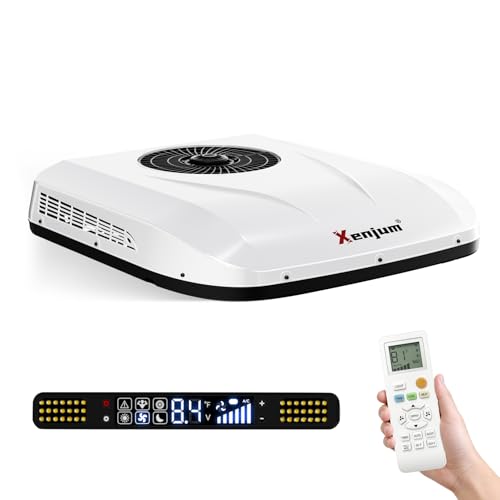
Xenjum 12V RV Air Conditioner with Heater
  • 12V DC, 11,000 BTU, 4,500 heat
  • 43 lbs, 6.1 inch profile
  • Inverter scroll compressor, 35 dB
Check price on Amazon for Xenjum 12V RV Air Conditioner with Heater (opens in a new tab)
Best for: Weight-limited vans

Our take

Best for van builds where weight and roof height matter most.

Why it made the shortlist

The Xenjum 12V RV Air Conditioner pairs 11,000 BTU cooling with 4,500 BTU heating in a 43 pound unit with a 6.1 inch profile. It has an inverter scroll compressor, runs at 35 dB and the listing says a 600Ah battery gives up to 10 hours of continuous cooling.

Against the Countrymod 12V 10K, it offers more BTU and heat at a lower price and lists a lighter 43 pound weight. Against the Gidrox 12V Heater, it adds a scroll compressor and a stated slim profile.

What works

  • Only 43 pounds, easy to lift on a van roof
  • Slim 6.1 inch profile
  • Inverter scroll compressor at 35 dB
  • 11,000 BTU cooling with 4,500 BTU heating

Watch out for

  • 600Ah bank needed for 10 hours
  • Efficiency claim is the seller's figure
02
Best for: Mid-size bank vans

Our take

Best for vans with a mid-size bank that want a documented power range.

Why it made the shortlist

The Countrymod 12V DC RV Air Conditioner is a 10,000 BTU rooftop unit with a 300 to 900W variable-frequency range. The listing says it uses about 0.3 kWh per hour, runs 45 to 55 dB and has a horizontal compressor for stability.

Against the Xenjum 12V 11K, it states a power range and a battery-life claim of up to 10 hours. Against the Gidrox 12V units, it adds an app remote and a lower stated draw.

The horizontal compressor sits lower for stability on the roof.

What works

  • States a 300 to 900W power range
  • About 0.3 kWh per hour claim
  • Horizontal compressor lowers center of gravity
  • App and remote included

Watch out for

  • Cooling only on this listing
03
Gidrox 10000 BTU 12V DC RV Air Conditioner with Heater
  • 12V DC, 10,000 BTU PTC
  • About 350W average claim
  • 40 dB Sleep, app and remote
Check price on Amazon for Gidrox 10000 BTU 12V DC RV Air Conditioner with Heater (opens in a new tab)
Best for: Winter camping vans

Our take

Best for van owners who winter camp and want heat from the same roof unit.

Why it made the shortlist

The Gidrox 10,000 BTU 12V DC unit with heater uses PTC for fast warmth on cold mornings and lists about 350W average at night under 30 degree C ambient. It states 40 dB in Sleep mode and has app, remote and panel control.

Against the outequip 12V Heater, it lists a power figure and a lower price.

What works

  • PTC heater for cool mornings
  • About 350W average draw claim
  • 40 dB in Sleep mode
  • App, remote and panel control

Watch out for

  • Wattage figure is for stated conditions
  • Weight is not stated
04
Gidrox 10000 BTU 12V DC RV Air Conditioner
  • 12V DC, 10,000 BTU inverter
  • About 350W average claim
  • 40 dB Sleep mode
Check price on Amazon for Gidrox 10000 BTU 12V DC RV Air Conditioner (opens in a new tab)
Best for: Warm-climate vans

Our take

Best for van owners in warm climates who want a battery-powered cooler.

Why it made the shortlist

The Gidrox 10,000 BTU 12V DC RV Air Conditioner uses inverter technology and cools within 3 minutes according to the listing. It cites the same 350W average draw and 40 dB Sleep mode as the heater version.

Against the outequip 12V Heater, it costs less and drops the heater.

What works

  • Inverter technology maintains a set temperature
  • About 350W average draw claim
  • App, remote and panel control

Watch out for

  • No heater
  • Weight is not stated
05

Best Heater Pick · 5 of 6

RV Air Conditioner

RV Air Conditioner
  • 12V DC, 10,000 BTU
  • 4,500 BTU PTC heater
  • UV ABS, EPDM gasket
Check price on Amazon for RV Air Conditioner (opens in a new tab)
Best for: Mild-weather vans

Our take

Best for small vans that need supplementary warmth.

Why it made the shortlist

The outequip 12V 10,000 BTU unit includes a 4,500 BTU PTC heater and cools in about 15 minutes by the listing. It uses UV-stabilized ABS, an EPDM foam gasket and brushless copper motor fans.

Against the Gidrox 12V Heater, it offers a larger stated heater at a higher price. Against the Xenjum 12V 11K, it adds weather-resistant gaskets and a directional duct.

What works

  • 4,500 BTU PTC heater
  • Spring-supported mounts and directional duct
  • Brushless copper motor fans
  • Weather-resistant ABS and zinc-coated condenser

Watch out for

  • Heater is not for extreme cold
  • No weight stated
06

Best No-Install Option · 6 of 6

BAYKUL Portable Camping Air Conditioner & Heater

BAYKUL Portable Camping Air Conditioner & Heater
  • 6,800 BTU cool, 7,500 BTU heat
  • 110V outlet or car inverter
  • About 550W, 46 dB
Check price on Amazon for BAYKUL Portable Camping Air Conditioner & Heater (opens in a new tab)
Best for: No-install setups

Our take

Best for vans with no roof hole to spare or for use in both a van and a tent.

Why it made the shortlist

The BAYKUL Portable Camping Air Conditioner and Heater delivers 6,800 BTU cooling and 7,500 BTU heating with R-32 refrigerant. It runs on a 110V outlet or a car inverter, draws about 550W and operates at 46 dB.

Against the 12V rooftop units, it needs no roof cutout and ships with a carry bag. Against the Xenjum 12V 11K, it offers more heat and less cooling.

What works

  • No roof cutout or installation
  • Higher heating than cooling BTU
  • Carry bag for easy transport
  • Runs from 110V or a car inverter

Watch out for

  • Needs 110V or an inverter
  • Takes up floor space in the van

Methodology

How We Built This Shortlist

Each pick was assessed across 5 criteria weighted for real-world use.

01

Weight and profile

Weight and roof height are compared since vans have little margin.

02

12V power draw

Stated watts and runtime claims are noted as seller figures.

03

Heat

PTC and portable heat output are listed.

04

Noise

dB ratings in Sleep or Eco modes are compared.

05

Install effort

Rooftop and portable options are separated.

Decision guide

Match an RV Air Conditioner For Camper Van to Your RV

By Van Setup

Your situationRecommended pickWhy
Lightest roof load, slim profileXenjum 12V 11K43 lbs and 6.1 inches
Mid-size bank, documented drawCountrymod 12V 10K300 to 900W range
Winter use, need heatGidrox 12V HeaterPTC heat with a wattage claim
Warm climate, lowest priceGidrox 12VCooling only
No roof cutout wantedBAYKUL PortablePlug-in, no install

By Budget

BudgetRecommended pick
$480 to $700BAYKUL Portable or Xenjum 12V 11K
$790 to $860Gidrox 12V or Gidrox 12V Heater
$930 to $950Countrymod 12V 10K or outequip 12V Heater

Rooftop 12V vs Portable

Rooftop 12V

Xenjum 12V 11K, Countrymod 12V 10K, Gidrox 12V Heater, Gidrox 12V and outequip 12V Heater mount in a roof opening. They keep floor space free.

Portable

BAYKUL Portable sits inside and needs no install. It uses 110V or a car inverter.

Most van builders should choose the Xenjum 12V 11K, and renters or tent users the BAYKUL Portable.

By Budget

Budget rangeRecommended pick
Under $500BAYKUL Portable
About $700 to $800Xenjum 12V 11K or Gidrox 12V
$860 to $950Gidrox 12V Heater, Countrymod 12V 10K or outequip 12V Heater

For Stealth and Low Roof Clearance Specifically

Look for

Look for a stated profile height, as the Xenjum 12V 11K lists at 6.1 inches.

In this comparison

The Xenjum 12V 11K lists 6.1 inches and the BAYKUL Portable needs no roof at all.

When to Spend More

Spend more if

Spend more if you want power documentation or heat. The Countrymod 12V 10K states 300 to 900W and the outequip 12V Heater adds 4,500 BTU of heat.

Save if

Save if you camp in warm weather. The Gidrox 12V is cooling only and costs less than the heater versions.

FAQ

Before You Bring One Home

Will it fit my van roof?

Most units fit a 14 inch opening. Check the Xenjum 12V 11K profile of 6.1 inches. Measure first.

What is the most common mistake?

Ignoring roof weight. A 43 pound unit still adds load. Check payload.

Is a rooftop unit worth it over portable?

Yes if you camp often. The BAYKUL Portable costs less and needs no install. Choose by use.

How do I wire it?

Use thick fused cable and keep runs short. Follow the manual.

How do I maintain it?

Clean the filter and coils. Inspect roof seals.

Bottom line

The short version

Browse more rv air conditioner for camper van on Amazon →
Bowen Higgins, RV Editor at RV Gear Lab

About the author

Bowen Higgins

RV Editor at RV Gear Lab

Bowen covers RV power, water systems, towing and leveling, upkeep and interior comfort, with a focus on matching gear to the rig, the hookups and the way you actually travel.

More from Bowen →Editorial standards

Keep reading

Related guides