

We research everything we recommend. When you buy through our links, we may earn a commission. Learn more

Buying guide · 10 min read · Updated October 2, 2026

5 Best RV Range Hood Vent Cover in 2026: A Practical RV Guide

Five RV range hood vent covers compared by material, depth range and flap design, for owners replacing a cracked or missing stove exhaust cap.

Bowen HigginsBy Bowen HigginsRV Editor at RV Gear Lab5 products comparedSpec-sheet researched

At a glance

Our top picks

A range hood vent cover is the small exterior flap that keeps rain, wasps and road dust out of your stove exhaust, and the cracked plastic originals on many trailers rarely last past a few summers. This list compares aluminum and ABS replacements by the measurements that decide fit: rough opening size, adjustable depth and how the flapper stays shut on the road. Each pick is judged on what the listing states, so a cover that publishes its opening size ranks above one that only says it fits most RVs.

RV Gear Lab field notes

The Rig Fit Check

Start with the job
Safoner Aluminum RV Stove Exhaust Vent Cover leads this shortlist for Long-term replacement on a trailer you keep. Use that fit as a reference point, then compare the alternatives against your own space and workload.
Specs that separate the picks
The first details to compare are Aluminum body, Aluminum alloy with coating, 3 flanges, 5/8 to 1 5/8 inch. Confirm the exact model and included components before ordering.
Trade-off to plan for
Listing does not state the rough opening size

Before you buy

What Matters Before You Choose an RV Range Hood Vent Cover

Key buying criteria so you get the right fit the first time.

  1. 01

    Rough opening size

    The rough opening is the hole in your sidewall the cover frame must fit, and range hood openings are commonly around 3 1/2 inches tall. A cover even half an inch off leaves gaps for wasps and rain. Measure your opening with a tape before buying and match it to a published dimension, not a 'fits most' claim.

  2. 02

    Adjustable wall depth

    Sidewall thickness varies between trailers, so the frame needs to bridge from the exterior skin to the interior hood. A cover with a 1.2 to 2.2 inch slider or three fixed flanges avoids cutting. Measure your wall depth at the opening and check it falls inside the listed range.

  3. 03

    Body material

    Stove vent covers sit in direct sun and take heat from cooking exhaust, so material decides lifespan. Aluminum resists cracking and fading, while ABS and polyethylene are cheaper and can go brittle over years. Look for the material named in the title or description.

  4. 04

    Travel flap lock

    A loose flapper bangs against the frame at highway speed and can crack or break off. A clip or single-lock damper holds it shut and still lets exhaust open it under airflow. Read the description for the word lock, clip or latch.

  5. 05

    Sealing supplies

    Water enters at the frame edge, not through the flap, so a butyl or foil tape seal matters. Kits that include tape and screws let you finish the job in one pass. Check the contents list for tape and screw count before assuming they are included.

Our standards

Why You Can Trust RV Gear Lab

At RV Gear Lab, we compare products based on rig fit and power or hookup compatibility, verified specifications, usability, setup requirements, weight, durability, and real-world trade-offs. We do not rank products purely on marketing claims or commission rates.

We have not personally tested every product listed. Where hands-on testing is not available, recommendations are based on verified manufacturer specifications, product documentation, use-case fit, and comparative research.

How we review RV gear →

Detailed reviews

The 5 best rv range hood vent cover, explained

01
Best for: Long-term replacement on a trailer you keep

Our take

Compared with the Camp'N and TonGass plastic caps below, the metal body resists the UV cracking that kills those covers, and its built-in clip holds the flapper still on the highway.

Why it made the shortlist

Butyl tape is packed in for the waterproof seal around the frame.

It suits owners who want one install that lasts the life of the trailer.

What works

  • Aluminum frame will not crack or yellow in sun
  • Adjusts to 2.2 inches of wall depth without cutting
  • Clip stops the flapper from rattling while towing

Watch out for

  • Listing does not state the rough opening size
02
Terapaton Aluminum RV Range Hood Vent Cover
  • Aluminum alloy with coating
  • Locking damper flap
  • 10 screws plus two tapes
Check price on Amazon for Terapaton Aluminum RV Range Hood Vent Cover (opens in a new tab)
Best for: First-time installers wanting a full kit

Our take

Against the Safoner above, it trades a slightly lower price for the foil tape and screw count spelled out in the box contents, so the install needs nothing from the hardware drawer.

Why it made the shortlist

The Terapaton is also aluminum with the same 1.2 to 2.2 inch adjustable depth, and its kit includes 10 rust-proof screws, butyl tape and aluminum foil tape for sizing the frame. A single-lock damper keeps the flapper closed during travel and opens with exhaust airflow.

It suits first-time DIYers who want every consumable in one bag.

What works

  • Foil tape included for fitting depth exactly
  • Ships with 10 rust-proof screws and butyl tape
  • Single lock holds flap shut over bumps

Watch out for

  • Black finish shows dust and water spots
  • Opening dimensions are not stated
03

Best for Odd Wall Depths · 3 of 5

Camco RV Range Hood Vent Repair/Replacement Kit

Camco RV Range Hood Vent Repair/Replacement Kit
  • 3 flanges, 5/8 to 1 5/8 inch
  • Fits 10 3/4 x 3 7/8 openings
  • Polyethylene flap and scoop
Check price on Amazon for Camco RV Range Hood Vent Repair/Replacement Kit (opens in a new tab)
Best for: Older trailers with thin sidewalls

Our take

Where the aluminum covers have a continuous depth slider, the Camco gives three fixed flange options covering 5/8 to 1 5/8 inch walls, which is the thinner range.

Why it made the shortlist

The Camco kit is a polyethylene replacement that fits side wall openings from 10 3/4 by 3 7/8 inches up to 11 by 4 1/8 inches, with three mounting flanges for different depths. It also includes the flap and a scoop, so it rebuilds the whole vent rather than patching one piece.

It suits owners with older, thin-walled trailers who want a name-brand part.

What works

  • Fit range is published down to the fraction of an inch
  • Three flange depths cover thin sidewalls
  • Flap and scoop both included in one kit

Watch out for

  • Plastic body ages faster than the aluminum picks
  • Won't suit walls deeper than 1 5/8 inches
04

Best Budget · 4 of 5

Camp'N RV Exhaust Vent Cover

Camp'N RV Exhaust Vent Cover
  • 3 1/2 inch tall opening
  • White finish
  • Direct cap replacement
Check price on Amazon for Camp'N RV Exhaust Vent Cover (opens in a new tab)
Best for: Quick low-cost cap replacement

Our take

It undercuts every aluminum pick here, and next to the TonGass it offers the color choice (a black version also exists) in place of published ABS material details.

Why it made the shortlist

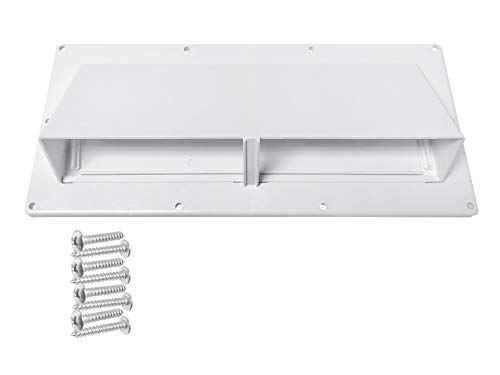
The Camp'N white cover is a straightforward replacement for a worn kitchen exhaust cap, sized for a rough opening about 3 1/2 inches tall. It comes in white to match most trailer sidewalls, with a clean low-profile look.

It suits owners who simply need a cap back on the hood and plan to replace it again later.

What works

  • White finish blends into most trailer sidewalls
  • Simple swap with no cutting for stock openings

Watch out for

  • Listing gives no material or depth range
  • Likely less UV life than aluminum
05

Best Published Specs · 5 of 5

TonGass RV Range Hood Vent Cover for Camper

TonGass RV Range Hood Vent Cover for Camper
  • 10 3/8 x 3 1/2 rough opening
  • UV-resistant ABS
  • 10 screws included
Check price on Amazon for TonGass RV Range Hood Vent Cover for Camper (opens in a new tab)
Best for: Measure-first buyers on a tight budget

Our take

It suits buyers who check dimensions first.

Why it made the shortlist

The TonGass states its numbers: a 10 3/8 by 3 1/2 inch rough opening, a 1 11/16 inch collar and an overall size of 11 5/8 by 5 1/4 inches. It is molded from impact-resistant, UV-protected ABS and ships with 10 screws.

What works

  • Full dimensions published, so measuring is easy
  • ABS resists impact and sun better than thin plastic
  • Ten mounting screws come in the box

Watch out for

  • Collar is only 1 11/16 inches deep
  • No butyl tape or sealant in the kit

Methodology

How We Built This Shortlist

Each pick was assessed across 4 criteria weighted for real-world use.

01

Fit data

We compared how clearly each listing states rough opening size and wall depth range, since a vent cover that does not fit is a return.

02

Material

We compared aluminum, ABS and polyethylene bodies for UV and crack resistance on an exposed sidewall.

03

Flap behavior

We looked at whether the flapper locks or clips for travel and opens freely with exhaust airflow.

04

Kit contents

We counted what is in the box: screws, butyl tape, foil tape and extra flanges.

Decision guide

Match an RV Range Hood Vent Cover to Your RV

By Sidewall Condition

Your situationRecommended pickWhy
Newer trailer, want a one-time fixSafoner Aluminum CoverAluminum body with 1.2 to 2.2 inch depth range
Old thin sidewall, cracked originalCamco Repair KitFlanges cover 5/8 to 1 5/8 inch walls
Need all tapes and screws in one bagTerapaton Aluminum KitFoil tape, butyl tape and 10 screws included
Replacing a missing cap quicklyCamp'N White CoverCheapest direct swap in the lineup

By Budget

BudgetRecommended pick
$10 to $20TonGass ABS Cover or Camp'N White Cover
$20 to $40Camco Repair Kit or Terapaton Aluminum Kit
$30 to $40Safoner Aluminum Cover

Aluminum vs Plastic

Aluminum

Safoner Aluminum Cover and Terapaton Aluminum Kit resist UV cracking and rust, and both adjust to 2.2 inches of depth.

Plastic

Camp'N White Cover, TonGass ABS Cover and Camco Repair Kit cost less and weigh less, but plastic can fade or crack after years of sun.

Most owners should default to Safoner Aluminum Cover unless budget is the deciding factor.

By Install Style

Install preferenceRecommended pick
Want to measure firstTonGass ABS Cover
Rebuild the whole vent with flap and scoopCamco Repair Kit
No trimming, slider fitTerapaton Aluminum Kit

For Travel Trailer Owners Specifically

Look for

A locking or clipped flapper and a stated rough opening near 3 1/2 inches tall.

In this comparison

Safoner Aluminum Cover has a clip to stop the flapper moving in transit, and TonGass ABS Cover publishes a 10 3/8 x 3 1/2 inch opening.

When to Spend More

Spend more if

Spend more on Safoner Aluminum Cover or Terapaton Aluminum Kit if the trailer will stay in the sun for years, since metal outlasts plastic caps.

Save if

Save with Camp'N White Cover or TonGass ABS Cover if you plan to resell soon or just need the hood sealed for this season.

FAQ

Before You Bring One Home

How do I measure for a range hood vent cover?

Measure the width and height of the hole in the sidewall, and the thickness of the wall at the opening. Compare to the cover's published rough opening and depth range.

Are aluminum covers worth it over plastic?

For a trailer kept outside, yes. Aluminum avoids the UV cracking common on old plastic caps, while plastic covers like the Camp'N suit short-term fixes.

Do I need butyl tape for installation?

Butyl tape seals the frame edge against water. Safoner Aluminum Cover and Terapaton Aluminum Kit include it, and the TonGass does not list any, so buy a roll if you choose that one.

Why does my vent flap rattle when towing?

An unlatched flapper swings with road vibration. Covers with a clip or lock, like the Safoner and Terapaton, hold it still until the stove exhaust pushes it open.

Bottom line

The short version

Browse more rv range hood vent cover on Amazon →
Bowen Higgins, RV Editor at RV Gear Lab

About the author

Bowen Higgins

RV Editor at RV Gear Lab

Bowen covers RV power, water systems, towing and leveling, upkeep and interior comfort, with a focus on matching gear to the rig, the hookups and the way you actually travel.

More from Bowen →Editorial standards

Keep reading

Related guides