

We research everything we recommend. When you buy through our links, we may earn a commission. Learn more

Buying guide · 10 min read · Updated October 2, 2026

6 Best Under Bench RV Air Conditioner in 2026: A Practical RV Guide

Under-bench RV air conditioners compared: the one true under-bench heat pump, plus under-vehicle, rooftop and portable alternatives with voltage and fit notes.

Bowen HigginsBy Bowen HigginsRV Editor at RV Gear Lab6 products comparedSpec-sheet researched

At a glance

Our top picks

Under-bench RV air conditioners hide the unit in a storage bay or under a bench seat, and almost no listings use that term. Only one pick here is titled under-bench, so this guide compares it with an under-vehicle 12V kit, two other 12V options, a slim rooftop heat pump and a portable unit.

Because installs differ so much, each pick is judged on what the listing states about voltage, mounting and size. Capacity labels are treated as maker ratings and not compared across brands, and 12V DC and 115V AC units are never treated as interchangeable.

RV Gear Lab field notes

The Rig Fit Check

Start with the job
Pioneer® 10 leads this shortlist for Hidden installation on 115V. Use that fit as a reference point, then compare the alternatives against your own space and workload.
Specs that separate the picks
The first details to compare are 10,000 BTU, 115V, 12V DC, 10,000 BTU, 13.5K BTU heat pump. Confirm the exact model and included components before ordering.
Trade-off to plan for
Needs bench or bay space

Before you buy

What Matters Before You Choose an Under Bench RV Air Conditioner

Key buying criteria so you get the right fit the first time.

  1. 01

    Where it physically fits

    An under-bench unit needs a bay or bench cavity with room for airflow and service access. Measure the space before you buy. Pioneer lists the format but check its dimensions on the listing.

  2. 02

    12V or 115V

    A 12V DC unit pulls heavy current from a battery bank, while a 115V unit needs shore power or a generator. AClengda lists a 70A starting current, which needs thick cable and a big battery. Do not treat the two as equal.

  3. 03

    Condensate and airflow

    A hidden unit needs a drain path and clear air intake. Poor airflow raises noise and reduces cooling. Check the listing for drainage and mounting directions.

  4. 04

    Capacity labels

    BTU labels are maker ratings and are not measured the same across brands. Treat 9,000, 10,000 and 13,500 BTU as size classes. Match them to your coach size and insulation.

  5. 05

    Heat pump and inverter

    An inverter heat pump varies compressor speed and heats as well as cools. Pioneer lists 3.5 C.O.P. heating. Check heating capacity in the listing before relying on it for cold nights.

  6. 06

    Total installed cost

    Under-bench and split installs need ducting, wiring and sometimes professional help. A cheaper unit can cost more installed. Add parts and labor before comparing.

Our standards

Why You Can Trust RV Gear Lab

At RV Gear Lab, we compare products based on rig fit and power or hookup compatibility, verified specifications, usability, setup requirements, weight, durability, and real-world trade-offs. We do not rank products purely on marketing claims or commission rates.

We have not personally tested every product listed. Where hands-on testing is not available, recommendations are based on verified manufacturer specifications, product documentation, use-case fit, and comparative research.

How we review RV gear →

Detailed reviews

The 6 best under bench rv air conditioner, explained

01

Best True Under-Bench · 1 of 6

Pioneer® 10

Pioneer® 10
  • 10,000 BTU, 115V
  • 10.1 EER, 3.5 C.O.P.
  • R32, pre-charged
Check price on Amazon for Pioneer® 10 (opens in a new tab)
Best for: Hidden installation on 115V

Our take

It suits owners with a bay or bench space who want the unit out of sight.

Why it made the shortlist

The Pioneer 10,000 BTU unit is titled as an under-bench RV inverter heat pump on 110 to 120V. It lists 10.1 EER cooling, 9,500 BTU/H heating at 3.5 C.O.P. and R32 refrigerant, pre-charged and ready to install.

It is also the highest priced, with the inverter and heat pump in a hidden-unit format.

It is listed for RVs, skoolies and camper vans.

What works

  • True under-bench format
  • Inverter heat pump heats and cools
  • Pre-charged R32 refrigerant
  • Listed for RVs and vans

Watch out for

  • Needs bench or bay space
The catch
It is the only pick named under-bench and the only one to list both cooling and heating efficiency figures.
02
Best for: 12V under-vehicle option

Our take

It suits owners who want the outdoor unit out of sight on a 12V system.

Why it made the shortlist

The AClengda concealed unit has an outdoor unit that can be installed under the vehicle, flat on the roof or erected at the back, according to its listing. The evaporator measures 26.7 by 11 by 6.3 inches and is ceiling mounted.

What works

  • Outdoor unit can sit under vehicle
  • Three outdoor mounting options
  • Brushless motor evaporator

Watch out for

  • Starting current of 70A
  • Needs strong battery bank
03
Best for: Inverter heat pump on the roof

Our take

It suits owners who accept a rooftop unit and want a slim profile.

Why it made the shortlist

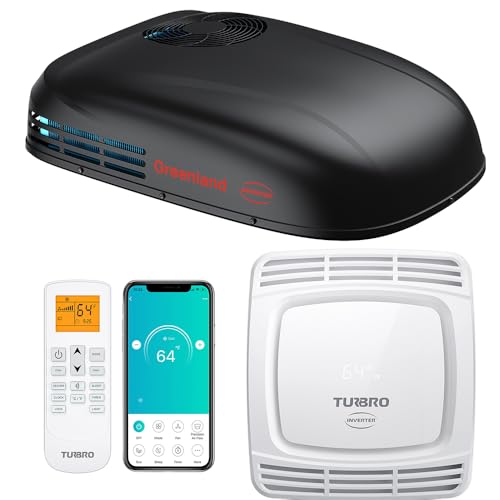
The TURBRO 13.5K inverter is a rooftop unit with cooling and heat pump, fan and dry modes. It lists a 10 inch thickness, up to 35 percent thinner than most competitors, and a ceiling light with remote or app control.

It lists a 13,500 BTU capacity above the Pioneer and fits a 14.25 by 14.25 inch roof opening. It is priced below the Pioneer.

What works

  • Inverter compressor
  • Thin 10 inch profile
  • Heat pump and dry modes

Watch out for

  • Rooftop, not under-bench
  • Voltage not stated
04

Best Large 12V · 4 of 6

DC 12V RV Air Conditioner

DC 12V RV Air Conditioner
  • 12V DC, 15,000 BTU
  • Cutout 12.2 x 9.3 inch
  • 3-speed fan
Check price on Amazon for DC 12V RV Air Conditioner (opens in a new tab)
Best for: 15,000 BTU on 12V DC

Our take

It suits owners who run 12V and want a large capacity label.

Why it made the shortlist

The Jrswin 12V DC unit lists 15,000 BTU of cooling and heating, a 3-speed fan and a digital control panel. It lists a roof opening of at least 12.2 by 9.3 inches.

What works

  • Smaller roof cutout
  • Cooling and heating listed
  • Digital control panel

Watch out for

  • Rooftop, not under-bench
  • Runtime depends on battery
The catch
It lists a smaller cutout than standard 14.25 inch units and a 7 to 9 hour battery runtime that depends on the vehicle's battery system.
05

Best Quiet Split · 5 of 6

12V DC air conditioner

12V DC air conditioner
  • 12V DC, 9,000 BTU
  • 40 dB indoor noise
  • 60 to 70A current
Check price on Amazon for 12V DC air conditioner (opens in a new tab)
Best for: 40 dB indoor unit

Our take

It suits owners with a split layout who want low listed noise.

Why it made the shortlist

The AClengda 9,000 BTU 12V unit lists a 40 decibel indoor noise level, a 850 watt power rating and a 60 to 70 amp current requirement. It lists five wind speeds and a remote.

It is the lower priced AClengda and lists the lowest noise figure. It uses R134a refrigerant.

It runs from the vehicle battery without starting the engine.

What works

  • Low 40 dB noise listing
  • Runs without the engine
  • Remote and 5 fan speeds

Watch out for

  • Current draw of 60 to 70A
  • Refrigerant not included
06
Best for: No install cooling

Our take

It suits owners who want a movable unit for a small space.

Why it made the shortlist

The GETUHAND portable tent air conditioner is 5,200 BTU, 400 watts, 33 lbs and 22.4 by 11.2 by 13.8 inches. It lists cooling up to 108 square feet and a 24-hour timer.

It is the lowest priced pick and needs no install, unlike the Pioneer. It lists cool, dry, sleep and fan modes.

No drainage is needed below 70 percent humidity.

What works

  • No installation needed
  • Cools up to 108 sq ft
  • Light enough to carry

Watch out for

  • Needs drainage above 70% humidity
  • Small capacity

Methodology

How We Built This Shortlist

Each pick was assessed across 4 criteria weighted for real-world use.

01

Mounting format

Under-bench, under-vehicle, rooftop and portable formats were separated first.

02

Voltage and current

12V DC and 115V AC units were sorted, and listed amp draws were noted.

03

Fit and cutout

Listed roof openings and unit sizes were compared.

04

Listed noise and weight

Decibel and weight figures were noted as stated.

Decision guide

Match an Under Bench RV Air Conditioner to Your RV

By install format

Your situationRecommended pickWhy
True under-bench, 115VPioneer Under-BenchOnly under-bench pick.
12V with hidden outdoor unitAClengda Concealed 10KUnder-vehicle option.
Slim rooftop heat pumpTURBRO 13.5K10 inch profile.
Large 12V rooftopJrswin 12V 15K15,000 BTU.
No installGETUHAND PortablePortable.

By Budget

BudgetRecommended pick
$370 to $450GETUHAND Portable or AClengda 12V 9K
$470 to $800Jrswin 12V 15K or AClengda Concealed 10K
$1090 to $1400TURBRO 13.5K or Pioneer Under-Bench

Hidden vs rooftop

Hidden or split

Pioneer Under-Bench, AClengda Concealed 10K and AClengda 12V 9K keep the outdoor unit out of sight.

Rooftop or portable

TURBRO 13.5K, Jrswin 12V 15K and GETUHAND Portable are on the roof or free-standing.

Take Pioneer Under-Bench for true hidden install on 115V and AClengda Concealed 10K on 12V.

By voltage

PowerRecommended pick
115V under-benchPioneer Under-Bench
12V with 70A startingAClengda Concealed 10K
12V quiet splitAClengda 12V 9K
12V large capacityJrswin 12V 15K

For Van Conversions Specifically

Look for

A low profile, 12V option and a ventilated bay.

In this comparison

The AClengda Concealed 10K and Pioneer Under-Bench both list van use.

When to Spend More

Spend more if

Spend more for Pioneer Under-Bench if you want a true hidden unit with heat.

Save if

Save with GETUHAND Portable or AClengda 12V 9K.

FAQ

Before You Bring One Home

What is an under-bench RV air conditioner?

It is a unit mounted in a bench or bay instead of on the roof. Pioneer is the only pick titled under-bench.

What is the most expensive mistake?

Ignoring voltage. A 12V unit needs a big battery bank, and a 115V unit needs shore power or a generator.

Is the Pioneer worth it over a rooftop unit?

It hides the unit and adds heat, but costs more. TURBRO is cheaper and rooftop.

How do I install a hidden unit?

Plan the drain, the airflow and the wiring first. Mount securely and follow the listing's directions.

What maintenance does a hidden unit need?

Keep the filters and coils clean and check drains. Leave access for service.

Bottom line

The short version

Browse more under bench rv air conditioner on Amazon →
Bowen Higgins, RV Editor at RV Gear Lab

About the author

Bowen Higgins

RV Editor at RV Gear Lab

Bowen covers RV power, water systems, towing and leveling, upkeep and interior comfort, with a focus on matching gear to the rig, the hookups and the way you actually travel.

More from Bowen →Editorial standards

Keep reading

Related guides