

We research everything we recommend. When you buy through our links, we may earn a commission. Learn more

Buying guide · 11 min read · Updated October 2, 2026

5 Best Budget Backpacking Water Filters for Viruses in 2026: A Practical Camping Guide

Budget backpacking and camp water filters sorted by virus protection: 0.01 micron electric and pocket units, a gravity bag and a 0.2 micron RV cartridge.

Danny WalkerBy Danny WalkerCamping Editor at RV Gear Lab5 products comparedSpec-sheet researched

At a glance

Our top picks

Viruses are the awkward part of backcountry water. They are far smaller than the bacteria and protozoa that most hiking filters stop, so a unit that clears giardia can still leave a virus gap. On a budget, the smart move is to read the pore size and the claim wording together.

Four of these five picks are portable and two are built on 0.01 micron membranes, the size class where ultrafiltration reaches into virus territory. A third, the gravity bag, states bacteria and protozoa only. The fifth is a 0.2 micron RV cartridge that suits a base camp or rig, not a pack, and it is included because it is the one with a named bacteria and virus claim.

Weight, flow and power all shape a real trip. A pocket filter weighs almost nothing, an electric unit saves effort but needs a charge, and a gravity bag fills while you set up camp. We sorted them by how much protection each states and how much hassle that protection brings in the field.

RV Gear Lab field notes

The Campsite Fit Check

Start with the job
Greeshow Portable Electric Water Filter, 0.01 Micron leads this shortlist for Hikers who want 0.01 micron filtering without pumping by hand.. Use that fit as a reference point, then compare the alternatives against your own space and workload.
Specs that separate the picks
The first details to compare are 0.01 micron, 5-stage filtration, 0.01 micron Ahlstrom membrane, 0.2 micron absolute pleated. Confirm the exact model and included components before ordering.
Trade-off to plan for
Most expensive pick in this guide

Before you buy

What Matters Before You Choose a Budget Backpacking Water Filter for Viruses

Key buying criteria so you get the right fit the first time.

  1. 01

    Virus protection claims

    Viruses are tiny, and most hiking filters with 0.1 or 0.2 micron pores do not stop them. A 0.01 micron membrane is in the right size class, and a named virus claim carries more weight than a micron number. Read for the word virus on the listing and treat silence as a no.

  2. 02

    Weight on your back

    Every ounce counts across a multi-day route. A straw-style filter weighs next to nothing, while an electric unit adds a battery. Decide whether the convenience of automation is worth the extra carry, and consider a gravity bag if you camp in one place for the evening.

  3. 03

    Flow and filling time

    Flow ranges from 200 to 300 ml per minute on slow pumps to 700 ml per minute on the faster electric unit. A group of four needing several litres loses a lot of time at slow flow. Look for a stated rate rather than a phrase like fast.

  4. 04

    Power source and backup

    A battery that dies mid-trip leaves a purifier dead weight. Solar, USB-C and a hand crank provide fallbacks, with the crank being the only one that works under heavy cloud. Gravity and pocket filters skip this issue entirely.

  5. 05

    Cartridge lifespan and cleaning

    Capacity ratings from 264 gallons to 4000 litres affect cost per trip. Membranes clog, so a backflush syringe or cleaning cycle matters. Look at how the filter is cleaned in the field, since an unmaintained membrane loses flow quickly.

  6. 06

    Freeze and storage damage

    A hollow fiber or ultrafiltration membrane that freezes with water inside can crack without showing it, leaving a filter that looks fine and no longer works. Keep it in a sleeping bag on cold nights and dry it before long storage, since a damaged membrane gives no visible warning. Replacing a suspect filter costs far less than a week of illness.

Our standards

Why You Can Trust RV Gear Lab

At RV Gear Lab, we compare products based on campsite fit, verified specifications, usability, setup requirements, weight, durability, and real-world trade-offs. We do not rank products purely on marketing claims or commission rates.

We have not personally tested every product listed. Where hands-on testing is not available, recommendations are based on verified manufacturer specifications, product documentation, use-case fit, and comparative research.

How we review camping gear →

Detailed reviews

The 5 best budget backpacking water filters for viruses, explained

01
Greeshow Portable Electric Water Filter, 0.01 Micron
  • 0.01 micron, 5-stage filtration
  • USB-C, solar or hand-crank charging
  • Up to 264 gallons per cartridge
Check price on Amazon for Greeshow Portable Electric Water Filter, 0.01 Micron (opens in a new tab)
Best for: Hikers who want 0.01 micron filtering without pumping by hand.

Our take

One cartridge is rated at up to 264 gallons, or 1,000 litres, which spreads cost across many trips.

Why it made the shortlist

Greeshow's electric purifier pairs a 5-stage cartridge with a 0.01 micron membrane and an automatic pump, so water moves from stream to bottle with the press of a button. Squeezing and hand pumping drop out of the routine completely, which helps after a long day on trail.

Power comes three ways: an integrated USB-C charge, solar, and a hand crank, with a 3000mAh battery behind it. That variety matters on multi-day trips where outlets are scarce. A smart backwash cycle keeps the cartridge clear between fills.

Within this shortlist it is the most expensive pick, and the extra spend over the pocket filters buys automation and a built-in battery.

What works

  • Fully automatic electric pumping
  • Three ways to recharge
  • Backwash keeps the cartridge clear
  • 264 gallon cartridge life

Watch out for

  • Most expensive pick in this guide
  • Needs a charge before long trips
  • No named virus certification
02
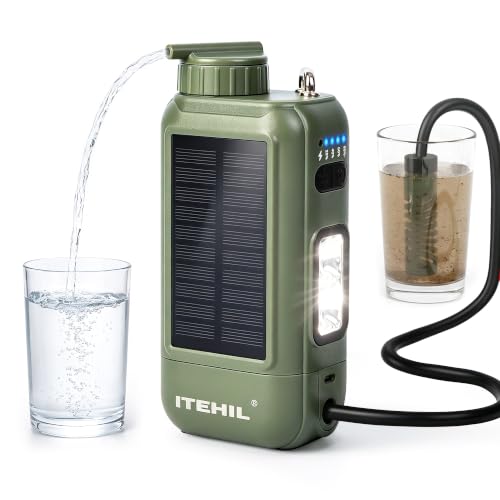
ITEHIL Portable Electric Water Filter, 0.01 Micron
  • 0.01 micron Ahlstrom membrane
  • 5200mAh battery, 4 hours runtime
  • 700 ml per minute output
Check price on Amazon for ITEHIL Portable Electric Water Filter, 0.01 Micron (opens in a new tab)
Best for: Group trips where one unit fills several bottles per stop.

Our take

Priced just below the Greeshow, it suits trips where several people need water at once, since faster output and a bigger battery cut the time spent standing at the stream.

Why it made the shortlist

ITEHIL combines an Ahlstrom filtration membrane with a pre-stage ultrafiltration layer, giving a stated precision of 0.01 micron. That is the same size class as the Greeshow, so protection is comparable, and the two compete on convenience.

A 5200mAh battery runs for about 4 hours of continuous purifying on a full charge, and output reaches 700 ml per minute, the quickest flow in the electric pair. Type-C and solar both recharge it, and the maker says 30 minutes of sun yields a useful top-up.

What works

  • Fastest electric flow here
  • Large 5200mAh battery
  • Solar and Type-C charging
  • Converts stream or lake water

Watch out for

  • No hand-crank backup
  • Electronics add trail weight
03
RV Water Filter Store Virus Hero 0.2 Micron Cartridge
  • 0.2 micron absolute pleated
  • 3 to 4 GPM at 55 PSI
  • Fits RV Essential System canister
Check price on Amazon for RV Water Filter Store Virus Hero 0.2 Micron Cartridge (opens in a new tab)
Best for: Van or trailer base camps that already run a matching canister.

Our take

It sits mid-pack on price, and it stays useful year after year at a camp or in a vehicle, while the pocket units stay in the pack.

Why it made the shortlist

Virus Hero is a pleated 0.2 micron absolute cartridge sold for canister number three of an RV filter system, with a named claim of removing and reducing viruses and bacteria. It is the one pick in this shortlist whose listing says so directly.

Flow is the standout, at 3 to 4 GPM at 55 PSI, far beyond anything a pocket filter delivers. Where a trip ends at a rig with a hose hookup, that volume fills tanks, kettles and bottles in minutes.

Consider it the stationary partner to a portable filter.

What works

  • Named virus and bacteria claim
  • Long-term base-camp value

Watch out for

  • Not portable on foot
  • Needs a matching canister and pressure source
04

Best Hands-Off Camp Filter · 4 of 5

VFX All-in-One Portable Gravity Water Filter System

VFX All-in-One Portable Gravity Water Filter System
  • Hollow fiber membrane
  • 3 litre bladder and carry bag
  • Up to 1 litre per minute
Check price on Amazon for VFX All-in-One Portable Gravity Water Filter System (opens in a new tab)
Best for: Camp-based hikers filtering several litres while they pitch the tent.

Our take

Costing noticeably less than the electric pair, it suits hikers who value simplicity and a mesh bag that packs flat.

Why it made the shortlist

VFX bundles a hollow fiber membrane filter, a 3 litre bladder, a carry bag and a backflush syringe, so the whole kit is in one purchase. Hang the bag, let gravity work, and water flows at up to 1 litre per minute with no pumping.

Hollow fiber membranes are a proven method for bacteria and protozoa, and the kit attaches to any bottle, bladder or hydration reservoir. The syringe lets you backflush on the trail, which restores flow without replacing parts.

For camps with several people, the 3 litre bladder is a real time saver.

What works

  • Gravity flow, zero pumping
  • Syringe backflush included
  • Complete kit in one box
  • Fits bottles and reservoirs

Watch out for

  • Claims cover bacteria and protozoa only
  • Needs a high hanging point
05
FS-TFC Pocket Water Filter, 0.01 Micron
  • 0.01 micron pocket filter
  • 500 ml per minute flow
  • 4000 litre rated capacity
Check price on Amazon for FS-TFC Pocket Water Filter, 0.01 Micron (opens in a new tab)
Best for: Ultralight hikers and emergency kits that need a pocket-sized filter.

Our take

A lifetime guarantee from the maker backs it, which suits emergency kits where a filter sits unused for months.

Why it made the shortlist

This pocket straw-style filter carries a 0.01 micron rating and a collapsible handle, so it rides on a lanyard or in a bug-out bag without taking space. It is the cheapest pick in this guide and the lightest.

Flow is stated at 500 ml per minute, and the filter can drink directly from a source or screw onto a bottle. Capacity is listed at 4000 litres with SGS certification, a high figure for a pocket unit.

For solo hikers, scouts and glovebox kits, it covers the basics at the lowest outlay.

What works

  • Cheapest pick in this guide
  • Lightest option here
  • Drinks direct or fills bottles
  • High 4000 litre capacity

Watch out for

  • Slow for filling groups
  • Cleaning needs backflushing care

Methodology

How We Built This Shortlist

Each pick was assessed across 5 criteria weighted for real-world use.

01

Pore size and claim wording

We read each stated micron figure and the exact words around it. A 0.01 micron membrane sits in the size range where virus control is plausible, while a bacteria and protozoa claim does not cover viruses. Wording matters as much as the number.

02

Weight and packability

A filter you leave at home protects no one. We weighed how each unit packs, from a pocket straw to a battery-powered pump, and treated pack weight as a cost. Units that fold flat or ride on a lanyard scored best for hikers.

03

Flow rate and effort

Stated flow in millilitres or litres per minute shows how long you spend at the source. We compared pumping effort too, from automatic electric to gravity to drink-direct, because effort adds up at the end of a hiking day.

04

Power and upkeep

Electric units need a charge, so we looked at battery size, solar options and backflushing. Gravity and pocket filters carry no battery risk but need cleaning. This part of the review rests on product specs and our analysis, not field trials.

05

Value over the filter lifespan

We compared stated cartridge capacity against price position. A filter rated for thousands of litres spreads its cost thin, and an inexpensive straw with a long lifespan can beat a pricier unit that needs early replacement.

Decision guide

Match a Budget Backpacking Water Filter for Viruses to Your Camp Setup

By Trip Style

Match the filter to how you actually move and camp.

TripPick and why
Ultralight day hikes and emergency kitsFS-TFC Pocket weighs next to nothing and drinks direct
Multi-day treks with a groupITEHIL Electric fills fast with a big battery
Base camp with a tent and a hang pointVFX Gravity filters three litres with no effort
Van or trailer with a hose hookupVirus Hero 0.2 gives the highest flow and a named virus claim
Solo trip with minimal effortGreeshow Electric pumps automatically and recharges three ways

By Budget

Prices climb with automation and battery size.

BandPick and what it buys
Entry of this shortlistFS-TFC Pocket buys a 0.01 micron filter that fits a pocket
Low-midVFX Gravity buys a complete gravity kit with a bladder and syringe
MidVirus Hero 0.2 buys a named virus claim and high flow for rigs
Upper-midITEHIL Electric adds a large battery and faster output
TopGreeshow Electric adds hand-crank backup and a 264 gallon cartridge

Electric vs Manual

The choice is between charging a device and carrying a simpler one.

Electric

Greeshow Electric and ITEHIL Electric pump on their own and use 0.01 micron membranes, so you spend less effort and more on batteries.

Manual or gravity

VFX Gravity and FS-TFC Pocket need no power, so they cost less and weigh less, but you supply the effort or the hanging point.

Pick electric for groups and long days, manual for light, cheap and reliable.

By Filtering Standard

What the filter claims to stop is a different question from how you carry it.

PriorityPick and why
Named virus and bacteria removalVirus Hero 0.2 states it directly
0.01 micron membrane classGreeshow Electric, ITEHIL Electric and FS-TFC Pocket all state 0.01 micron
Bacteria and protozoa onlyVFX Gravity states hollow fiber removal of both

For Virus Concern Specifically

Look for

A 0.01 micron membrane or a named virus claim, plus a certification you can name, rather than just a micron number.

In this comparison

Virus Hero 0.2 states virus removal directly, while Greeshow Electric, ITEHIL Electric and FS-TFC Pocket reach the 0.01 micron size class.

When to Spend More

Spend more if

You hike with others or camp for days, which makes Greeshow Electric or ITEHIL Electric worth the extra for automation and battery.

Save if

You travel light or build an emergency kit, where FS-TFC Pocket or VFX Gravity gives plenty of protection for much less.

FAQ

Before You Bring One Home

Does a 0.01 micron filter remove viruses?

A 0.01 micron membrane is small enough in principle, but the real proof is a certification or an explicit claim. None of the 0.01 micron listings here carry a named virus standard, so treat them as strong bacteria and protozoa filters with virus potential, and add chemical or UV treatment in high-risk water.

Why include an RV cartridge in a backpacking guide?

Only one pick states a virus and bacteria claim outright: the Virus Hero 0.2, which suits base camps with a hose or a pressurised rig. It does not travel on a trail, but it fills out the shortlist for people who camp from a vehicle.

Is gravity filtering as safe as electric?

Safety depends on the membrane, not the delivery method. The VFX uses hollow fiber filtration for bacteria and protozoa, while the electric units use 0.01 micron membranes. Gravity is quieter and needs no power, which is its main advantage.

How do I stop a filter from freezing?

Keep it inside your sleeping bag or a jacket pocket on cold nights. A frozen membrane can crack internally and still look fine, so replace any unit that froze with water inside it.

How long should a pocket filter last?

Stated capacities run from 264 gallons for the Greeshow cartridge to 4000 litres for the FS-TFC. Those are best-case figures in clean water, so backflush regularly and replace the filter once flow stays slow after cleaning.

Do I still need a prefilter for muddy water?

Yes, when the source is silty. Pour it through a bandana or let it settle first, because heavy sediment clogs any membrane early. Electric units with a pre-stage handle more silt than a bare pocket filter.

Bottom line

The short version

Browse more budget backpacking water filters for viruses on Amazon →
Danny Walker, Camping Editor at RV Gear Lab

About the author

Danny Walker

Camping Editor at RV Gear Lab

Danny covers camping gear, campsite setup, outdoor power, sleep systems and practical camping advice, with a focus on helping campers make better gear decisions.

More from Danny →Editorial standards

Keep reading

Related guides