


We research everything we recommend. When you buy through our links, we may earn a commission. Learn more

Buying guide · 10 min read · Updated October 2, 2026

5 Best Trekking Poles Under 50 in 2026: A Practical Camping Guide

Best trekking poles under $50: five aluminum pairs compared on 6061 versus 7075 alloy, grips, lock type, weight and packed length for day hikes.

Danny WalkerBy Danny WalkerCamping Editor at RV Gear Lab5 products comparedSpec-sheet researched
Hiker with a loaded backpack climbing a mountain trail

At a glance

Our top picks

Fifty dollars buys a full pair of aluminum trekking poles, and the five here run from about $21 to $40. None are carbon fiber, so the differences are alloy grade, grip material, lock style, weight and how small they fold for a pack.

They were compared on shaft alloy, weight per pole, adjustment range, collapsed length and included accessories like baskets and spare tips. The ranking rewards the pair that covers the most terrain for the least money, with the pricier pairs justified only by folding size or weight.

RV Gear Lab field notes

The Campsite Fit Check

Start with the job
Cascade Mountain Tech Trekking Poles leads this shortlist for All-season day hikes. Use that fit as a reference point, then compare the alternatives against your own space and workload.
Specs that separate the picks
The first details to compare are 6061 aluminum, 10 oz each, 7075 aluminum, four sections, 10.4 oz, tri-fold to 15 inches. Confirm the exact model and included components before ordering.
Trade-off to plan for
Heavier than the 7075 pairs

Before you buy

What Matters Before You Choose a Trekking Pole Under 50

Key buying criteria so you get the right fit the first time.

  1. 01

    6061 versus 7075 aluminum

    7075 aluminum is stiffer and stronger for its weight than 6061, so a 7075 pole can be thinner and lighter. The tradeoff is cost, which is why most budget poles use 6061. For day hikes either works. For heavy packs and rocky terrain, choose 7075.

  2. 02

    Lock type

    Lever locks open and close with one hand and work with gloves, which makes mid-hike height changes quick. Twist locks are lighter but can slip if the internal expander wears or fills with grit. Check the lock before every hike, and tighten or clean it if a pole slowly collapses under your weight.

  3. 03

    Grip material

    Cork wicks sweat and molds to your hand over time, EVA foam is soft and warm, and hard plastic can feel slick when wet. Cork costs a bit more but wears well on long days. Choose cork or foam for hot or humid trails, and wear a strap so the pole cannot slip away on a descent.

  4. 04

    Weight and fatigue

    An ounce on each pole matters because you lift it with every step, thousands of times over a day. Poles near 10 oz feel light, while 12 oz poles tire your arms sooner on all-day hikes. Compare the stated weight per pole, not per pair, and remember that spring absorbers add a few ounces.

  5. 05

    Packed length

    A three-section pole folds to about 24 inches, while a four-section or tri-fold pole folds to 15 or 16 inches. A short folded length fits a carry-on bag or the side of a daypack and keeps poles from snagging brush. Measure the bag you will use before you buy, and note the collapsed length on the product page.

  6. 06

    Baskets and tips

    Baskets stop poles sinking into snow and mud, and tungsten carbide tips grip rock and ice. Spare tips replace worn ones, which wear out after many miles. Check what is in the box before buying separate accessories, and swap in baskets only when the ground is soft.

Our standards

Why You Can Trust RV Gear Lab

At RV Gear Lab, we compare products based on campsite fit, verified specifications, usability, setup requirements, weight, durability, and real-world trade-offs. We do not rank products purely on marketing claims or commission rates.

We have not personally tested every product listed. Where hands-on testing is not available, recommendations are based on verified manufacturer specifications, product documentation, use-case fit, and comparative research.

How we review camping gear →

Detailed reviews

The 5 best trekking poles under 50, explained

01

Best Value Under $50 · 1 of 5

Cascade Mountain Tech Trekking Poles

Cascade Mountain Tech Trekking Poles
  • 6061 aluminum, 10 oz each
  • 26 to 54 inch quick lock
  • Cork grip, extended EVA
Check price on Amazon for Cascade Mountain Tech Trekking Poles (opens in a new tab)
Best for: All-season day hikes

Our take

A full-featured pair that covers four seasons for under $25.

Why it made the shortlist

The Cascade poles are aircraft-grade 6061 aluminum at about 10 oz each, with a quick-lock mechanism that adjusts from 26 to 54 inches without stopping. A cork grip with an extended EVA down-grip handles steep climbs, and tungsten carbide tips come with rubber snow and mud baskets, boots and tip covers.

The cork grip resists sweat better than plain foam.

They suit most day hikers and weekend backpackers who want one pair for all seasons. A travel bag is included.

What works

  • Quick lock adjusts on the move
  • Snow and mud baskets included
  • Cork grip with extended down-grip
  • Tungsten carbide tips

Watch out for

  • Heavier than the 7075 pairs
  • Longer folded length
The catch
Heavier than the 7075 pairs and longer packed.
02
Best for: Joint-friendly hiking

Our take

Pick these when downhill impact bothers your knees or wrists.

Why it made the shortlist

The Aihoye 7075 poles use aircraft-grade 7075 aluminum with a spring shock absorber in the lower section, cork grips and a four-section design that folds to 16 inches. A combination of quick-flip locks and an internal twist lock balances strength and speed.

The shock absorber reduces wrist impact on descents, which suits tender knees or hips.

They suit hikers with joint concerns who want cushioning on downhill sections. The cork grips wick sweat.

What works

  • Spring shock absorber cushions descents
  • Cork grips resist sweat
  • Folds to 16 inches
  • Two-stage lock design

Watch out for

  • Shock absorber adds weight
  • More joints to maintain
The catch
The built-in spring adds weight and a failure point.
03

Best Foldable Pair · 3 of 5

Trekology Trek-Z Hiking Trekking Poles

Trekology Trek-Z Hiking Trekking Poles
  • 10.4 oz, tri-fold to 15 inches
  • Flip lock, metal lock caps
  • Two heights, 20 cm range
Check price on Amazon for Trekology Trek-Z Hiking Trekking Poles (opens in a new tab)
Best for: Travel and flights

Our take

The pick for anyone who flies with poles.

Why it made the shortlist

The tri-fold design collapses to 15 inches and reinforced joints have metal lock caps.

They suit travelers who fly with their poles. Choose the 100 to 120 cm or 115 to 135 cm size to match your height.

What works

  • Folds to 15 inches
  • Metal lock caps reinforce joints
  • EVA grip handles sweat
  • Fits checked or carry-on bags

Watch out for

  • Narrow adjustment range
The catch
Each size adjusts only 20 cm.
04

Best Lightest Pair · 4 of 5

TrailBuddy Trekking Poles

TrailBuddy Trekking Poles
  • 9.7 oz, 7075 aluminum
  • 24.5 to 54 inch lever locks
  • Cork handles, padded straps
Check price on Amazon for TrailBuddy Trekking Poles (opens in a new tab)
Best for: Light and fast adjustments

Our take

A lighter 7075 pair with quick locks for long days.

Why it made the shortlist

TrailBuddy poles use 7075 aluminum at 9.7 oz per pole, adjusting from 24.5 to 54 inches with one-handed lever locks. Padded straps, moisture-wicking cork handles and threaded tips for accessories complete the design.

At about $40 they are the lightest pair here and cost $16 more than the Cascade. The lever locks are quicker than twist locks on other models.

They suit hikers who want the lightest aluminum pair and speedy adjustments. They also work for kids.

What works

  • Lightest pair at 9.7 oz
  • One-handed lever locks
  • Cork handles wick sweat
  • Threaded tips take accessories

Watch out for

  • Cork handles wear with heavy use
The catch
Costs $16 more than the Cascade pair.
05

Best Budget Spare Tips · 5 of 5

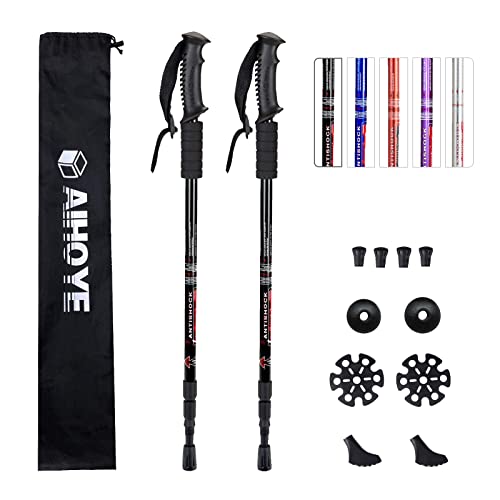
Aihoye Hiking Trekking Poles

Aihoye Hiking Trekking Poles
  • 10.3 oz aviation aluminum
  • Anti-shock, foam handle
  • 10 replacement tips
Check price on Amazon for Aihoye Hiking Trekking Poles (opens in a new tab)
Best for: First pair and casual walks

Our take

The cheapest way to try trekking poles, with spare tips in the box.

Why it made the shortlist

The Aihoye foam-grip poles are aviation aluminum at 10.3 oz each, with an anti-shock design, an ergonomic plastic grip with a secondary foam handle and 10 replacement rubber tips. A free replacement policy and a one-year warranty back the pair.

At about $21 they are the cheapest pair here and cost $3 less than the Cascade. The plastic grip is less sweat-friendly than cork.

They suit casual walkers and first-time hikers. Replacement tips cover many miles.

What works

  • 10 replacement tips included
  • One-year warranty
  • Anti-shock design

Watch out for

  • Plastic grip is less comfortable
  • Less refined than cork
The catch
The plastic grip gets slick in sweat.

Methodology

How We Built This Shortlist

Each pick was assessed across 5 criteria weighted for real-world use.

01

Shaft alloy

6061 and 7075 aluminum were compared for strength and weight.

02

Weight per pole

Weights from 9.7 to 10.8 oz were compared.

03

Locks and adjustment

Lever, flip and twist locks were compared.

04

Packed length

Folded lengths of 15 to 16 inches were compared.

05

Price against the cap

Every pick sits at or under $50, and the top pick covers the most terrain per dollar.

Decision guide

Match a Trekking Pole Under 50 to Your Camp Setup

By hiker

Your situationRecommended pickWhy
All-season day hikerCascade 6061 PolesBaskets, carbide tips, quick locks.
Sore knees on descentsAihoye 7075 CorkSpring shock absorber.
Flying with polesTrekology Trek-ZTri-fold to 15 inches.
Lightest pairTrailBuddy 70759.7 oz with lever locks.
First pair, tight budgetAihoye Foam GripAbout $21 with spare tips.

By Budget

BudgetRecommended pick
$20 to $30Aihoye Foam Grip or Cascade 6061 Poles
$20 to $40Aihoye 7075 Cork or TrailBuddy 7075
$30 to $40Trekology Trek-Z

7075 vs 6061

7075 alloy

The Aihoye 7075 Cork and TrailBuddy 7075 are stiffer and lighter for the same strength.

6061 alloy

The Cascade 6061 Poles are heavier but cheaper and perfectly good for day hikes.

Take the Cascade 6061 Poles unless weight or folding size matters most.

By budget

Price tierRecommended pick
About $21Aihoye Foam Grip
About $24Cascade 6061 Poles
About $24, shock absorberAihoye 7075 Cork
About $40, lightestTrailBuddy 7075
About $40, foldableTrekology Trek-Z

For beginners on rocky trails specifically

Look for

Look for lock reliability, tungsten tips and a wrist strap you can adjust.

In this comparison

The Cascade 6061 Poles have quick locks and carbide tips. The Aihoye 7075 Cork adds a shock absorber.

When to Spend More

Spend more if

Spend more if you fly or care about weight: the Trekology Trek-Z folds to 15 inches and the TrailBuddy 7075 weighs 9.7 oz per pole.

Save if

Save if you hike a few times a year: the Cascade 6061 Poles at about $24 cover all terrain, and the Aihoye Foam Grip at about $21 is cheapest.

FAQ

Before You Bring One Home

Are trekking poles worth it for day hikes?

Yes on hills and rough ground. Poles share load with your arms, reduce knee impact on descents and add balance on stream crossings. The Cascade 6061 Poles at about $24 are enough for most day hikers.

What mistake do hikers make with trekking poles?

Many set the poles too long. Your elbows should bend about 90 degrees on flat ground, and you should shorten the poles on climbs and lengthen them on descents. Check the lock after each adjustment.

Is a shock absorber useful?

It can help on long descents, since the spring softens impact on wrists and elbows. The Aihoye 7075 Cork adds a spring, but it also adds weight and a part that can wear. Without joint pain, a standard pole is fine.

How do I adjust a lever lock?

Open the lever, slide the section to the right length and close the lever firmly. If it slips, tighten the lever adjustment nut with a coin until it holds firmly. The TrailBuddy 7075 uses one-handed lever locks, so you can adjust while holding the other pole.

How should I clean and store trekking poles?

Wipe the poles, rinse off mud or salt and dry the sections before collapsing them. Open the locks for storage so the expanders do not stay compressed for months. Store the poles in a dry place, and check the tips for wear before each season.

Bottom line

The short version

Browse more trekking poles under 50 on Amazon →
Danny Walker, Camping Editor at RV Gear Lab

About the author

Danny Walker

Camping Editor at RV Gear Lab

Danny covers camping gear, campsite setup, outdoor power, sleep systems and practical camping advice, with a focus on helping campers make better gear decisions.

More from Danny →Editorial standards

Keep reading

Related guides