


We research everything we recommend. When you buy through our links, we may earn a commission. Learn more

Buying guide · 10 min read · Updated October 2, 2026

6 Best Water Filters Under 50 in 2026: A Practical Camping Guide

Best water filters under $50: six RV hose, counter, sediment and bottle filters for campsites, compared on certifications, flow and what $50 really buys.

Danny WalkerBy Danny WalkerCamping Editor at RV Gear Lab6 products comparedSpec-sheet researched
Dome tent and hammock at a forest campsite at golden hour

At a glance

Our top picks

Fifty dollars gets you a proper RV hookup filter system, a large counter dispenser or a sediment pre-filter, and none of them make unsafe water safe to drink. The six here run from about $18 to $50 and cover different jobs: taste at the tap, sediment at the hose, and drinks at the picnic table.

The ranking asks what the extra money over a $25 hose filter buys: a bigger housing, a stated certification, or a larger reservoir. The top spot goes to the best campsite system under the cap, and the others are placed by the job they do.

RV Gear Lab field notes

The Campsite Fit Check

Start with the job
FS-TFC RV Water Filter System Reduces Bad Taste leads this shortlist for RV hookups and campgrounds. Use that fit as a reference point, then compare the alternatives against your own space and workload.
Specs that separate the picks
The first details to compare are 0.2 micron carbon block, GAC and KDF, 6-step filtration, 35 cups, 200 gallon filter. Confirm the exact model and included components before ordering.
Trade-off to plan for
Larger and heavier than hose filters

Before you buy

What Matters Before You Choose a Water Filter Under 50

Key buying criteria so you get the right fit the first time.

  1. 01

    What the certification covers

    NSF/ANSI 42 covers aesthetic effects such as chlorine taste and odor, while 53 covers health effects like lead, and 58 covers reverse osmosis systems. A filter with no certification can only be judged on its media. Look in the product details for the exact numbers, and match them to what you want to remove.

  2. 02

    Filter vs purifier

    A filter reduces chlorine taste, odor and particles, while a purifier is tested to remove bacteria and viruses as well. None of the six products here claims to purify untreated water, so they suit treated campground taps and well pre-filtering only. If your source is a stream, lake or unknown tank, boil the water or use a dedicated purifier, and check the product details for a stated microbial claim.

  3. 03

    Capacity and filter life

    Filter life ranges from 40 gallons on the Brita XL Pitcher to 200 gallons on the Waterdrop WFD-40L Dispenser, and a cheap filter that needs changing every month costs more over a season. Divide the replacement price by the stated gallons to get a real cost per gallon. Look for the gallon rating and the time limit in the product details.

  4. 04

    Hose fit and flow

    RV and camp filters connect to a garden hose with a standard thread, and a tight, high-flow filter fills a tank quickly. A housing too small for the spigot slows your tank fill. Look for a standard hose thread and a flow rate in gallons per minute.

  5. 05

    Source water and sediment

    If your water carries sand, rust or silt, a carbon filter clogs within weeks, and a spin-down pre-filter like the Turboyhood saves it by catching grit first. Well water and old campground lines are the usual culprits. Look at a glass of your water before you buy, and choose a pre-filter for cloudy or gritty water.

Our standards

Why You Can Trust RV Gear Lab

At RV Gear Lab, we compare products based on campsite fit, verified specifications, usability, setup requirements, weight, durability, and real-world trade-offs. We do not rank products purely on marketing claims or commission rates.

We have not personally tested every product listed. Where hands-on testing is not available, recommendations are based on verified manufacturer specifications, product documentation, use-case fit, and comparative research.

How we review camping gear →

Detailed reviews

The 6 best water filters under 50, explained

01
FS-TFC RV Water Filter System Reduces Bad Taste
  • 0.2 micron carbon block
  • NSF/ANSI 58 described
  • Clear housing, twist-in cartridge
Check price on Amazon for FS-TFC RV Water Filter System Reduces Bad Taste (opens in a new tab)
Best for: RV hookups and campgrounds

Our take

The most complete campsite filter system under $50.

Why it made the shortlist

The FS-TFC RV Water Filter System uses an activated carbon block described as 0.2 micron and certified to NSF/ANSI 58, in a clear housing that lets you see when it needs changing. It connects to a standard hose or faucet, installs in about 5 minutes and uses a twist-in cartridge.

It costs about $36, around $10 more than the Camco Tastepure 2-Pack, and it is a larger system with a longer service life than a standard hose-end filter.

It suits RVers and campers who fill tanks from campground spigots and want a filter that lasts the season. It also works at home for gardening and pets.

What works

  • Clear housing shows filter condition
  • Bigger than a standard hose filter
  • Installs in about 5 minutes
  • Connects to any standard hose

Watch out for

  • Larger and heavier than hose filters
  • Not a microbial purifier
The catch
It improves taste and removes particles; it does not purify untreated water.
02

Best RV Hose Filters · 2 of 6

Camco Tastepure RV Water Filter 2-pk

Camco Tastepure RV Water Filter 2-pk
  • GAC and KDF, 6-step filtration
  • NSF/ANSI 42 and 53 listed
  • Lead-free materials, made in USA
Check price on Amazon for Camco Tastepure RV Water Filter 2-pk (opens in a new tab)
Best for: Weekend RV trips

Our take

Two certified filters for about $26.

Why it made the shortlist

The Camco Tastepure ships two RV hose filters with a 6-step filtration design that combines GAC carbon and KDF media. They are listed to NSF/ANSI 42 and 53, carries the lead-free certification and is made in the USA.

It costs about $26, about $10 less than the FS-TFC RV System, and you get two filters in the pack.

It suits weekend RVers who want a spare filter ready and a trusted certification. Hose-end filters improve taste and odor and do not purify.

What works

  • Two filters in the pack
  • Reduces chlorine, taste and odor
  • NSF/ANSI 42 and 53 listed
  • Lead-free certified materials

Watch out for

  • Small hose-end size
  • Hose-end filters do not purify
The catch
Do not use it to treat river water.
03

Best Counter Dispenser · 3 of 6

Waterdrop WFD-40L Water Filter Dispenser

Waterdrop WFD-40L Water Filter Dispenser
  • 35 cups, 200 gallon filter
  • NSF 42 and 372
  • 14.37 x 5.55 x 9.95 in
Check price on Amazon for Waterdrop WFD-40L Water Filter Dispenser (opens in a new tab)
Best for: Camper kitchens

Our take

A big dispenser with a long-life filter.

Why it made the shortlist

The Waterdrop WFD-40L is a 35-cup filter dispenser measuring 14.37 by 5.55 by 9.95 inches, with a carbon fiber filter that passed NSF 42 and 372 and is rated for 200 gallons. It has a carry handle and a sliding lid.

It costs about $34, $3 less than the Brita XL Pitcher, and its filter lasts about five times as long as a standard pitcher filter.

It suits camper kitchens, cabins and vans that need a chilled drinking-water jug on the counter. The slim shape fits a cooler or fridge shelf.

What works

  • Large 35-cup capacity
  • Filter rated for 200 gallons
  • Slim shape fits a fridge shelf
  • Carry handle and sliding lid

Watch out for

  • Does not lower TDS
  • Needs counter space
The catch
It handles taste and chlorine, not microbes.
04

Best Brand-Name Pitcher · 4 of 6

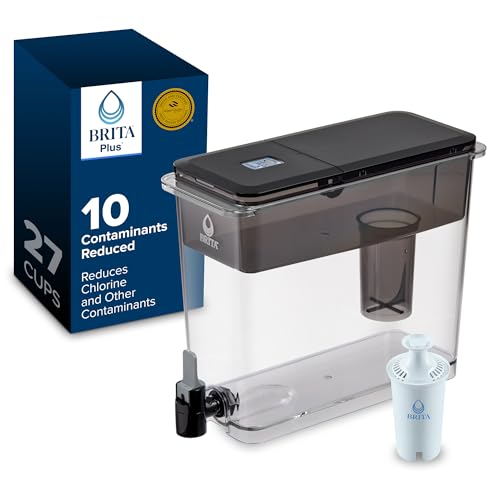
Brita XL 27 Cup Water Filter Pitcher

Brita XL 27 Cup Water Filter Pitcher
  • 27 cups, BritaPlus filter
  • WQA NSF/ANSI certified
  • Replace every 40 gallons
Check price on Amazon for Brita XL 27 Cup Water Filter Pitcher (opens in a new tab)
Best for: Camper counters

Our take

The pick when you want a recognized filter and a spigot.

Why it made the shortlist

It is certified by WQA to NSF/ANSI standards.

It costs about $50, the top of the budget and $16 above the Waterdrop WFD-40L Dispenser.

It suits campers who prefer a household-name filter and a spigot for refilling bottles. It lives on the counter.

What works

  • Brand-name filter reduces copper and mercury
  • Spigot fills bottles easily
  • BPA-free dispenser
  • Filter finds replacements everywhere

Watch out for

  • Filter needs changing every 2 months
The catch
Replacement filters add running costs.
05
Best for: Wells and cabins

Our take

A hardy sediment guard for well or cabin water.

Why it made the shortlist

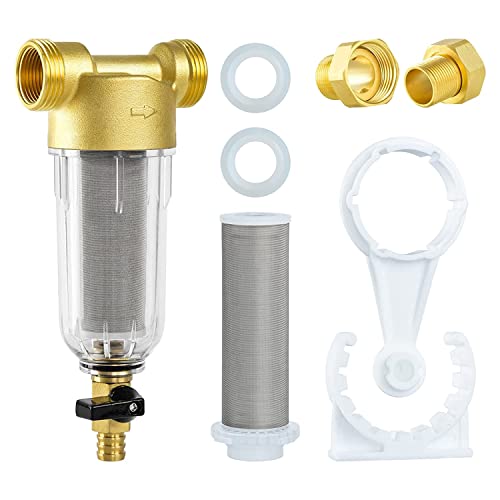
The Turboyhood is a 50 micron spin-down sediment filter with food-grade stainless mesh. It flushes clean and can be reused, and ships with 1 inch male NPT, 3/4 inch female NPT and 3/4 inch male NPT fittings.

It costs about $30, close to the Camco Tastepure 2-Pack, and it removes sand, rust and dirt rather than chlorine. It is a pre-filter for a well or a washing machine and not a taste filter.

It is a reusable part, so it avoids cartridge costs.

What works

  • Flushes clean and reuses
  • Stainless mesh handles sand and rust
  • Three fittings included
  • Protects pumps and filters

Watch out for

  • Does not remove chlorine or taste
  • Pre-filter only
The catch
Pair it with a carbon filter for taste.
06
Best for: Tap water on the go

Our take

A handy personal filter for treated water.

Why it made the shortlist

The Brita Hard-Sided Filtering Bottle is a 26 oz BPA-free bottle with an activated carbon block filter that cuts chlorine taste and odor. It has an easy-sip straw, a carry loop and a one-handed push-button lid.

It costs about $18, the lowest in the group, and it filters as you drink, which no counter system can.

It suits campers on developed sites with a treated tap. It also suits day hikers filling at a trailhead faucet.

What works

  • Filters as you drink
  • Leakproof push-button lid
  • Top-rack dishwasher safe
  • Filter lasts about 2 months

Watch out for

  • Not a purifier
  • Small 26 oz size
The catch
Do not use it on stream water.

Methodology

How We Built This Shortlist

Each pick was assessed across 5 criteria weighted for real-world use.

01

Certifications

NSF/ANSI marks were checked, as was what each one covers.

02

Filter type

Carbon block, KDF and sediment filters were separated.

03

Capacity and flow

Gallons, cups and flow design were compared.

04

Fit for camp use

Hose fittings, size and weight were checked.

05

Price against the cap

All six are under $50.

Decision guide

Match a Water Filter Under 50 to Your Camp Setup

By campsite job

Your situationRecommended pickWhy
RV hookup at a campgroundFS-TFC RV SystemClear housing and a bigger carbon block.
Two spare hose filtersCamco Tastepure 2-PackNSF/ANSI 42 and 53 in a pair.
Counter jug for a camper kitchenWaterdrop WFD-40L Dispenser35 cups and a 200 gallon filter.
Brand-name pitcher with a spigotBrita XL 27 Cup PitcherBritaPlus filter and a tap.
Well water or cabinTurboyhood Spin Down Filter50 micron stainless mesh.
Personal bottleBrita Hard-Sided BottleFilters as you drink.

By Budget

BudgetRecommended pick
$10 to $30Brita Hard-Sided Bottle or Camco Tastepure 2-Pack
$20 to $40Turboyhood Spin Down Filter or Waterdrop WFD-40L Dispenser
$30 to $50FS-TFC RV System or Brita XL 27 Cup Pitcher

Hose or system vs counter jug

Hose or system

The FS-TFC RV System, Camco Tastepure 2-Pack and Turboyhood Spin Down Filter treat water before it enters your tank or pump.

Counter or bottle

The Waterdrop WFD-40L Dispenser, Brita XL 27 Cup Pitcher and Brita Hard-Sided Bottle treat drinking water at the point of use.

Choose the FS-TFC RV System for a tank and the Waterdrop WFD-40L Dispenser for drinking water.

By price tier

Price tierRecommended pick
About $18Brita Hard-Sided Bottle
About $26Camco Tastepure 2-Pack
About $30Turboyhood Spin Down Filter
About $34Waterdrop WFD-40L Dispenser
About $36FS-TFC RV System
About $50Brita XL 27 Cup Pitcher

For RV travelers specifically

Look for

Look for a standard hose thread, a stated NSF/ANSI mark and a housing you can inspect.

In this comparison

The FS-TFC RV System adds a clear housing, and the Camco Tastepure 2-Pack supplies a spare.

When to Spend More

Spend more if

Spend more if you fill a tank daily: the FS-TFC RV System and Brita XL 27 Cup Pitcher add capacity, a clear housing or a spigot.

Save if

Save if you only need better-tasting tap water: the Brita Hard-Sided Bottle is about $18, and the Camco Tastepure 2-Pack about $26.

FAQ

Before You Bring One Home

Do these filters make stream water safe?

No. The FS-TFC RV System, Camco Tastepure 2-Pack and the others reduce taste, odor and particles but are not tested as purifiers. For untreated water, boil it or use a purifier. Treat hookup water with a filter only for taste.

What do campers get wrong when buying a water filter?

They assume a filter makes any water safe. Another common mistake is skipping a sediment pre-filter, which lets grit clog the carbon in a few weeks. Match the filter to the job, and treat untreated water separately by boiling or purifying.

Is the FS-TFC worth about $10 more than the Camco?

If you fill a tank often, yes. Its larger housing and clear window show when to change the cartridge, and the twist-in design makes replacement quick. For occasional weekend trips, the Camco Tastepure 2-Pack gives two certified filters for about $10 less.

How do I install an RV hose filter?

Screw it onto the spigot, attach the hose to the outlet, and flush for a minute before filling your tank. With the FS-TFC RV System the twist-in cartridge replaces in seconds. Keep the housing out of freezing weather.

How often should I replace the filter?

It depends on use and water quality. A Brita XL filter changes at 40 gallons or about 2 months, while the Waterdrop WFD-40L filter is rated for 200 gallons. Replace sooner if flow slows noticeably or if chlorine taste returns.

Bottom line

The short version

Browse more water filters under 50 on Amazon →
Danny Walker, Camping Editor at RV Gear Lab

About the author

Danny Walker

Camping Editor at RV Gear Lab

Danny covers camping gear, campsite setup, outdoor power, sleep systems and practical camping advice, with a focus on helping campers make better gear decisions.

More from Danny →Editorial standards

Keep reading

Related guides