

We research everything we recommend. When you buy through our links, we may earn a commission. Learn more

Buying guide · 11 min read · Updated October 2, 2026

6 Best 1000 Watt RV Solar Panel Kits in 2026: A Practical RV Guide

Six 1000 watt RV solar panel kits compared on charge controller limits, panel layout, roof area and cost per watt, from $270 to $580.

Bowen HigginsBy Bowen HigginsRV Editor at RV Gear Lab6 products comparedSpec-sheet researched

At a glance

Our top picks

A 1000 watt solar array is the point where an RV stops topping up a battery and starts running real loads. On paper it harvests about 4 kilowatt-hours on a four-hour sun day, and with typical system losses of roughly 25 percent (our estimate, not a listing claim) a realistic figure is closer to 3 kWh. The part most shoppers miss is the charge controller: a 1000W array on a 12V battery can push roughly 70 to 83 amps, and a 40A controller will quietly cap the output near 576W.

We compared six kits and panel packs priced from $269.99 to $579.99 on how they reach 1000W (two huge panels, five mid-size ones or ten small ones), whether a controller is included and how big it is, what the listing says about weight and roof footprint, and cost per watt. The spread is more than 2 to 1, and the picks below explain what the extra money buys.

RV Gear Lab field notes

The Rig Fit Check

Start with the job
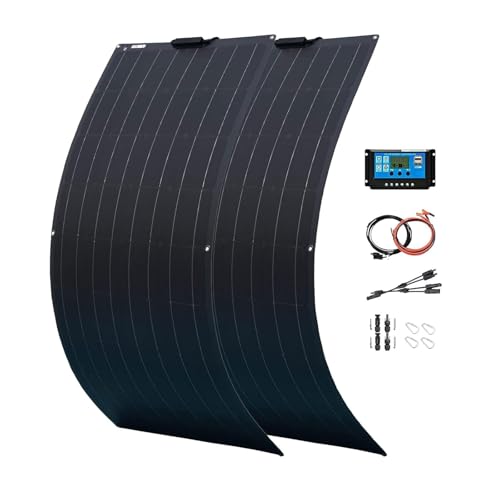
1000 Watt Solar Panel Kit, 40A Controller, 2 x 500W Flexible Monocrystalline Panels leads this shortlist for buyers wanting panels and controller in one box. Use that fit as a reference point, then compare the alternatives against your own space and workload.
Specs that separate the picks
The first details to compare are 2 x 500W flexible panels, 2 x 500W, 23% efficiency, 1000W flexible kit. Confirm the exact model and included components before ordering.
Trade-off to plan for
40A caps a 12V array near 576W

Before you buy

What Matters Before You Choose a 1000 Watt RV Solar Panel Kit

Key buying criteria so you get the right fit the first time.

  1. 01

    Controller amps versus array watts

    A charge controller limits how many amps flow into the battery, so its rating caps how much of a big array you can use. On a 12V battery charging at about 14.4V, a 40A controller handles roughly 576W and a 50A one roughly 720W (our estimate). Look for the controller amp rating in the title or bullets, and if it is missing, ask the seller before you pay.

  2. 02

    How the 1000W is made up

    Listings reach 1000W with two 500W panels, five 200W panels or ten 100W panels, and each layout changes weight, wiring and shading behavior. Two huge panels are hard to fit and a single shaded corner can hurt more of the array, while ten small panels need more connectors. Count the panels in the title and check whether sizes are given.

  3. 03

    Roof area and weight

    At about 23 percent efficiency, 1000W needs roughly 45 to 55 square feet of unshaded roof, and rigid glass adds weight, such as 23.8 pounds per 200W panel. An RV roof also has vents, an air conditioner and antennas that cut your usable area. Measure the free space on your roof and compare it with the listed panel dimensions.

  4. 04

    Flexible versus glass surface

    Flexible ETFE panels weigh less and bend, but when bonded flat they have no airflow behind them, and one listing here warns not to mount on wood, asphalt shingles, fabric or foam. Glass panels with an aluminum frame sit on brackets and carry named standards. Read the mounting instructions in the listing and choose based on your roof surface.

  5. 05

    Series versus parallel wiring

    Wiring panels in series raises voltage and lowers current, which lets a smaller controller handle more watts, while parallel raises current and needs thicker cable. A 1000W array at 12V can reach 78A, but at 48V the same array is about 21A. Check the panel voltage and the controller's maximum input voltage before you pick a wiring plan.

  6. 06

    Real daily energy

    A 1000W array produces about 4 kWh on a four-hour sun day on paper, but heat, dirt, wiring loss and shading usually cut that to about 3 kWh (our estimate). Compare that figure with your daily use, which for a fridge, lights and a laptop may be only 1 to 2 kWh. Do the sum for your own appliances rather than trusting a listing's daily output claim.

Our standards

Why You Can Trust RV Gear Lab

At RV Gear Lab, we compare products based on rig fit and power or hookup compatibility, verified specifications, usability, setup requirements, weight, durability, and real-world trade-offs. We do not rank products purely on marketing claims or commission rates.

We have not personally tested every product listed. Where hands-on testing is not available, recommendations are based on verified manufacturer specifications, product documentation, use-case fit, and comparative research.

How we review RV gear →

Detailed reviews

The 6 best 1000 watt rv solar panel kits, explained

01
Best for: Buyers wanting panels and controller in one box

Our take

Pick it if you want one box that covers panels and a controller and you are comfortable bonding flexible panels to a roof.

Why it made the shortlist

This kit pairs two 500W flexible monocrystalline panels with a 40A charge controller for $369.99, or about $0.37 per watt. The listing says the panels suit 12 to 48V battery charging, bend to fit curved roofs, and have six grommet holes so they can be fastened with screws or attached with silicone and adhesive tape. The junction box is described as sealed and waterproof.

What works

  • Flexible panels fit curved roof surfaces
  • Six grommet holes allow screw or adhesive mounting
  • About $0.37 per watt, below the glass options

Watch out for

  • 40A caps a 12V array near 576W
  • Listing publishes no panel size or weight
The catch
Against the Portable 500W Kit it costs $99 more and its controller is smaller, 40A versus 50A, so it is the weaker kit on charging headroom.
02
Best for: Lowest-cost 1000W kit with a usable controller

Our take

Choose this if you want the cheapest complete route to roughly 700W of usable 12V charging, or you plan to wire at a higher voltage.

Why it made the shortlist

The Portable 500W Kit costs $270.99 and includes two 500W monocrystalline flexible panels with a stated 23 percent conversion efficiency, an ETFE film coating for abrasion resistance, and a 50A intelligent controller with real-time voltage monitoring and overcharge, over-discharge and short-circuit protection. The listing says the panels bend up to 30 degrees to follow curved roofs without complex brackets.

It ranks second because it undercuts the Flex 500W Kit by $99 and offers a 50A controller instead of 40A, which lets a 12V array reach about 720W at 14.4V (an estimate) instead of 576W.

What works

  • 50A controller supports about 720W on a 12V battery
  • Costs only $270.99 with a controller included
  • Controller monitors voltage and guards against overcharge
  • Bends 30 degrees to follow curved roofs

Watch out for

  • No panel dimensions or weight are published
  • Two panels of about 23 square feet each are awkward
03
Best for: Tight budgets if the seller confirms controller specs

Our take

1000 Watt Flexible Solar Panel Kit with Charge Controller, Off Grid Power is the better fit when tight budgets if the seller confirms controller specs.

Why it made the shortlist

The Flex Basic Kit is the cheapest listing here at $269.99, or $0.27 per watt. It is described as a 1000 watt flexible kit with a charge controller, using monocrystalline cells, a sealed waterproof junction box and six mounting holes for fasteners, silicone or tape. The listing positions it for RVs, boats, campervans and golf carts.

It ranks third because the listing never states the controller amp rating, the panel count or the individual panel wattage, while the Portable 500W Kit costs just $1 more and publishes a 50A controller and 23 percent efficiency. That is a real difference when the controller size decides how much of the array you can use.

What works

  • Controller is included with the panels
  • Sealed junction box described as waterproof
  • Flexible panels suit curved or irregular roof surfaces

Watch out for

  • Panel count and size are not stated
04
Best for: Permanent rooftop arrays on larger rigs

Our take

Pick it if you want proven rigid glass with documented standards and the flexibility to split 1000W into five roof positions.

Why it made the shortlist

This pack contains five 200W N-type panels with 25.8 percent cell efficiency and 16-busbar cells, certified to IEC 61215, IEC 61730 and UL 61730. Each panel measures 52.8 x 30.3 x 1.18 inches and weighs 23.8 pounds, so the set adds about 119 pounds and roughly 55 square feet (our arithmetic). It has tempered glass, an aluminum frame, a low temperature coefficient of minus 0.3 percent per kelvin, and a 25-year performance warranty with 10 years of technical support.

It ranks fourth by price, $579.99 or $0.58 per watt, which is $210 above the Flex 500W Kit and $94 above the 10x100W N-Type pack. It lists no controller, so add one.

What works

  • Certified to IEC 61215, IEC 61730 and UL 61730
  • 25-year performance warranty is the longest listed
  • Five panels are easier to fit around roof vents
  • Partial-shade cell layout keeps output when shaded

Watch out for

  • No charge controller is included, so budget extra
  • Totals about 119 lb and 55 square feet
The catch
In return it states certifications, a partial-shade design with series-parallel cell strings, and the number of panels you can mount in smaller groups, which makes it easier to route around vents than two huge sheets.
05
Best for: Roofs with many small open spots

Our take

Choose it if your roof has many small usable spaces and you want glass panels you can mount in groups of two to four on separate zones.

Why it made the shortlist

This pack gives you ten 100W N-type panels with 25.8 percent efficiency, 16-busbar cells, 3.2mm anti-reflective tempered glass, an aluminum frame and an IP68 junction box. It carries the same IEC 61215, IEC 61730 and UL 61730 certification wording as the 5x200W pack. At $485.99 it costs about $0.49 per watt.

Ten panels means ten sets of connectors and a larger wiring plan, so a combiner box and careful fusing matter more here than with two big sheets.

What works

  • Ten small panels fit between roof vents and fixtures
  • Certified to IEC 61215 and UL 61730
  • Rigid glass with IP68 junction boxes
  • About $94 cheaper than the 5x200W pack

Watch out for

  • No controller is included, so budget extra spend
  • Ten panels mean many MC4 connections to seal
06
Best for: Weight-sensitive builds needing flexible modules

Our take

Pick it if weight or curved surfaces rule out glass and you want to place small panels one at a time.

Why it made the shortlist

The DOKIO 10-Pack supplies ten 100W flexible 18V panels for $449.77, or about $0.45 per watt. The listing describes an ETFE top sheet for better light transmission and wear resistance, MC4 connectors, panels that bend safely up to 30 degrees, and wiring in series for higher voltage or in parallel for higher current. Each panel arrives with foam protectors to limit shipping damage.

It ranks sixth because the listing is the thinnest on numbers: no efficiency, weight, certification or controller.

What works

  • Small panels are easy for one person to place
  • ETFE top sheet resists wear and passes light
  • Series or parallel wiring suits many battery voltages
  • Costs $36 less than the 10x100W N-Type pack

Watch out for

  • No efficiency, weight or certification is listed
  • Listing warns against mounting on combustible roof surfaces

Methodology

How We Built This Shortlist

Each pick was assessed across 5 criteria weighted for real-world use.

01

Real charging ceiling

We converted each kit's controller rating into watts at 14.4V to see how much of the 1000W array a 12V battery can actually absorb, and flagged listings that do not state the controller size.

02

Panel layout and roof fit

We compared two, five and ten panel layouts, using any published dimensions and weights, and estimated square footage where the listing gives only wattage and efficiency.

03

Cost per watt and what is included

We divided price by 1000W and then separated kits that include a controller from panel-only packs that need extra spend.

04

Build, standards and warranty

We looked for named certifications, glass versus flexible surfaces, junction box ratings and the written warranty terms.

05

Honesty of the 1000W claim

We checked whether each listing explains how the wattage is made up, and noted where panel count, size or controller details are missing.

Decision guide

Match a 1000 Watt RV Solar Panel Kit to Your RV

By Roof Layout

Your situationRecommended pickWhy
Large open flat roof with space for two sheetsPortable 500W KitTwo panels, 50A controller, lowest wiring effort
Roof cluttered by vents and a skylight10x100W N-TypeTen small glass panels fit in gaps
Medium roof, wants fewer panels than ten5x200W N-TypeFive panels of 52.8 x 30.3 inches
Curved or arched roof surfaceFlex 500W KitFlexible panels bend to fit curves
Need to place panels alone without lifting heavy glassDOKIO 10-PackSlim flexible 100W panels are easy to carry

By Budget

BudgetRecommended pick
$270Portable 500W Kit or Flex Basic Kit
$370Flex 500W Kit
$450 to $490DOKIO 10-Pack or 10x100W N-Type
Around $5805x200W N-Type

Flexible vs Rigid Glass Panels

Flexible

Thin ETFE-coated panels bend about 30 degrees, weigh far less, and suit curved roofs, but they are usually bonded flat, which traps heat, and the listings here publish less certification. The Flex 500W Kit, Portable 500W Kit, Flex Basic Kit and DOKIO 10-Pack are flexible.

Rigid glass

Tempered glass in an aluminum frame stands off the roof for airflow, carries named IEC and UL standards and long performance warranties, but weighs more. The 5x200W N-Type and 10x100W N-Type packs are rigid.

Most buyers who plan to keep the rig for years should default to rigid glass unless a curved roof or weight limit rules it out.

By What Is Included

What you need in the boxRecommended pick
Controller with a stated ratingPortable 500W Kit (50A) or Flex 500W Kit (40A)
Panels only, controller chosen separately5x200W N-Type or 10x100W N-Type
Controller and panels, details to be confirmedFlex Basic Kit
Flexible panels, add your own controllerDOKIO 10-Pack

For 12V Battery Banks Specifically

Look for

A controller rated at least 80A for 1000W on a 12V bank (1000W divided by 12.8V is about 78A, estimate), or a plan to wire panels at 24V or 48V so a smaller controller can handle the load.

In this comparison

The Portable 500W Kit gives about 720W on a 50A controller and the Flex 500W Kit about 576W on 40A; the 5x200W N-Type and 10x100W N-Type packs need you to buy an 80A class controller.

When to Spend More

Spend more if

You plan a permanent installation and want documented standards; the 5x200W N-Type pack lists IEC and UL 61730 certification and a 25-year performance warranty, and the 10x100W N-Type pack fits cluttered roofs.

Save if

You are testing demand before committing; the Portable 500W Kit at $270.99 includes a 50A controller, and it is the cheapest route to meaningful charging on a 12V system.

FAQ

Before You Bring One Home

Can a 1000W solar kit run an RV air conditioner?

Only for short periods. A 13,500 BTU rooftop air conditioner draws roughly 1,200 to 1,800 watts while running, more than a 1000W array can supply, and it needs a large inverter and battery bank. Solar can offset part of the load, but plan on shore power or a generator for steady air conditioning.

What size charge controller does a 1000W array need?

For a 12V battery you need about 80A (1000W divided by 12.8V is roughly 78A). For a 24V bank about 40A, and for 48V about 21A. A 40A or 50A controller will work with a 12V bank but will clip the output, so budget for a bigger one or wire at a higher voltage.

Is the Portable 500W Kit better than the Flex 500W Kit?

On charging headroom yes: it lists a 50A controller versus 40A and costs $99 less. The Flex 500W Kit offers 12 to 48V compatibility and a sealed junction box in its listing. If you are on a 12V system, the 50A controller is the more useful difference.

How do I mount flexible panels on a fiberglass roof?

Clean and dry the surface, test the adhesive on a small spot, and use the panel's grommet holes or adhesive made for the roof material. Leave airflow where you can, since heat trapped under a flat-bonded panel lowers output. Follow the maker's heat and combustible-material warnings.

How many batteries do I need with 1000W of solar?

A rule of thumb is to store at least a day of your usage. If you use 2 kWh daily, a 200Ah 12V lithium battery stores about 2.56 kWh, and a 1000W array can refill it in a sunny day. Lead-acid banks need to be about twice as large for the same usable energy.

How do I keep a 1000W system safe?

Fuse each parallel string, size cables for the amperage, use a combiner box for ten-panel setups, and check connectors yearly. Clean panels with water and a soft cloth, and inspect roof seals around every bracket.

Bottom line

The short version

Browse more 1000 watt rv solar panel kits on Amazon →
Bowen Higgins, RV Editor at RV Gear Lab

About the author

Bowen Higgins

RV Editor at RV Gear Lab

Bowen covers RV power, water systems, towing and leveling, upkeep and interior comfort, with a focus on matching gear to the rig, the hookups and the way you actually travel.

More from Bowen →Editorial standards

Keep reading

Related guides