

We research everything we recommend. When you buy through our links, we may earn a commission. Learn more

Buying guide · 10 min read · Updated October 2, 2026

5 Best 2000 Watt RV Generators in 2026: A Practical RV Guide

Five 2000W gas and dual fuel inverter generators for RVs compared on true running watts, noise, weight and outlets, from $279 to $569.

Bowen HigginsBy Bowen HigginsRV Editor at RV Gear Lab5 products comparedSpec-sheet researched

At a glance

Our top picks

Almost every generator sold as a 2000 watt model reaches that number only for a few seconds. The figure on the box is usually starting (surge) watts, and the power you can draw all day, the running watts, is often 1,600 to 1,800. That gap decides whether your fridge, lights, laptop and a small appliance run together or the generator trips as soon as the microwave clicks on.

We compared five 2000W-class inverter generators priced from $278.99 to $569 on the number that matters most, rated running watts, then on weight, published noise, the outlets that are actually on the panel, and how clearly the listing states what it can deliver. One rule shaped the ranking: a unit that publishes a real 2000 running-watt rating sits above one that only advertises 2000 as a peak.

RV Gear Lab field notes

The Rig Fit Check

Start with the job
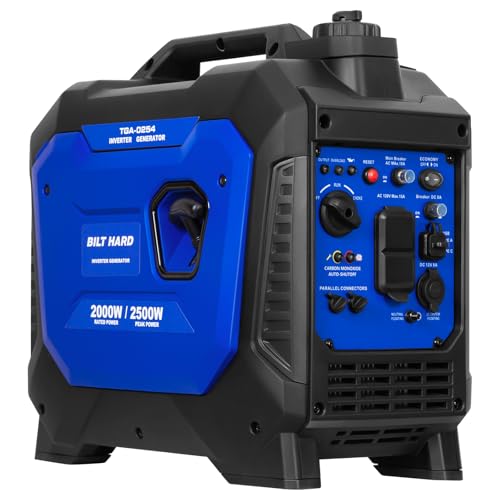
BILT HARD 2500W Quiet Inverter Generator, 80cc, CO Sensor, Parallel Ready leads this shortlist for owners who need the full 2000 watts continuously. Use that fit as a reference point, then compare the alternatives against your own space and workload.
Specs that separate the picks
The first details to compare are 2,500 start, 2,000 running watts, 1,800 running watts, 1,600 running watts. Confirm the exact model and included components before ordering.
Trade-off to plan for
Listing gives no weight or noise figure to compare

Before you buy

What Matters Before You Choose a 2000 Watt RV Generator

Key buying criteria so you get the right fit the first time.

  1. 01

    Running vs starting watts

    Starting (surge) watts are what the generator can push for a few seconds to start a motor, while running watts are what it can supply continuously. A model advertised as 2000 watts but rated for 1,600 running watts will overload if you add a toaster to a fridge and charger. Find the word running or rated in the bullet points and size against that number, not the headline.

  2. 02

    Real outlets on the panel

    A 2000W generator usually offers only 120V 20A duplex outlets, 12V DC and USB ports. A 30A TT-30 RV plug will not fit those outlets, so you need an adapter cord, and the 20A circuit then limits you to about 2,400 watts by arithmetic, more than the generator can deliver. Look at the outlet list in the listing for TT-30R or L5-30R before assuming direct RV plug-in.

  3. 03

    Published weight and noise

    Weight and decibel figures tell you whether the unit is carryable and campground friendly. Under 40 pounds is easy for one person, while a 60 dBA reading at 23 feet is comparable to conversation. Be careful when a listing omits both figures or states noise at no load, because noise rises with load, and compare the test load as well as the number.

  4. 04

    Fuel type and storage

    Gasoline degrades in a few months and clogs carburetors if left in the tank, while propane stores for years. A dual fuel model costs more, and typically produces less power on propane than on gasoline. Check the listing for a propane kit and for output on each fuel, and drain or stabilize gasoline before storing.

  5. 05

    Carbon monoxide shutdown

    Carbon monoxide builds up near campers, and a CO sensor that shuts the engine off can prevent poisoning. This is protection, not permission to run a generator near windows or an awning. Look for CO shutdown in the safety line of the listing, and always keep the generator outdoors and well away from the RV.

  6. 06

    Parallel capability and warranty

    Parallel kits connect two units to double output, which is the usual way a 2000W class generator reaches air conditioner power. The kit is typically sold separately and has to match the brand and model. Check whether the kit is included and confirm the warranty length, which one listing here states as two years while others do not.

Our standards

Why You Can Trust RV Gear Lab

At RV Gear Lab, we compare products based on rig fit and power or hookup compatibility, verified specifications, usability, setup requirements, weight, durability, and real-world trade-offs. We do not rank products purely on marketing claims or commission rates.

We have not personally tested every product listed. Where hands-on testing is not available, recommendations are based on verified manufacturer specifications, product documentation, use-case fit, and comparative research.

How we review RV gear →

Detailed reviews

The 5 best 2000 watt rv generators, explained

01
Best for: Owners who need the full 2000 watts continuously

Our take

Pick it if you want the full 2000 watts as a continuous number, for example a compressor fridge plus lights and a laptop at once.

Why it made the shortlist

It uses an 80cc four-stroke OHV engine, a 1.11-gallon tank that the listing says gives up to 5.5 hours at 50 percent load, pure sine wave output under 3 percent THD, two 120V NEMA 5-20 outlets and a 12V 8A DC output. A carbon monoxide sensor shuts the engine down automatically.

It ranks above the All Power America by 200 running watts for $21 more, and above the GENMAX by 400 running watts for $30 less. The parallel kit is sold separately.

What works

  • Parallel ready, so a second unit can double output
  • Built-in CO sensor shuts the engine down automatically

Watch out for

  • Listing gives no weight or noise figure to compare
  • Parallel kit is not included in the box
02
Best for: Budget buyers running a fridge and small electronics

Our take

This suits a weekend camper with a fridge, lights and chargers who wants the lowest entry price.

Why it made the shortlist

The All Power America generator is the cheapest here at $278.99 and lists 2,000 starting watts with 1,800 running watts from a 79.7cc gas engine. It weighs 39.6 pounds, runs at 62 dBA at 25 percent load, and the listing claims up to 6.5 hours at 50 percent load from a 0.88-gallon tank. The panel carries two 120V 20A outlets and two USB ports, plus low oil, overload and CO warning lights with CO shutdown.

Both it and the GENMAX offer 120V 20A outlets rather than a 30A RV plug.

What works

  • Publishes both weight and noise figures plainly
  • 1,800 running watts covers fridge, lights and chargers
  • Two 20A outlets plus two USB ports

Watch out for

  • No 30A RV outlet, so a 20A adapter cord is needed
  • 5.6 pounds heavier than the GENMAX
03
Best for: Campers who carry the generator by hand every trip

Our take

Choose it if you lift the generator in and out of a truck bed or trunk every trip and your loads stay under about 1,600 watts.

Why it made the shortlist

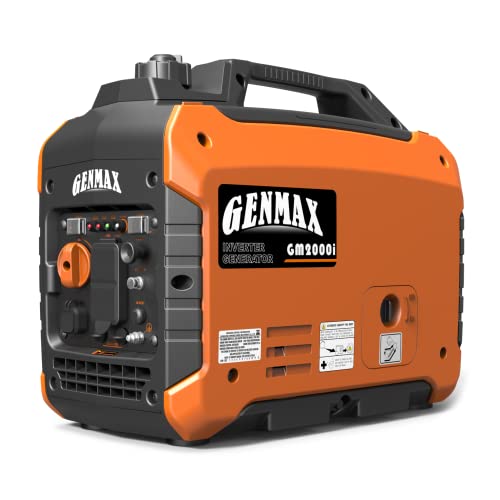
The GENMAX GM2000i is the lightest generator in this group at 34 pounds, with a 79.7cc four-stroke OHV engine, 2,000 starting watts and 1,600 running watts. The listing gives 60 dBA, a claim of 8 hours at 50 percent load on a 1-gallon tank, an Eco mode, CO detect shutdown, low oil and overload alarms, 120V 20A outlets and one 5V 1A port.

It ranks third because it has the lowest running rating of the five, 400 watts below the BILT HARD, while costing $30 more at $329.99. In return it is 5.6 pounds lighter than the All Power and states a lower 60 dBA figure than the All Power's 62.

What works

  • Lightest pick at 34 pounds for easy loading
  • 60 dBA noise figure is published in the listing
  • Claims 8 hours at half load from a 1-gallon tank
  • CO detect shutdown plus low oil and overload alarms

Watch out for

  • Costs $30 more than the BILT HARD for less output
04
Best for: Campers who want propane as a fuel option

Our take

Pick it if you already carry propane for a camp stove or want fuel that stores for years without going stale.

Why it made the shortlist

The K&S KS 2000iHS CO runs on gasoline or propane and ships with the hose and regulator needed for propane. The listing describes pure sine wave 120V 60Hz output, a soundproof housing at 57 dB at 23 feet, an Eco mode said to cut fuel use by up to 50 percent at low loads, and up to 2000 watts of output.

Against the AFOERIT, which also lists 57 dB, it adds propane for $270.

What works

  • Runs on gasoline or propane with kit included
  • 57 dB at 23 feet is among the quietest figures here
  • Eco mode claims up to 50% less fuel at low load
  • Pure sine output suits laptops and medical devices

Watch out for

  • Most expensive here at $569, over $239 above rivals
05
Best for: Quiet-camper shoppers who will confirm specs with the seller

Our take

The strongest case for AFOERIT 2000W Gas Inverter Generator with CO Shutoff and Eco Mode is two-year warranty is stated in the listing.

Why it made the shortlist

The AFOERIT lists a 2000W gas inverter engine with a cast iron cylinder liner, pure sine wave output, 57 dB operation, a built-in CO shutdown, low-oil shutdown, overload protection, EPA approval and a two-year warranty. At $299 it sits just $0.99 below the BILT HARD.

It matches the K&S on the 57 dB claim for $270 less and carries a stated two-year warranty, which none of the other four listings mention.

What works

  • Two-year warranty is stated in the listing
  • 57 dB figure matches the quietest unit here
  • CO shutdown plus low-oil and overload protection
  • EPA approved at $299, under the $330 GENMAX

Watch out for

  • No running-watt, weight or tank size in listing
  • Ranked last because the key spec is not published
The catch
The listing text does not state starting versus running watts, weight, or tank size.

Methodology

How We Built This Shortlist

Each pick was assessed across 5 criteria weighted for real-world use.

01

Rated running watts

We separated continuous running watts from starting watts, since 2000 on the box is usually the surge figure, and ranked units that publish a real continuous number higher.

02

Weight and noise disclosure

We compared published weight and decibel figures and noted when a listing leaves them out, because a generator you cannot lift or camp beside quietly has failed its job.

03

Outlets for RV use

We checked which receptacles are actually on the panel, including 20A duplex outlets, 12V DC and USB, and whether any 30A RV outlet is listed.

04

Safety systems

We looked for CO shutdown, low-oil shutdown and overload protection, which matter most when a generator runs near a camper.

05

Fuel and runtime claims

We recorded tank size and the stated runtime at a stated load, and treated runtime numbers as manufacturer claims rather than measured results.

Decision guide

Match a 2000 Watt RV Generator to Your RV

By What You Need to Run

Your situationRecommended pickWhy
Fridge, lights, laptop and phone chargers togetherBILT HARD 2500Publishes 2,000 running watts, the most headroom
Light loads only, lowest costAll Power 20001,800 running watts at $278.99
You lift it into a truck bed every tripGENMAX GM2000i34 pounds, lightest of the five
You want propane as a backup fuelK&S 2000iHSDual fuel with propane kit included
Quiet camp and a stated warranty matterAFOERIT 200057 dB claim and two-year warranty

By Budget

BudgetRecommended pick
Under $285All Power 2000 at $278.99
$299 to $300AFOERIT 2000 or BILT HARD 2500
Around $330GENMAX GM2000i
Around $570K&S 2000iHS

Gas Only vs Dual Fuel

Gas only

Four of the five run on gasoline alone. The BILT HARD 2500, All Power 2000, GENMAX GM2000i and AFOERIT 2000 cost $279 to $330, start simply and burn stale-prone fuel that needs stabilizer if stored.

Dual fuel

Only the K&S 2000iHS accepts propane, which stores for years and burns cleaner, but it costs $569, about $240 to $270 more than the gas-only picks, and the listing leaves running watts unpublished.

Most buyers should default to a gas-only unit such as the BILT HARD 2500 unless propane storage is a specific need.

By Weight and Noise

What you care aboutRecommended pick
Lowest weight (34 lb)GENMAX GM2000i
Quietest stated figure (57 dB at 23 ft)K&S 2000iHS or AFOERIT 2000
Published weight and noise together, lowest priceAll Power 2000 (39.6 lb, 62 dBA at 25% load)
Weight not published, but most running wattsBILT HARD 2500

For Running an RV Air Conditioner Specifically

Look for

Check the AC data plate for starting amps. A 13,500 BTU unit commonly needs several times its running draw to start, and at 120V a 1,800 watt generator delivers 15 amps. As a rough estimate, that is below what most full-size units need, so a soft start device or a larger generator is usually required.

In this comparison

The BILT HARD 2500 is the only one with a 2,000 running-watt rating, so it is the best chance, and two units in parallel with its separate kit is the realistic route. None of the five lists a 30A RV outlet.

When to Spend More

Spend more if

You want propane (K&S 2000iHS at $569) or the lightest carry (GENMAX GM2000i at $329.99), since those two features are not on the cheapest units.

Save if

Your loads stay under 1,800 watts and you run on gasoline; the All Power 2000 at $278.99 or BILT HARD 2500 at $299.99 covers it.

FAQ

Before You Bring One Home

Can a 2000 watt generator run an RV air conditioner?

Usually not on its own. A 13,500 BTU unit needs a starting surge well above 2,000 watts, and the 1,600 to 1,800 running watts most of these units deliver is below that. Two generators in parallel, or a soft start device, are the usual routes.

What is the difference between 2000 starting watts and 2000 running watts?

Starting watts are a brief peak used when a motor kicks on, while running watts are continuous output. Here only the BILT HARD lists 2,000 running watts; the All Power America lists 1,800 and the GENMAX lists 1,600.

Is a dual fuel generator worth the extra money at this size?

Only if you value propane storage. The K&S 2000iHS costs $569, around $240 more than gas-only rivals, and the listing does not publish a separate running rating on propane.

How do I connect a 2000W generator to a 30 amp RV?

Use a 20A-to-30A RV adapter cord into a 20A outlet, and keep the load under the generator's running rating. Turn off the RV air conditioner and large appliances before connecting, and plug in loads one at a time.

How should I store the generator between trips?

Run the carburetor dry or add fuel stabilizer, change the oil per the manual, and store it dry and level. Propane on the K&S avoids the stale-fuel issue entirely.

Bottom line

The short version

Browse more 2000 watt rv generators on Amazon →
Bowen Higgins, RV Editor at RV Gear Lab

About the author

Bowen Higgins

RV Editor at RV Gear Lab

Bowen covers RV power, water systems, towing and leveling, upkeep and interior comfort, with a focus on matching gear to the rig, the hookups and the way you actually travel.

More from Bowen →Editorial standards

Keep reading

Related guides