


We research everything we recommend. When you buy through our links, we may earn a commission. Learn more

Buying guide · 11 min read · Updated August 19, 2026

8 Best 240v Portable Power Stations in 2026: A Practical RV Guide

We compared 240v portable power stations by measured usable energy, continuous output, and safety documentation rather than ranking by headline wattage alone.

Bowen HigginsBy Bowen HigginsRV Editor at RV Gear Lab8 products comparedSpec-sheet researched

At a glance

Our top picks

Best 240v Portable Power Stations deserves capacity-specific scrutiny before ranking, since this category comes down to requiring native documented 240V output and identifying the exact receptacle topology.

Each pick here was judged on measured usable energy and safety documentation plus requiring native documented 240V output and identifying the exact receptacle topology, not just its price tag.

RV Gear Lab field notes

The Rig Fit Check

Start with the job
AFERIY P280 Portable Power Station, 2800W (Peak 5600W) leads this shortlist for buyers prioritizing 2048wh (expandable to 10.24kwh), 2800w. Use that fit as a reference point, then compare the alternatives against your own space and workload.
Specs that separate the picks
The first details to compare are 2048Wh (expandable to 10.24kWh), 2800W, 2048Wh, 2400W (4800W surge), 48.5 lbs, 3840Wh (expandable to 11.5kWh), 3600W. Confirm the exact model and included components before ordering.
Trade-off to plan for
Genuinely complex dual PV input setup for DIY solar wiring

Before you buy

What Matters Before You Choose a 240v Portable Power Station

Key buying criteria so you get the right fit the first time.

  1. 01

    Require Native Documented 240V Output

    Confirm 240v portable power stations has genuine documented 240V output and identify the exact receptacle and topology used.

  2. 02

    Separate 240V From 120V Ratings

    Verify continuous 240V output and current are published separately from standard 120V outlet ratings.

  3. 03

    Check Single-Unit vs Paired-Unit 240V

    Confirm whether 240V requires one unit, two paired units, or an external hub to achieve.

  4. 04

    Verify Neutral, Ground, and GFCI Compliance

    Check neutral, ground, GFCI, and transfer-panel compatibility directly from the manufacturer manual.

  5. 05

    Test the Target Appliance's Real Surge

    Test the intended 240V appliance's startup surge and confirm required cable or adapter compatibility.

Our standards

Why You Can Trust RV Gear Lab

At RV Gear Lab, we compare products based on rig fit and power or hookup compatibility, verified specifications, usability, setup requirements, weight, durability, and real-world trade-offs. We do not rank products purely on marketing claims or commission rates.

We have not personally tested every product listed. Where hands-on testing is not available, recommendations are based on verified manufacturer specifications, product documentation, use-case fit, and comparative research.

How we review RV gear →

Detailed reviews

The 8 best 240v portable power stations, explained

01
AFERIY P280 Portable Power Station, 2800W (Peak 5600W)
  • 2048Wh (expandable to 10.24kWh), 2800W
  • 38-min 0-80% charge
  • NEMA TT-30 industrial outlet
Check price on Amazon for AFERIY P280 Portable Power Station, 2800W (Peak 5600W) (opens in a new tab)
Best for: Buyers prioritizing 2048wh (expandable to 10.24kwh), 2800w

Our take

A server-level under-10ms UPS response handles power fluxes instantly, and the inverter uses pure sine wave exclusively for both input and output, matching standard wall outlet power quality.

Why it made the shortlist

1800W AC input plus 1200W PV input combine for a genuine 38-minute 0-80% charge, among the fastest documented in this capacity class. The 2048Wh LFP battery expands to 10.24kWh with extra batteries, and dual PV inputs let you add multi-channel DC solar input without extra MPPT management hardware.

A NEMA TT-30 industrial outlet on the 2800W output specifically supports high-wattage appliances, backed by a documented 4000+ cycle, 10-year LFP battery.

What works

  • 38-minute 0-80% charge is among the fastest documented here
  • Dual PV inputs skip extra MPPT management hardware entirely
  • NEMA TT-30 outlet directly supports high-wattage appliances

Watch out for

  • Genuinely complex dual PV input setup for DIY solar wiring
  • 5600W peak is a surge figure, not sustained output
02
AFERIY P210 Solar Generator, 2048Wh Portable Power Station, 2400W
  • 2048Wh, 2400W (4800W surge), 48.5 lbs
  • 16dB at normal load, 30dB at full
  • 7-year extended warranty
Check price on Amazon for AFERIY P210 Solar Generator, 2048Wh Portable Power Station, 2400W (opens in a new tab)
Best for: Buyers prioritizing 2048wh, 2400w (4800w surge), 48.5 lbs

Our take

Sixteen ports support up to 16 simultaneous devices, including six 20Ah AC outlets, dual USB, four USB-C (20W and 100W), dual DC5521, a car port, and an XT60 port.

Why it made the shortlist

A 2400W inverter (4800W surge) exclusively uses pure sine wave for both input and output, delivering power identical to standard wall outlet quality for genuine sensitive-electronics safety. A server-level under-10ms UPS response instantaneously activates battery backup during outages.

Silent operation stays under 30dB at full load and just 16dB at normal load, genuinely quiet enough not to disturb sleep, and the AFERIY app manages energy consumption remotely. A documented 7-year extended warranty, two years longer than standard, backs this at just 48.5 lbs, 20% lighter than typical for this capacity.

What works

  • 7-year warranty is genuinely two years longer than standard coverage
  • 16dB normal-load noise is genuinely quiet for overnight use
  • 48.5 lbs is documented 20% lighter than typical for this capacity

Watch out for

  • MPPT and car charging modules require separate compatible adapters
  • 16 ports adds real setup complexity for casual users
03
AFERIY 3840Wh Portable Power Station, Expandable to 11520Wh
  • 3840Wh (expandable to 11.5kWh), 3600W
  • 1.5hr fastest full charge
  • UL Listed, 7-year support
Check price on Amazon for AFERIY 3840Wh Portable Power Station, Expandable to 11520Wh (opens in a new tab)
Best for: Buyers prioritizing 3840wh (expandable to 11.5kwh), 3600w

Our take

Under-10ms UPS transfer time helps keep computers, security cameras, and medical freezers running through storms, with documented runtime estimates of about 17 hours for common household essentials or 1-2 days for a refrigerator specifically.

Why it made the shortlist

This documents eligibility for the U.S. LiFePO4 cells deliver 3840Wh capacity and 3600W continuous output, expandable from 3.8kWh up to a genuine 11.5kWh with additional battery packs.

Four recharge paths reach as fast as 1.5 hours to full under supported conditions, and fifteen ports plus app control cover AC, USB-A, USB-C, DC5521, XT60, and a 12V car socket, backed by UL Listing and a 7-year support period.

What works

  • Documents eligibility for a real U.S. solar tax credit
  • UL Listing is a genuine independently verified safety standard
  • Documented specific runtime estimates, not vague marketing claims

Watch out for

  • 80.46 lb net weight is genuinely heavy for portable use
  • Tax credit eligibility requires separate confirmation from a professional
04
Jackery HomePower 3600 Plus Portable Power Station, 3600W, 3584Wh
  • 3584Wh (expandable to 21kWh), 3600W
  • Ceramic membrane cells, 302°F tested
  • Wheeled luggage-style design
Check price on Amazon for Jackery HomePower 3600 Plus Portable Power Station, 3600W, 3584Wh (opens in a new tab)
Best for: Buyers prioritizing 3584wh (expandable to 21kwh), 3600w

Our take

Expandable from 3584Wh to 21kWh per unit (43kWh with multiple units), Jackery states this can power a 3-person household for over 2 weeks.

Why it made the shortlist

Dual voltage (120V and 240V in parallel) delivers 3600W output, doubling to 7200W when paired, genuinely enough to run pumps, heaters, and dryers. High-temp resistant ceramic membrane cells tested at 302°F specifically prevent thermal runaway, backed by 6000 rated cycles and a 10-year lifespan claim documented down to -4°F operation.

The plug-and-play design paired with MTS needs no complex installation, and the luggage-style design with wheels and a telescopic handle makes rolling it between rooms genuinely practical despite the scale.

What works

  • Ceramic membrane cells are specifically tested against thermal runaway
  • Expandable to a genuine 21kWh per unit for extended backup
  • Wheeled luggage design makes rolling between rooms practical

Watch out for

  • Full 21kWh expansion requires purchasing additional units
  • Genuinely large footprint even with the lighter, smaller claims
05
BLUETTI Apex 300 Portable Power Station, 2764.8Wh 3840W
  • 2764.8Wh (expandable via B300K/B500K)
  • 120V/240V switchable in one system
  • Modular ecosystem: Hub D1, Charger 1/2, SolarX 4K
Check price on Amazon for BLUETTI Apex 300 Portable Power Station, 2764.8Wh 3840W (opens in a new tab)
Best for: Buyers prioritizing 2764.8wh (expandable via b300k/b500k)

Our take

Adding Hub D1 enables RV 12V DC loads, Charger 1/2 enables fast alternator charging while driving, and SolarX 4K adds high solar input, a genuinely modular ecosystem most competitors don't offer.

Why it made the shortlist

This starts at 2765Wh and expands with B300K or B500K batteries as needs grow, genuinely letting you avoid paying for capacity you don't need on day one.

Zero-millisecond UPS keeps essentials running during outages, with app alerts helping you prepare before storms hit, and EV-grade LiFePO4 battery technology backs long-term daily reliability.

What works

  • Modular expansion ecosystem is genuinely more flexible than fixed-capacity rivals
  • 120V/240V switching in one system covers more real-life scenarios
  • Zero-millisecond UPS is documented as instantaneous switching

Watch out for

  • Full ecosystem (Hub, Chargers, SolarX) requires separate purchases
  • Starting capacity may need immediate expansion for heavier use
The catch
Switching between 120V and 240V through the app or onboard controls covers both everyday appliances and heavier home or RV loads in one system.
06
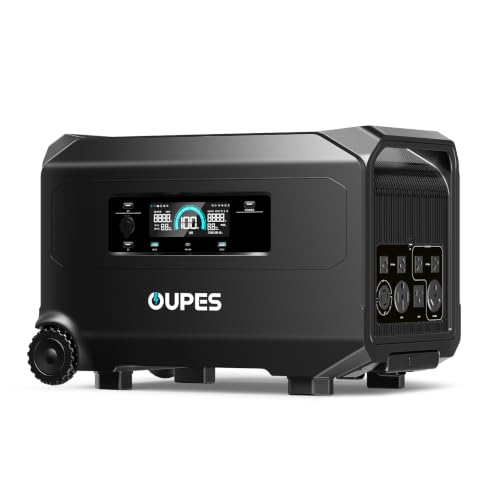
OUPES Guardian 6000 V2 Portable Power Station, 4608Wh, 6000W
  • 4608Wh (expandable to 41,472Wh), 6000W
  • 64-min full recharge, 5x faster claim
  • Direct transfer switch integration
Check price on Amazon for OUPES Guardian 6000 V2 Portable Power Station, 4608Wh, 6000W (opens in a new tab)
Best for: Buyers prioritizing 4608wh (expandable to 41,472wh), 6000w

Our take

Combined 240V AC and solar input reaches a full recharge from empty in just 64 minutes, documented 5x faster than comparable stations.

Why it made the shortlist

Dual 120V/240V voltage capability delivers a genuine 6000W continuous output (7200W boost, 9000W surge), running everything from sensitive electronics to heavy-duty tools. Direct connection to standard transfer switches or inlet boxes turns this into whole-house backup in seconds, no electrician required.

Expandable from 4608Wh to 41,472Wh with optional battery packs, and 3600W solar input capacity across a wide 12-175V range genuinely suits remote cabins and mobile living. Note that pass-through charging behavior differs by input type per the listing.

What works

  • Connects directly to transfer switches for instant whole-house backup
  • 64-minute full recharge is genuinely fast at this massive capacity
  • Expandable to a genuine 41,472Wh for extreme off-grid needs

Watch out for

  • Pass-through output availability varies by charging input type
  • Extremely large scale requires serious space and budget commitment
07
PECRON Two E3600LFP Power Stations with 240V Double Voltage Hub
  • 3072Wh x2 units, 240V hub included
  • 1.3hr full charge at 3200W AC
  • Expandable to 15,360Wh
Check price on Amazon for PECRON Two E3600LFP Power Stations with 240V Double Voltage Hub (opens in a new tab)
Best for: Buyers prioritizing 3072wh x2 units, 240v hub included

Our take

Fast charging reaches full in 1.3 hours with 3200W AC input, or 1.5 hours using eight 300W solar panels combined, genuinely quick even for this dual-unit scale.

Why it made the shortlist

Expansion to a documented 15,360Wh maximum is possible with EP3000-48V battery packs.

Sixteen output options per unit (doubled with two units) cover AC, TT30-R, USB-A, USB-C, XT60-F, cigar port, and DC5525 outputs, and the bundle ships with two full sets of cables, screwdrivers, and accessory pouches, backed by the standard 2+3 year PECRON warranty.

What works

  • Genuine true 240V output achieved by pairing two real units
  • 1.3-hour full charge stays fast even at this dual-unit scale
  • Bundle includes two complete cable and accessory sets

Watch out for

  • Two-unit bundle is genuinely large, heavy, and expensive
  • Full 15,360Wh expansion requires yet more separate battery packs
08
PECRON E3800LFP Portable Power Station, 3840Wh, 120/240V 4200W
  • 3840Wh (expandable to 53.76kWh), 4200W
  • 1.4hr full charge at 3200W AC
  • 14 ports, LCD touchscreen + app control
Check price on Amazon for PECRON E3800LFP Portable Power Station, 3840Wh, 120/240V 4200W (opens in a new tab)
Best for: Buyers prioritizing 3840wh (expandable to 53.76kwh), 4200w

Our take

Fourteen output ports include four 4200W AC outlets plus a TT30-R RV-ready outlet delivering genuine 100V-120V pure sine wave power.

Why it made the shortlist

3500+ cycle UL-certified automotive-grade LiFePO4 cells retain 80% capacity after full discharge-charge cycles, genuinely durable for 10 years of home backup, camping, or RV off-grid living. A massive 3840Wh capacity, expandable to a documented 53.76kWh maximum, supports high-power devices up to 4200W AC.

Multi-way fast charging spans AC (0-100% in 1.4 hours at 3200W), solar (up to 3000W input), and car charging, with 8-20ms UPS instant protection for computers and telecom equipment, plus LCD touchscreen and WiFi/Bluetooth app control for remote monitoring.

What works

  • Expandable to a genuinely enormous 53.76kWh maximum capacity
  • 1.4-hour full charge at 3200W is fast for this massive scale
  • LCD touchscreen plus app control gives dual monitoring options

Watch out for

  • Full 53.76kWh expansion requires a serious multi-unit investment
  • 3840Wh base unit alone is genuinely large and heavy

Methodology

How We Built This Shortlist

Each pick was assessed across 5 criteria weighted for real-world use.

01

Rated Wh Verified Against Usable Energy

Checked documented battery capacity separately from continuous AC output, since a high wattage rating doesn't guarantee enough stored energy to run a device for long.

02

Continuous Output vs Surge Separated

Compared continuous inverter rating against surge or boost mode claims, since many listings blend the two into one headline number.

03

Charging Speed and Path Documented

Verified AC, solar, and car charging times from official specs, noting where fastest speeds require specific modes, apps, or additional hardware.

04

Safety and Certification Evidence Checked

Looked for UL, UL2743, or other documented safety certification and battery chemistry evidence rather than trusting a safety claim alone.

05

Real Ownership Costs Included

Weighed included cables, solar panel bundling, warranty length, and app requirements as part of the real cost and usability of each pick.

Decision guide

Match a 240v Portable Power Station to Your RV

Require Native Documented 240V Output

Confirm 240v portable power stations has genuine documented 240V output and identify the exact receptacle and topology used.

Separate 240V From 120V Ratings

Verify continuous 240V output and current are published separately from standard 120V outlet ratings.

Check Single-Unit vs Paired-Unit 240V

Confirm whether 240V requires one unit, two paired units, or an external hub to achieve.

Verify Neutral, Ground, and GFCI Compliance

Check neutral, ground, GFCI, and transfer-panel compatibility directly from the manufacturer manual.

Test the Target Appliance's Real Surge

Test the intended 240V appliance's startup surge and confirm required cable or adapter compatibility.

FAQ

Before You Bring One Home

What's the biggest mistake buyers make shopping for 240v portable power stations?

Trusting a single headline wattage or watt-hour number without checking whether it describes continuous output, surge capability, or rated versus usable energy.

Should I prioritize price or documented safety certification for 240v portable power stations?

Safety documentation first, since an uncertified battery pack carries real risk regardless of price. Narrow the field by verified chemistry and certification, then compare price among finalists.

What's the real difference between watts and watt-hours for a power station?

Watts (W) measure how much power the station can deliver at once, essentially how many devices it can run simultaneously, while watt-hours (Wh) measure total stored energy, essentially how long it can run those devices. A station with high W but low Wh can power a lot at once but only briefly.

Is LiFePO4 battery chemistry actually safer than standard lithium-ion?

LiFePO4 (LFP) cells are generally considered more thermally stable than standard lithium-ion or lithium-polymer cells, with a lower risk of thermal runaway, and most current portable power stations have shifted to LFP for this reason. Still, verify UL or UL2743 safety certification directly rather than assuming chemistry alone guarantees safety.

Can I use any solar panel with a portable power station?

Not always. Some manufacturers restrict compatibility to their own branded panels or require a specific voltage and connector type, so check the station's documented solar input specs and connector type before assuming a third-party panel will work.

Bottom line

The short version

Browse more 240v portable power stations on Amazon →
Bowen Higgins, RV Editor at RV Gear Lab

About the author

Bowen Higgins

RV Editor at RV Gear Lab

Bowen covers RV power, water systems, towing and leveling, upkeep and interior comfort, with a focus on matching gear to the rig, the hookups and the way you actually travel.

More from Bowen →Editorial standards

Keep reading

Related guides