

We research everything we recommend. When you buy through our links, we may earn a commission. Learn more

Buying guide · 10 min read · Updated October 1, 2026

6 Best 300Ah Lithium RV Batteries in 2026: A Practical RV Guide

Our picks for 300Ah and 314Ah LiFePO4 RV batteries, compared on BMS current, size, weight, cold-charge cutoff, and warranty, so one battery can replace three.

Bowen HigginsBy Bowen HigginsRV Editor at RV Gear Lab6 products comparedSpec-sheet researched

At a glance

Our top picks

A single 300Ah LiFePO4 battery stores roughly 3,840Wh, about what three 100Ah lithium batteries or six lead-acid group 27s would give you in usable energy, and it does it in one box with one set of cables.

Every pick here sits between 300Ah and 314Ah with a 200A BMS, so the ranking comes down to the details that actually differ: physical size, weight, the exact temperature where charging stops, monitoring, and how long the seller stands behind it.

RV Gear Lab field notes

The Rig Fit Check

Start with the job
ECO-WORTHY 12V 314Ah LiFePO4 Battery with Bluetooth and LED leads this shortlist for owners who want to check charge at a glance in the bay. Use that fit as a reference point, then compare the alternatives against your own space and workload.
Specs that separate the picks
The first details to compare are 314Ah, 4019Wh, 314Ah, 4.01kWh, 58.78 lbs, 300Ah, 3840Wh. Confirm the exact model and included components before ordering.
Trade-off to plan for
Charge cutoff at 19.4F is lower than ideal

Before you buy

What Matters Before You Choose a 300Ah Lithium RV Battery

Key buying criteria so you get the right fit the first time.

  1. 01

    Confirm True 300Ah Capacity

    Ah rating times 12.8V gives watt-hours, and a genuine 300Ah battery should list about 3,840Wh. Some listings round up or show pack options that are not the battery you receive. Check that the Ah, Wh, and weight are consistent; a 300Ah LiFePO4 battery usually weighs 54 to 61 lbs.

  2. 02

    Check Exact Charge Cutoff Temperature

    LiFePO4 should not charge below about 32F, or lithium plating permanently costs capacity. Some batteries stop charging at 32F while others only at 19F or never say. Look for a specific number tied to charging, not a discharge limit like -4F.

  3. 03

    Fit the Larger Case

    A 300Ah battery is around 15 to 16.3 inches long, much larger than a Group 31 tray. If it does not fit, you will need a new bracket or a different bay. Measure length, width, and height including terminals and compare to the listing dimensions.

  4. 04

    Size Cables and Fusing for 200A

    A 200A BMS can push enough current to overheat thin RV factory cables. Undersized wiring is one of the most common upgrade mistakes. Use 2/0 AWG for short runs at 200A and add a class T fuse near the battery positive.

  5. 05

    Upgrade the Charger Too

    A 300Ah battery charged by a 35A lead-acid converter can take nine or more hours to fill and may never reach full. A lithium-capable converter of 55A or more matches this size well. Check the battery's recommended charge voltage, usually 14.4 to 14.6V.

  6. 06

    Read the Warranty Term

    Stated warranties in this class range from one to five years. A longer warranty on a $400 to $500 battery matters more than on a cheap one. Look for the term in the listing bullets and keep your order record.

Our standards

Why You Can Trust RV Gear Lab

At RV Gear Lab, we compare products based on rig fit and power or hookup compatibility, verified specifications, usability, setup requirements, weight, durability, and real-world trade-offs. We do not rank products purely on marketing claims or commission rates.

We have not personally tested every product listed. Where hands-on testing is not available, recommendations are based on verified manufacturer specifications, product documentation, use-case fit, and comparative research.

How we review RV gear →

Detailed reviews

The 6 best 300ah lithium rv batteries, explained

01
Best for: Owners who want to check charge at a glance in the bay

Our take

It suits fifth wheels and Class A coaches with a roomy battery bay.

Why it made the shortlist

The ECO-WORTHY 314Ah tops this list because it gives you the most information with the least effort. A built-in LED screen shows state of charge right on the case, a buzzer sounds on faults, and the app adds remote detail, all on top of 4,019Wh of storage from a 200A BMS.

ECO-WORTHY's low-temperature cutoff sits at 19.4F, which is below the 32F point usually recommended for LiFePO4, so it ranks first on usability rather than cold-weather caution.

In freezing climates, keep the battery inside heated space or pick a heated model.

What works

  • Onboard screen shows charge without opening an app
  • Fault buzzer flags problems right away
  • Upgraded from 300Ah to 314Ah at same size
  • Expands to 32kWh for future solar growth

Watch out for

  • Charge cutoff at 19.4F is lower than ideal
  • Largest case here at 16.3 inches long
  • 60.4 lbs needs two people to lift
The catch
The SUPER EMPOWER 314Ah below matches its capacity in a slightly smaller, lighter body and cuts charging at a safer 32F, but lacks the onboard display.
02
Best for: Cold-region owners wanting 314Ah with safe charge limits

Our take

This is the pick if you camp in shoulder seasons and want the BMS to protect you.

Why it made the shortlist

The SUPER EMPOWER 314Ah is the most cautious design here.

Against its 300Ah sibling below, you pay about $30 more for 14 extra amp-hours.

Just note the app connects within about 5 meters, so plan to check it nearby.

What works

  • Pauses charging below 32F, the safe threshold
  • 5-year warranty with stated charger settings
  • Smaller and lighter than the ECO-WORTHY
  • Clear CC/CV charging guidance on listing

Watch out for

  • No on-case display, app only
  • Bluetooth range is about 5 meters
The catch
It matches the ECO-WORTHY above on capacity while being smaller (15.11 x 7.62 x 9.82 inches) and slightly lighter, but you only see charge through the app.
03
Best for: Van builds where every pound counts

Our take

Choose it for camper vans and truck campers where payload is tight.

Why it made the shortlist

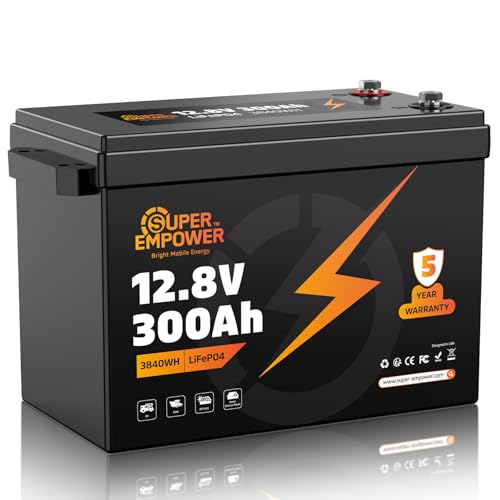
The TEMGO 300Ah stands out for weight. At 54.67 lbs it is the lightest 300Ah battery in this roundup, and it can be expanded up to 10 in parallel, which is more flexible than the 4P limit common elsewhere.

The SUPER EMPOWER 300Ah below costs about the same and offers five years.

What works

  • Lightest 300Ah battery in this roundup
  • Supports up to 10 batteries in parallel
  • Mounts in any position
  • Bluetooth app monitoring included

Watch out for

  • Only a one-year service life promise stated
  • Exact cold cutoff temperature not given
04
Best for: Buyers who want long warranty coverage without paying for 314Ah

Our take

Pick it if you want peace of mind over a five-year horizon.

Why it made the shortlist

This SUPER EMPOWER 300Ah is the sibling of the runner-up, with the same 32F charge pause and 5-year warranty in a 300Ah format. It measures 15.35 x 7.59 x 9.84 inches and weighs 58.4 lbs.

In return you get a much longer stated warranty and better-documented cold protection. Compared with the MEYULMOL below, it costs about $60 more for the warranty and clearer specs.

What works

  • Charging pauses below 32F
  • Listing reminds you to measure your compartment

Watch out for

  • Heavier than the TEMGO at similar capacity
  • App monitoring only, no display
05
Best for: Owners adding a separate shunt monitor anyway

Our take

It suits owners who already run a shunt-based monitor like a Victron or Renogy unit.

Why it made the shortlist

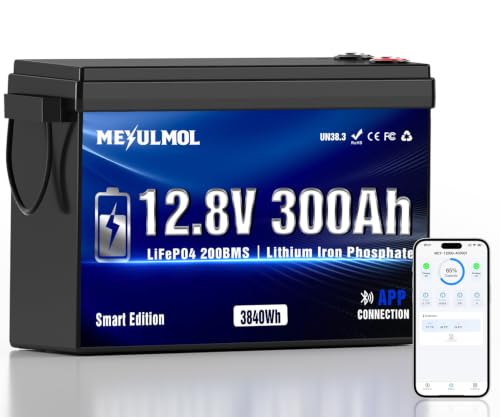
The MEYULMOL 300Ah gives you a 200A BMS and a clearly stated 32F charging cutoff for well under $400. That combination covers the two things that matter most in a big house battery: enough current for an inverter and protection from cold charging.

Its cycle-life claims are inconsistent across bullets, so plan around the lower figure.

What works

  • Precise 32F low-temperature charge cutoff
  • 200A BMS for a 2000W class inverter

Watch out for

  • No Bluetooth monitoring
  • Listing cycle claims vary from 4,000 to 15,000
The catch
It lacks the Bluetooth app found on every pick above it, so you rely on a separate battery monitor or your solar controller to see state of charge.
06
Best for: Warm-climate owners on the tightest budget

Our take

It is a reasonable buy for Southwest snowbirds who rarely see freezing temperatures.

Why it made the shortlist

The NebuQuic 300Ah is the lowest cost per amp-hour here. It supports 200A for both charging and discharging, which helps with large solar arrays or a big alternator charger, and it lists cycle life honestly at several depths (4,000 at 100 percent, 6,000 at 80 percent).

It trails the MEYULMOL because its low-temperature protection is described at -4F, a discharge figure, with no clear charging cutoff at 32F.

In cold climates, a model with a stated 32F charge cutoff is the safer choice.

What works

  • Cheapest 300Ah battery in this roundup
  • Lists cycles at three depths of discharge

Watch out for

  • Low-temp protection mentioned at -4F only
  • No Bluetooth or display
  • Brand has a short track record

Methodology

How We Built This Shortlist

Each pick was assessed across 5 criteria weighted for real-world use.

01

Verified 300Ah Class Capacity

We only included batteries listed between 300Ah and 314Ah and checked that Wh figures matched 12.8V times Ah.

02

Cold-Charge Threshold

We compared the exact temperature at which each BMS stops charging, favoring 32F over lower or unstated values.

03

Size and Weight

We compared dimensions and weight, since a 300Ah battery is roughly 15 to 16 inches long and around 55 to 60 lbs.

04

Monitoring Options

We credited onboard displays and Bluetooth apps because flat LiFePO4 voltage makes charge hard to read otherwise.

05

Warranty and Support

We weighed stated warranty length, which ranged from one to five years across this class.

Decision guide

Match a 300Ah Lithium RV Battery to Your RV

By Climate

Where you campPickReason
Freezing nights commonSUPER EMPOWER 12V 314AhCharge pause below 32F, resume above 41F
Occasional frostSUPER EMPOWER 12V 300AhSame 32F pause, lower price
Mild winters, budgetMEYULMOL 12V 300Ah32F cutoff, no app
Warm year roundNebuQuic 12V 300AhLowest price, cold rules matter less
Heated basement bayECO-WORTHY 12V 314AhBest monitoring, cold handled by the bay

By Budget

BudgetPick
Around $320NebuQuic 12V 300Ah
$350 to $400MEYULMOL 12V 300Ah
$400 to $460SUPER EMPOWER 12V 300Ah or TEMGO 12V 300Ah
$460 to $500SUPER EMPOWER 12V 314Ah
Around $500ECO-WORTHY 12V 314Ah

One 300Ah vs Three 100Ah Batteries

One 300Ah battery

One case, one BMS, and fewer connections. Every pick here, including the ECO-WORTHY 12V 314Ah and MEYULMOL 12V 300Ah, takes this route with a 200A BMS.

Three 100Ah batteries

Three smaller units fit separate trays and add their BMS currents to 300A, but need equal-length cables and more space overall.

If your bay can fit a 15 to 16 inch battery, a single 300Ah unit is simpler; go with three 100Ah batteries only if you need more than 200A of continuous current.

By Monitoring Preference

You wantPick
Charge level visible on the caseECO-WORTHY 12V 314Ah
Phone app with long warrantySUPER EMPOWER 12V 314Ah
App on the lightest batteryTEMGO 12V 300Ah
No app, using your own shuntMEYULMOL 12V 300Ah

For a 2000W Inverter Setup Specifically

Look for

A 200A continuous BMS, 2/0 AWG cables, a class T fuse near the battery, and enough capacity to run the inverter for several hours.

In this comparison

The SUPER EMPOWER 12V 314Ah pairs a 200A BMS with 4kWh and a cautious charge window, so a 2000W inverter can run high loads for well over an hour.

When to Spend More

Spend more if

You winter camp or want to read charge at a glance. The SUPER EMPOWER 12V 314Ah and ECO-WORTHY 12V 314Ah justify their prices with better cold limits and monitoring.

Save if

You already own a shunt monitor and camp in mild weather. The MEYULMOL 12V 300Ah or NebuQuic 12V 300Ah delivers the same 200A BMS for much less.

FAQ

Before You Bring One Home

Will a 300Ah lithium battery fit in my RV battery box?

Usually not in a Group 24 or 31 tray. Most 300Ah batteries are 15 to 16.3 inches long, so measure your bay and check terminal height before buying.

What is the biggest mistake when installing a 300Ah battery?

Reusing thin factory cables. A 200A BMS can push current that overheats small wire, so upgrade to properly sized cable and add a fuse near the battery.

Is a 314Ah battery worth it over a 300Ah?

Only if the price difference is small. The extra 14Ah adds about 180Wh, roughly 5 percent more runtime, so the warranty and cold protection often matter more.

How do I charge a 300Ah battery from my RV converter?

Set or replace the converter with a lithium profile of 14.4 to 14.6V. A 55A or larger lithium converter will refill a 300Ah battery in a practical time from shore power.

How should I store a 300Ah battery for winter?

Disconnect it, store it around 50 to 60 percent charged, and keep it above freezing if you plan to charge it. LiFePO4 self-discharges slowly, so a check every few months is enough.

Can I parallel two 300Ah batteries?

Yes, most here support 4P, but use the same brand and model and charge both fully before connecting so they start balanced.

Bottom line

The short version

Browse more 300ah lithium rv batteries on Amazon →
Bowen Higgins, RV Editor at RV Gear Lab

About the author

Bowen Higgins

RV Editor at RV Gear Lab

Bowen covers RV power, water systems, towing and leveling, upkeep and interior comfort, with a focus on matching gear to the rig, the hookups and the way you actually travel.

More from Bowen →Editorial standards

Keep reading

Related guides