

We research everything we recommend. When you buy through our links, we may earn a commission. Learn more

Buying guide · 10 min read · Updated October 2, 2026

6 Best 50 Amp RV Surge Protectors in 2026: A Practical RV Guide

Six plug-in 50 amp RV surge protectors ranked by what each adds per dollar, from a plain $47.99 analyzer to relay models with displays, from $44.99 to $109.99.

Bowen HigginsBy Bowen HigginsRV Editor at RV Gear Lab6 products comparedSpec-sheet researched

At a glance

Our top picks

At 50 amps the plug-in surge protector market splits into a price ladder, and the rungs are easy to climb without knowing what you are paying for. The cheapest units are a wiring analyzer with a surge component, the middle units add a relay that disconnects the coach at bad voltage, and the top rungs add displays, wattage readouts or brand name. Joule numbers jump around in all three tiers and do not follow price.

We compared six plug-in 50 amp units from $44.99 to $109.99 as a value ladder: what does each rung add, what does the listing actually state, and where does paying more stop buying anything. Smart and app-driven EMS-style models and the classic hardwired motorhome picks are covered in sibling guides, so this one stays with straightforward plug-in protectors a first-time 50 amp owner can compare quickly.

RV Gear Lab field notes

The Rig Fit Check

Start with the job
AMEHO 50 Amp RV Surge Protector, 19000J, Smart Auto Shutoff, 6-in-1 LED Screen, IP67 leads this shortlist for first-time 50 amp owners wanting a clear display. Use that fit as a reference point, then compare the alternatives against your own space and workload.
Specs that separate the picks
The first details to compare are 19,000J, 104 to 132V window, 20,000J, relay 104 to 132V, 26,000J, ETL and FCC. Confirm the exact model and included components before ordering.
Trade-off to plan for
Warranty length is not stated

Before you buy

What Matters Before You Choose a 50 Amp RV Surge Protector

Key buying criteria so you get the right fit the first time.

  1. 01

    Relay versus plain analyzer

    A relay physically opens the circuit when voltage drops or rises outside a safe range, while a plain analyzer only absorbs spikes and lights a chart. Brownouts, not lightning, are the common cause of air conditioner damage at crowded parks. Read the listing for words like auto shutoff or disconnect and prefer a stated window.

  2. 02

    Both legs of the service

    A 50 amp service has two hot legs, L1 and L2, and a fault on one leg can run half your coach wrong while the other half looks fine. A display showing each leg or lights for missing L1 and L2 reveals this. Check that the listing names per-leg faults or shows two voltages.

  3. 03

    Reset behavior after a trip

    Automatic reconnect restores power when voltage returns, which keeps food cold but restarts compressors immediately. Manual reset waits for you, which is safer for the compressor but leaves the coach off while you are away. Check the reset wording and decide which suits how often you leave the rig.

  4. 04

    Real wattage rating

    A full 50 amp RV service carries about 12,000 watts across two 120 volt legs. A listing that gives 6,250 watts is quoting one 125 volt leg, which is easy to misread as lower capacity. Check that the unit is described as 50A for 120/240V service and that its plug matches the pedestal.

  5. 05

    Theft provision

    A plug-in protector at a pedestal is visible and portable, so it is a common loss. A built-in ring for a chain or cable lock secures it in seconds. Check the listing for an anti-theft ring, and if none is listed, budget about ten dollars for a cable lock.

  6. 06

    Joule claims and certification

    Joule claims here range from 4,200 to 30,000 and each seller uses its own method, so they are not comparable. Certification marks like UL and ETL address electrical safety, while FCC addresses radio interference. Use named certifications over bare joule counts when choosing.

Our standards

Why You Can Trust RV Gear Lab

At RV Gear Lab, we compare products based on rig fit and power or hookup compatibility, verified specifications, usability, setup requirements, weight, durability, and real-world trade-offs. We do not rank products purely on marketing claims or commission rates.

We have not personally tested every product listed. Where hands-on testing is not available, recommendations are based on verified manufacturer specifications, product documentation, use-case fit, and comparative research.

How we review RV gear →

Detailed reviews

The 6 best 50 amp rv surge protectors, explained

01
Best for: First-time 50 amp owners wanting a clear display

Our take

Pick this if you want a relay with a stated window and a screen that shows each leg and kWh.

Why it made the shortlist

The AMEHO 50 amp unit is rated at 19,000 joules, with a large LED screen showing six readings: wattage, kWh, and the voltage and amperage of both power lines. Its listing states that it cuts power on over-voltage, under-voltage or over-temperature and reconnects when voltage returns to 104 to 132 volts. It carries an IP67 cover, a fireproof ABS housing, and FCC, RoHS and UL cord testing.

It ranks first because it states its cutoff window, shows both legs separately and prints the fault guide on the unit, at $79.99.

What works

  • Stated reconnect window of 104 to 132 volts
  • Screen shows wattage, kWh and both line voltages
  • Fault guide is printed directly on the unit
  • Fireproof ABS housing with IP67 cover

Watch out for

  • Warranty length is not stated
  • Costs $35.00 more than the cheapest relay unit
02
Kohree 50 Amp RV Surge Protector, 20000J, Voltage Protection, IP67
  • 20,000J, relay 104 to 132V
  • Voltage and current display
  • IP67, two design patents
Check price on Amazon for Kohree 50 Amp RV Surge Protector, 20000J, Voltage Protection, IP67 (opens in a new tab)
Best for: Owners who want the relay behavior explained

Our take

Choose it if you want a manufacturer that explains how the relay works and a patent-protected design.

Why it made the shortlist

The Kohree 50 amp unit is rated at 20,000 joules and its listing explains its operating principle: a relay trips when input voltage rises above 132 volts or falls below 104 volts, and reconnects automatically when voltage normalizes. It adds a large LED screen showing voltage and current, an IP67 cover, flame-retardant housing, pure copper contacts, a right-angle plug and two U.S. design patents.

It costs $41.00 more than the 26000J manual-reset unit, and $24.00 below the Carmtek. The listing includes a useful caution: if voltage sits near 105 volts, adding load can push it past the threshold and trip the unit.

What works

  • Listing explains relay trip points and auto reconnect
  • Pure copper contacts and a right-angle plug
  • Display shows both voltage and current status
  • Warns that load near 105V can trigger a trip

Watch out for

  • Display shows fewer readings than the AMEHO
  • No warranty length appears in the listing
03
Best for: Budget buyers who want a relay and a lock ring

Our take

Pick this if you want a relay and a theft ring at the lowest price and are happy to reset it by hand.

Why it made the shortlist

This $44.99 50 amp unit is rated at 26,000 joules, with an LED display for voltage, current and power, indicator lights for wiring faults, an oversized waterproof cover, an anti-theft ring and ETL and FCC certification.

Compared with the GEARGO 13000J, it costs $5.00 less and adds a relay and a lock ring.

What works

  • Anti-theft ring is included for pedestal locking
  • ETL and FCC certification are both listed
  • Shuts off on low voltage and over-temperature

Watch out for

  • Manual reset leaves the coach off until you return
  • No voltage window is stated in the listing
04
Best for: Budget buyers who only need surge and wiring checks

Our take

Choose it if you want plain surge and wiring protection with a warranty at a low price.

Why it made the shortlist

Its listing gives ratings of 50A, 125V and 6,250 watts and an operating range of minus 35 to plus 110 degrees Celsius. It costs $47.99.

Note that its 6,250 watt figure is one 125 volt leg; a full 50 amp service carries two legs.

What works

  • Lights name missing L1 and missing L2 faults
  • Comes with a three-year warranty at only $47.99
  • Listing describes a triple-layer protection design inside

Watch out for

  • No cutoff relay, display or lock ring
  • Listing rates 6,250 watts, one leg of the service
The catch
It is $3.00 above the 26000J Manual Reset, which adds shutoff and a ring, and $2.00 below the GEARGO 13000J, which lists fewer joules and fewer fault states.
05
Best for: Buyers who want a plain unit from a known brand

Our take

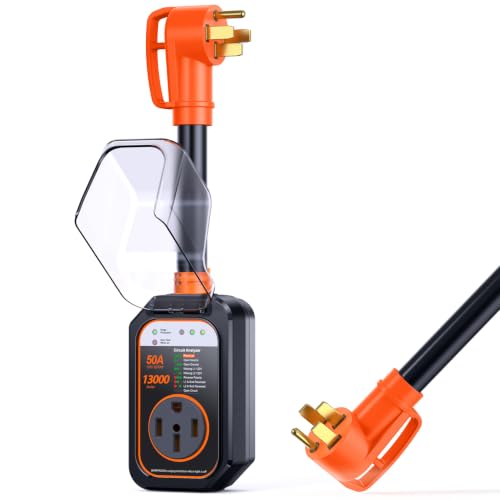
GEARGO 50 Amp RV Surge Protector Waterproof, 13000J, Circuit Analyzer, IP68 makes the shortlist because three-year warranty is stated in the listing.

Why it made the shortlist

The GEARGO 50 amp is a plain plug-in protector rated at 13,000 joules with a circuit analyzer chart listing correct wiring, open ground, open neutral, reverse polarity, hot and ground reversed and no power. The listing mentions FCC testing, V-1 flame-retardant materials, an IP68 design with a protective cover, a right-angle plug with grip handles and a three-year warranty. It costs $49.99.

It ranks fifth at $49.99, $2.00 above the RVRVHOMM that lists more joules and more fault states, and $5.00 above the 26000J Manual Reset that adds a relay and ring. It is $36.00 below the Kohree.

What works

  • Three-year warranty is stated in the listing
  • V-1 flame-retardant material and IP68 cover
  • Right-angle plug with ergonomic grip handles
  • Fault chart names six wiring conditions

Watch out for

  • No relay, display or lock ring is listed
  • Fault chart lacks the per-leg missing L1 or L2 states
06
Best for: Buyers who prioritize a UL test and fault detail

Our take

Choose it if the UL test and the long fault chart matter most and you do not need a relay.

Why it made the shortlist

The Carmtek 50 amp unit absorbs spikes up to 4,200 joules, rated 50A at 125/250 volts and 50/60 Hz, with an operating range of minus 35 to plus 110 degrees Celsius. Its circuit analyzer chart lists ten conditions including L1 open, L2 open and L1 or L2 reversed with neutral or ground, and the listing says it is UL tested, built from flame-retardant material, weather resistant and thermally protected.

It ranks last at $109.99 because it is the second most expensive pick and has the lowest joule rating. It costs $24.00 more than the Kohree and $30.00 more than the AMEHO, both of which list relays and 19,000 to 20,000 joules. Its strongest point is the detailed ten-state fault chart, which is longer than the RVRVHOMM's nine, and a named UL test.

What works

  • Ten fault states include per-leg L1 and L2
  • UL tested and flame-retardant material is stated
  • Thermal protection is named in the listing

Watch out for

  • No display or automatic cutoff is described

Methodology

How We Built This Shortlist

Each pick was assessed across 5 criteria weighted for real-world use.

01

What each price rung adds

We sorted the six units into plain analyzers, relay units and display units, and checked what the listing says each step up actually gives you.

02

Stated cutoff window and reset type

We looked for named voltage limits and whether the unit restores automatically, waits for a manual reset, or has no cutoff at all.

03

Fault detection on a 50 amp pedestal

We counted the faults each listing names and noted which ones cover each 120 volt leg, such as missing L1 or L2.

04

Display and theft features

We compared screens, readings shown, and whether a lock ring is included, since plug-in units sit in plain sight at the pedestal.

05

Certification and joule claims

We recorded named marks such as UL, ETL and FCC and treated joule claims as seller figures, since they range from 4,200 to 30,000 here.

Decision guide

Match a 50 Amp RV Surge Protector to Your RV

By What You Want Per Dollar

Your situationRecommended pickWhy
Want a stated window and a full readoutAMEHO 19000JReconnect window stated and six readings on screen
Want the relay logic explained clearlyKohree 20000JListing explains trip and reconnect points
Cheapest unit that still shuts off26000J Manual ResetRelay plus lock ring for $44.99
Plain protection with a warrantyRVRVHOMM 30000JNine fault states and three years for $47.99
Plain unit from a familiar brandGEARGO 13000JSix-state chart and three-year warranty at $49.99

By Budget

BudgetRecommended pick
$44 to $5026000J Manual Reset ($44.99), RVRVHOMM 30000J ($47.99) or GEARGO 13000J ($49.99)
$79 to $86AMEHO 19000J ($79.99) or Kohree 20000J ($85.99)
Around $110Carmtek 4200J ($109.99)

Relay vs Plain Analyzer

Relay unit

The protector opens its contacts when voltage leaves a safe range, which protects compressors in a brownout. The AMEHO 19000J, Kohree 20000J and 26000J Manual Reset describe a relay or shutoff.

Plain analyzer

The protector absorbs spikes and lights a fault chart but keeps passing sagging power. The RVRVHOMM 30000J, GEARGO 13000J and Carmtek 4200J work this way.

If you run air conditioners on 50 amp service, default to a relay unit; only choose a plain analyzer at parks with proven steady power.

By Reset Preference

How you want it to recoverRecommended pick
Automatic reconnect inside a stated windowAMEHO 19000J or Kohree 20000J
Stay off until I reset it26000J Manual Reset
No shutoff at all, just fault lightsRVRVHOMM 30000J or GEARGO 13000J
Per-leg fault lights with thermal protectionCarmtek 4200J

For a First 50 Amp Rig Specifically

Look for

A stated voltage window, a display that shows both legs, a lock provision and a named certification. A first-time owner also benefits from a printed fault guide on the unit so a trip can be diagnosed at the pedestal without a manual.

In this comparison

The AMEHO 19000J prints its fault guide on the unit and shows both legs, the Kohree 20000J explains its relay, and the 26000J Manual Reset adds an anti-theft ring for $44.99.

When to Spend More

Spend more if

You run two air conditioners and want a stated window and readouts; the AMEHO 19000J costs $35.00 more than the 26000J Manual Reset and documents far more. The Kohree 20000J adds an explained relay.

Save if

You camp at known parks and want protection against wiring faults and spikes only; the RVRVHOMM 30000J at $47.99 or the GEARGO 13000J at $49.99 covers that.

FAQ

Before You Bring One Home

Can I use a 50 amp protector on a 30 amp pedestal?

Only through the proper adapter, and the unit then limits you to 30 amps of power. Putting the protector at the pedestal side is best. See our 30 amp guides for protectors made for that plug.

What is the biggest mistake with 50 amp protectors?

Buying on joules alone. A 30,000 joule plain analyzer will not disconnect your coach in a brownout, but a relay unit at 19,000 joules will. Look for a stated shutoff window first.

Is the AMEHO worth $35.00 over the cheapest relay unit?

It adds a stated window, a six-reading screen showing both legs and kWh, and UL cord testing. If you mostly watch the display yourself and want those details, yes. If you only need a shutoff and a lock ring, the 26000J Manual Reset is cheaper.

How do I plug in a protector correctly?

Turn off the pedestal breaker, plug the protector in, switch the breaker on and read the display before connecting your coach. Plug the coach cord into the protector only when the fault lights show correct wiring.

Why does my protector keep tripping at one park?

Often the pedestal has low voltage under load, and relay units trip when voltage falls below about 104 volts. Reduce loads, try another site, or ask the office to check the pedestal.

Do plug-in protectors need replacing after a storm?

If the unit absorbed a big surge, its internal parts may be spent even if the lights still work. Replace it after a close strike and test lights every trip.

Bottom line

The short version

Browse more 50 amp rv surge protectors on Amazon →
Bowen Higgins, RV Editor at RV Gear Lab

About the author

Bowen Higgins

RV Editor at RV Gear Lab

Bowen covers RV power, water systems, towing and leveling, upkeep and interior comfort, with a focus on matching gear to the rig, the hookups and the way you actually travel.

More from Bowen →Editorial standards

Keep reading

Related guides