

We research everything we recommend. When you buy through our links, we may earn a commission. Learn more

Buying guide · 10 min read · Updated October 2, 2026

5 Best Bluetooth Lithium RV Battery in 2026: A Practical RV Guide

Best Bluetooth lithium RV batteries compared by usable watt-hours, BMS amps, cold-charge cutoff and app limits, from $143 to $500.

Bowen HigginsBy Bowen HigginsRV Editor at RV Gear Lab5 products comparedSpec-sheet researched

At a glance

Our top picks

Bluetooth on a lithium battery only helps if the app works where you park, and that is rarely checked. Every battery here pairs with a phone app for voltage, current and state of charge, but the useful question is what happens when the phone is out of range or the app is closed. The BMS should keep protecting the cells on its own.

We ranked these on usable watt-hours per dollar, BMS current, stated low temperature behavior and case size, because a Group 24 case and a Group 27 case are not interchangeable in a tight battery tray. Prices run from $142.99 to $499.99, which works out to about $112 to $166 per kWh for the 100Ah and 125Ah units and about $124 for the big ECO-WORTHY.

RV Gear Lab field notes

The Rig Fit Check

Start with the job
ECO-WORTHY 12V 314AH ​LiFePO4 Lithium Battery Bluetooth with SOC LEDs leads this shortlist for Boondockers running an inverter. Use that fit as a reference point, then compare the alternatives against your own space and workload.
Specs that separate the picks
The first details to compare are 12V 314Ah, 4019Wh, 12V 125Ah, Group 27, 12V 100Ah LiFePO4. Confirm the exact model and included components before ordering.
Trade-off to plan for
Bay size and weight are not listed

Before you buy

What Matters Before You Choose a Bluetooth Lithium RV Battery

Key buying criteria so you get the right fit the first time.

  1. 01

    Usable watt-hours, not amp hours

    Watt-hours are volts times amp hours, and they are the fair way to compare batteries of different sizes. A 12.8V 100Ah battery holds about 1,280Wh, while the ECO-WORTHY 314Ah holds 4,019Wh. Look for a Wh figure in the title, as ECO-WORTHY and HumsiENK give, or multiply the amp hours by 12.8 yourself.

  2. 02

    BMS continuous current

    The BMS is the circuit board that protects the cells, and its current rating caps how much you can draw. A 100A BMS tops out near 1,200W at 12V, so a 2,000W inverter would trip it, while the ECO-WORTHY 200A BMS allows roughly 2,400W. Check the continuous amp figure and the peak figure, not just the word smart.

  3. 03

    Cold charging behavior

    LiFePO4 cells can be damaged if charged below freezing, so a good battery cuts off charging at low temperature. Dyness writes the threshold as 32°F (0°C), and HumsiENK lists a low temperature shutoff with an operating range of minus 4°F to 158°F. Look for a written temperature, because low temp protection with no number does not say when it trips.

  4. 04

    Group size and real dimensions

    BCI group numbers are standard tray sizes, but the real case still varies. Power Queen is Group 27 at 12.13 by 6.69 by 8.31 inches, while HumsiENK is Group 24 at 8.2 by 6.6 by 10.2 inches, so the two are not swaps. Measure your tray and compare length, width and height, since the height under a lid is what usually ruins a fit.

  5. 05

    What works without the app

    Bluetooth is short range and RV metal walls shorten it further, so you cannot count on a live connection from inside the rig. The BMS should protect the cells by itself, and a case display helps, as ECO-WORTHY's SOC LEDs show. Check the listing for local indicators and read the app's requested permissions, such as location or an account, before pairing.

  6. 06

    Series, parallel and warranty

    Series and parallel limits tell you how far a bank can grow, and mixing sizes or ages risks unbalanced loads. Dyness lists 4S4P for 16 batteries and ECO-WORTHY lists 4P2S or 2P4S, but warranty length and exclusions are often missing from the listing. Look for the written limit and the warranty terms before you buy a second battery.

Our standards

Why You Can Trust RV Gear Lab

At RV Gear Lab, we compare products based on rig fit and power or hookup compatibility, verified specifications, usability, setup requirements, weight, durability, and real-world trade-offs. We do not rank products purely on marketing claims or commission rates.

We have not personally tested every product listed. Where hands-on testing is not available, recommendations are based on verified manufacturer specifications, product documentation, use-case fit, and comparative research.

How we review RV gear →

Detailed reviews

The 5 best bluetooth lithium rv battery, explained

01
Best for: Boondockers running an inverter

Our take

Pick this if you want a single large battery to anchor a boondocking bank, or you run an inverter and need the 200A BMS ceiling.

Why it made the shortlist

The ECO-WORTHY 12V 314Ah LiFePO4 stores 4,019Wh according to the title, roughly three times the energy of a 100Ah battery. It has a 200A BMS, SOC LED indicators on the case, Bluetooth monitoring through the ECO-WORTHY app and low temperature protection that automatically cuts off charging when the cells get too cold.

Expansion up to 4P2S or 2P4S is listed, and the case is much bigger than the Group 24 and Group 27 batteries below.

What works

  • Holds 4,019Wh, about three 100Ah batteries
  • 200A BMS handles inverter sized loads
  • Low cost per kWh at about $124
  • SOC LEDs show charge without opening the app

Watch out for

  • Bay size and weight are not listed
  • Highest upfront cost of the five at $499.99
02
Best for: Group 27 battery trays

Our take

Pick this if your battery tray is a Group 27 slot and you want extra Ah without changing the size.

Why it made the shortlist

The Power Queen 12V 125Ah is built to the BCI Group 27 size, listed at 12.13 by 6.69 by 8.31 inches, and offers 25Ah more than a 100Ah battery in the same footprint. Bluetooth 5.0 monitoring starts by scanning a QR code on the top, and the self developed BMS lists more than 20 protections.

What works

  • Group 27 size with 125Ah of capacity
  • Bluetooth 5.0 setup through a QR code
  • BMS lists more than 20 protections
  • Cells described as automotive grade LiFePO4

Watch out for

  • Pricier per kWh than the 100Ah options
  • Cold charge cutoff and BMS amps not listed
03
Best for: Winter campers who want clear limits

Our take

Pick this if you winter camp and want to know exactly when charging stops.

Why it made the shortlist

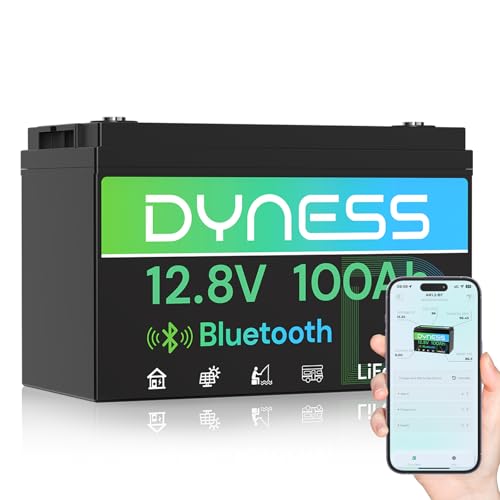
The Dyness 12V 100Ah RV battery lists a 100A BMS, A+ grade cells and Bluetooth 5.0 monitoring of voltage, current and capacity. Its low temperature protection is spelled out: it disconnects charging when the battery temperature falls below 32°F (0°C) and resumes after it warms, a threshold many listings never state.

At $199.98 it is $65.01 cheaper than the Power Queen and $8.99 above the HumsiENK at $190.99, which sits in the same 100A and 1,280Wh class. It can also expand to 4S4P, so 16 units form a 51.2V 400Ah system, which matters if you plan a higher voltage upgrade later.

What works

  • States charge cutoff at 32°F (0°C)
  • 100A BMS with A+ grade cells
  • Expands to 4S4P for a 51.2V system
  • Bluetooth 5.0 shows voltage and current

Watch out for

  • Dimensions and weight not given
  • 100A BMS limits inverter size to about 1,200W
04
Best for: Wet or exposed battery compartments

Our take

Pick this if the battery sits in a wet bay, a front tongue box or a boat style compartment.

Why it made the shortlist

The HumsiENK 12V 100Ah is a Group 24 battery rated 1,280Wh in the title, measuring 8.2 by 6.6 by 10.2 inches. It has a 100A smart BMS with app monitoring, an IP65 waterproof rating and a low temperature cutoff, with an operating range of minus 4°F to 158°F written in the listing.

The extra over BUKNUWO buys the IP65 rating and the written temperature range, while against Dyness you give up the written 32°F charge cutoff and the 4S4P expansion detail.

What works

  • Written temperature range, minus 4°F to 158°F
  • Compact Group 24 case at 1,280Wh
  • 100A smart BMS with phone monitoring

Watch out for

  • Marketed as a marine battery, not RV
  • Costs $48.00 more than the BUKNUWO
05
Best for: Budget weekend trailers

Our take

Pick this if you want the lowest cost and a light battery for a weekend trailer with simple loads.

Why it made the shortlist

The BUKNUWO 12.8V 100Ah weighs 22 pounds, which the listing calls two thirds lighter than a comparable lead acid battery. It has Bluetooth 5.0 monitoring for iOS and Android, a 100A BMS, an ABS casing and support for series and parallel expansion, all for the lowest price in this comparison.

At $142.99 it is the cheapest pick and about $112 per kWh, $48.00 below HumsiENK and $56.99 below Dyness.

What works

  • 22 pounds, easy to carry and install
  • Bluetooth 5.0 app for iOS and Android
  • 100A BMS with series and parallel support

Watch out for

  • No low temperature charge behavior listed
The catch
The caveat is that the listing does not state low temperature charging behavior, so a winter camper should look at Dyness or HumsiENK first, where the cutoff is written down.

Methodology

How We Built This Shortlist

Each pick was assessed across 4 criteria weighted for real-world use.

01

Usable energy per dollar

We converted amp hours to watt-hours and divided the price by kWh so batteries of different sizes compare fairly.

02

Protection and temperature

We looked for a stated BMS current and a written low temperature charge behavior, and marked anything missing as not listed.

03

App dependence

We noted what each listing says about Bluetooth monitoring, since the listings describe app features rather than offline behavior.

04

Case size and fit

Group size and dimensions were checked against the Group 24 and Group 27 tray standards.

Decision guide

Match a Bluetooth Lithium RV Battery to Your RV

By Battery Bay Size

Your situationRecommended pickWhy
Group 24 tray in a wet compartmentHumsiENK 100AhIP65 rating in an 8.2 by 6.6 by 10.2 inch case
Group 27 tray, want more AhPower Queen 125Ah125Ah in 12.13 by 6.69 by 8.31 inches
Group 24 tray, winter tripsDyness 100AhCharging stops below 32°F as written
Open bay with a large inverterECO-WORTHY 314Ah200A BMS and 4,019Wh in one unit
Light weight for weekend useBUKNUWO 100Ah22 pounds at $142.99

By Budget

BudgetRecommended pick
$140 to $200BUKNUWO 100Ah or HumsiENK 100Ah
$190 to $270Dyness 100Ah or Power Queen 125Ah
$490 to $500ECO-WORTHY 314Ah

One Big Battery vs Several 100Ah

One big battery

The ECO-WORTHY 314Ah gives 4,019Wh with one set of terminals and a 200A BMS, so cabling is simple. One failure takes out the whole bank, and the weight is not listed, so expect it to be much heavier than a Group 24 unit.

Several 100Ah batteries

Dyness 100Ah, HumsiENK 100Ah or BUKNUWO 100Ah in parallel give redundancy and are easier to lift one at a time, but each adds terminals, cabling and a parallel limit you need to respect.

Most trailers using under 2,000Wh a day do fine with two 100Ah units; choose ECO-WORTHY 314Ah only when you need the inverter headroom.

By Climate

Camping conditionsRecommended pick
Winter camping below freezingDyness 100Ah
Rain and splash exposureHumsiENK 100Ah
Mild three season useBUKNUWO 100Ah
Hot summers with big loadsECO-WORTHY 314Ah

For Buying Without Trusting the App Specifically

Look for

Local indicators on the case and a BMS that cuts charge by itself, so protection works with the phone off.

In this comparison

ECO-WORTHY 314Ah has SOC LEDs on the case, so you can read charge level without the app. The other four list app monitoring only, so confirm they show state of charge on the battery itself.

When to Spend More

Spend more if

Spend more on ECO-WORTHY 314Ah at $499.99 if you run an inverter or want 4,019Wh in one unit, since its roughly $124 per kWh beats the 100Ah units except BUKNUWO 100Ah.

Save if

Save with BUKNUWO 100Ah at $142.99 if your loads are light and you camp above freezing, where the missing cold charge detail does not matter.

FAQ

Before You Bring One Home

Does Bluetooth keep working when I am away from the RV?

No, Bluetooth is a short range link, so the app only shows data when your phone is near. The BMS protections run on their own whether or not the app is connected. A battery with SOC LEDs, like the ECO-WORTHY 314Ah, lets you check charge by sight.

Can I charge these below freezing?

Only if the battery allows it. Dyness states it stops charging below 32°F and resumes when it warms, and HumsiENK lists a low temperature shutoff. The ECO-WORTHY listing says it cuts off charging at low temperature without giving a number, so ask before relying on it.

Is the ECO-WORTHY 314Ah worth $499.99 over the 100Ah units?

On price per kWh, yes: about $124 against roughly $149 to $166 for HumsiENK, Dyness and Power Queen. BUKNUWO at $142.99 is still cheaper per kWh at about $112, so the real argument for ECO-WORTHY is one battery with a 200A BMS.

Can I mix these batteries in parallel?

It is best to use identical batteries bought together. Dyness lists expansion to 4S4P and ECO-WORTHY to 4P2S or 2P4S, but mixing brands, ages or sizes risks unbalanced loads. Read the written series and parallel limit first.

Will my converter charge a lithium battery?

Many older RV converters hold about 13.6V, which only partly charges LiFePO4. Check your converter's manual for a lithium profile or add a lithium compatible charger. None of these listings includes a charger.

Bottom line

The short version

Browse more bluetooth lithium rv battery on Amazon →
Bowen Higgins, RV Editor at RV Gear Lab

About the author

Bowen Higgins

RV Editor at RV Gear Lab

Bowen covers RV power, water systems, towing and leveling, upkeep and interior comfort, with a focus on matching gear to the rig, the hookups and the way you actually travel.

More from Bowen →Editorial standards

Keep reading

Related guides