

We research everything we recommend. When you buy through our links, we may earn a commission. Learn more

Buying guide · 11 min read · Updated October 1, 2026

6 Best Bluetooth RV Battery Monitors in 2026: A Practical RV Guide

Six Bluetooth shunt battery monitors for RVs compared on state of charge accuracy, app features, shunt rating, alarms, and price, from $90 to Victron.

Bowen HigginsBy Bowen HigginsRV Editor at RV Gear Lab6 products comparedSpec-sheet researched

At a glance

Our top picks

The voltage gauge on most RV panels is a poor fuel gauge, especially with lithium. A LiFePO4 battery holds a nearly flat voltage from about 90 percent down to 20 percent, so a reading of 13.2V tells you almost nothing about how many hours of furnace or fridge time you have left. A shunt-based monitor counts every amp going in and out and turns that into a real state of charge.

Every pick here uses a shunt and sends data to a phone app over Bluetooth. We compared the shunt current rating, the voltage range, what the app actually shows, how alarms work, and whether the monitor can share data with chargers or a remote system. Prices for Victron vary widely by seller, so those listings show check current price.

RV Gear Lab field notes

The Rig Fit Check

Start with the job
Victron SmartShunt 500A Bluetooth Battery Monitor, 6.5V to 70V leads this shortlist for most RV owners, especially Victron system users. Use that fit as a reference point, then compare the alternatives against your own space and workload.
Specs that separate the picks
The first details to compare are 500A shunt, 6.5V to 70V, Built-in display, 500A, 12V systems. Confirm the exact model and included components before ordering.
Trade-off to plan for
Needs a phone to see any reading

Before you buy

What Matters Before You Choose a Bluetooth RV Battery Monitor

Key buying criteria so you get the right fit the first time.

  1. 01

    Shunt-based measurement

    A shunt is a precision resistor on the battery negative that measures every amp flowing in or out. Counting those amps over time gives a true state of charge, which voltage alone cannot do with flat-curve lithium. Confirm the product includes a shunt rather than a clamp or voltage-only sensor.

  2. 02

    Shunt current rating

    The shunt rating must exceed your highest continuous current. A 2000W inverter can pull over 160 amps at 12V, and a 3000W unit well over 250, so a 300A shunt can be stretched. Add up your largest loads and pick a rating with margin, shown in the product title as 300A, 400A, or 500A.

  3. 03

    Everything through the shunt

    The monitor only sees current passing through it, so every load and charger negative must connect to the system side of the shunt, with only the battery on the other side. A single ground wire bypassing it makes the SOC drift. Check your wiring plan before buying and note that installation guides from these brands stress this point.

  4. 04

    Battery capacity setup and sync

    The monitor needs your bank's real amp-hour capacity and syncs to 100 percent when it sees a full charge. Entering the wrong capacity or never fully charging causes SOC errors that grow over days. Look for app settings for capacity and charged voltage, and plan a full charge occasionally.

  5. 05

    Alarms and history

    A low state of charge alarm warns you before the BMS shuts off the battery, and history shows parasitic draws you did not know about. Budget models vary widely in this area. Read the listing for named alarms and how many days of history are stored.

  6. 06

    Bluetooth range and integration

    Bluetooth often works through a trailer wall but struggles through metal compartments. Some monitors also share data with chargers or remote gateways, improving charging accuracy. Check the stated range and whether the app ties into gear you already own.

Our standards

Why You Can Trust RV Gear Lab

At RV Gear Lab, we compare products based on rig fit and power or hookup compatibility, verified specifications, usability, setup requirements, weight, durability, and real-world trade-offs. We do not rank products purely on marketing claims or commission rates.

We have not personally tested every product listed. Where hands-on testing is not available, recommendations are based on verified manufacturer specifications, product documentation, use-case fit, and comparative research.

How we review RV gear →

Detailed reviews

The 6 best bluetooth rv battery monitors, explained

01
Best for: Most RV owners, especially Victron system users

Our take

This is the pick for most RV owners, particularly anyone with or planning Victron gear.

Why it made the shortlist

The Victron SmartShunt 500A is the benchmark shunt monitor for RVs. It reports state of charge, time remaining, voltage, current, amp hours, charge cycles, deepest discharge, and voltage highs and lows in the VictronConnect app, and works from 6.5 to 70V.

What puts it above the BMV-712 ranked second is price and simplicity: it skips the wired display and does everything through the phone. Over the REDARC and LiTime units below, its advantage is VE.Smart Networking, which shares live battery data with Victron solar chargers so they charge more precisely. An aux input can monitor a second battery, a midpoint, or an optional temperature sensor.

What works

  • Tracks SOC, time remaining, cycles, and deepest discharge
  • Shares battery data with Victron solar chargers
  • Aux input for a second battery or temp sensor
  • No display to mount or wire

Watch out for

  • Needs a phone to see any reading
  • 500A may be small for a 3000W inverter
02
Best for: Owners who want a wall display and relay control

Our take

Choose it if you want a glanceable readout by the door and relay control.

Why it made the shortlist

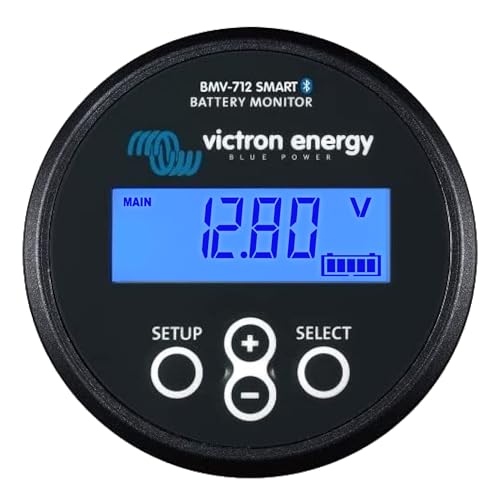
The Victron BMV-712 is the SmartShunt's sibling with a built-in display. It shows state of charge, voltage, current, and energy or time remaining on a wall-mounted screen, adds Bluetooth for the VictronConnect app, and works from 6.5 to 70V DC.

In exchange, it adds a programmable relay that can control other devices, such as starting a generator at a low state of charge, a feature none of the cheaper picks below offer. Its extra input can measure battery temperature, a midpoint, or a second battery.

What works

  • Wall display shows SOC without a phone
  • Programmable relay can trigger other devices
  • Second input for temperature or midpoint
  • Historical charts in the app

Watch out for

  • Display cable must be run to the shunt
The catch
It ranks second only because the display costs more and requires a cable run from the shunt.
03
Best for: REDARC owners and long-range monitoring

Our take

Choose REDARC 500A Smart Battery Monitor for 12V Systems for bluetooth range up to 42 meters.

Why it made the shortlist

The REDARC 500A monitor stands out for Bluetooth range. It uses Bluetooth 5.1 with a stated range of up to 42 meters and reports state of charge, time remaining, and current flow in the RedVision app, which also ties into REDARC's own charging gear.

Against the LiTime below, it costs about $99 more, mainly for brand reputation in the overlanding world and the long range.

What works

  • Bluetooth range up to 42 meters
  • Integrates with the RedVision app
  • Shows SOC, time remaining, and current flow

Watch out for

  • 12V systems only
  • Pricier than the LiTime and ANCEL
  • Listing gives little alarm detail
The catch
Next to the Victron units above, it is limited to 12V systems and lacks the aux input and solar charger networking, which places it third.
04
Best for: Value buyers wanting alarms and history

Our take

This suits LiTime battery owners and anyone wanting a full-featured shunt without Victron pricing.

Why it made the shortlist

The LiTime 500A smart shunt offers Victron-style data for about $100. It shows charge and discharge current, voltage, power, and state of charge in an app, logs history such as discharge capacity, cycles, and voltage highs and lows, and works across 8 to 120V systems.

Compared with the REDARC above, it adds adjustable alarms for low capacity, temperature, over-voltage, under-voltage, and over-current, plus a status light that flashes on a fault.

What works

  • Adjustable alarms for capacity, voltage, and current
  • Logs cycles and voltage highs and lows
  • Works on 12V to 48V banks
  • Status light flashes on faults

Watch out for

  • 1-year warranty only
  • No charger data sharing
05
Best for: Owners with Renogy solar or batteries

Our take

Buy it if you already run Renogy solar or batteries and want everything in one app.

Why it made the shortlist

The Renogy Battery Shunt 300 is built for the Renogy ecosystem. It records history and sends alerts through the DC Home app, supports remote monitoring through Renogy ONE, and includes a battery temperature sensor for lead-acid, LiFePO4, and lithium-ion batteries.

Its 300A rating is lower than the 500A LiTime above, which is why it ranks below it despite costing about $19 more. The included temperature sensor is a real plus over the ANCEL below, especially for lithium owners who camp in the cold.

What works

  • Includes a battery temperature sensor
  • Alerts and history in the DC Home app
  • Remote monitoring through Renogy ONE

Watch out for

  • 300A limits large inverter use
  • Not compatible with Renogy ONE M1
06
Best for: DIY owners buying a first battery monitor

Our take

This is a good first monitor for a DIY owner.

Why it made the shortlist

The ANCEL BM1000 is the least expensive full shunt monitor here at about $90. It tracks state of charge, voltage, current, power, and remaining capacity on a phone, keeps up to 30 days of energy history, and works on 10 to 120V systems including LiFePO4, AGM, and lead-acid.

Its 400A shunt sits between the Renogy 300A above and the 500A units, and ANCEL sizes it for typical 100 to 300A peak loads.

What works

  • Wrong-proof ports simplify DIY wiring
  • 30 days of usage history in the app
  • Reverse polarity and overload protection

Watch out for

  • Short 10m Bluetooth range
  • No temperature sensor

Methodology

How We Built This Shortlist

Each pick was assessed across 5 criteria weighted for real-world use.

01

State of charge method

Every pick uses a shunt for coulomb counting; we compared the extra data each reports beyond SOC, such as cycles and time remaining.

02

Shunt rating versus RV loads

We matched 300A, 400A, and 500A shunts to typical inverter and DC loads in RVs.

03

App and alarm depth

We weighed history logging, alarm options, and how clearly each app presents data.

04

System integration

Data sharing with chargers, relays, aux inputs, and remote platforms counted as real differentiators.

05

Install and range

We compared Bluetooth range, install aids, and included sensors or displays.

Decision guide

Match a Bluetooth RV Battery Monitor to Your RV

By Inverter Size

Your largest loadRecommended pick
No inverter or under 1000WRenogy Battery Shunt 300
1000W to 2000W inverterANCEL BM1000
2000W to 3000W inverterVictron SmartShunt 500A
Want a display plus relayVictron BMV-712

By Budget

BudgetRecommended pick
About $90ANCEL BM1000
About $100 to $120LiTime 500A or Renogy Battery Shunt 300
About $200REDARC 500A Smart Battery Monitor
Premium, check current priceVictron SmartShunt 500A or Victron BMV-712

App-Only vs Wired Display

App-only

The shunt sends data straight to your phone, so install is just the shunt and battery connections. That covers the Victron SmartShunt 500A, LiTime 500A, ANCEL BM1000, Renogy Battery Shunt 300, and REDARC 500A Smart Battery Monitor.

Wired display

A panel screen shows SOC to anyone at a glance, but needs a cable run and wall cutout. In this comparison that is the Victron BMV-712.

Most owners should go app-only; choose a display if several people use the rig or phones are not always at hand.

By Ecosystem

Gear you already ownRecommended pick
Victron solar chargerVictron SmartShunt 500A
Renogy solar or batteriesRenogy Battery Shunt 300
REDARC DC-DC chargerREDARC 500A Smart Battery Monitor
LiTime batteriesLiTime 500A
Mixed brandsANCEL BM1000

For Lithium Owners in Cold Weather Specifically

Look for

A temperature input or sensor plus alarms, since LiFePO4 should not be charged below about 32F and the monitor can warn you.

In this comparison

The Renogy Battery Shunt 300 includes a temperature sensor, and the Victron SmartShunt 500A accepts an optional sensor on its aux input.

When to Spend More

Spend more if

You want charger networking or relay control; the Victron SmartShunt 500A and Victron BMV-712 do things budget shunts cannot.

Save if

You just want an honest fuel gauge; the ANCEL BM1000 gives SOC and 30 days of history for about $90.

FAQ

Before You Bring One Home

Will a shunt monitor work with my lithium battery's own Bluetooth?

Yes, they can run together. The battery's BMS app reports its own estimate, while a shunt like the Victron SmartShunt measures the whole system, which helps with multiple batteries.

What is the most common installation mistake?

Leaving a ground wire connected directly to the battery negative, bypassing the shunt. Every load and charger must connect on the system side, or the state of charge will be wrong.

Is the Victron SmartShunt worth it over the ANCEL BM1000?

If you use Victron chargers or want aux inputs and higher shunt capacity, yes. If you only need a reliable fuel gauge, the ANCEL does the core job for much less.

How do I set up the monitor after installation?

Enter your bank capacity in amp-hours, set the charged voltage and tail current to suit your battery chemistry, then fully charge the bank so the monitor syncs to 100 percent.

Why does my state of charge drift over time?

Drift usually comes from incorrect capacity settings, a bypassed ground, or rarely reaching full charge. Fix wiring, correct settings, and charge fully to resync.

Does a battery monitor drain my battery?

Shunt monitors draw a very small current, but a rig left in storage for months should still be disconnected or kept on a maintainer to avoid slow drain.

Bottom line

The short version

Browse more bluetooth rv battery monitors on Amazon →
Bowen Higgins, RV Editor at RV Gear Lab

About the author

Bowen Higgins

RV Editor at RV Gear Lab

Bowen covers RV power, water systems, towing and leveling, upkeep and interior comfort, with a focus on matching gear to the rig, the hookups and the way you actually travel.

More from Bowen →Editorial standards

Keep reading

Related guides