

We research everything we recommend. When you buy through our links, we may earn a commission. Learn more

Buying guide · 11 min read · Updated October 2, 2026

5 Best Budget 24 Volt Solar Charge Controllers in 2026: A Practical RV Guide

Five solar charge controllers that handle 24V battery banks, from a sealed IP68 PWM unit to 80A and 100A MPPT models for large arrays.

Bowen HigginsBy Bowen HigginsRV Editor at RV Gear Lab5 products comparedSpec-sheet researched

At a glance

Our top picks

Wiring a bank at 24V halves the current for the same wattage, which means thinner cable, smaller losses and a controller that runs cooler. That is why larger RVs, boat conversions and cabins choose 24V, and it is why the controllers here are judged on how they behave at that voltage rather than on 12V convenience.

Every pick auto-detects 24V, and two reach up to 48V. The shortlist splits cleanly: two high-current MPPT units for large arrays, one sealed PWM unit for rough outdoor mounting, one PWM unit that speaks lithium, and a compact 30A MPPT board for a modest 24V setup.

Match amps to array wattage at 24V, where a 30A controller can pass roughly 720 watts. That is far more than a 12V system of the same amps, and it is the arithmetic that makes a small controller go a long way here.

RV Gear Lab field notes

The Rig Fit Check

Start with the job
100A MPPT Solar Charge Controller with Auto Parameter LCD Display | 12V/ 24V Solar Panel Regulator leads this shortlist for Large 24V arrays that need hundred-amp headroom for later growth.. Use that fit as a reference point, then compare the alternatives against your own space and workload.
Specs that separate the picks
The first details to compare are 100A MPPT, 12V/24V auto, 80A MPPT, 12V to 48V, 20A PWM, IP68 sealed. Confirm the exact model and included components before ordering.
Trade-off to plan for
Overkill for a small 24V bank

Before you buy

What Matters Before You Choose a Budget 24 Volt Solar Charge Controller

Key buying criteria so you get the right fit the first time.

  1. 01

    Watts passed at 24V

    Controller amps multiply by battery voltage to give watts. A 30A unit passes about 720 watts at 24V while the same amps pass 360 watts at 12V. Hence 24V banks need smaller controllers for the same array. Multiply amps by 24 and add a margin before shopping.

  2. 02

    Voltage range beyond 24V

    Detection of 36V and 48V as well as 24V protects your investment if the bank grows. It also covers a rebuild of the battery pack in different voltage. Check the title for the full list of voltages. A 24V-only unit is fine if the bank will stay put.

  3. 03

    Tracking method and array voltage

    MPPT lets panels run at higher voltage than the battery, which suits longer series strings feeding a 24V bank. PWM requires panel voltage near battery voltage and wastes the rest. For a few small panels PWM works. For larger strings MPPT pays back in extra current.

  4. 04

    Waterproofing

    Fixed outdoor installs expose controllers to rain and spray, so a sealed IP68 body avoids corrosion. Interior boards need a dry compartment. Look for the IP rating in the listing, not the word waterproof alone. Sealed units usually trade display detail for toughness.

  5. 05

    Lithium support

    Lithium packs need a fixed charge voltage and no equalization stage. Naming LiFePO4 and showing an icon for it generally means the profile is present. Without it a 24V lithium bank can sit undercharged. Search for the chemistry by name.

  6. 06

    Protection layers

    Reverse polarity, short circuit and over-temperature protections prevent the expensive failures. High-current 24V banks can deliver damaging fault currents. Count the named protections and fuse the battery lead regardless. Fusing is the real safety net.

Our standards

Why You Can Trust RV Gear Lab

At RV Gear Lab, we compare products based on rig fit and power or hookup compatibility, verified specifications, usability, setup requirements, weight, durability, and real-world trade-offs. We do not rank products purely on marketing claims or commission rates.

We have not personally tested every product listed. Where hands-on testing is not available, recommendations are based on verified manufacturer specifications, product documentation, use-case fit, and comparative research.

How we review RV gear →

Detailed reviews

The 5 best budget 24 volt solar charge controllers, explained

01
Best for: Large 24V arrays that need hundred-amp headroom for later growth.

Our take

It lands at the top of the price range in this guide and offers the most current.

Why it made the shortlist

The Depvko 100A is a plug-and-play MPPT controller with 12V and 24V auto-recognition, designed so you connect the battery first and the unit configures itself. A real-time LCD reports performance and mode at a glance.

It tracks maximum charging current with efficiency quoted up to 99 percent. Built-in defenses prevent overcharging and short circuits, which is reassuring on a high-current bank.

Expect to grow the array later and this one keeps pace.

What works

  • Hundred amps of capacity
  • Plug-and-play voltage recognition
  • Efficiency quoted up to 99 percent
  • Overcharge and short protections

Watch out for

  • Overkill for a small 24V bank
  • Limited to 24V maximum
02
Best for: Banks that may move from 24V to 36V or 48V later.

Our take

The LCD shows live performance data with button-driven navigation.

Why it made the shortlist

The AuraSolar 80A is an MPPT controller with 99.9 percent tracking efficiency and auto-detection from 12V up to 48V. That range lets one purchase follow a 24V bank through an upgrade.

It works with virtually any 12V, 24V, 36V or 48V battery in the owner's setup. Eight layers of protection cover overload, overheating and short circuits.

It sits at the same price tier as the Depvko 100A while offering four voltages, which makes it the flexible pick.

What works

  • Four system voltages supported
  • Eight layers of protection
  • Live LCD performance data
  • Strong tracking efficiency stated

Watch out for

  • Input voltage ceiling not prominent
  • Newer brand with limited history
03
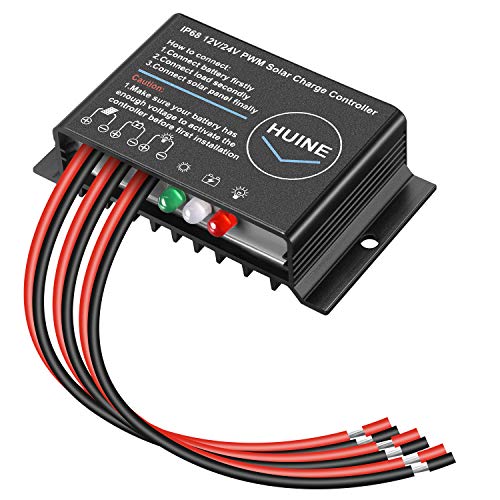
Best for: Exposed 24V installs such as fencing, boats and outdoor posts.

Our take

Three LED lights report charging status and battery level without any screen.

Why it made the shortlist

The HUINE 20A is an IP68 waterproof PWM controller with four-stage charging, built for outdoor use where rain reaches the hardware. It suits solar fencing and similar fixed installations.

It senses 12V or 24V automatically and runs around the clock, protecting against short circuit, overcharge, over-discharge and reverse connection. Short cables are supplied for the panel, battery and load.

Low on price, it suits installations that must survive water.

What works

  • IP68 survives rain and splashing
  • Four-stage PWM charging
  • Pre-attached short cables
  • Full set of protections

Watch out for

  • No numeric display
  • Twenty amps limits array size
04
Best for: 24V lithium banks with moderate panel wattage.

Our take

It sits near the entry price in this guide and is the lithium-aware option among the PWM units.

Why it made the shortlist

SLD, FLD, GEL, AGM, SLA, LiFePO4, ternary and LTO battery types are named and shown as icons on its LCD. That breadth suits a 24V pack built from lithium cells.

A 55V maximum PV input handles 900 watts into a 24V system according to the listing. A backlit display cycles through PV and power status.

A 24V LiFePO4 bank with a modest array is a clear match.

What works

  • Names LiFePO4 and similar chemistries
  • Stated 55V input limit
  • Backlit cycling display
  • Large wattage allowance at 24V

Watch out for

  • PWM wastes extra panel voltage
  • Twenty amps caps array size
05
Best for: Compact 24V setups that still want MPPT at the lowest outlay.

Our take

Entry pick of this guide, it delivers MPPT where most 24V-capable budget units are PWM.

Why it made the shortlist

The AWXYG 30A is an MPPT controller that auto-detects 12V and 24V and sets itself up once the battery is wired. A straightforward menu lets owners change settings without a manual.

Dual USB ports at 5V and 2.5A max charge phones, tablets and small devices. Comprehensive built-in safeguards protect the battery.

Thirty amps at 24V passes roughly 720 watts, plenty for a modest array.

What works

  • MPPT at the lowest outlay
  • Thirty amps passes about 720W at 24V
  • Simple menu setup
  • Built-in battery safeguards

Watch out for

  • Capped at 24V systems
  • Limited input voltage disclosure

Methodology

How We Built This Shortlist

Each pick was assessed across 5 criteria weighted for real-world use.

01

24V behavior first

We evaluated each controller for how it handles 24V banks, including auto-detection and the wattage the amp rating passes at that voltage. At 24V the same amps carry double the power of a 12V system. Product specs for each unit were compared against that arithmetic.

02

Current and scalability

Ratings run from 20A to 100A. We matched each to a realistic 24V array and looked at who benefits from headroom. A larger controller is rarely wasted when the array may grow.

03

Tracking method

MPPT and PWM suit different arrays. We separated the three MPPT units from the two PWM units and ranked MPPT higher for larger strings. Our analysis kept PWM where sealing or lithium icons add value.

04

Environmental protection

An IP68 rating and short pre-attached cables matter for outdoor fixed installs. We compared stated sealing and protections. That lifted the HUINE for exposed uses.

05

Price positioning

Prices set the order and are never printed. The step from the entry 30A MPPT to the 80A and 100A units buys current capacity and, on the AuraSolar, a 48V range. Those mechanisms hold when prices shift.

Decision guide

Match a Budget 24 Volt Solar Charge Controller to Your RV

By Array Wattage at 24V

At 24V, amps convert to roughly 24 watts each.

ArrayController sizePick
Up to about 500W20 to 30 ampsAWXYG 24V 30A
Lithium bank, about 800W20A with 900W allowanceBougeRV Li 20A
1,500W to 1,900W80 ampsAuraSolar 80A
Over 2,000W or planned growth100 ampsDepvko 24V 100A
Fixed outdoor loadSealed 20AHUINE 20A

By Budget

Positions within this shortlist.

BandWhat the step buysPick
Entry of this shortlistMPPT at thirty ampsAWXYG 24V 30A
LowLithium icons and a stated 55V ceilingBougeRV Li 20A
Low-midIP68 sealing for outdoor postsHUINE 20A
UpperFour-voltage range to 48VAuraSolar 80A
TopHundred-amp headroomDepvko 24V 100A

MPPT vs PWM at 24V

Tracking method changes how much the panels deliver.

MPPT

Converts surplus panel voltage to extra current and supports longer strings. Picks: Depvko 24V 100A, AuraSolar 80A and AWXYG 24V 30A.

PWM

Simple and robust, best when panel and battery voltages match. Picks: HUINE 20A and BougeRV Li 20A.

Choose MPPT with AuraSolar 80A for a large array, and HUINE 20A when sealing outweighs tracking.

By Installation Environment

Where the controller lives changes the winner.

EnvironmentNeedPick
Outdoor post or fenceIP68 ratingHUINE 20A
Dry electronics bayDisplay and USBAWXYG 24V 30A
Large off-grid cabinHigh current, 48V upgrade pathAuraSolar 80A
Lithium van conversionChemistry iconsBougeRV Li 20A

For Boat and Van Conversions Specifically

Space and moisture drive the requirements.

Look for

Compact bodies, sealing or a dry mounting plan, and the right chemistry mode.

In this comparison

HUINE 20A brings sealing, BougeRV Li 20A brings lithium icons and AWXYG 24V 30A brings compact MPPT.

When to Spend More

Match current to your future array.

Spend more if

The array will grow or the bank may reach 48V. AuraSolar 80A and Depvko 24V 100A offer the room.

Save if

The array is modest and fixed. AWXYG 24V 30A and HUINE 20A already match it.

FAQ

Before You Bring One Home

Why choose 24V over 12V?

Doubling the voltage halves the current for the same power, so cables can be thinner and losses smaller. Larger RVs, boats and cabins gain the most. Every pick here auto-detects 24V.

How many watts can a 30A controller handle at 24V?

Roughly 720 watts, since amps times volts gives the limit. Allow some margin, so aim below that. The AWXYG 24V 30A fits arrays up to about 500 watts comfortably.

Do all of these work with lithium?

BougeRV Li 20A names LiFePO4 and similar chemistries. The others do not describe a dedicated lithium profile in the same way. Check the battery maker's voltage limits before choosing.

When is IP68 sealing worth it?

When the controller is exposed to rain, spray or condensation, such as on a fence post or boat. HUINE 20A is sealed. Interior units need a dry compartment.

Can the 80A and 100A units run a 12V bank?

Yes, both auto-detect 12V, though the amps only matter if the array is large enough. At 12V the same wattage means double the current. Fuse and cable sizing must follow the amps.

What should I fuse and wire first?

Connect the battery first through a fuse sized for the controller, then the panels. Auto-detection depends on seeing the battery on startup. Disconnect in reverse order.

Bottom line

The short version

Browse more budget 24 volt solar charge controllers on Amazon →
Bowen Higgins, RV Editor at RV Gear Lab

About the author

Bowen Higgins

RV Editor at RV Gear Lab

Bowen covers RV power, water systems, towing and leveling, upkeep and interior comfort, with a focus on matching gear to the rig, the hookups and the way you actually travel.

More from Bowen →Editorial standards

Keep reading

Related guides