

We research everything we recommend. When you buy through our links, we may earn a commission. Learn more

Buying guide · 11 min read · Updated October 2, 2026

6 Best Budget 60 Amp Solar Charge Controllers in 2026: A Practical RV Guide

Six 60 amp solar charge controllers sorted by what the rating really delivers, from a 200V app-monitored MPPT unit to simple PWM and 12V/24V boards.

Bowen HigginsBy Bowen HigginsRV Editor at RV Gear Lab6 products comparedSpec-sheet researched

At a glance

Our top picks

At a glance · 6 picks

Not every 60 amp controller delivers sixty amps the same way. Some advertise a big number and quietly reduce output as they warm up, while others state a true continuous rating and the input voltage to back it. That gap is the first thing to understand when a rating this high appears on a very low price.

Here the six picks run from a 200V, app-monitored MPPT unit at the top of the price range to a plain 12V/24V board at the bottom. In between sits a 60A PWM model with a 100V input, and three MPPT units that trade extras for outlay.

A 60A controller suits large RV arrays, 24V conversions and off-grid builds. On 12V it supports about 780 watts, so confirm your roof really carries that much before paying for capacity you cannot use.

RV Gear Lab field notes

The Rig Fit Check

Start with the job
IPANDEE 60A MPPT Solar Charge Controllers,200V Max PV Input,99.9% Efficiency,12V/24V/36V/48V leads this shortlist for Large arrays that need 200V input, app monitoring and sustained output.. Use that fit as a reference point, then compare the alternatives against your own space and workload.
Specs that separate the picks
The first details to compare are 60A MPPT, 200V PV input, 60A PWM, 100V PV input, 60A MPPT, 4 voltages. Confirm the exact model and included components before ordering.
Trade-off to plan for
Most expensive pick here

Before you buy

What Matters Before You Choose a Budget 60 Amp Solar Charge Controller

Key buying criteria so you get the right fit the first time.

  1. 01

    Sustained versus peak current

    A controller rated for 60A may deliver that only briefly before heat forces it to reduce output. A stated continuous rating means it holds the current around the clock. On a hot roof this separates a dependable unit from a disappointing one. The word continuous and a stated temperature behavior are the signs to seek.

  2. 02

    Array wattage fit

    At 12V a 60A controller carries about 780 watts and at 24V about 1,560 watts. A roof holding 400 watts does not need it. Divide your panel watts by battery voltage and add a quarter. If the answer is under 40 amps, consider a smaller unit.

  3. 03

    PV input ceiling

    Series wiring adds panel voltage, and cold weather lifts it further. A 200V ceiling allows long strings of residential panels, while 100V limits you to a few. Going over the ceiling damages the controller. Use panel open-circuit voltage plus a cold margin.

  4. 04

    MPPT versus PWM at this size

    PWM at 60A is simple and cheap but throws away surplus panel voltage. MPPT recovers it, and the difference grows with array size. For a big array the extra current pays for the controller in a few seasons. Choose PWM only when voltages already match.

  5. 05

    Monitoring and integration

    An app and RS485 Modbus let you watch a big system and tie it to other equipment. A clock LCD with seven modes is enough for a simple rig. Remote visibility matters more as arrays grow. Decide how often you will check.

  6. 06

    Battery profile flexibility

    Banks at this size are often lithium or custom. Listing many battery types or allowing parameter changes avoids mismatches. Fixed lead-acid profiles risk undercharging lithium. Read the chemistry list before choosing.

Our standards

Why You Can Trust RV Gear Lab

At RV Gear Lab, we compare products based on rig fit and power or hookup compatibility, verified specifications, usability, setup requirements, weight, durability, and real-world trade-offs. We do not rank products purely on marketing claims or commission rates.

We have not personally tested every product listed. Where hands-on testing is not available, recommendations are based on verified manufacturer specifications, product documentation, use-case fit, and comparative research.

How we review RV gear →

Detailed reviews

The 6 best budget 60 amp solar charge controllers, explained

01
Best for: Large arrays that need 200V input, app monitoring and sustained output.

Our take

Top of the price range, it buys the 200V ceiling, the stated continuous rating and wireless monitoring.

Why it made the shortlist

The IPANDEE 60A is built around multi-curve MPPT tracking that keeps hunting for the best power point under cloud and partial shade. Automatic detection spans 12V through 48V systems.

The listing states true 60A continuous output for around-the-clock charging, a 200V maximum PV input and up to 3,120W of solar capacity. App monitoring, RS485 Modbus and expandable system integration add visibility.

What works

  • 200V maximum PV input
  • True continuous 60A stated
  • App monitoring and Modbus
  • Multi-curve tracking handles shade

Watch out for

  • Most expensive pick here
  • More controller than small rigs need
02
Best for: Matched-voltage arrays and unusual battery chemistries.

Our take

Upper-middle pricing fits a bank whose panel voltage already matches the battery.

Why it made the shortlist

Detection covers 12V, 24V, 36V and 48V systems, with a 100V maximum PV input and a stated input power range of 720W to 2,880W. Regulation stays simple with three-stage PWM charging.

It supports 14 battery types including sealed, user, flooded, gel, LiFePO4 and ternary lithium. On the backlit display sit charging current, generated energy and temperature.

What works

  • Handles 14 battery types
  • Stated power range by voltage
  • Backlit display with energy data
  • Dual USB outputs

Watch out for

  • PWM leaves surplus voltage unused
  • Less efficient than MPPT
03
Best for: Owners who want timer and light-control modes with MPPT.

Our take

Mid-pack on price, it adds timer modes and richer readouts beyond the plain boards.

Why it made the shortlist

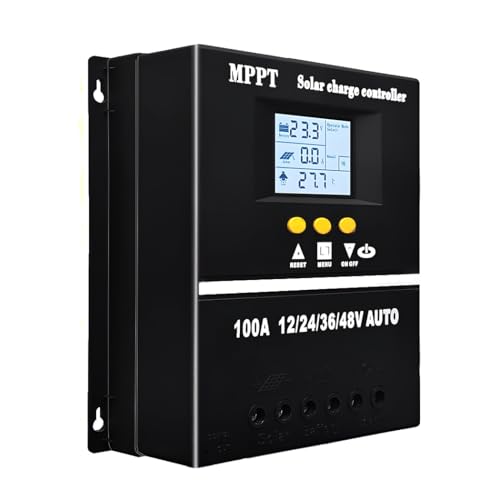
The Depvko 60A is an MPPT controller that detects four system voltages and carries dual 5V USB ports. Its clock display has seven modes, including light control and timed switching.

Those modes can power outdoor lighting on a schedule. Protection covers over-voltage, over-current, power failure, overcharge, deep discharge and reverse polarity.

What works

  • Seven timer and light modes
  • Shows temperature and currents
  • Four voltages auto-detected
  • Broad protection list

Watch out for

  • No wireless monitoring
  • No parallel capability
04
Best for: Buyers who want MPPT and four voltages without a big outlay.

Our take

Slightly cheaper than the Depvko, it copies that design and stands as the value pick among mid-range MPPT units.

Why it made the shortlist

The SOGTICPS 60A uses an MPPT algorithm with a backlit LCD and clock offering seven operating modes. It detects 12V, 24V, 36V and 48V systems.

Battery over-voltage and over-current protection are built in, and the display shows operating data and status as it changes.

What works

  • MPPT with four voltages
  • Backlit LCD and clock
  • Over-voltage and current guards

Watch out for

  • Looks like several siblings
  • No stated input ceiling
05
Best for: 12V and 24V owners who want dual USB ports and a simple LCD.

Our take

Close to the entry price, it delivers 60A MPPT to buyers who do not need 36V or 48V.

Why it made the shortlist

The DYVIAHOME 60A is an MPPT controller for 12V and 24V systems that manages panels and batteries automatically. Dual 5V USB outputs charge phones, tablets and PCs.

Protection against over-current, short-circuit, reverse connection, low voltage and overcharge supports the battery. Status and data appear on the LCD, which also allows mode and parameter changes.

What works

  • Dual USB charging ports
  • Parameters editable on LCD
  • Core protections included
  • Low outlay for 60A MPPT

Watch out for

  • Limited to 12V and 24V
  • Sparse documentation
06
Best for: Lowest-outlay 60A MPPT for a 12V or 24V roof array.

Our take

It brings sixty amps of tracking to the lowest price in this guide, a sensible stop for a big 12V or 24V roof.

Why it made the shortlist

The AWXYG 60A is the entry pick, an MPPT controller that auto-detects 12V or 24V and configures through a plain menu. It is pitched as a significant step up from PWM regulators.

USB charging at 5V and 2.5A max comes with comprehensive safeguards that protect the battery.

What works

  • Lowest outlay of the six
  • Simple menu setup
  • USB charging included
  • Battery safeguards built in

Watch out for

  • Limited to 12V and 24V
  • Few published electrical limits

Methodology

How We Built This Shortlist

Each pick was assessed across 5 criteria weighted for real-world use.

01

What the rating delivers

We evaluated each listing for statements about sustained output, since a 60A label can hide thermal derating. Only the IPANDEE states continuous output directly. Product specs set the baseline for the rest.

02

Input voltage and power range

Stated PV limits ran from 100V to 200V. Where a listing gave a power range by system voltage we credited it. Our analysis valued numbers over adjectives.

03

Monitoring depth

App monitoring, Modbus and a clock LCD all appear. We compared what each shows and how readable it is. That separated the premium unit from the plain boards.

04

Battery fit

PWM and MPPT units list different chemistries. We looked at named lithium types and adjustable parameters. That shaped who each unit suits.

05

Price ordering

Prices set the order and are never printed. The step from the entry AWXYG to the IPANDEE buys a 200V ceiling, a stated continuous rating and monitoring rather than extra amps.

Decision guide

Match a Budget 60 Amp Solar Charge Controller to Your RV

By Panel String Voltage

Input ceiling decides how many panels can be chained.

StringNeedPick
Many panels in one string200V inputIPANDEE 60A
Moderate series string100V inputPowMr 60A PWM
Two panels in seriesMPPT with four voltagesDepvko 60A
Parallel panelsAny 12V or 24V unitAWXYG 60A
Mixed panel brandsMPPT toleranceSOGTICPS 60A

By Budget

Positions inside this shortlist.

BandWhat the step buysPick
Entry of this shortlist60A MPPT, 12V/24V, menuAWXYG 60A
LowDual USB with a parameter menuDYVIAHOME 60A
Low-midFour voltages with clock modesSOGTICPS 60A
MidSame modes plus temperature readoutsDepvko 60A
Upper-midPWM with 14 battery typesPowMr 60A PWM
Top200V input, stated continuous 60A, appIPANDEE 60A

Sustained Output vs Headline Rating

Two ways of reading the same number.

Stated continuous

The maker commits to holding the rating around the clock. Pick: IPANDEE 60A.

Headline rating

A peak figure that may derate when hot, acceptable for modest loads. Picks: AWXYG 60A, DYVIAHOME 60A, SOGTICPS 60A, Depvko 60A and PowMr 60A PWM.

Choose IPANDEE 60A for sustained high output, or AWXYG 60A if the array will run well below the rating.

By Monitoring Preference

How do you want to watch the system?

PreferenceNeedPick
Phone app and ModbusWireless and RS485IPANDEE 60A
Energy and temperature readoutsBacklit displayPowMr 60A PWM
Clock and load timersSeven modesDepvko 60A
Basic status onlySimple LCDDYVIAHOME 60A

For Large RV Roofs Specifically

Big roofs push a controller harder.

Look for

A stated continuous rating, wide input and room to grow.

In this comparison

IPANDEE 60A states continuous output and 3,120W capacity, and Depvko 60A offers four voltages for flexibility.

When to Spend More

Where the top pick pays off.

Spend more if

You run long strings, high wattage or want remote monitoring. IPANDEE 60A covers all three.

Save if

A modest array feeds a 12V or 24V bank. AWXYG 60A and DYVIAHOME 60A give MPPT at the lowest outlay.

FAQ

Before You Bring One Home

Do I need a 60A controller for an RV?

Only for large arrays, since a typical 400 watt roof needs about 40 amps at 12V with margin. A 24V or 48V bank stretches 60 amps much further. Add up panel watts first.

What does continuous output mean?

It means the controller can hold its rated current for hours without derating. IPANDEE 60A states this. Others publish only the headline rating.

Is PWM at 60A ever a good idea?

When panel voltage already matches battery voltage and cost matters most. PowMr 60A PWM suits that case. For larger arrays MPPT recovers extra energy.

How high can the PV voltage go?

IPANDEE 60A states 200V and PowMr 60A PWM states 100V. The others do not state a figure clearly. Stay under the ceiling at the coldest expected temperature.

Which of these handles lithium?

PowMr 60A PWM names LiFePO4 and ternary lithium, and IPANDEE 60A supports a wide range of battery settings. Others offer adjustable parameters. Match to the battery maker's limits.

What size wire and fuse do I need?

Sixty amps calls for heavy cable and a properly rated fuse near the battery. Use a wire gauge chart for the run length. Undersized cable overheats first.

Bottom line

The short version

Browse more budget 60 amp solar charge controllers on Amazon →
Bowen Higgins, RV Editor at RV Gear Lab

About the author

Bowen Higgins

RV Editor at RV Gear Lab

Bowen covers RV power, water systems, towing and leveling, upkeep and interior comfort, with a focus on matching gear to the rig, the hookups and the way you actually travel.

More from Bowen →Editorial standards

Keep reading

Related guides