

We research everything we recommend. When you buy through our links, we may earn a commission. Learn more

Buying guide · 7 min read · Updated August 19, 2026

7 Best Budget Portable Power Stations in 2026: A Practical RV Guide

We compared budget portable power stations by measured usable energy, continuous output, and safety documentation rather than ranking by headline wattage alone.

Bowen HigginsBy Bowen HigginsRV Editor at RV Gear Lab5 products comparedSpec-sheet researched

At a glance

Our top picks

A quick scan of budget portable power stations listings rarely settles the question of verifying real usable energy and safety documentation before price scoring, so that's where we started.

We compared this lineup on measured usable energy and safety documentation plus verifying real usable energy and safety documentation before price scoring, since rated capacity alone regularly overstates real-world runtime.

RV Gear Lab field notes

The Rig Fit Check

Start with the job
MARBERO M822 Portable Power Station, 200W, 148Wh leads this shortlist for buyers prioritizing 148wh, 200w (270w max), 3.3 lbs. Use that fit as a reference point, then compare the alternatives against your own space and workload.
Specs that separate the picks
The first details to compare are 148Wh, 200W (270W max), 3.3 lbs, 280Wh, 300W max, ~5 lbs, 256Wh, 300W (600W surge), 6.4 lbs. Confirm the exact model and included components before ordering.
Trade-off to plan for
Not suited for appliances drawing over 270W peak

Before you buy

What Matters Before You Choose a Budget Portable Power Station

Key buying criteria so you get the right fit the first time.

  1. 01

    Date-Stamp Current Price

    Verify budget portable power stations's current street price and include any required charger, panel, or cable accessories in the total cost.

  2. 02

    Require Safety Documentation Before Scoring Price

    Require clear battery chemistry and safety or certification documentation before factoring price into the ranking.

  3. 03

    Measure Usable Wh, Not Nominal Values

    Measure usable Wh and continuous AC output rather than trusting nominal headline values alone.

  4. 04

    Check Replacement and Warranty Support

    Verify replacement and warranty support, plus app or firmware availability where applicable.

  5. 05

    Price the Total Accessory Cost

    Price necessary solar panels, cables, and chargers before declaring the total value of a budget pick.

Our standards

Why You Can Trust RV Gear Lab

At RV Gear Lab, we compare products based on rig fit and power or hookup compatibility, verified specifications, usability, setup requirements, weight, durability, and real-world trade-offs. We do not rank products purely on marketing claims or commission rates.

We have not personally tested every product listed. Where hands-on testing is not available, recommendations are based on verified manufacturer specifications, product documentation, use-case fit, and comparative research.

How we review RV gear →

Detailed reviews

The 5 best budget portable power stations, explained

01
MARBERO M822 Portable Power Station, 200W, 148Wh
  • 148Wh, 200W (270W max), 3.3 lbs
  • 7.5x5.3x3.6in compact frame
  • Pass-through charging supported
Check price on Amazon for MARBERO M822 Portable Power Station, 200W, 148Wh (opens in a new tab)
Best for: Buyers prioritizing 148wh, 200w (270w max), 3.3 lbs

Our take

Two LED flashlights, one on top with two brightness levels and one on the side with three modes including SOS, add genuine emergency utility.

Why it made the shortlist

A 110V AC inverter supports most household AC needs excluding heating appliances over 270W, and pass-through charging is documented as supported.

Three recharge methods (wall outlet in 7 hours, car adapter in 9 hours, or an optional solar panel) give real flexibility for a station this compact.

What works

  • Genuinely compact 3.3 lb frame with real 200W output
  • Two separate LED flashlights, one with dedicated SOS mode
  • Pass-through charging documented as fully supported

Watch out for

  • Not suited for appliances drawing over 270W peak
  • Solar panel for the third charging method sold separately
02
ZeroKor Portable Power Station 300W, 280Wh (without Solar Panel)
  • 280Wh, 300W max, ~5 lbs
  • MPPT-enabled, 3 recharge paths
  • 12-month customer support
Check price on Amazon for ZeroKor Portable Power Station 300W, 280Wh (without Solar Panel) (opens in a new tab)
Best for: Buyers prioritizing 280wh, 300w max, ~5 lbs

Our take

Three charging methods (home AC outlet, DC5521 13V-23V solar panels sold separately, or 12V car charging cable) work with a built-in MPPT controller, and the listing specifically warns that devices over 300W, especially heat-prone appliances, can damage the unit.

Why it made the shortlist

This 280Wh station delivers 300W max output (AC outlet) through multiple charging ports: dual AC outlets, a DC port, three 5V/3A USB ports, and a QC USB port, with an LED flashlight offering reading and SOS modes. At about 5 lbs with a handle, it's genuinely easy to fit in a car for indoor or outdoor use.

Built-in BMS covers short-circuit, over-current, over-voltage, and overload protection, with a 12-month customer support commitment and a specific recommendation to recharge at least every half-month if idle.

What works

  • Built-in MPPT controller optimizes solar charging when a panel is added
  • About 5 lbs makes this genuinely easy to fit in a car trunk
  • SOS-mode flashlight adds real emergency utility

Watch out for

  • No solar panel included, must be purchased separately
03
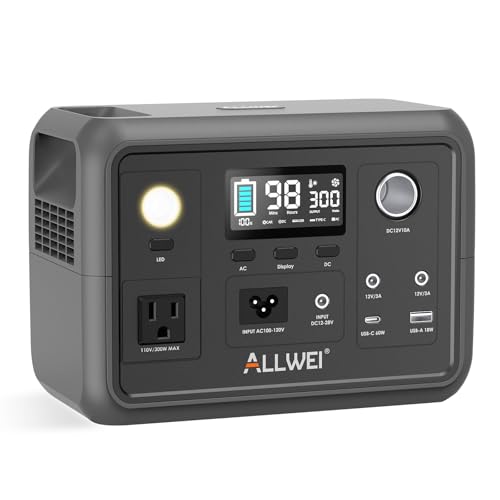
ALLWEI Portable Power Station 300W, 256Wh LiFePO4 Battery
  • 256Wh, 300W (600W surge), 6.4 lbs
  • 2-2.5hr full charge (AC+solar combined)
  • 6-layer BMS, pass-through charging
Check price on Amazon for ALLWEI Portable Power Station 300W, 256Wh LiFePO4 Battery (opens in a new tab)
Best for: Buyers prioritizing 256wh, 300w (600w surge), 6.4 lbs

Our take

3000 charge-discharge cycles document nearly a decade of regular use, backed by 6-layer BMS protection and pass-through charging that lets you charge the station and devices simultaneously.

Why it made the shortlist

This 256Wh LiFePO4 station delivers 300W continuous power with a 600W peak surge through pure sine wave output, genuinely safe for laptops, mini fridges, CPAP machines, and drones. Six output ports include an AC outlet, dual DC5521 ports, a car cigarette lighter port, an 18W USB-A, and a 60W USB-C PD.

Flexible recharging spans AC wall (3.5-4 hours), 12V car (3.5-4 hours), solar with a 100W panel (4-5 hours), or dual AC+solar charging that cuts full recharge to just 2-2.5 hours, with a built-in MPPT controller optimizing solar efficiency and a 3-level LED light with SOS mode for emergencies.

What works

  • Dual AC+solar charging cuts full recharge to a genuine 2-2.5 hours
  • Pass-through charging lets you charge station and devices at once
  • 6.4 lbs and compact size make this genuinely backpack-portable

Watch out for

  • 100W solar panel for fastest charging is sold separately
  • 300W rated output limits use to lighter appliances only
04
Jackery Explorer 300 Portable Power Station, 292Wh
  • 292Wh, 300W (600W surge), 7.5 lbs
  • 11+ year life, 4000+ cycles
  • 6 devices, USB-C PD 100W
Check price on Amazon for Jackery Explorer 300 Portable Power Station, 292Wh (opens in a new tab)
Best for: Buyers prioritizing 292wh, 300w (600w surge), 7.5 lbs

Our take

Solar charging with a 100W panel reaches 80% in about 2.8 hours, or a portable 40W panel gets there in 7.5 hours, genuinely flexible for different outdoor setups.

Why it made the shortlist

At just 7.5 lbs, this is documented 17% lighter than the industry average for its class, with an integrated handle genuinely built for long hikes. Six devices connect at once across 2 AC outlets, a 100W USB-C PD port, 2 USB-A ports, and a 120W car port, with 300W rated output and 600W peak surge.

What works

  • 7.5 lbs is documented 17% lighter than the industry average
  • 11+ year service life is genuinely long for this capacity
  • USB-C PD 100W charges devices without a separate adapter

Watch out for

  • 300W rated output limits higher-draw appliances
  • No included solar panel for the documented charge times
05
Takki 111Wh Portable Solar Generator with 21W Foldable Solar Panel
  • 111Wh, includes 21W solar panel (23% eff.)
  • 2.29 lbs, 5.7x4.13x3in
  • Publishes specific device runtimes
Check price on Amazon for Takki 111Wh Portable Solar Generator with 21W Foldable Solar Panel (opens in a new tab)
Best for: Buyers prioritizing 111wh, includes 21w solar panel (23% eff.)

Our take

At just 2.29 lbs and 5.7x4.13x3 inches, both the station and folded panel (0.92 lbs) are genuinely backpack-portable.

Why it made the shortlist

This 111Wh (30,000mAh) station documents specific real-world runtimes: 6+ phone charges, 3+ tablet charges, about 2 hours running a 40W CPAP, and about 10+ hours for a small fan, concrete numbers rather than vague claims. The included 21W foldable panel reaches full charge outdoors in 6-7 hours with a genuine 23% conversion efficiency and 10 different DC connector sizes for wide compatibility.

A 3-level LED flashlight and a separate 2-level light panel both include SOS mode, and an AC charger reaches full charge in about 6 hours, positioning this specifically for hiking, off-grid, and power-outage emergency kits.

What works

  • Publishes specific documented runtimes instead of vague marketing claims
  • 21W bundled panel with 10 connector sizes has genuinely wide compatibility
  • 2.29 lbs makes the whole kit genuinely backpack-portable

Watch out for

  • Small 111Wh capacity limits use to genuinely light devices
  • Solar charging takes 6-7 hours, slower than AC alone

Methodology

How We Built This Shortlist

Each pick was assessed across 5 criteria weighted for real-world use.

01

Rated Wh Verified Against Usable Energy

Checked documented battery capacity separately from continuous AC output, since a high wattage rating doesn't guarantee enough stored energy to run a device for long.

02

Continuous Output vs Surge Separated

Compared continuous inverter rating against surge or boost mode claims, since many listings blend the two into one headline number.

03

Charging Speed and Path Documented

Verified AC, solar, and car charging times from official specs, noting where fastest speeds require specific modes, apps, or additional hardware.

04

Safety and Certification Evidence Checked

Looked for UL, UL2743, or other documented safety certification and battery chemistry evidence rather than trusting a safety claim alone.

05

Real Ownership Costs Included

Weighed included cables, solar panel bundling, warranty length, and app requirements as part of the real cost and usability of each pick.

Decision guide

Match a Budget Portable Power Station to Your RV

Date-Stamp Current Price

Verify budget portable power stations's current street price and include any required charger, panel, or cable accessories in the total cost.

Require Safety Documentation Before Scoring Price

Require clear battery chemistry and safety or certification documentation before factoring price into the ranking.

Measure Usable Wh, Not Nominal Values

Measure usable Wh and continuous AC output rather than trusting nominal headline values alone.

Check Replacement and Warranty Support

Verify replacement and warranty support, plus app or firmware availability where applicable.

Price the Total Accessory Cost

Price necessary solar panels, cables, and chargers before declaring the total value of a budget pick.

FAQ

Before You Bring One Home

What's the biggest mistake buyers make shopping for budget portable power stations?

Trusting a single headline wattage or watt-hour number without checking whether it describes continuous output, surge capability, or rated versus usable energy.

Should I prioritize price or documented safety certification for budget portable power stations?

Safety documentation first, since an uncertified battery pack carries real risk regardless of price. Narrow the field by verified chemistry and certification, then compare price among finalists.

What's the real difference between watts and watt-hours for a power station?

Watts (W) measure how much power the station can deliver at once, essentially how many devices it can run simultaneously, while watt-hours (Wh) measure total stored energy, essentially how long it can run those devices. A station with high W but low Wh can power a lot at once but only briefly.

Is LiFePO4 battery chemistry actually safer than standard lithium-ion?

LiFePO4 (LFP) cells are generally considered more thermally stable than standard lithium-ion or lithium-polymer cells, with a lower risk of thermal runaway, and most current portable power stations have shifted to LFP for this reason. Still, verify UL or UL2743 safety certification directly rather than assuming chemistry alone guarantees safety.

Can I use any solar panel with a portable power station?

Not always. Some manufacturers restrict compatibility to their own branded panels or require a specific voltage and connector type, so check the station's documented solar input specs and connector type before assuming a third-party panel will work.

Bottom line

The short version

Browse more budget portable power stations on Amazon →
Bowen Higgins, RV Editor at RV Gear Lab

About the author

Bowen Higgins

RV Editor at RV Gear Lab

Bowen covers RV power, water systems, towing and leveling, upkeep and interior comfort, with a focus on matching gear to the rig, the hookups and the way you actually travel.

More from Bowen →Editorial standards

Keep reading

Related guides