

We research everything we recommend. When you buy through our links, we may earn a commission. Learn more

Buying guide · 11 min read · Updated October 2, 2026

6 Best Budget Solar Charge Controllers for Lithium in 2026: A Practical RV Guide

Six solar charge controllers that name LiFePO4 or lithium support, checked for charge profile, app control and what they leave out at a low price.

Bowen HigginsBy Bowen HigginsRV Editor at RV Gear Lab6 products comparedSpec-sheet researched

At a glance

Our top picks

At a glance · 6 picks

Lithium compatible is the most overused phrase on a solar controller listing. A true lithium profile holds a fixed absorption voltage, skips the equalize stage that damages lithium cells and stops charging when the battery is full. A board that merely accepts a lithium battery may do none of those things.

So the question for these six picks is how convincingly each one describes its lithium behavior. Two give a clear mode selection, two add Bluetooth to adjust settings, and two are plain boards that name lithium types in the title.

Cold is the other trap. Lithium should not be charged below freezing unless the battery has a heater or BMS protection, and a budget controller usually cannot read the battery temperature. Whichever pick you choose, the battery's own BMS is the real low-temperature safeguard.

RV Gear Lab field notes

The Rig Fit Check

Start with the job
ECO-WORTHY 30A 12/24V PWM Solar Charge Controller with Bluetooth | Solar Panel Battery Intelligent Regulator leads this shortlist for Lithium owners who want Bluetooth monitoring on a 30A board.. Use that fit as a reference point, then compare the alternatives against your own space and workload.
Specs that separate the picks
The first details to compare are 30A PWM, 12V/24V, 30A PWM, 12V/24V auto, MPPT, 12V/24V auto. Confirm the exact model and included components before ordering.
Trade-off to plan for
Most expensive pick here

Before you buy

What Matters Before You Choose a Budget Solar Charge Controller for Lithium

Key buying criteria so you get the right fit the first time.

  1. 01

    A true lithium profile

    Lithium wants a fixed absorption voltage, commonly around 14.4 to 14.6V on a 12V LiFePO4 bank, and no equalization stage. A listing that names LiFePO4 and a selectable mode normally contains that profile. A bare compatible claim may leave the battery undercharged. Search for the chemistry by name and for a mode selector.

  2. 02

    No equalization

    Equalization pushes lead-acid cells to a higher voltage to even them out, and it harms lithium. Controllers that run it on every battery type are a risk. Pick a lithium mode that disables equalization. Do not use a lead-acid mode as a shortcut.

  3. 03

    Adjustable parameters

    Different lithium batteries specify different charge voltages. Adjustable absorption and float voltage can match the battery maker's numbers. Bluetooth or a menu is the usual route. Follow the battery datasheet.

  4. 04

    Low-temperature behavior

    Charging lithium below freezing can damage cells unless the battery has a heater or BMS cutoff. Most budget controllers cannot read battery temperature. The battery's BMS is the real protection. Choose a battery with low-temperature protection for cold climates.

  5. 05

    Charge current and panel size

    A 20A controller passes about 260 watts on 12V and a 30A unit about 390. Match the amps to the array, and make sure the battery accepts that charge rate. Lithium banks accept high rates, which makes MPPT more valuable. Divide watts by 12 and add a margin.

  6. 06

    Monitoring and protections

    A readout of battery voltage lets you confirm the bank reaches its absorption target. Short circuit and reverse polarity protection guard wiring. Bluetooth makes adjustment easier. Treat these as supporting features after chemistry.

Our standards

Why You Can Trust RV Gear Lab

At RV Gear Lab, we compare products based on rig fit and power or hookup compatibility, verified specifications, usability, setup requirements, weight, durability, and real-world trade-offs. We do not rank products purely on marketing claims or commission rates.

We have not personally tested every product listed. Where hands-on testing is not available, recommendations are based on verified manufacturer specifications, product documentation, use-case fit, and comparative research.

How we review RV gear →

Detailed reviews

The 6 best budget solar charge controllers for lithium, explained

01
Best for: Lithium owners who want Bluetooth monitoring on a 30A board.

Our take

Wireless setup and monitoring justify its top price position, and they make adjusting a lithium profile far easier than on a plain button board.

Why it made the shortlist

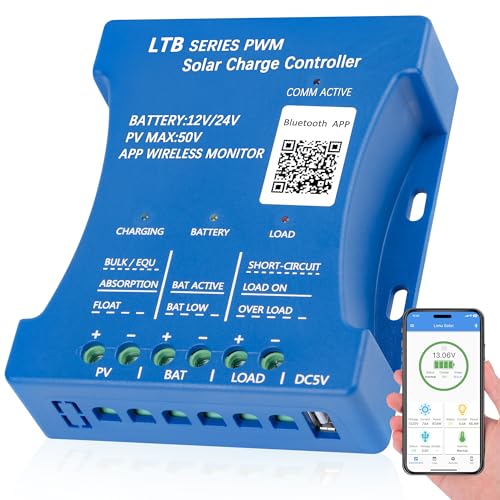
The ECO-WORTHY 30A is a PWM controller for 12V and 24V systems with built-in Bluetooth for app control. Advanced components monitor voltage and current, and an industrial chip handles regulation.

Lead-acid, gel and lithium phosphate batteries are all named as suitable. Short circuit, open circuit and reverse protections are listed.

What works

  • Bluetooth app control built in
  • Names lithium phosphate batteries
  • Industrial control chip
  • Short and reverse protections

Watch out for

  • Most expensive pick here
  • PWM wastes extra panel voltage
02
Best for: Lithium banks needing app-based setup with five battery types.

Our take

An app route to lithium settings arrives at a lower outlay than the ECO-WORTHY.

Why it made the shortlist

The TCEUMIK 30A PWM supports wireless connection through a mobile app and fits sealed, gel, flooded, LiFePO4 and lithium batteries. The controller identifies the battery type after the battery is connected first.

It auto-matches 12V or 24V and uses three-stage PWM charging. Connecting the battery before the panel lets the unit set itself correctly.

What works

  • App-based wireless setup
  • Names LiFePO4 and lithium
  • Three-stage PWM charging
  • Auto-matches 12V or 24V

Watch out for

  • App quality varies
  • Thin brand support
03
Best for: Lithium owners who want MPPT tracking and three clear battery modes.

Our take

Priced near the entry level, it delivers MPPT tracking with a clear mode system, an uncommon pairing at this tier.

Why it made the shortlist

The HHFLY is an MPPT controller that auto-detects 12V or 24V and ships in mode b1 for lead-acid, ready out of the box. Separate lithium modes are selected from the menu.

Three-stage charging runs bulk, absorption and float, and the large LCD cycles through battery voltage and temperature when the menu key is pressed. USB output is shared at 5V and 2A.

What works

  • Three clear battery modes
  • LCD cycles voltage and temperature
  • Dual USB included

Watch out for

  • Ships set for lead-acid
  • Few published electrical limits
04
Best for: A single panel maintaining a small 12V lithium battery outdoors.

Our take

A small outdoor setup that needs MPPT in a sealed body suits this lower-tier unit.

Why it made the shortlist

The SOLPERK MPPT 10A is a waterproof controller for 12V batteries that monitors system voltage automatically and tracks maximum power. LED indicators show battery and panel status.

Multiple protection functions extend battery life and guard against wiring faults. It is small enough for tight spots and sealed against the weather.

What works

  • MPPT in a sealed small body
  • Simple LED status lights
  • Multiple built-in protections
  • Right size for one panel

Watch out for

  • Ten amps limits array size
  • Lithium profile not described in detail
05
Best for: 12V LiFePO4 owners who want quick wiring and an LCD.

Our take

A 12V lithium van that needs a clear display suits this lower-middle option.

Why it made the shortlist

The Rolokit 20A is a 12V PWM controller that the maker calls compatible with lithium, LiFePO4, AGM and gel batteries. It is built for 12V solar systems with minimal setup.

A real-time LCD and battery level indicator replace guesswork with numbers, and six layers of protection cover the usual faults. A stay-cool design keeps it running reliably.

What works

  • Names LiFePO4 on the title
  • Real-time LCD with battery level
  • Six protection layers
  • Quick wiring design

Watch out for

  • 12V systems only
  • Twenty amps caps array size
06
Best for: The lowest-outlay board that names lithium on its listing.

Our take

Nothing else here undercuts it for a lithium-capable 30A board.

Why it made the shortlist

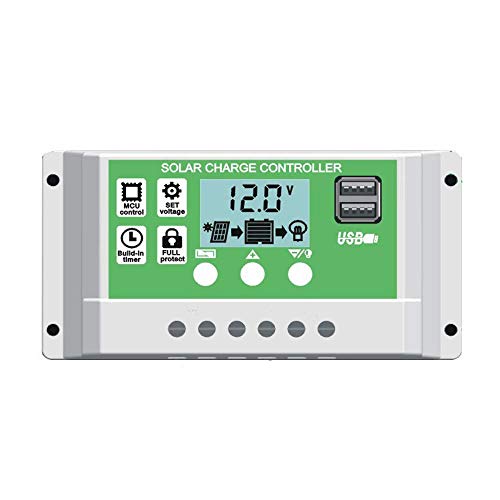
The EpRec 30A is the entry pick, a four-stage PWM controller for 12V and 24V systems fit for lithium-ion, lithium iron phosphate and lead-acid batteries. PV, battery and load charge and discharge parameters appear on a backlit LCD.

Small devices draw power from the shared USB ports. Dual MOSFET reverse current, overheat, under-voltage discharge and short circuit protections are listed.

What works

  • Lowest outlay of the six
  • Names lithium-ion and LiFePO4
  • Four-stage PWM charging
  • Dual MOSFET protection

Watch out for

  • Lithium profile detail is thin
  • Basic brand and support

Methodology

How We Built This Shortlist

Each pick was assessed across 5 criteria weighted for real-world use.

01

How lithium is described

We evaluated how each listing describes lithium handling, from a named LiFePO4 mode to a vague compatible label. Product specs that explain selection earned the most credit. A bare claim ranked lower.

02

Setup and visibility

Bluetooth, app control and clear LCDs make it easier to confirm a profile. We compared what each unit lets you see and change. That separated the top two from the plain boards.

03

PWM against MPPT

Only some picks track maximum power. We weighed MPPT advantages against the simplicity of PWM. Our analysis noted that lithium banks often use higher-voltage panels where MPPT gains.

04

Weather and size

Sealed bodies and compact designs matter for small installs. We compared the stated sealing and the current ratings. That shaped who each suits.

05

Price ordering

Prices set the order and are never printed. The step from the cheapest EpRec up to the ECO-WORTHY buys wireless monitoring and tuning rather than more amps.

Decision guide

Match a Budget Solar Charge Controller for Lithium to Your RV

By How You Want to Set the Profile

Lithium settings are easier with the right interface.

PreferenceNeedPick
Phone app with BluetoothWireless adjustmentECO-WORTHY 30A
App plus five battery typesRemote setupTCEUMIK 30A PWM
Menu key and clear modesThree battery modesHHFLY MPPT
Plain LCD for a 12V bankDirect numbersRolokit 20A
No setup effortPreset lithium namedEpRec 30A

By Budget

Positions within this shortlist.

BandWhat the step buysPick
Entry of this shortlistThirty amps, lithium namedEpRec 30A
LowSealed MPPT for a small bankSOLPERK MPPT 10A
Low-midClear LCD and 12V LiFePO4 focusRolokit 20A
MidMPPT with three battery modesHHFLY MPPT
Upper-midApp setup and five battery typesTCEUMIK 30A PWM
TopBluetooth monitoring on 30AECO-WORTHY 30A

MPPT vs PWM for Lithium

Tracking method matters more with higher-voltage panels.

MPPT

Recovers surplus panel voltage, which helps with higher-voltage panels and a bank that charges fast. Picks: HHFLY MPPT and SOLPERK MPPT 10A.

PWM

Simple and inexpensive when panels match the battery voltage. Picks: ECO-WORTHY 30A, TCEUMIK 30A PWM, Rolokit 20A and EpRec 30A.

Choose HHFLY MPPT for higher-voltage panels, or ECO-WORTHY 30A when app control matters most.

By Bank Voltage and Size

Matching current and voltage prevents surprises.

BankNeedPick
12V, small battery, one panel10A sealedSOLPERK MPPT 10A
12V, medium roof20A with LCDRolokit 20A
12V or 24V, large roof30ATCEUMIK 30A PWM
24V lithium bank12V/24V autoHHFLY MPPT

For Winter and Cold Climates Specifically

Cold exposes the limits of budget controllers.

Look for

A battery with BMS low-temperature cutoff, MPPT tracking and a visible temperature readout.

In this comparison

HHFLY MPPT shows temperature on its LCD, and ECO-WORTHY 30A lets you adjust settings over Bluetooth.

When to Spend More

Know when wireless features justify the step up.

Spend more if

You tune charge voltages or monitor from inside. ECO-WORTHY 30A and TCEUMIK 30A PWM add Bluetooth and app control.

Save if

The battery ships with a standard profile and you check it rarely. EpRec 30A and Rolokit 20A keep the outlay low.

FAQ

Before You Bring One Home

What makes a controller lithium-ready?

A fixed absorption voltage near the battery maker's figure, no equalization and ideally a selectable lithium mode. ECO-WORTHY 30A and HHFLY MPPT describe battery modes. A bare compatible label is a weaker signal.

Can I charge LiFePO4 with a lead-acid mode?

It is risky, because the equalize or higher float stage can stress lithium. Pick a controller with a lithium mode or adjustable voltages. Follow the battery datasheet.

Do these controllers protect lithium in the cold?

Mostly no. Budget controllers rarely read battery temperature, so the battery's BMS or heater provides low-temperature protection. HHFLY MPPT shows temperature, which helps you see conditions.

Is Bluetooth worth it on a controller?

It helps if you adjust voltages or like to monitor from inside the rig. ECO-WORTHY 30A and TCEUMIK 30A PWM offer it. A plain LCD is fine for a set-and-forget bank.

Why does the HHFLY ship in lead-acid mode?

The listing states it arrives set to mode b1 for lead-acid so it works out of the box. You select a lithium mode from the menu. Do this before connecting a lithium bank.

What panel size should I match to 30A?

Around 300 watts on a 12V battery with margin. Divide panel watts by 12 and add a quarter. Larger arrays need a bigger controller.

Bottom line

The short version

Browse more budget solar charge controllers for lithium on Amazon →
Bowen Higgins, RV Editor at RV Gear Lab

About the author

Bowen Higgins

RV Editor at RV Gear Lab

Bowen covers RV power, water systems, towing and leveling, upkeep and interior comfort, with a focus on matching gear to the rig, the hookups and the way you actually travel.

More from Bowen →Editorial standards

Keep reading

Related guides