

We research everything we recommend. When you buy through our links, we may earn a commission. Learn more

Buying guide · 10 min read · Updated October 2, 2026

6 Best Group 31 RV Battery in 2026: A Practical RV Guide

Six Group 31 RV batteries compared on chemistry, usable energy, cranking amps and price, so you can pick the right house or dual purpose bank.

Bowen HigginsBy Bowen HigginsRV Editor at RV Gear Lab6 products comparedSpec-sheet researched

At a glance

Our top picks

Group 31 is a case size, not a promise. The same 13 inch box holds a lithium house battery, a dual purpose AGM that can also crank an engine, and a plain starting battery that will die in a few deep discharges. We sorted six listings by what they actually do, then compared stated cycles, cold amps, case dimensions and price, so you can match the label on the shelf to the job in your rig.

RV Gear Lab field notes

The Rig Fit Check

Start with the job
Litime 12V 100Ah Group 31 LiFePO4 Battery for RV leads this shortlist for RV house banks. Use that fit as a reference point, then compare the alternatives against your own space and workload.
Specs that separate the picks
The first details to compare are 12V 100Ah LiFePO4, 110Ah, 825CCA, 105Ah, 825CCA, 1072MCA. Confirm the exact model and included components before ordering.
Trade-off to plan for
Cannot start an engine, no cranking amps listed

Before you buy

What Matters Before You Choose a Group 31 RV Battery

Key buying criteria so you get the right fit the first time.

  1. 01

    Chemistry decides the job

    Group 31 describes only the case, so the same size can hold a lithium deep cycle battery, a dual purpose AGM or a starting battery. A starting battery spends its life delivering short bursts and loses capacity quickly when it runs a fridge overnight. Check the title and bullets for the words deep cycle, dual purpose or starting before anything else.

  2. 02

    Usable energy, not rated Ah

    Ah is the capacity on paper, and lead acid chemistries should normally be cycled to about 50% to protect the plates. A 100Ah AGM therefore gives roughly 50Ah of everyday use, while a 100Ah LiFePO4 can deliver close to all of its 1,280Wh. Look for a stated depth of discharge next to any cycle count.

  3. 03

    Cycle life at a stated depth

    A cycle number means little without the depth of discharge it was measured at. Interstate states 400 deep cycles for the 31-AGM7 and LiTime states 4000+ cycles at 100% DOD, which are very different promises. Divide price by cycles and treat any listing with no cycle figure as unknown.

  4. 04

    Cranking amps versus reserve

    Cold cranking amps (CCA) show how hard a battery can start an engine, while reserve capacity shows how many minutes it can supply 25 amps. You need CCA only if the battery starts something, and reserve capacity matters for house loads. Compare them on the listing, such as 825CCA with 240 minutes on the Weize.

  5. 05

    Case fit and cold limits

    A true Group 31 case is about 13 x 6.6 x 8.4 inches, and the 31M variant can place terminals differently. A tray that holds one brand may not fit another by a quarter inch. Check posted dimensions and terminal side, and for lithium confirm the charging cutoff, which is 32F on the LiTime.

Our standards

Why You Can Trust RV Gear Lab

At RV Gear Lab, we compare products based on rig fit and power or hookup compatibility, verified specifications, usability, setup requirements, weight, durability, and real-world trade-offs. We do not rank products purely on marketing claims or commission rates.

We have not personally tested every product listed. Where hands-on testing is not available, recommendations are based on verified manufacturer specifications, product documentation, use-case fit, and comparative research.

How we review RV gear →

Detailed reviews

The 6 best group 31 rv battery, explained

01
Best for: RV house banks

Our take

Pick this if the battery is a house bank, not an engine starter.

Why it made the shortlist

The LiTime is a 12V 100Ah LiFePO4 battery in the Group 31 footprint, rated for 4000+ cycles at 100% depth of discharge and meeting the ABYC E-13 standard. Its low temperature protection stops charging below 32F and stops discharging below -4F, a limit worth knowing before winter trips.

It has no cranking rating, so it will not replace a starting battery.

What works

  • 4000+ cycles at full depth means decades of weekend use
  • Nearly all of the 100Ah is usable energy
  • Expands to 4P4S for a bigger bank later

Watch out for

  • Cannot start an engine, no cranking amps listed
  • Charging stops below 32F without extra heating
02
Weize BCI Group 31M Dual Purpose AGM Battery
  • 110Ah, 825CCA
  • 240 minute reserve capacity
  • Charge at 14.4V constant
Check price on Amazon for Weize BCI Group 31M Dual Purpose AGM Battery (opens in a new tab)
Best for: Dual purpose start and house

Our take

It is $10.00 cheaper than the Marxon 105Ah and lists more capacity (110Ah against 105Ah) with the same 825CCA.

Why it made the shortlist

The Weize is a BCI Group 31M dual purpose AGM rated 110Ah, 825 cold cranking amps and 240 minutes of reserve capacity. It asks for a constant 14.4V charge, which most RV converters and generator chargers can deliver, and it is sealed and leak proof.

Pick this if one battery must both start a motorhome engine or generator and run a few lights and a fan.

What works

  • Starts engines and runs house loads in one box
  • Sealed AGM, no watering and no spills

Watch out for

  • No cycle life figure is listed
  • Dual purpose plates wear faster under deep discharge
The catch
Dual purpose plates tolerate fewer deep cycles than a true deep cycle, and the listing gives no cycle count.
03
Best for: Tight battery trays

Our take

Pick this if you have already measured a tight battery box and need the posted dimensions.

Why it made the shortlist

The Marxon is a Group 31M dual purpose battery rated 12V 105Ah, 825CCA, 1072MCA and 200 minutes of reserve capacity. The listing gives exact case dimensions of 12.99 x 6.61 x 8.35 inches and terminal layout (positive left, negative right), which is the detail that decides whether it fits a tray.

What works

  • Exact dimensions and terminal side are published
  • 825CCA starting power with 105Ah of capacity
  • Sealed lead calcium build needs no watering

Watch out for

  • Costs $10.00 more than the Weize for less capacity
  • Hardware is limited to screws, no terminal accessories
04
Best for: Cranking plus cycling

Our take

Pick this if you want the strongest published AGM cycle claim plus 925CCA in one battery.

Why it made the shortlist

The Interstate 31-AGM7 is a pure lead AGM rated 12V 100Ah, 925CCA and 1155CA. Interstate says it delivers 400 extreme deep cycles and lasts 2X longer than alloyed AGM, and it lists refrigeration, APU and uninterruptible power use.

It still costs $139.36 more than the LiTime, which lists 4000+ cycles, so the value case rests on cranking power and brand support.

What works

  • 925CCA beats every other dual purpose pick here
  • Pure lead plates claim 2X the life of alloy AGM
  • Sealed design suits cab and compartment mounting

Watch out for

  • Costs $139.36 more than the lithium LiTime
  • Only 400 cycles, far below lithium
05
Best for: 31M case required

Our take

At $459.95 it costs $35.00 more than the 31-AGM7 for the same Ah and cold cranking amps, and the listings show no spec that justifies the gap.

Why it made the shortlist

The Interstate 31M is a marine and RV dual purpose pure lead AGM rated 12V 100Ah and 925CCA, sold as Group 31M. Interstate lists the same pure lead construction and the same 2X to 3X longer life claim as the 31-AGM7.

For everyone else, the 31-AGM7 is the cheaper way to get the same published numbers.

What works

  • 925CCA gives strong cranking power for hard engine starts
  • Pure lead plates for extended service life
  • Marine rated build tolerates vibration from rough roads

Watch out for

  • Costs $35.00 more than the identical 31-AGM7
06
Best for: Starting duty only

Our take

Pick this if you need a Group 31 cranking battery for a tow vehicle or generator.

Why it made the shortlist

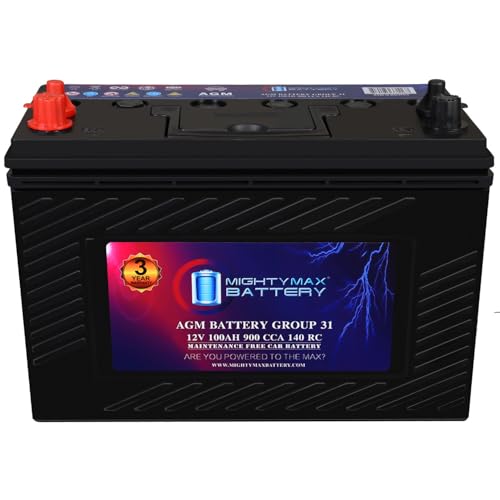
The Mighty Max MM-G31 is a 12V 100Ah AGM rated 900CCA with 140 minutes of reserve capacity, and the listing calls it a start and stop car battery. It is sealed, spill proof and built to resist shock and vibration.

Do not buy it as a deep cycle house bank, because the listing gives no deep cycle rating.

What works

  • 900CCA starting power in a sealed case
  • Spill proof design mounts in cab or bay

Watch out for

  • Shortest reserve capacity of the group

Methodology

How We Built This Shortlist

Each pick was assessed across 4 criteria weighted for real-world use.

01

Chemistry and duty

We separated lithium house batteries, dual purpose AGM and starting batteries, since each fails differently under daily cycling.

02

Usable energy

We compared stated Ah and voltage and noted the depth of discharge a normal owner can actually use.

03

Case and cranking data

We checked posted dimensions, terminal layout, cold cranking amps and reserve capacity where the listing gives them.

04

Cost over life

We weighed price against stated cycle counts, treating unlisted cycle life as unknown rather than assuming it.

Decision guide

Match a Group 31 RV Battery to Your RV

By Job in the Rig

Your situationRecommended pickWhy
Boondocking house bank, no engine startingLiTime 100Ah LithiumStated 4000+ cycles and near full usable capacity beat any AGM here.
One battery to start a generator and run lightsWeize 110Ah AGM825CCA and 110Ah in one sealed box for $239.99.
Tow vehicle or generator starting onlyMighty Max MM-G31900CCA at $229.99 with no deep cycle features you would pay for.
Fridge or APU duty with occasional crankingInterstate 31-AGM7Pure lead plates with a stated 400 deep cycle rating.

By Budget

BudgetRecommended pick
$220 to $240Mighty Max MM-G31 or Weize 110Ah AGM
$240 to $290Marxon 105Ah AGM or LiTime 100Ah Lithium
$420 to $460Interstate 31-AGM7 or Interstate 31M AGM

Lithium vs AGM

Lithium (LiFePO4)

The LiTime 100Ah Lithium can be discharged almost fully, lists 4000+ cycles and is far lighter, but it cannot crank an engine and charges only above 32F.

AGM (lead)

The Weize 110Ah AGM, Marxon 105Ah AGM, Interstate 31-AGM7, Interstate 31M AGM and Mighty Max MM-G31 can crank engines and charge in cold weather, but you should plan on using about half the rated Ah to protect plate life.

Default to lithium for a pure house bank, and pick an AGM only when the same battery has to start something.

By Budget

Best pickRecommended pick
Under $240Mighty Max MM-G31
$240 to $290LiTime 100Ah Lithium
$290 to $430Interstate 31-AGM7
Above $430Interstate 31M AGM

For Winter Camping Specifically

Look for

The charging cutoff temperature on the listing, since lithium cells can be damaged by charging when frozen.

In this comparison

The LiTime 100Ah Lithium stops charging below 32F and discharging below -4F, so below freezing the Weize 110Ah AGM is the safer charge acceptor.

When to Spend More

Spend more if

Spend more on the LiTime 100Ah Lithium ($285.59) if you cycle the battery nightly, because its stated 4000+ cycles dwarf the 400 cycles Interstate lists for the 31-AGM7.

Save if

Save with the Mighty Max MM-G31 ($229.99) if the battery only starts a tow vehicle or generator and never runs a fridge overnight.

FAQ

Before You Bring One Home

Can a Group 31 lithium battery replace my AGM house battery?

Usually yes, because the 100Ah LiTime fits the same case size. Confirm your converter or charger has a lithium profile or can hold 14.4V without a desulfation mode.

Is a dual purpose battery good for a house bank?

It works as a small house bank when it also has to start an engine, like the Weize 110Ah AGM. A dedicated deep cycle or lithium battery will outlast it under nightly cycling.

Does Group 31M differ from Group 31?

The 31M marine variant is the same size family but can use different post styles and plate construction. Compare the posted dimensions and terminal side before ordering.

How cold is too cold for the LiTime?

LiTime lists charging stopping below 32F and discharging stopping below -4F. If you camp below freezing, plan on a warm compartment or an AGM.

Bottom line

The short version

Browse more group 31 rv battery on Amazon →
Bowen Higgins, RV Editor at RV Gear Lab

About the author

Bowen Higgins

RV Editor at RV Gear Lab

Bowen covers RV power, water systems, towing and leveling, upkeep and interior comfort, with a focus on matching gear to the rig, the hookups and the way you actually travel.

More from Bowen →Editorial standards

Keep reading

Related guides