

We research everything we recommend. When you buy through our links, we may earn a commission. Learn more

Buying guide · 10 min read · Updated October 2, 2026

4 Best Lithium RV Battery Monitor in 2026: A Practical RV Guide

Four lithium-ready RV battery monitors compared by measurement method, shunt rating, alerts and price, so you can match one to your LiFePO4 bank.

Bowen HigginsBy Bowen HigginsRV Editor at RV Gear Lab4 products comparedSpec-sheet researched

At a glance

Our top picks

A lithium battery hides its state of charge. Voltage barely moves between 90 percent and 30 percent on LiFePO4, so a plain voltmeter tells you almost nothing until the pack is nearly empty. That is why the measurement method matters more than the display on a lithium RV monitor. We compared four options by how they measure, how much current they handle, and what they cost, and we flag where a listing stays silent on lithium behavior.

RV Gear Lab field notes

The Rig Fit Check

Start with the job
BINTA Shunt Battery Monitor 8-120V 0-150A Voltage Current Voltmeter Ammeter leads this shortlist for A 100Ah to 300Ah LiFePO4 bank with a modest inverter. Use that fit as a reference point, then compare the alternatives against your own space and workload.
Specs that separate the picks
The first details to compare are Shunt, 100A continuous, 150A peak, Bluetooth, 6V/12V/24V, Bluetooth 5.3, 72 days history. Confirm the exact model and included components before ordering.
Trade-off to plan for
100A continuous limit is tight for large inverters

Before you buy

What Matters Before You Choose a Lithium RV Battery Monitor

Key buying criteria so you get the right fit the first time.

  1. 01

    Shunt versus voltage readout

    A shunt measures current on the negative cable and integrates it into amp-hours, while a voltage monitor guesses from volts. LiFePO4 holds near 13.2 to 13.3V across most of its range, so a voltage guess can be off by tens of percent. Look for the words shunt, amp-hours or coulomb counting on the listing.

  2. 02

    Lithium named in the listing

    Chemistry settings change how a monitor reads charge and when it calls the pack full. A monitor tuned for lead-acid will mislabel a resting LiFePO4 bank as nearly empty or full. Check that LiFePO4 or lithium appears in the supported battery types, not just a generic 12V claim.

  3. 03

    Continuous and peak amps

    The shunt carries your entire load, so its rating caps what you can safely run through it. A 100A continuous shunt will overheat behind a 2000W inverter, which can pull over 170A at 12V. Compare the continuous figure on the listing with your inverter wattage divided by 12.

  4. 04

    Idle draw and sleep mode

    A monitor runs all the time, including while the rig is parked for months. A draw of about 1mA, as the ANCEL BM300 lists, costs under 1Ah a month, while a backlit display can pull far more. Look for a stated idle or sleep current in milliamps.

  5. 05

    Alerts, logging and display

    A screen on the wall is easy to read but only helps when you are inside, while an app can warn you from the campsite. History matters when you want to see why a bank dropped overnight. Check whether the listing names stored history length and whether alerts need the phone in Bluetooth range.

Our standards

Why You Can Trust RV Gear Lab

At RV Gear Lab, we compare products based on rig fit and power or hookup compatibility, verified specifications, usability, setup requirements, weight, durability, and real-world trade-offs. We do not rank products purely on marketing claims or commission rates.

We have not personally tested every product listed. Where hands-on testing is not available, recommendations are based on verified manufacturer specifications, product documentation, use-case fit, and comparative research.

How we review RV gear →

Detailed reviews

The 4 best lithium rv battery monitor, explained

01
Best for: A 100Ah to 300Ah LiFePO4 bank with a modest inverter

Our take

Against the Quicklynks BM7 at $39.99, it costs $5.96 less and measures real current instead of inferring charge from voltage.

Why it made the shortlist

The BINTA is a true shunt monitor at $34.03. It counts amp-hours in and out, reports state of charge, remaining capacity up to 999Ah, voltage and current, and handles 100A continuous with a 150A peak. That current counting is what makes a lithium percentage believable.

Pick this if you want a percentage you can plan around.

What works

  • Counts real amps, so lithium percentage stays meaningful
  • Backlit display readable in direct sunlight
  • Remembers saved settings even after a full power loss

Watch out for

  • 100A continuous limit is tight for large inverters
  • Wired display needs a cable run and mounting
02
Best for: A simple health check on a single house battery

Our take

It costs $5.96 more than the BINTA Shunt and $8.00 less than the ANCEL BM300, which sits in between on features.

Why it made the shortlist

The Quicklynks BM7 is a clip-on Bluetooth monitor at $39.99 that lists LiFePO4 among supported chemistries on 6V, 12V and 24V banks. It reports voltage, temperature, cranking and charging checks, and carries an IP67 rating with reverse-connection protection.

Pick this if you want phone alerts without cutting a cable.

What works

  • Installs on the terminals with no shunt wiring
  • Phone app shows voltage and temperature remotely
  • IP67 housing suits an exposed battery bay

Watch out for

  • No amp counting listed, so percentage is an estimate
  • Needs the phone nearby for live data
03

Best for Multiple Batteries · 3 of 4

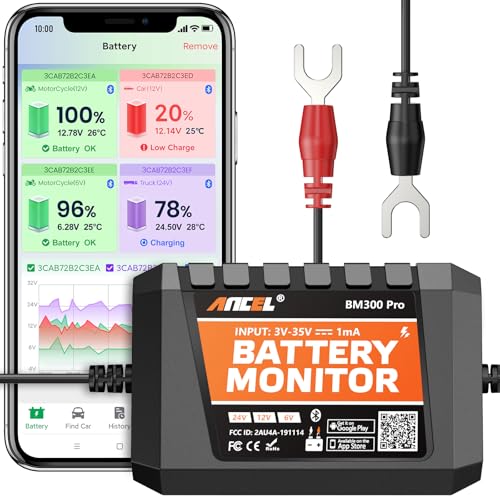
ANCEL BM300 Pro Bluetooth Battery Monitor for 6V

ANCEL BM300 Pro Bluetooth Battery Monitor for 6V
  • Bluetooth 5.3, 72 days history
  • Pairs four units per app
  • About 1mA draw, IP67
Check price on Amazon for ANCEL BM300 Pro Bluetooth Battery Monitor for 6V (opens in a new tab)
Best for: Owners watching a chassis battery plus a house bank

Our take

It is $8.00 above the Quicklynks BM7 and $13.96 above the BINTA Shunt, and the extra money buys history and multi-battery views, not current counting.

Why it made the shortlist

The ANCEL BM300 Pro costs $47.99 and covers 6V, 12V and 24V systems over Bluetooth 5.3. Each unit watches one battery, up to four in one app, and it stores 72 days of history while out of range. Idle draw is listed at about 1mA.

Pick this if you track a chassis battery and a house bank.

What works

  • One app covers up to four separate batteries
  • 72 days of stored history syncs later
  • About 1mA draw will not drain a parked bank

Watch out for

  • Lithium support is not stated
  • Estimates charge from voltage, no shunt
04
Best for: A cheap voltage readout on a small or secondary bank

Our take

Pick this if you want a cheap live voltage readout.

Why it made the shortlist

The DROK is a $17.49 panel meter listing 10-100V lithium, LiFePO4, lead-acid and NiMH packs. It shows voltage, a temperature reading and a capacity percentage you program against voltage points.

What works

  • Cheapest way to see live pack voltage
  • Wide 10-100V range suits 12V to 48V
  • Percentage points can be set by hand

Watch out for

  • Defaults to a 48V lead-acid profile
  • Temperature is the meter body, not the cells

Methodology

How We Built This Shortlist

Each pick was assessed across 4 criteria weighted for real-world use.

01

Measurement method

We separated shunt current counting from voltage-based estimates, since that decides whether a lithium percentage can be trusted.

02

Lithium support stated

We checked whether the listing names LiFePO4 or lithium, and marked silence as unverified instead of assuming support.

03

Current and voltage range

We compared continuous amps, peak amps and system voltage against typical RV inverter and bank sizes.

04

Display and alerts

We weighed wired displays, app access, stored history and idle draw against what an owner reads daily.

Decision guide

Match a Lithium RV Battery Monitor to Your RV

By Measurement Method

Your situationRecommended pickWhy
You size trips by remaining percentageBINTA ShuntIt counts amp-hours, so the number stays valid while the pack sits in the flat LiFePO4 voltage curve.
You want a quick health check from your phoneQuicklynks BM7It clips on, lists LiFePO4, and reports voltage and temperature without any shunt wiring.
You monitor a chassis battery and a house bankANCEL BM300One app shows up to four batteries, each with its own unit and stored history.
You only need to see live pack voltageDROK MeterIt is a $17.49 voltage meter with a hand-programmed percentage table.

By Budget

BudgetRecommended pick
$10 to $40DROK Meter or BINTA Shunt
$30 to $50Quicklynks BM7 or ANCEL BM300

Shunt vs Voltage-Based

Shunt (current counting)

A shunt sits on the negative cable and measures every amp, so state of charge survives LiFePO4's flat voltage curve. In this roundup that is the BINTA Shunt, limited to 100A continuous.

Voltage-based (clip-on or panel)

These infer charge from resting voltage, which is fine for lead-acid but loose for lithium mid-range. The Quicklynks BM7, ANCEL BM300 and DROK Meter all work this way.

Most lithium owners should default to the BINTA Shunt unless a wireless install matters more than percentage accuracy.

By Install Style

Best matchRecommended pick
Wired display near the bed or galleyBINTA Shunt
No cable runs, battery bay onlyQuicklynks BM7
Several batteries across rig and tow vehicleANCEL BM300
Panel mount in a golf cart or small bankDROK Meter

For a LiFePO4 House Bank Specifically

Look for

A shunt rated above your inverter's maximum DC draw, plus LiFePO4 named on the listing.

In this comparison

The BINTA Shunt matches both for banks under 100A continuous; the Quicklynks BM7 names LiFePO4 but estimates charge instead of counting amps.

When to Spend More

Spend more if

Spend more if your inverter can pull past 100A, since the BINTA Shunt tops out there and a pricier shunt avoids a failure under load.

Save if

Save if you only want a quick glance at voltage, where the DROK Meter at $17.49 does the job.

FAQ

Before You Bring One Home

Can a voltage-only monitor work with lithium?

It can show pack voltage, but its percentage will be loose because LiFePO4 voltage stays flat for most of the discharge. Use it as a health check and add a shunt if you plan around remaining capacity.

Does a lithium battery's own BMS replace a monitor?

The BMS protects the cells and often reports basic data, but it only cuts off at limits and does not always track your daily use. A separate monitor shows the trend before the BMS steps in.

What current rating should the shunt have?

Divide your inverter wattage by 12 and add headroom, so a 1000W inverter needs at least 84A before losses. The BINTA Shunt lists 100A continuous, which fits that size but not a 2000W unit.

Where does the shunt go?

It goes on the negative cable between the battery and every load and charger, with all ground paths running through it. A load wired around the shunt is not counted, which skews the percentage.

Do these monitors need calibration?

A shunt monitor needs your battery capacity and a full-charge sync point entered once, and it may drift without a periodic full charge. Voltage monitors need little setup but never become accurate.

Bottom line

The short version

Browse more lithium rv battery monitor on Amazon →
Bowen Higgins, RV Editor at RV Gear Lab

About the author

Bowen Higgins

RV Editor at RV Gear Lab

Bowen covers RV power, water systems, towing and leveling, upkeep and interior comfort, with a focus on matching gear to the rig, the hookups and the way you actually travel.

More from Bowen →Editorial standards

Keep reading

Related guides