

We research everything we recommend. When you buy through our links, we may earn a commission. Learn more

Buying guide · 10 min read · Updated October 2, 2026

5 Best Portable Power Station For Boondocking in 2026: A Practical RV Guide

Five portable power stations for boondocking, from a 2,048Wh fridge-ready unit to 6.5 lb weekend packs, sized by daily load and solar recharge.

Bowen HigginsBy Bowen HigginsRV Editor at RV Gear Lab5 products comparedSpec-sheet researched

At a glance

Our top picks

Boondocking power is a 24-hour budget, not a spec-sheet contest. A 12V fridge, a laptop, lights and a phone can eat 600 to 1,000Wh a day, so the useful question is how many sunny hours you need to refill what you used. The five stations here split into two camps: two 2,000Wh-class units that can carry a real camp, and three sub-300Wh packs that cover electronics and a small cooler. Check the output ports and the solar input cap before you trust any capacity number.

RV Gear Lab field notes

The Rig Fit Check

Start with the job
Anker SOLIX C2000 Gen2 Portable Power Station & 200W Bifacial Panel leads this shortlist for multi-day boondocking with a fridge. Use that fit as a reference point, then compare the alternatives against your own space and workload.
Specs that separate the picks
The first details to compare are 2,048Wh, 2,400W rated, 2,150Wh capacity, 292Wh LiFePO4, 7.5 lb. Confirm the exact model and included components before ordering.
Trade-off to plan for
Costs $520.00 more than the Lipower 2400W

Before you buy

What Matters Before You Choose a Portable Power Station For Boondocking

Key buying criteria so you get the right fit the first time.

  1. 01

    Daily watt-hour budget

    Watt-hours (Wh) are the amount of energy stored, so a 2,048Wh station can supply about 2,048 watts for an hour. A fridge averaging 40W uses roughly 960Wh over 24 hours, which would drain a 292Wh pack in under 8 hours. Add up your own devices before shopping and compare the total to the listed Wh.

  2. 02

    Continuous versus surge watts

    Continuous watts are what the inverter can supply steadily, and surge watts are a short burst for motors starting up. A fridge compressor can pull several times its running draw for a second. Check that rated output, not peak, exceeds your largest single appliance.

  3. 03

    Solar input ceiling

    Every station caps how many watts of solar it accepts, and extra panel wattage beyond that is wasted. A 100W panel on a 100W input refills about 500Wh on a five sun-hour day. Look for the maximum solar input line in the spec table, not the marketing claim.

  4. 04

    Standby draw

    Standby draw is the power the inverter burns just by being on. A 9W idle uses 216Wh per day, which is why Anker highlights it for fridge runtime. Look for a listed standby or idle figure and a way to switch the AC off.

  5. 05

    One-person liftability

    A station you cannot carry gets left at home, and a 40 lb unit is hard to move in a tight van. Packs of 6.5 to 8.86 lb are easy to stow in a cabinet. Check the listed weight and dimensions, and treat a missing weight as a warning.

Our standards

Why You Can Trust RV Gear Lab

At RV Gear Lab, we compare products based on rig fit and power or hookup compatibility, verified specifications, usability, setup requirements, weight, durability, and real-world trade-offs. We do not rank products purely on marketing claims or commission rates.

We have not personally tested every product listed. Where hands-on testing is not available, recommendations are based on verified manufacturer specifications, product documentation, use-case fit, and comparative research.

How we review RV gear →

Detailed reviews

The 5 best portable power station for boondocking, explained

01
Best for: Multi-day boondocking with a fridge

Our take

Against the Lipower 2400W it costs $520.00 more ($1,169.99 versus $649.99), and the extra money buys the panel, the 4kWh expansion option and a 58 minute full AC recharge.

Why it made the shortlist

The Anker SOLIX C2000 Gen 2 pairs a 2,048Wh battery with 2,400W rated and 4,000W peak output, and the listing bundles a 200W bifacial panel. That standby figure matters most when you are camped for days with no hookup.

Pick this if you boondock for several days and want solar in the box.

What works

  • Expands to 4kWh, doubling fridge runtime to about 64 hours
  • Recharges fully in 58 minutes from AC
  • Bundled 200W panel gives you a solar start

Watch out for

  • Costs $520.00 more than the Lipower 2400W
  • Weight is not listed, so check liftability
02

Best Value Large · 2 of 5

Lipower 2400W Portable Power Station

Lipower 2400W Portable Power Station
  • 2,150Wh capacity
  • 2,400W rated, 4,000W surge
  • 10ms UPS switchover
Check price on Amazon for Lipower 2400W Portable Power Station (opens in a new tab)
Best for: Big capacity on a budget

Our take

It sits $390.99 above the Jackery Explorer 300, and the difference buys about seven times the capacity.

Why it made the shortlist

The Lipower 2400W holds 2,150Wh, slightly more than the Anker SOLIX C2000, and delivers 2,400W continuous with 4,000W surge. Its 10ms UPS switchover is handy if you also plug it into shore power. The listing says it fully recharges from a wall outlet in roughly 1.5 hours.

Pick this if you want large capacity on a tighter budget.

What works

  • More capacity than the Anker at $520.00 less
  • Wall recharge in about 1.5 hours
  • 10ms switchover protects a CPAP or router

Watch out for

  • Weight and warranty are not listed
03
Jackery Explorer 300 Portable Power Station
  • 292Wh LiFePO4, 7.5 lb
  • 300W rated, 600W surge
  • 4,000+ cycle rating
Check price on Amazon for Jackery Explorer 300 Portable Power Station (opens in a new tab)
Best for: Electronics and lights

Our take

Price is $259, which is $79.01 above the DaranEner 600W.

Why it made the shortlist

The Jackery Explorer 300 is a 292Wh LiFePO4 pack weighing 7.5 lb, with 300W rated and 600W surge output. It has two AC outlets, a 100W USB-C port and a 120W car port. Jackery rates it for over 4,000 charge cycles to 70% capacity.

For that you get a longer cycle rating than the DaranEner's 3,500 and Jackery's solar pairing, with 80% in about 2.8 hours on a 100W panel. Pick this if you want a pack for phones, laptops and lights.

What works

  • Weighs 7.5 lb, easy one hand carry
  • 100W USB-C port charges a laptop fast
  • LiFePO4 cells rated over 4,000 cycles

Watch out for

  • 300W output cannot run a microwave or heater
  • Solar panel is sold separately, so budget extra
04

Best for Mini Fridges · 4 of 5

DaranEner Portable Power Station 600W

DaranEner Portable Power Station 600W
  • 288Wh LiFePO4, 8.86 lb
  • 600W rated, 1,200W peak
  • 100W solar input
Check price on Amazon for DaranEner Portable Power Station 600W (opens in a new tab)
Best for: Mini fridge and fan loads

Our take

At $179.99 it costs $79.01 less than the Jackery Explorer 300 and $30.00 more than the EnginStar 300.

Why it made the shortlist

It weighs 8.86 lb and measures 10.0 x 6.6 x 8.2 inches. It accepts a 100W solar panel, and AC charging reaches 80% in about 2 hours.

The extra 300W of output is the real gain, because small coolers and fans start with a surge. Pick this if you run a compact 12V fridge or a blender.

What works

  • 600W output handles mini fridge startup surges
  • Charges to 80% from AC in 2 hours
  • Cheaper than the Jackery by $79.01

Watch out for

  • 288Wh runs a fridge only a few hours
  • Warranty term is not listed
The catch
The caveat is 3,500 cycles and no stated warranty.
05
Best for: Lamp, fan and phone backup

Our take

At $149.99 it is the cheapest pick here, $30.00 under the DaranEner 600W.

Why it made the shortlist

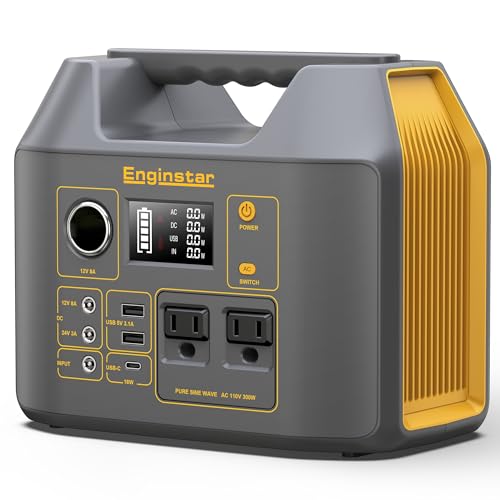
The EnginStar 296Wh is a 6.5 lb pack measuring 9 x 5.5 x 7.5 inches, with two pure sine wave 110V outlets and a 300W rating. The listing offers three charging methods: wall, car and solar. A full wall charge takes about 7 hours.

You give up the DaranEner's 600W output and faster charging. Pick this if you need a light backup for lamps, a fan and phones.

What works

  • Lightest pick here at only 6.5 lb
  • Two pure sine wave outlets for sensitive gear
  • Costs $30.00 less than the DaranEner

Watch out for

  • Full wall charge takes about 7 hours
  • 300W cap rules out most appliances

Methodology

How We Built This Shortlist

Each pick was assessed across 4 criteria weighted for real-world use.

01

Daily energy fit

We checked rated Wh against a realistic 24-hour camp load of fridge, lights and electronics.

02

Output and surge

We compared continuous watts and peak watts against motor and fridge startup demands.

03

Recharge options

We looked at AC time, listed solar input and whether a panel is bundled.

04

Carry and storage

We weighed listed weight and dimensions for one person liftability and cabinet fit.

Decision guide

Match a Portable Power Station For Boondocking to Your RV

By Daily Load

Your situationRecommended pickWhy
Fridge plus electronics, 3 or more daysAnker SOLIX C20002,048Wh with a 4kWh expansion path
Weekend with a compact fridgeLipower 2400W2,150Wh at $649.99
Phones, laptop and lights onlyJackery Explorer 300292Wh at 7.5 lb
Fan and small coolerDaranEner 600W600W output handles startup surge

By Budget

BudgetRecommended pick
$140 to $180EnginStar 300 or DaranEner 600W
$250 to $650Jackery Explorer 300 or Lipower 2400W
$1160 to $1170Anker SOLIX C2000

Big Station vs Pocket Pack

Big station

Anker SOLIX C2000 and Lipower 2400W hold over 2,000Wh and put out 2,400W, so a fridge and coffee maker both run. They cost $649.99 to $1,169.99 and weight is not listed.

Pocket pack

Jackery Explorer 300, DaranEner 600W and EnginStar 300 hold under 300Wh and weigh 6.5 to 8.86 lb. They handle electronics and lights but a fridge drains them in hours.

Most boondockers should default to a big station unless the van has no floor space.

By Recharge Source

Best fitRecommended pick
Fast AC top-up at a hookup or generatorAnker SOLIX C2000
AC recharge in about 1.5 hoursLipower 2400W
Pairs with a 100W panel for daily top-upsJackery Explorer 300
Car or wall charging only, slower is fineEnginStar 300

For Dispersed Camping With a 12V Fridge Specifically

Look for

Standby draw under 10W and enough output for compressor startup surge.

In this comparison

Anker SOLIX C2000 idles at 9W and lists 32 hours for a dual-door fridge; DaranEner 600W is the budget option for a compact unit.

When to Spend More

Spend more if

Spend more if you stay four or more days: the Anker SOLIX C2000 adds a bundled panel and 4kWh expansion for $520.00 over the Lipower 2400W.

Save if

Save if trips are short: the Jackery Explorer 300 at $259 covers phones and a laptop without paying for capacity you will not use.

FAQ

Before You Bring One Home

How big a power station do I need for boondocking?

Add up daily watt-hours for every device and aim for 1.5 times that total. A fridge, laptop and lights usually land between 600 and 1,000Wh.

Can a 300W station run a fridge?

Only a small 12V cooler, and only for part of a day. A 292Wh pack like the Jackery Explorer 300 runs out within hours on a compressor fridge.

Is LiFePO4 worth it for off-grid use?

Yes for frequent use, because LiFePO4 cells are rated for thousands of cycles. The Jackery Explorer 300 lists over 4,000, and DaranEner lists over 3,500.

Do I need a bigger solar panel than my station accepts?

No, the station caps solar input, and extra wattage is wasted. Check the maximum input before buying panels.

How should I store the station between trips?

Charge it partway and top it up every few months. EnginStar suggests a full charge every 2 to 3 months.

Bottom line

The short version

Browse more portable power station for boondocking on Amazon →
Bowen Higgins, RV Editor at RV Gear Lab

About the author

Bowen Higgins

RV Editor at RV Gear Lab

Bowen covers RV power, water systems, towing and leveling, upkeep and interior comfort, with a focus on matching gear to the rig, the hookups and the way you actually travel.

More from Bowen →Editorial standards

Keep reading

Related guides