

We research everything we recommend. When you buy through our links, we may earn a commission. Learn more

Buying guide · 10 min read · Updated October 2, 2026

5 Best Portable Power Station For CPAP in 2026: A Practical RV Guide

Five compact power stations compared for CPAP use by capacity, AC and 12V outputs, weight and price, with a simple overnight runtime method.

Bowen HigginsBy Bowen HigginsRV Editor at RV Gear Lab5 products comparedSpec-sheet researched

At a glance

Our top picks

A CPAP is a small, steady load, so capacity and clean output matter more than raw wattage. Many machines draw roughly 30 to 60W without a heated humidifier, and a humidifier can raise that sharply, so check your own power label. We compared five compact stations by watt-hours, outlet types, weight and price, and we mark every spec a listing leaves out.

RV Gear Lab field notes

The Rig Fit Check

Start with the job
LIPOWER Portable Power Station leads this shortlist for A nightly CPAP user who wants pass-through charging. Use that fit as a reference point, then compare the alternatives against your own space and workload.
Specs that separate the picks
The first details to compare are 296Wh, 300W rated, 600W peak, 256Wh LiFePO4, 3000 cycles, 296Wh, 300W, two AC outlets. Confirm the exact model and included components before ordering.
Trade-off to plan for
Battery chemistry is not listed, so cycle life is unknown

Before you buy

What Matters Before You Choose a Portable Power Station For CPAP

Key buying criteria so you get the right fit the first time.

  1. 01

    Watt-hours against CPAP draw

    Runtime equals usable watt-hours divided by your CPAP's draw, and many machines use roughly 30 to 60W without a heated humidifier. A 296Wh unit at 85 percent usable gives about 250Wh, around 6 hours at 40W. Read the wattage on your power supply label, then divide.

  2. 02

    Heated humidifier load

    A heated humidifier can multiply the draw several times, so a station that lasts a night dry can die by morning. If you run one, plan for the higher figure on your label. Turn the heater off or use a rainout-free setting to stretch runtime.

  3. 03

    Pure sine output

    Pure sine AC is smooth, as the EnginStar 300W and DaranEner 288Wh list, and sensitive electronics prefer it. Modified output can cause noise or errors on a CPAP motor. Look for pure sine wave in the bullet points, not only a wattage.

  4. 04

    12V direct output

    A CPAP with a 12V cable avoids inverter conversion, which wastes 10 to 20 percent. The DaranEner 288Wh lists a 12V/120W car port and the Powkey 192Wh two 12V 10A outputs. Check your CPAP's DC adapter voltage before relying on this.

  5. 05

    Weight and carry

    A unit you can lift with one hand is easier to keep by the bed. The ALLWEI 256Wh at 6.4 lb and Powkey 192Wh at 4.7 lb are easy; the LiPower TP300 at 9.2 lb is heavier. Treat an unlisted weight, as with the DaranEner 288Wh, as a question for the seller.

Our standards

Why You Can Trust RV Gear Lab

At RV Gear Lab, we compare products based on rig fit and power or hookup compatibility, verified specifications, usability, setup requirements, weight, durability, and real-world trade-offs. We do not rank products purely on marketing claims or commission rates.

We have not personally tested every product listed. Where hands-on testing is not available, recommendations are based on verified manufacturer specifications, product documentation, use-case fit, and comparative research.

How we review RV gear →

Detailed reviews

The 5 best portable power station for cpap, explained

01

Best Overall · 1 of 5

LIPOWER Portable Power Station

LIPOWER Portable Power Station
  • 296Wh, 300W rated, 600W peak
  • Pass-through charging, 1 hour recharge
  • 9.2 lb, 8 ports
Check price on Amazon for LIPOWER Portable Power Station (opens in a new tab)
Best for: A nightly CPAP user who wants pass-through charging

Our take

At $249.99 it costs $100.00 more than the EnginStar 300W and $46.24 more than the DaranEner 288Wh.

Why it made the shortlist

It packs 296Wh, 300W rated and 600W peak output, weighs 9.2 lb, and offers 8 ports, 120V AC, dual 100W USB-C PD and a DC output. It also lists pass-through charging and a 1-hour recharge.

Pick this if you want a pass-through unit built around CPAP.

What works

  • Listing names CPAP use directly, so fit is less guesswork
  • Pass-through lets it run while recharging
  • Fast one-hour recharge before a trip

Watch out for

  • Battery chemistry is not listed, so cycle life is unknown
  • $100.00 above EnginStar 300W for similar capacity
02

Best LiFePO4 Pick · 2 of 5

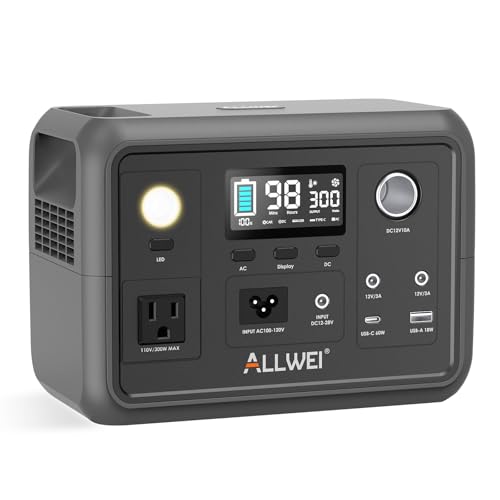
ALLWEI Portable Power Station 300W

ALLWEI Portable Power Station 300W
  • 256Wh LiFePO4, 3000 cycles
  • 300W rated, 600W peak
  • 6.4 lb, DC5521 and car ports
Check price on Amazon for ALLWEI Portable Power Station 300W (opens in a new tab)
Best for: A traveler with a CPAP and a 12V cable

Our take

Pick this if you want LiFePO4 at a low price.

Why it made the shortlist

The ALLWEI 256Wh uses LiFePO4 cells rated for 3,000 cycles, and delivers 300W continuous and 600W peak through one AC outlet, DC5521 ports, a car socket and a 60W USB-C. It weighs 6.4 lb and measures 9.25 by 5 by 6.81 inches.

What works

  • Lightweight at 6.4 lb for travel
  • Car and DC ports allow a 12V CPAP cable

Watch out for

  • 256Wh is the thinnest capacity of the 300W units
  • Only one AC outlet, so a CPAP uses the whole plug
03
Best for: A budget buyer who wants the most overnight capacity

Our take

Pick this if the most capacity per dollar is the priority.

Why it made the shortlist

The EnginStar 300W holds 296Wh, outputs 300W through two 110V pure sine AC outlets, and weighs 6.5 lb in a 9 by 5.5 by 7.5 inch body. It carries ETL certification, a voltage and temperature protecting BMS, and charges from a 12-25V solar panel, a wall plug or a car.

What works

  • Two pure sine AC outlets, safe for sensitive CPAP electronics
  • ETL certification stated on the listing

Watch out for

  • Battery chemistry is not stated, so cycle life is unknown
  • Only a 12 month service term listed
04

Best for 12V CPAP Cables · 4 of 5

Portable Power Station 600W Surge

Portable Power Station 600W Surge
  • 288Wh, 350W (600W surge)
  • 12V/120W car port, 60W USB-C
  • Wall charge up to 90W
Check price on Amazon for Portable Power Station 600W Surge (opens in a new tab)
Best for: A CPAP with a 12V power cable

Our take

At $203.75 it is $54.75 above the ALLWEI 256Wh and $46.24 below the LiPower TP300.

Why it made the shortlist

The DaranEner 288Wh outputs 350W (600W surge) through two AC outlets, with a 12V/120W car port, a 60W USB-C PD port and two QC USB-A ports. It recharges from a wall outlet at up to 90W, a car at up to 100W, or solar with MPPT.

Pick this if your CPAP has a 12V cable, since the 120W car port avoids inverter loss.

What works

  • 12V/120W port suits a direct CPAP cable
  • Highest AC output of the 300-class units
  • MPPT solar charging is built in

Watch out for

  • Wall charging limited to 90W, so refill is slow
  • Weight is not listed, so carrying it is a guess
05

Best Ultra-Light · 5 of 5

200W Portable Power Station

200W Portable Power Station
  • 192Wh LiFePO4, 4.7 lb
  • 200W AC, two 12V 10A outputs
  • 7.1 x 5.3 x 5.5 inches
Check price on Amazon for 200W Portable Power Station (opens in a new tab)
Best for: A backup for a short nap or 12V CPAP cable

Our take

Pick this if you need a small unit for short trips or a 12V CPAP cable.

Why it made the shortlist

The Powkey 192Wh uses LiFePO4, weighs 4.7 lb and measures 7.1 by 5.3 by 5.5 inches with a foldable handle. It offers one 120V AC outlet at 200W, USB ports and two 12V 10A DC outputs.

What works

  • Lightest in this roundup at 4.7 lb
  • Two 12V 10A outputs for DC cables

Watch out for

  • 192Wh is too small for a full night
  • 200W AC limit excludes heated humidifier setups

Methodology

How We Built This Shortlist

Each pick was assessed across 4 criteria weighted for real-world use.

01

Capacity and runtime

We compared watt-hours against a typical CPAP draw and counted roughly 15 percent inverter loss for AC use.

02

Output type

We checked for pure sine AC, DC 12V ports and pass-through charging that suit sensitive medical devices.

03

Weight and size

We noted listed weights and dimensions for carry-on or tent use, and flagged missing numbers.

04

Battery chemistry

We marked LiFePO4 claims when stated and called out listings that omit the chemistry.

Decision guide

Match a Portable Power Station For CPAP to Your RV

By Nights of Runtime

Your situationRecommended pickWhy
One night, no humidifier, about 40WEnginStar 300W296Wh minus inverter loss gives around 250Wh, about 6 hours at 40W.
One night with a 12V cableDaranEner 288WhThe 12V/120W port skips inverter loss, stretching 288Wh further.
Short nap or backup onlyPowkey 192Wh192Wh gives about 4 hours at 40W.
Pass-through use with wall power availableLiPower TP300It runs your CPAP while it recharges.

By Budget

BudgetRecommended pick
$90 to $150Powkey 192Wh or ALLWEI 256Wh
$140 to $210EnginStar 300W or DaranEner 288Wh
$240 to $250LiPower TP300

AC Outlet vs 12V DC Cable

AC outlet

Works with any CPAP power brick but loses roughly 10 to 20 percent in the inverter. LiPower TP300 and EnginStar 300W are the main AC options.

12V DC cable

Feeds the CPAP directly, so a 40W load lasts longer. DaranEner 288Wh, Powkey 192Wh and ALLWEI 256Wh offer a car or DC port.

Use DC if your CPAP has a 12V cable; otherwise default to AC on the LiPower TP300.

By Budget

Best matchRecommended pick
Under $120Powkey 192Wh
$120 to $155EnginStar 300W or ALLWEI 256Wh
$155 to $220DaranEner 288Wh
Over $220LiPower TP300

For Camping Without Hookups Specifically

Look for

At least 250Wh, a 12V or DC output, and a recharge path from solar or a car.

In this comparison

The DaranEner 288Wh covers this with a 120W car port and solar MPPT; the EnginStar 300W also accepts 12-25V solar.

When to Spend More

Spend more if

Spend more on the LiPower TP300 if you want pass-through charging and a listing that names CPAP use.

Save if

Save with the EnginStar 300W at $149.99 if you want 296Wh without paying the $100.00 premium.

FAQ

Before You Bring One Home

How long will a 296Wh station run a CPAP?

Around 6 hours at 40W after inverter loss, so a typical 8 hour night is borderline. Use a 12V cable or turn off the humidifier to extend it.

Is pass-through charging safe for a CPAP?

The LiPower TP300 lists it, so it can run the CPAP while charging. Check your manual for approved backup-power guidance, since medical use needs reliability.

Can I use a station as my main medical power?

It is a convenience for travel and outages, not certified medical equipment. Keep a backup plan and ask your sleep provider if the CPAP is life-critical.

Does cold weather shorten runtime?

Batteries lose capacity in cold, and the listings give no cold-weather figure. Keep the unit inside the sleeping area.

How do I recharge between nights?

Wall recharge on the DaranEner 288Wh is limited to 90W, while the LiPower TP300 claims 1 hour. Solar or car charging also works on the EnginStar 300W.

Bottom line

The short version

Browse more portable power station for cpap on Amazon →
Bowen Higgins, RV Editor at RV Gear Lab

About the author

Bowen Higgins

RV Editor at RV Gear Lab

Bowen covers RV power, water systems, towing and leveling, upkeep and interior comfort, with a focus on matching gear to the rig, the hookups and the way you actually travel.

More from Bowen →Editorial standards

Keep reading

Related guides