


We research everything we recommend. When you buy through our links, we may earn a commission. Learn more

Buying guide · 11 min read · Updated August 19, 2026

8 Best Portable Power Stations for Fridge in 2026: A Practical RV Guide

We compared portable power stations for fridge by measured usable energy, continuous output, and safety documentation rather than ranking by headline wattage alone.

Bowen HigginsBy Bowen HigginsRV Editor at RV Gear Lab8 products comparedSpec-sheet researched

At a glance

Our top picks

Ranking portable power stations for fridge fairly means putting measuring compressor startup surge and duty cycle instead of trusting nameplate running watts ahead of anything the listing photos suggest.

We leaned on measured usable energy and safety documentation plus measuring compressor startup surge and duty cycle instead of trusting nameplate running watts to separate genuinely capable stations from well-marketed ones.

RV Gear Lab field notes

The Rig Fit Check

Start with the job
OUPES Mega 1 Lite Portable Power Station, 1024Wh 2000W (4500W Surge) leads this shortlist for buyers prioritizing 1024wh, 2000w (4500w surge), 26.7 lbs. Use that fit as a reference point, then compare the alternatives against your own space and workload.
Specs that separate the picks
The first details to compare are 1024Wh, 2000W (4500W surge), 26.7 lbs, 1024Wh, 1800W (2700W Power Lifting), 1024Wh, 1800W (3600W X-Boost surge). Confirm the exact model and included components before ordering.
Trade-off to plan for
800W solar recharge speed requires three 240W panels

Before you buy

What Matters Before You Choose a Portable Power Station for Fridge

Key buying criteria so you get the right fit the first time.

  1. 01

    Measure Compressor Startup Surge

    Check portable power stations for fridge's documented startup surge and running draw against the actual refrigerator or a representative compressor load.

  2. 02

    Estimate Runtime From Duty-Cycle Logging

    Estimate runtime using duty-cycle behavior and measured usable AC energy, not a single running-watts figure.

  3. 03

    Test Restart at Low Charge

    Verify restart behavior after the station reaches low state of charge or after a brief transfer event.

  4. 04

    Compare Inverter Efficiency at Low Average Load

    Compare inverter efficiency at the refrigerator's relatively low average load, since efficiency varies by load level.

  5. 05

    Plan for Food Safety, Not Just Power

    Treat this as food-safety backup planning rather than trusting one power station to guarantee a fixed duration for every fridge.

Our standards

Why You Can Trust RV Gear Lab

At RV Gear Lab, we compare products based on rig fit and power or hookup compatibility, verified specifications, usability, setup requirements, weight, durability, and real-world trade-offs. We do not rank products purely on marketing claims or commission rates.

We have not personally tested every product listed. Where hands-on testing is not available, recommendations are based on verified manufacturer specifications, product documentation, use-case fit, and comparative research.

How we review RV gear →

Detailed reviews

The 8 best portable power stations for fridge, explained

01
OUPES Mega 1 Lite Portable Power Station, 1024Wh 2000W (4500W Surge)
  • 1024Wh, 2000W (4500W surge), 26.7 lbs
  • 46-min 0-100% AC recharge
  • 800W solar input, 70-min full charge
Check price on Amazon for OUPES Mega 1 Lite Portable Power Station, 1024Wh 2000W (4500W Surge) (opens in a new tab)
Best for: Buyers prioritizing 1024wh, 2000w (4500w surge), 26.7 lbs

Our take

Dual 140W PD USB-C ports charge laptops at maximum speed without bulky adapters, and under-20ms UPS switchover protects CPAP machines and routers.

Why it made the shortlist

A massive 1400W AC input delivers a genuine 0-100% recharge in 46 minutes, among the fastest full charges documented at this capacity. The rated 2000W output with 4500W surge capacity handles a stated 99% of high-power appliances including hair dryers and power tools through pure sine wave delivery.

Up to 800W solar input via Anderson port reaches full recharge in as fast as 70 minutes with three 240W panels, and at 26.7 lbs, this stays genuinely trunk-portable despite the 1024Wh capacity.

What works

  • 46-minute full AC recharge is genuinely among the fastest here
  • 800W solar input reaches full charge in just 70 minutes
  • Dual 140W PD USB-C ports charge laptops without bulky adapters

Watch out for

  • 800W solar recharge speed requires three 240W panels
02
BLUETTI Elite 100 V2 Portable Power Station, 1024Wh 1800W
  • 1024Wh, 1800W (2700W Power Lifting)
  • 70-min fast charge, 30dB silent mode
  • 25 lbs, 17L compact design
Check price on Amazon for BLUETTI Elite 100 V2 Portable Power Station, 1024Wh 1800W (opens in a new tab)
Best for: Buyers prioritizing 1024wh, 1800w (2700w power lifting)

Our take

Silent mode runs at just 30dB, 50% quieter than typical 1kWh stations, genuinely suited to overnight camping or indoor use.

Why it made the shortlist

1800W rated output (2700W with Power Lifting) genuinely covers 90% of everyday appliances across 11 ports, and 1200W TurboBoost AC charging or up to 1000W solar input delivers a documented 70-minute full recharge, the fastest solar charge rate BLUETTI states for this capacity class.

What works

  • 30dB silent mode is 50% quieter than typical 1kWh stations
  • 70-minute fast charge is genuinely quick for this capacity
  • 25 lbs and 17L is compact for the power delivered

Watch out for

  • Fastest charging requires the 1200W TurboBoost mode
  • Silent mode likely trades off maximum charge speed
03
EcoFlow DELTA 3 Classic Portable Power Station, 1024Wh 1800W
  • 1024Wh, 1800W (3600W X-Boost surge)
  • 45-min 0-80% X-Stream charge
  • <10ms UPS switchover
Check price on Amazon for EcoFlow DELTA 3 Classic Portable Power Station, 1024Wh 1800W (opens in a new tab)
Best for: Buyers prioritizing 1024wh, 1800w (3600w x-boost surge)

Our take

Under-10ms UPS switchover protects PCs and medical devices from data loss during outages, and LiFePO4 cells rated for 10+ years pair with EV-grade CTC design for durability.

Why it made the shortlist

X-Stream AC charging hits 0-80% in a genuine 45 minutes.

A 500W solar panel (sold separately) recharges the unit in 2.5 hours, and the EcoFlow app adds Storm Alert and Self-Powered Mode for proactive outage prep.

What works

  • X-Boost expands rated output to a genuine 2600W continuous
  • 45-minute 0-80% charge is genuinely fast via X-Stream
  • Storm Alert mode proactively preps for incoming outages

Watch out for

  • Not compatible with DELTA 2 or Delta 3 Smart Extra Batteries
  • Solar panel for the 2.5-hour charge is sold separately
The catch
X-Boost technology pushes rated 1800W output to a documented 3600W surge, expandable to 2600W continuous with X-Boost for heavier loads like refrigerators and microwaves.
04
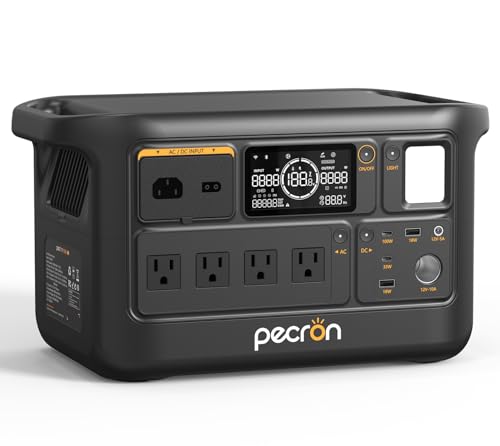
PECRON F1000LFP Power Station, 1500W AC Output, 960Wh
  • 960Wh, 1500W AC, 23.9 lbs
  • 70-min full AC charge
  • 25dB app-controlled quiet mode
Check price on Amazon for PECRON F1000LFP Power Station, 1500W AC Output, 960Wh (opens in a new tab)
Best for: Buyers prioritizing 960wh, 1500w ac, 23.9 lbs

Our take

600W solar input reaches 80% charge in 1.4 hours, and the included AC charger achieves 1000W charging for a full charge in just 70 minutes.

Why it made the shortlist

1500W pure sine wave AC output effortlessly powers refrigerators, power tools, and medical equipment from a 960Wh capacity documented to run a small refrigerator for a full day. Ten output ports include four 1500W AC outlets, dual USB-C (33W and 100W), a DC 5525 port, a cigar port, and dual USB-A, plus a 5W LED light for camping nights.

App control sets the unit to operate at a genuinely quiet 25dB, ideal for indoor office or bedroom use, and under-20ms UPS keeps computers, WiFi, and fish tanks running through blackouts. At just 23.9 lbs in a 15x8.5x8.4 inch frame, it's genuinely portable for RV or trunk storage.

What works

  • 25dB app-controlled quiet mode is genuinely bedroom-suitable
  • 70-minute full AC charge is genuinely fast for this capacity
  • 23.9 lbs with comfortable handles is genuinely RV-portable

Watch out for

  • Solar and power station ship separately per the listing
  • Car charger for continuous charging is sold separately
05
UDPOWER S2400 Portable Power Station, 2083Wh, 2400W (Surge 3000W)
  • 2083Wh, 2400W (3000W surge), 41 lbs
  • 0.01s instant backup switch
  • 1.3hr 0-100% recharge at 1600W
Check price on Amazon for UDPOWER S2400 Portable Power Station, 2083Wh, 2400W (Surge 3000W) (opens in a new tab)
Best for: Buyers prioritizing 2083wh, 2400w (3000w surge), 41 lbs

Our take

Instant backup protection switches within a documented 0.01 seconds during outages, keeping sensitive electronics running without interruption.

Why it made the shortlist

Fifteen simultaneous devices connect across 6 AC outlets, dual USB-C, four USB-A, dual DC5521, a car port, and a solar input, genuinely comprehensive for this capacity class.

What works

  • 41 lbs is genuinely lighter than similarly-rated 2000Wh+ rivals
  • 0.01-second backup switch is documented exceptionally fast
  • 15 simultaneous device ports covers nearly every connection type

Watch out for

  • 440W max solar input trails some rivals' 800W+ ceilings
  • 15-year lifespan claim depends on documented 4000-cycle usage
06
Jackery Explorer 1000 v2 Portable Power Station, 1070Wh, 1500W
  • 1070Wh, 1500W AC, 3000W surge
  • 1hr fast charge via app
  • 23.8 lbs, foldable handle
Check price on Amazon for Jackery Explorer 1000 v2 Portable Power Station, 1070Wh, 1500W (opens in a new tab)
Best for: Buyers prioritizing 1070wh, 1500w ac, 3000w surge

Our take

The LFP battery retains over 70% capacity after 4000 cycles, a documented decade-plus lifespan.

Why it made the shortlist

A 1500W AC output with a 3000W surge peak handles fridges and electric pots, and at 23.8 lbs with a foldable handle it stays genuinely liftable for camping trips. ChargeShield 2.0 technology backs a real 1-hour full charge once emergency charging is enabled in the Jackery App, defaulting to a battery-friendlier 1.7 hours otherwise.

Three pure sine wave AC ports, two USB-C, one USB-A, and a DC car port cover most devices at once, and the app's 30dB quiet overnight mode is a genuine option for light sleepers.

What works

  • 1-hour emergency charging is a genuine app-enabled feature
  • 70% capacity retained after 4000 cycles is documented
  • 23.8 lbs keeps this genuinely easy to carry

Watch out for

  • Only compatible with Jackery's own solar panels
  • 1-hour charging needs the app enabled every time
07
AFERIY P210 Solar Generator, 2048Wh Portable Power Station, 2400W
  • 2048Wh, 2400W (4800W surge), 48.5 lbs
  • 16dB at normal load, 30dB at full
  • 7-year extended warranty
Check price on Amazon for AFERIY P210 Solar Generator, 2048Wh Portable Power Station, 2400W (opens in a new tab)
Best for: Buyers prioritizing 2048wh, 2400w (4800w surge), 48.5 lbs

Our take

Sixteen ports support up to 16 simultaneous devices, including six 20Ah AC outlets, dual USB, four USB-C (20W and 100W), dual DC5521, a car port, and an XT60 port.

Why it made the shortlist

A 2400W inverter (4800W surge) exclusively uses pure sine wave for both input and output, delivering power identical to standard wall outlet quality for genuine sensitive-electronics safety. A server-level under-10ms UPS response instantaneously activates battery backup during outages.

Silent operation stays under 30dB at full load and just 16dB at normal load, genuinely quiet enough not to disturb sleep, and the AFERIY app manages energy consumption remotely. A documented 7-year extended warranty, two years longer than standard, backs this at just 48.5 lbs, 20% lighter than typical for this capacity.

What works

  • 7-year warranty is genuinely two years longer than standard coverage
  • 16dB normal-load noise is genuinely quiet for overnight use
  • 48.5 lbs is documented 20% lighter than typical for this capacity

Watch out for

  • MPPT and car charging modules require separate compatible adapters
  • 16 ports adds real setup complexity for casual users
08
GRECELL 999Wh Portable Power Station 1000W for Outdoor & Home
  • 999Wh, 1000W (2000W peak), 17 lbs
  • 800W MPPT solar input
  • 24-month warranty, 2000+ cycles
Check price on Amazon for GRECELL 999Wh Portable Power Station 1000W for Outdoor & Home (opens in a new tab)
Best for: Buyers prioritizing 999wh, 1000w (2000w peak), 17 lbs

Our take

Triple MPPT charging technology accepts AC wall power, 800W MPPT solar panels, or a 12V car port, with pass-through charging enabling simultaneous charge and discharge.

Why it made the shortlist

1000W continuous power (2000W peak) through pure sine wave AC outlets safely powers laptops, CPAP devices, mini-fridges, and rice cookers. Ten devices connect simultaneously across dual AC outlets, USB-C PD 60W, three USB-A QC ports, a wireless pad, a car port, and dual DC outputs, with individual switches controlling each module independently.

The automotive-grade battery is rated for over 2000 charge cycles, and at 17 pounds with an ergonomic handle, it's genuinely built for one-handed transport with a 24-month warranty backing it.

What works

  • 800W MPPT solar input is genuinely high for this capacity class
  • Individual port switches let you manage power module by module
  • 17 lbs with ergonomic handle is genuinely one-hand portable

Watch out for

  • 2000 rated cycles trails the 3000-4000+ common on rival LFP cells
  • 10-12 hour AC recharge time is slower than fast-charge competitors

Methodology

How We Built This Shortlist

Each pick was assessed across 5 criteria weighted for real-world use.

01

Rated Wh Verified Against Usable Energy

Checked documented battery capacity separately from continuous AC output, since a high wattage rating doesn't guarantee enough stored energy to run a device for long.

02

Continuous Output vs Surge Separated

Compared continuous inverter rating against surge or boost mode claims, since many listings blend the two into one headline number.

03

Charging Speed and Path Documented

Verified AC, solar, and car charging times from official specs, noting where fastest speeds require specific modes, apps, or additional hardware.

04

Safety and Certification Evidence Checked

Looked for UL, UL2743, or other documented safety certification and battery chemistry evidence rather than trusting a safety claim alone.

05

Real Ownership Costs Included

Weighed included cables, solar panel bundling, warranty length, and app requirements as part of the real cost and usability of each pick.

Decision guide

Match a Portable Power Station for Fridge to Your RV

Measure Compressor Startup Surge

Check portable power stations for fridge's documented startup surge and running draw against the actual refrigerator or a representative compressor load.

Estimate Runtime From Duty-Cycle Logging

Estimate runtime using duty-cycle behavior and measured usable AC energy, not a single running-watts figure.

Test Restart at Low Charge

Verify restart behavior after the station reaches low state of charge or after a brief transfer event.

Compare Inverter Efficiency at Low Average Load

Compare inverter efficiency at the refrigerator's relatively low average load, since efficiency varies by load level.

Plan for Food Safety, Not Just Power

Treat this as food-safety backup planning rather than trusting one power station to guarantee a fixed duration for every fridge.

FAQ

Before You Bring One Home

Can any portable power station reliably run a refrigerator?

Not automatically. Startup surge and duty cycle vary significantly by exact appliance model, so verify the manufacturer's documented power requirement and test with the actual device rather than assuming a generic runtime estimate applies.

Does station idle power draw meaningfully affect backup runtime?

Yes. Standby or idle power consumption varies between models, and for a low-average-load device like a fridge compressor cycling on and off, that idle draw can meaningfully shorten total backup time compared to the theoretical calculation.

What's the real difference between watts and watt-hours for a power station?

Watts (W) measure how much power the station can deliver at once, essentially how many devices it can run simultaneously, while watt-hours (Wh) measure total stored energy, essentially how long it can run those devices. A station with high W but low Wh can power a lot at once but only briefly.

Does a surge or peak wattage rating mean the station can run appliances at that power level?

No. Surge or peak ratings describe a brief burst the inverter can handle, typically for a compressor or motor startup, not a sustained output level. Always check the continuous or rated wattage figure for what the station can actually run for extended periods.

Is LiFePO4 battery chemistry actually safer than standard lithium-ion?

LiFePO4 (LFP) cells are generally considered more thermally stable than standard lithium-ion or lithium-polymer cells, with a lower risk of thermal runaway, and most current portable power stations have shifted to LFP for this reason. Still, verify UL or UL2743 safety certification directly rather than assuming chemistry alone guarantees safety.

Bottom line

The short version

Browse more portable power stations for fridge on Amazon →
Bowen Higgins, RV Editor at RV Gear Lab

About the author

Bowen Higgins

RV Editor at RV Gear Lab

Bowen covers RV power, water systems, towing and leveling, upkeep and interior comfort, with a focus on matching gear to the rig, the hookups and the way you actually travel.

More from Bowen →Editorial standards

Keep reading

Related guides