

We research everything we recommend. When you buy through our links, we may earn a commission. Learn more

Buying guide · 10 min read · Updated October 2, 2026

4 Best Quiet RV Inverter in 2026: A Practical RV Guide

Quiet RV inverters compared on fan noise claims, idle draw, transfer switches and size, so you know what silent really costs before you buy.

Bowen HigginsBy Bowen HigginsRV Editor at RV Gear Lab4 products comparedSpec-sheet researched

At a glance

Our top picks

A quiet RV inverter is mostly about fans, and fans spin faster as load rises, so a silent label at 100W tells you little about 1500W. Renogy states under 51dB, while AIMS lists no noise figure at all, so we flagged that gap. Quiet also depends on where you mount the unit, since a bedroom closet changes everything. We ranked four pure sine units on what the listings actually say.

RV Gear Lab field notes

The Rig Fit Check

Start with the job
Renogy Inverter PUH leads this shortlist for Bedroom-adjacent installs needing stated low noise. Use that fit as a reference point, then compare the alternatives against your own space and workload.
Specs that separate the picks
The first details to compare are 2000W pure sine, 2500W, 7500W surge, 1000W pure sine. Confirm the exact model and included components before ordering.
Trade-off to plan for
Noise claim states no distance or load

Before you buy

What Matters Before You Choose a Quiet RV Inverter

Key buying criteria so you get the right fit the first time.

  1. 01

    Fan noise and load

    Inverter noise comes mostly from cooling fans that speed up as load and heat rise. A unit quiet at 100W can be loud at 1500W, so a single decibel number is incomplete. Look for load-sensing fans and a stated dB figure with a load or distance, and treat missing figures as unknown.

  2. 02

    Idle draw on the battery

    Idle draw is the power the inverter uses with nothing plugged in, and it quietly drains a small bank overnight. A larger inverter usually idles higher than a smaller one. Look for no-load power in the specs, and switch the inverter off when not in use if none is listed.

  3. 03

    Transfer switch and charger

    A transfer switch moves outlets between shore power and the inverter, and an inverter charger also recharges the battery from shore. This saves a separate converter but adds cost. Check for transfer switch, charge current and auto generator start in the listing.

  4. 04

    Mounting and ventilation

    A quiet inverter stuffed in a closed cabinet runs hotter and its fans work harder, so it ends up louder. Leave airflow space around the vents and avoid mounting next to the bed on a thin wall. Look for dimensions and vent placement in the listing before choosing a spot.

  5. 05

    Safety certification

    ETL or UL listings show an independent lab tested the electrical safety of the design. Without one, protection claims are the maker's word. ALLWEI 1000 states ETL listing to UL 458, so check for that exact phrase on any inverter you consider.

Our standards

Why You Can Trust RV Gear Lab

At RV Gear Lab, we compare products based on rig fit and power or hookup compatibility, verified specifications, usability, setup requirements, weight, durability, and real-world trade-offs. We do not rank products purely on marketing claims or commission rates.

We have not personally tested every product listed. Where hands-on testing is not available, recommendations are based on verified manufacturer specifications, product documentation, use-case fit, and comparative research.

How we review RV gear →

Detailed reviews

The 4 best quiet rv inverter, explained

01

Best Overall · 1 of 4

Renogy Inverter PUH

Renogy Inverter PUH
  • 2000W pure sine
  • Under 51dB claim
  • UPS transfer switch, Bluetooth
Check price on Amazon for Renogy Inverter PUH (opens in a new tab)
Best for: Bedroom-adjacent installs needing stated low noise

Our take

Pick this if you want a stated noise number and shore switching.

Why it made the shortlist

The Renogy PUH 2000 is a 2000W pure sine inverter with a UPS transfer switch, Bluetooth and a wired remote.

What works

  • Only unit here that states a noise figure
  • Transfer switch swaps shore and battery power smoothly
  • Bluetooth and remote let you monitor from the bed

Watch out for

  • Noise claim states no distance or load
  • No built-in battery charger like AIMS 2500
The catch
It costs $404.01 less than AIMS 2500 and lacks the AIMS built-in charger.
02
Best for: Full-time RVers wanting inverter plus charger in one unit

Our take

It costs $404.01 more than Renogy PUH 2000, and that money buys a built-in battery charger and bigger surge.

Why it made the shortlist

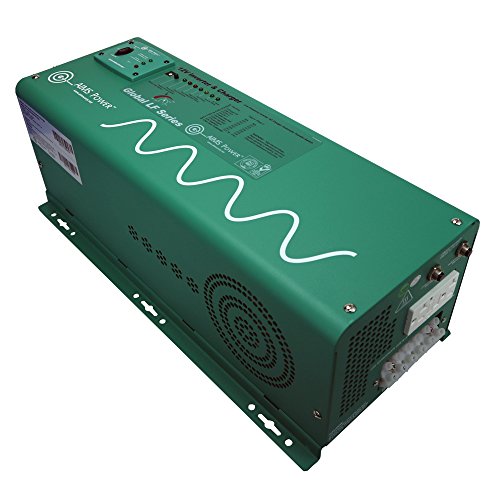
The AIMS 2500 is a 2500W pure sine inverter charger with 7500W surge for 20 seconds, a transfer switch, a charge current dial and auto generator start. A direct-connect AC terminal block makes it a hardwire unit at $719.

No noise figure is listed. Pick this if you want inverter, charger and transfer switch in one box.

What works

  • Built-in charger removes a separate converter purchase
  • 7500W surge for 20 seconds starts heavy motors
  • Charge current dial limits load on a small generator

Watch out for

  • No noise figure is listed
  • Costs $404.01 more than Renogy PUH 2000
03
Best for: Light loads like TVs and laptops on a budget

Our take

It is $205.00 less than Renogy PUH 2000 and gives half the watts, with no transfer switch.

Why it made the shortlist

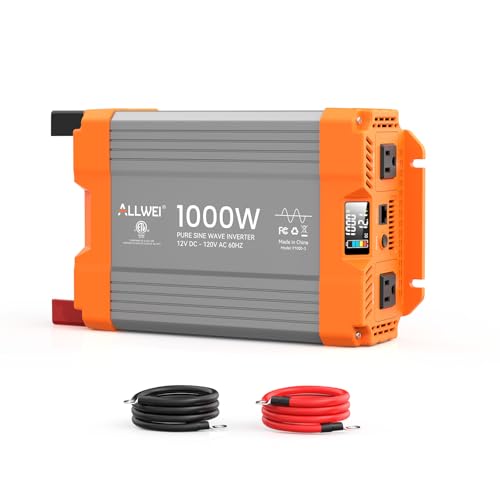
The ALLWEI 1000W pure sine inverter is ETL listed to UL 458, has 8-fold protection and auto cooling fans that adjust speed by load and temperature. It costs $109.99.

Against OLTEANP 600 it adds 400W for $40.00 more. Pick this if you run a laptop, TV and small appliance.

What works

  • ETL listing to UL 458 shows third-party safety testing
  • Fans adjust to load so light use stays quiet
  • Eight protection types cover common faults

Watch out for

  • No noise figure is listed, so quietness is unverified
  • Too small for a microwave and a coffee maker together
04
Best for: Charging electronics in a van or small camper

Our take

It is $40.00 below ALLWEI 1000 and gives 400W less, so it suits phones, a laptop and a small TV.

Why it made the shortlist

The OLTEANP 600W pure sine inverter delivers 600W continuous and 1200W peak, with a smart LCD showing status and full protections. It connects directly to a 12V battery and sells for $69.99.

What works

  • LCD shows status so you catch faults early
  • Small size fits tight cabinets near the battery

Watch out for

  • 600W cannot run a microwave, so cooking needs a bigger unit
The catch
A smaller inverter draws less current, which helps when the battery bank is small.

Methodology

How We Built This Shortlist

Each pick was assessed across 4 criteria weighted for real-world use.

01

Noise claims

We favored stated decibel figures and flagged listings that gave none, since fan noise is the quiet question.

02

Load and surge

We compared continuous and surge watts against the loads a quiet-focused buyer actually runs.

03

Transfer and charging

Transfer switches and built-in chargers scored higher for full RV integration.

04

Safety and value

Certification, protections and price per watt shaped the final order.

Decision guide

Match a Quiet RV Inverter to Your RV

By Where You Mount It

Your situationRecommended pickWhy
Bedroom closet or under the bedRenogy PUH 2000Only unit with a stated under 51dB figure
Utility bay near batteriesAIMS 2500Noise matters less, charger and surge matter more
Cabinet beside the TVALLWEI 1000Load-sensing fans stay slow at light load
Small van, electronics onlyOLTEANP 600Low draw, small footprint

By Budget

BudgetRecommended pick
$60 to $110OLTEANP 600 or ALLWEI 1000
$310 to $720Renogy PUH 2000 or AIMS 2500

Fan Cooled Quiet at Light Load vs Stated Low Noise

Load-sensing fans

ALLWEI 1000 adjusts fan speed by load and temperature, so it stays quiet at light load but can get louder near its limit. OLTEANP 600 has similar protections but no listed noise figure.

Stated noise figure

Renogy PUH 2000 states under 51dB, which gives a number to hold the seller to. AIMS 2500 lists none, so its noise is unknown.

Default to the Renogy PUH 2000 if sleeping near the inverter, since it is the only one with a number.

By Budget

PickRecommended pick
Under $100OLTEANP 600
$100 to $150ALLWEI 1000
$300 to $350Renogy PUH 2000
Above $700 for inverter plus chargerAIMS 2500

For Sleeping Near the Inverter Specifically

Look for

A stated dB figure, load-sensing fans and a mounting spot with air around it

In this comparison

Renogy PUH 2000 states under 51dB and has a UPS transfer switch, and ALLWEI 1000 adds load-sensing fans for lighter use.

When to Spend More

Spend more if

Spend more on the AIMS 2500 at $719 if you want one box that inverts, charges and switches, because it replaces a separate converter.

Save if

Save with ALLWEI 1000 at $109.99 if loads stay at 1000W or less, since you pay $205.00 less than Renogy PUH 2000.

FAQ

Before You Bring One Home

How loud is a typical RV inverter?

Noise comes mostly from fans and rises with load. Renogy PUH 2000 claims under 51dB, while others in this list publish no figure.

Can I run an inverter overnight for a CPAP?

A small pure sine unit like ALLWEI 1000 handles a CPAP, but its idle draw uses battery. Check that your bank covers the idle plus the CPAP draw for the night.

Is an inverter charger better than an inverter alone?

AIMS 2500 combines both and saves a separate converter, but it costs $404.01 more than Renogy PUH 2000. Only buy it if you need the charger.

Where should I mount it to keep it quiet?

Mount it in a ventilated utility bay or closet away from the bed, with clear space around the vents. Cramped enclosures make fans work harder.

Bottom line

The short version

Browse more quiet rv inverter on Amazon →
Bowen Higgins, RV Editor at RV Gear Lab

About the author

Bowen Higgins

RV Editor at RV Gear Lab

Bowen covers RV power, water systems, towing and leveling, upkeep and interior comfort, with a focus on matching gear to the rig, the hookups and the way you actually travel.

More from Bowen →Editorial standards

Keep reading

Related guides