

We research everything we recommend. When you buy through our links, we may earn a commission. Learn more

Buying guide · 10 min read · Updated October 2, 2026

6 Best RV AC Soft Start Kit in 2026: A Practical RV Guide

Six RV AC soft start kits compared by startup reduction, generator claims, waterproofing and voltage range, from a $60 module to a universal 6-ton starter.

Bowen HigginsBy Bowen HigginsRV Editor at RV Gear Lab6 products comparedSpec-sheet researched

At a glance

Our top picks

An RV AC soft start kit ramps the compressor up slowly so the inrush current stays low enough for a generator, a 30 amp hookup or a shared circuit. The useful questions are how much startup reduction a listing states, whether it covers your BTU size and how it is protected on the roof.

This list runs from a $60 110V module to a $355 universal soft starter rated for up to 6 tons, with the 15,000 BTU, 2200W generator claims scattered between.

RV Gear Lab field notes

The Rig Fit Check

Start with the job
TURBRO RV AC Soft Start Kit for Smooth Startup Under Low-Power Condition leads this shortlist for Non-inverter 15K ACs. Use that fit as a reference point, then compare the alternatives against your own space and workload.
Specs that separate the picks
The first details to compare are 60 to 75 percent startup reduction, 40 percent smaller, low-profile fit, Up to 75 percent inrush reduction. Confirm the exact model and included components before ordering.
Trade-off to plan for
Not for inverter RV ACs

Before you buy

What Matters Before You Choose an RV AC Soft Start Kit

Key buying criteria so you get the right fit the first time.

  1. 01

    Startup reduction versus running load

    A soft start reduces the startup current, often called inrush, not the running watts. A kit that cuts startup by 70 percent still draws the same wattage once the compressor runs. Look for startup or inrush wording, not a running savings claim.

  2. 02

    BTU and voltage match

    Kits are sized to a compressor, and many list a ceiling such as 15,000 BTU. A kit for 110V will not suit a 240V unit. Check your AC's BTU and voltage against the listing.

  3. 03

    Generator and breaker goals

    The main benefit is running an AC from a small generator or sharing a circuit. A 2200W generator claim usually applies to a single 15,000 BTU unit. Match claims to your actual generator.

  4. 04

    Weather rating

    A roof-mounted module faces rain and heat. IPX5 and IP65 ratings describe water protection. Check the rating or a waterproof statement.

  5. 05

    One kit per compressor

    Each compressor needs its own soft start. A two-AC coach needs two kits. Count your units before buying.

  6. 06

    Wiring and installation

    Install means wiring a module to the compressor's capacitor wires, and color-coded wires help. Disconnect power first. Check for an instruction guide and support.

Our standards

Why You Can Trust RV Gear Lab

At RV Gear Lab, we compare products based on rig fit and power or hookup compatibility, verified specifications, usability, setup requirements, weight, durability, and real-world trade-offs. We do not rank products purely on marketing claims or commission rates.

We have not personally tested every product listed. Where hands-on testing is not available, recommendations are based on verified manufacturer specifications, product documentation, use-case fit, and comparative research.

How we review RV gear →

Detailed reviews

The 6 best rv ac soft start kit, explained

01
Best for: Non-inverter 15K ACs

Our take

Best for non-inverter rooftop units that need over 40A to start.

Why it made the shortlist

The TURBRO kit lists a 60 to 75 percent reduction in the power needed to start non-inverter RV air conditioners and fits units up to 15,000 BTU. It runs on 100 to 240V, carries dual IPX5 waterproofing with an epoxy-sealed circuit board and states it can run two ACs under 30A on a 30A hookup with two kits.

Against the Kedite and NAYAMOL, it adds a stated voltage range and a BTU ceiling. Against the SoftStartRV unit, it costs less than half.

What works

  • States 60 to 75 percent startup reduction
  • Wide 100 to 240V range
  • Dual IPX5 waterproof protection
  • Clear BTU ceiling at 15,000

Watch out for

  • Not for inverter RV ACs
  • One kit per air conditioner
02
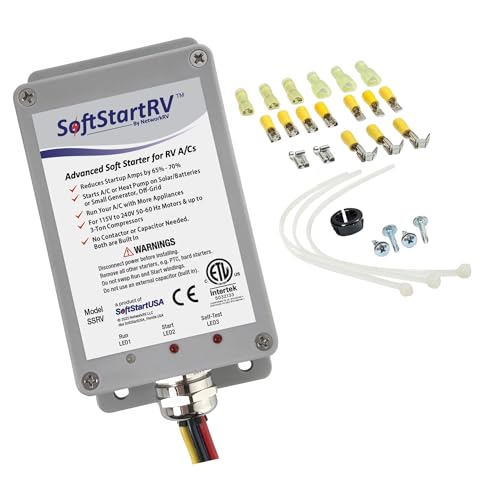
SoftStartRV Soft Start for RV Air Conditioner
  • 40 percent smaller, low-profile fit
  • Starts 15,000 BTU on 2200W generator
  • 100 percent waterproof
Check price on Amazon for SoftStartRV Soft Start for RV Air Conditioner (opens in a new tab)
Best for: Low-profile roof units

Our take

Best for owners who want a known brand with live installation help.

Why it made the shortlist

Its listing says it can start two ACs on 30 amp, one on a small generator or 15 amp, and run a 15,000 BTU AC on a 2200W generator.

What works

  • Smaller body fits low-profile AC units
  • Waterproof enclosure
  • Live support and install tutorials
  • Works with a 2200W generator

Watch out for

  • Costs far more than generic kits
  • One unit per air conditioner
The catch
The SoftStartRV unit is described as 40 percent smaller to fit low-profile RV AC units and 100 percent waterproof.
03
Best for: Budget DIY installs

Our take

Best for budget DIYers who want a rooftop-ready rating.

Why it made the shortlist

The Kedite soft starter lists inrush reduction up to 75 percent, an IP65 waterproof rating and reverse motor protection. It is aimed at DIY installation and works with generators, solar systems and standard power supplies.

Against the TURBRO, it costs less and lists a higher IP rating. Against the NAYAMOL, it adds reverse motor protection.

What works

  • Reverse motor protection
  • Easy DIY install claim
  • Works with generators and solar

Watch out for

  • Fewer fit details than TURBRO
  • No stated BTU ceiling
04

Best Small-Generator Kit · 4 of 6

NAYAMOL RV Soft Start For Air Conditioner

NAYAMOL RV Soft Start For Air Conditioner
  • 65 to 70 percent startup reduction
  • Starts 15K BTU on 2200W generator
  • 20A household use
Check price on Amazon for NAYAMOL RV Soft Start For Air Conditioner (opens in a new tab)
Best for: Small generator users

Our take

Best for people running a 15,000 BTU AC on a small generator or household outlet.

Why it made the shortlist

The NAYAMOL lists starting a 15,000 BTU air conditioner on a 2200W generator, a 65 to 70 percent startup current reduction and use on a 20A household connector. It has an insulated dustproof housing and a waterproof wiring harness.

Against the Wodli, it lists the same claim without LED indicators. Against the Cosdam, it states a reduction percentage and a 15,000 BTU example.

What works

  • States 65 to 70 percent reduction
  • 2200W generator example given
  • Dustproof, waterproof wiring harness
  • Plug-and-play installation

Watch out for

  • Two ACs on 30A need two kits
  • Fit for inverter ACs not stated
05

Best Budget 110V Module · 5 of 6

RV Soft Start for Air Conditioner

RV Soft Start for Air Conditioner
  • 110V, 60Hz soft start module
  • One module per air conditioner
  • Reduces inrush and flicker
Check price on Amazon for RV Soft Start for Air Conditioner (opens in a new tab)
Best for: Budget 110V rooftop units

Our take

Best for budget shoppers with a compatible 110V rooftop unit.

Why it made the shortlist

The Cosdam is a 110V, 60Hz soft start module for compatible rooftop units in motorhomes, travel trailers and fifth wheels.

Against the Kedite and NAYAMOL, it costs less.

What works

  • Targets light flicker and breaker trips
  • Made for 110V rooftop units
  • Supports shore or generator power

Watch out for

  • No stated reduction percentage
  • Few details on waterproofing
The catch
Its listing describes gradual compressor inrush, fewer voltage dips and light flicker and notes one module is needed per air conditioner.
06

Best Universal Soft Starter · 6 of 6

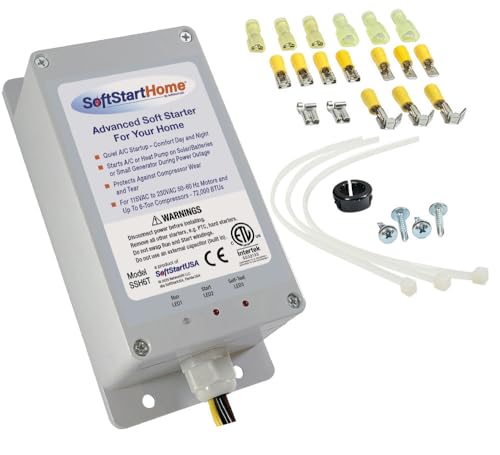
SoftStart Home

SoftStart Home
  • Up to 70 percent startup reduction
  • Up to 6 tons (72,000 BTU)
  • 110-240V, AC and heat pumps
Check price on Amazon for SoftStart Home (opens in a new tab)
Best for: Large or home-style AC units

Our take

Best for owners with an oversized AC or a home-style unit in a van or tiny house.

Why it made the shortlist

The SoftStart Home soft starter lists a startup power reduction of up to 70 percent and compatibility up to 6 tons (72,000 BTU) on 110 to 240V units. It is aimed at air conditioners and heat pumps on generators, RVs and solar.

Against the RV-specific kits, it covers residential and commercial units. Against the TURBRO, it supports far larger systems at far higher cost.

What works

  • Supports up to 72,000 BTU
  • Covers 110 to 240V units
  • Works with heat pumps and generators
  • Compact body

Watch out for

  • Most expensive pick here
  • Overkill for one 15,000 BTU RV AC

Methodology

How We Built This Shortlist

Each pick was assessed across 5 criteria weighted for real-world use.

01

Stated reduction

We compared listed startup reduction percentages, noting those without a figure.

02

Capacity and voltage

We compared BTU ceilings and voltage ranges.

03

Generator claims

We noted 2200W generator and 30A claims.

04

Weather protection

We compared waterproof and IP ratings.

05

Install help

We noted wiring support, LEDs and live help.

Decision guide

Match an RV AC Soft Start Kit to Your RV

By Budget

Your situationRecommended pickWhy
Under $65, 110V rooftop unitCosdam 110VLowest price in this list.
Under $80, rooftop ratedKedite StarterIP65 waterproof with reverse motor protection.
Under $80, small generatorNAYAMOL Kit2200W generator claim stated.
Around $120, clear specsTURBRO KitStated BTU ceiling and voltage range.
Around $295, brand supportSoftStartRV KitLive support and low-profile fit.

By Budget

BudgetRecommended pick
$50 to $80Cosdam 110V or NAYAMOL Kit
$70 to $120Kedite Starter or TURBRO Kit
$290 to $360SoftStartRV Kit or SoftStart Home

Generator Use vs Shore Power

Generator use

A soft start helps most on a 2200W generator. The NAYAMOL Kit and SoftStartRV Kit state this directly.

Shore power

A soft start also helps on 30A hookups with two ACs. The TURBRO Kit lists this scenario.

Choose the NAYAMOL Kit for a small generator and the TURBRO Kit for shore power with two ACs.

By Unit Size

PreferenceRecommended pick
Up to 15,000 BTUTURBRO Kit
Low-profile roof unitSoftStartRV Kit
Above 15,000 BTU or home unitSoftStart Home
110V rooftop moduleCosdam 110V

For Small Generators Specifically

Look for

Look for a stated reduction percentage, a 15,000 BTU on 2200W example and weather protection, as the TURBRO Kit listing shows.

In this comparison

The NAYAMOL Kit and SoftStartRV Kit state the 2200W claim, and the Kedite Starter adds IP65 protection.

When to Spend More

Spend more if

Spend more if you want brand support and a low-profile fit, as with the SoftStartRV Kit, or capacity for a large unit with the SoftStart Home.

Save if

Save if you have a single 15,000 BTU unit: the TURBRO Kit and Cosdam 110V cover it at a modest price.

FAQ

Before You Bring One Home

Does a soft start reduce running watts?

No, it reduces startup current. Running draw stays the same once the compressor spins up. Treat it as a generator aid.

Will it let me run an RV AC on a 2200W generator?

Several listings, such as the NAYAMOL Kit, state this for a 15,000 BTU unit. Results depend on your generator and other loads. Check your own specifications.

Is the SoftStartRV Kit worth the extra cost?

It adds live support and a low-profile fit. Cheaper kits cover the electrical task. Pay extra only if you want help.

How do I install a soft start kit?

Turn off power and open the AC shroud. Wire the module to the compressor capacitor as the manual shows. Test the unit.

How do I maintain it?

Check the housing for cracks and the wiring for corrosion each season. Keep the roof unit clean. Replace the module if it stops working.

Bottom line

The short version

Browse more rv ac soft start kit on Amazon →
Bowen Higgins, RV Editor at RV Gear Lab

About the author

Bowen Higgins

RV Editor at RV Gear Lab

Bowen covers RV power, water systems, towing and leveling, upkeep and interior comfort, with a focus on matching gear to the rig, the hookups and the way you actually travel.

More from Bowen →Editorial standards

Keep reading

Related guides