

We research everything we recommend. When you buy through our links, we may earn a commission. Learn more

Buying guide · 12 min read · Updated October 2, 2026

6 Best Tri-Fuel Inverter Generators in 2026: A Practical RV Guide

Six tri-fuel inverter generators compared on gas, propane and natural gas output, 50A outlets and hose kits, so you choose the fuel plan before the model.

Bowen HigginsBy Bowen HigginsRV Editor at RV Gear Lab6 products comparedSpec-sheet researched

At a glance

Our top picks

A tri-fuel inverter generator is really one engine with three different power ratings. The big number in the title belongs to gasoline, and the same machine gives up roughly 8 to 10 percent on propane and roughly 19 to 20 percent on natural gas, according to the rating lines on the listings below. That means a "9000 watt" tri-fuel unit is closer to 6,500 running watts on a home gas line, and that gap decides whether a central air conditioner starts or trips the breaker.

We compared six tri-fuel inverter models from $1,399 to $2,099.00 on what their listings publish: running watts for each of the three fuels, the outlets that matter for a transfer switch, hose kits, remote and automatic start, and the tank and runtime claims. The goal is to show who actually benefits from a natural gas connection, and who is paying a premium for a fuel they will never plug in.

RV Gear Lab field notes

The Rig Fit Check

Start with the job
Westinghouse 8200 Peak Watt Tri-Fuel Portable Inverter Generator (iGen8200TFc) leads this shortlist for budget-minded home backup on a transfer switch. Use that fit as a reference point, then compare the alternatives against your own space and workload.
Specs that separate the picks
The first details to compare are 6,600W gas, 5,280W natural gas, 6,000W gas, 4,800W natural gas, Hoses included for gas and propane. Confirm the exact model and included components before ordering.
Trade-off to plan for
Feature text does not mention a natural gas hose

Before you buy

What Matters Before You Choose a Tri-Fuel Inverter Generator

Key buying criteria so you get the right fit the first time.

  1. 01

    Running watts on each fuel

    A tri-fuel generator has three separate ratings, and the advertised figure is almost always the gasoline one. Natural gas is a lean fuel, so listings show roughly 19 to 20 percent less, such as 5,280 watts against 6,600 for the Westinghouse iGen8200TFc. Read the bullet that lists all three and size your loads to the natural gas number if that is the fuel you will burn.

  2. 02

    Natural gas hookup and hoses

    Natural gas connects through a hose to a low-pressure supply, and not every box includes the hose. Without it the first outage becomes a shopping trip, and a permanent connection should be installed to local code. Check the listing for a named gas hose length, as on the Champion 11000, and confirm whether a regulator comes with it.

  3. 03

    Outlet type for your inlet

    Transfer switches and generator inlets use specific plugs, and a 50A 14-50R does not mate with a 30A or 37.5A outlet without an adapter. A mismatch can force you to buy cords or rework the panel. Compare the outlet names on the listing to the receptacle you have, noting that the Champion 11000 lists 30A and 37.5A outlets rather than a 50A.

  4. 04

    Automatic start capability

    Two-wire start lets a compatible transfer system start the engine when the utility drops, which matters if you are away or asleep during an outage. A manual-start unit sits idle until someone is there. Look for the words two-wire or ATS start, as on the GENMAX 8000 and 9000, and confirm your transfer system supports it.

  5. 05

    Weight and placement

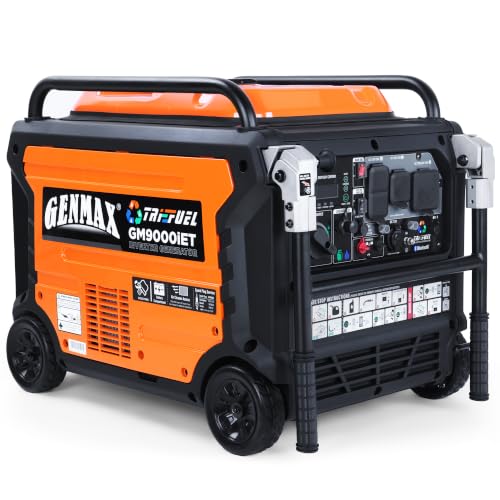
    A large tri-fuel inverter generator is a stationary appliance in practice, since the GENMAX GM9000iET weighs 138 lb on four wheels. A unit that cannot be rolled to a safe spot outdoors becomes a hazard because carbon monoxide must stay away from windows and doors. Look for the listed weight and the wheel kit, and plan a path to a spot well clear of any opening.

  6. 06

    Runtime at your actual load

    Runtime claims are stated at a specific load, often 25 percent, and the figure shrinks quickly as load grows. The Westinghouse iGen8200TFc claims up to 17 hours on 3.9 gallons at 25 percent, but a household with an air conditioner running sits well above that load. Match the runtime claim to the load you will really run, and treat half the listed hours as a cautious planning figure when load is higher.

Our standards

Why You Can Trust RV Gear Lab

At RV Gear Lab, we compare products based on rig fit and power or hookup compatibility, verified specifications, usability, setup requirements, weight, durability, and real-world trade-offs. We do not rank products purely on marketing claims or commission rates.

We have not personally tested every product listed. Where hands-on testing is not available, recommendations are based on verified manufacturer specifications, product documentation, use-case fit, and comparative research.

How we review RV gear →

Detailed reviews

The 6 best tri-fuel inverter generators, explained

01
Best for: Budget-minded home backup on a transfer switch

Our take

Pick it if your plan is a generator on a transfer switch or interlock kit and you want a clear natural gas number to budget loads against.

Why it made the shortlist

The Westinghouse iGen8200TFc publishes all three ratings plainly: 6,600 running and 8,200 peak watts on gasoline, 5,940 and 7,380 on propane, and 5,280 and 6,560 on natural gas. It has one 120/240V 14-50R 50A outlet for home backup, a TT-30R 30A RV outlet and a GFCI 20A duplex, runs a 298 cc engine, and claims up to 17 hours on a 3.9 gallon tank at 25 percent load.

It ranks first because it is the cheapest unit here at $1,399 and still lists a 50A outlet, about 60 dBA at 25 percent load, parallel capability and a CO sensor. Against the Champion 8500 it saves $145.99 and gives up the key fob range and the included gas hoses.

What works

  • Lists running watts for gas, propane and natural gas
  • Has a 50A outlet ready for a transfer switch
  • Runs around 60 dBA at quarter load, per the listing

Watch out for

  • Feature text does not mention a natural gas hose
  • No automatic two-wire start or phone app control
02
Best for: Unattended automatic start during outages

Our take

Choose it if the generator will run unattended during an outage and you want it to start itself when a compatible system calls for it.

Why it made the shortlist

The GENMAX GM8000iETC lists 8,000 surge and 6,000 running watts on gasoline, 7,250 and 5,500 on propane, and 6,500 and 4,800 on natural gas from a 312 cc engine. Its panel carries one 120/240V 14-50R, one L5-30R 30A 120V outlet, two GFCI 5-20R outlets and USB ports, and it can start by key fob, push button, Bluetooth app, recoil or a two-wire automatic start signal.

What works

  • Five start methods including two-wire automatic start
  • Cheaper than the Champion 8500 by $44.99
  • Digital display shows load, fuel level and runtime
  • Includes both a 14-50R and an L5-30R outlet

Watch out for

  • Listing does not state hoses are included
The catch
Compared with the Westinghouse iGen8200TFc you pay $100.99 more and get 480 fewer watts on natural gas (4,800 against 5,280), which matters if the gas line is your main fuel.
03
Best for: Buyers who want hoses included

Our take

Choose it if you want to connect to natural gas on day one without sourcing a hose and you value the long key fob range.

Why it made the shortlist

The Champion 8500-Watt is a tri-fuel inverter that ships with a 25 ft natural gas hose and a 6.6 ft propane hose, so it is ready for any fuel out of the box. It adds a wireless key fob that starts it from up to 80 feet away, a claimed 13 hour run time at 64 dB(A), and a connection for energy storage systems or automatic transfer switches that enables 120V AC battery charging.

What works

  • Ships with 25 ft natural gas and propane hoses
  • Key fob starts it from 80 feet away
  • Connects to energy storage and transfer systems
  • Three-year warranty with lifetime tech support

Watch out for

  • Running watts per fuel are missing from the listing
  • Costs $145.99 more than the Westinghouse 8200
The catch
What the premium buys is the hose set and a 3-year limited warranty with lifetime technical support.
04
Best for: Natural gas homes with bigger motor loads

Our take

Pick it if the gas line is your main fuel and you need to cover a larger motor load, such as a central air conditioner, on natural gas.

Why it made the shortlist

The GENMAX GM9000iET lists 9,000 peak and 8,000 running watts on gasoline, 8,000 and 7,000 on propane, and 7,000 and 6,500 on natural gas from a 349 cc engine. Outlets are one 120/240V 14-50R, one L5-30R, two GFCI 5-20R and 12V DC ports, and it starts five ways including Bluetooth app and a two-wire automatic start. The listing gives its weight as 138 lb with four wheels.

That makes it the strongest natural gas performer under $1,700 here.

What works

  • 6,500W on natural gas, 1,700W above the GM8000
  • Two-wire automatic start supports unattended backup
  • Includes 14-50R, L5-30R and two GFCI outlets
  • Wheels and handle on a 138 lb frame

Watch out for

  • Weighs 138 lb, heavy for solo loading
  • Costs $200 more than the GENMAX GM8000iETC
05
Champion 11,000-Watt Remote Start Tri Fuel Portable Inverter Generator
  • 9,000W gas, 7,290W natural gas
  • 30A locking and 37.5A outlets
  • Hoses and 80 ft key fob
Check price on Amazon for Champion 11,000-Watt Remote Start Tri Fuel Portable Inverter Generator (opens in a new tab)
Best for: High natural gas output on a 30A or 37.5A inlet

Our take

Choose it if you want the largest natural gas figure here and your inlet is a 30A or 37.5A style connection.

Why it made the shortlist

The Champion 11,000-Watt gives 11,000 starting and 9,000 running watts on gasoline, 8,100 running on propane and 7,290 on natural gas. Its outlets are two 120V 20A GFCI duplexes, a 120/240V 30A locking outlet, a 120/240V 37.5A outlet and a 12V automotive outlet, and it has a wireless key fob with 80 ft range plus a CO Shield shutoff. Natural gas and propane hoses are included.

It ranks fifth because its 240V outlets top out at 37.5A rather than a listed 50A, which matters if your transfer panel or RV cord expects a 14-50. In return it is $99.01 cheaper than the DuroMax XP9500iHT at $1,999.99, and its natural gas rating of 7,290 watts is 790 watts above the GENMAX GM9000iET, for $300 more than that GENMAX.

What works

  • Natural gas and propane hoses are included
  • CO Shield shuts the unit down automatically
  • Costs $99.01 less than the DuroMax XP9500iHT

Watch out for

  • No 50A outlet appears in the listing
  • Costs $300 more than the GENMAX GM9000iET
06
DuroMax XP9500iHT 9,500-Watt Tri Fuel Portable Digital Inverter Generator
  • 7,600W gasoline, 459 cc engine
  • 50 amp outlet, remote start
  • Meters and parallel capability
Check price on Amazon for DuroMax XP9500iHT 9,500-Watt Tri Fuel Portable Digital Inverter Generator (opens in a new tab)
Best for: Owners who want a 50A outlet and a large engine

Our take

Pick it if you are already committed to the brand or want a 50A outlet and a digital panel on a larger engine.

Why it made the shortlist

The DuroMax XP9500iHT lists 9,500 peak and 7,600 running watts on gasoline from a 459 cc engine with a boron cast-iron sleeve and 100 percent clean copper windings. It has a 50 amp plug aimed at transfer switch or interlock use, a CO alert shutdown, automatic low oil shutdown, a volt and hour meter, remote and electric start, and parallel capability.

The Champion 11000 is $99.01 cheaper with more stated output.

What works

  • Includes a 50A plug for transfer switch use
  • Copper windings and boron cast-iron sleeve stated
  • Hour and voltage meters on the digital panel
  • Automatic low oil and CO shutdown built in

Watch out for

  • Most expensive of the six at $2,099
  • Propane and natural gas watts are not listed

Methodology

How We Built This Shortlist

Each pick was assessed across 5 criteria weighted for real-world use.

01

Output on each fuel

We read the running watts for gasoline, propane and natural gas on each listing, and noted where a page publishes only one number, since a tri-fuel rating is really three ratings.

02

Outlets for a transfer switch

We checked whether a 14-50R 50A, an L14-30R or an L5-30R outlet is named, because the outlet decides how the unit connects to a home panel or inlet.

03

Hoses and fuel hookup

We looked at whether natural gas and propane hoses are in the box or left as a separate purchase, since that affects first-day readiness and total cost.

04

Start and control options

Remote key fobs, Bluetooth apps and two-wire automatic start were compared, since unattended operation is the main reason to pay for tri-fuel at home.

05

Price against stated output

We compared the $1,399 to $2,099.00 spread against natural gas watts, which is the number most buyers are really buying.

Decision guide

Match a Tri-Fuel Inverter Generator to Your RV

By Fuel Plan

Decide which fuel you will actually burn most often, then size to that fuel's rating.

Your situationRecommended pickWhy
Natural gas is the main fuel, big motor loadsChampion 110007,290W on natural gas, the highest listed
Natural gas main fuel, mid-size homeGENMAX GM9000iET6,500W on natural gas from a 349 cc engine
Propane first, natural gas occasionallyWestinghouse iGen8200TFc5,940W propane, 5,280W natural gas, lowest price
Gasoline stored, propane as backupGENMAX GM8000iETC6,000W gasoline and 5,500W propane
Want hoses ready with no extra buyingChampion 850025 ft natural gas and 6.6 ft propane hoses included

By Budget

BudgetRecommended pick
Under $1,450Westinghouse iGen8200TFc
$1,450 to $1,550GENMAX GM8000iETC or Champion 8500
$1,550 to $1,750GENMAX GM9000iET
$1,950 to $2,100Champion 11000 or DuroMax XP9500iHT

Natural Gas Line vs Propane Cylinders

Natural gas line

The utility supply does not run out in a long outage the way a tank does, but every unit with a published rating loses about 19 to 20 percent of its gasoline output, such as the GENMAX GM8000iETC falling from 6,000 to 4,800 watts and the Champion 11000 from 9,000 to 7,290 watts. A permanent connection also needs proper fittings and a qualified installer under local rules.

Propane cylinders

Propane costs a smaller loss of roughly 8 to 10 percent, such as the Westinghouse iGen8200TFc going from 6,600 to 5,940 watts, and the fuel is portable. The tradeoff is cylinder size: a small cylinder will not last a multi-day outage at high load, so you must plan refills.

Most home backup buyers should size for the natural gas rating, since it is the lowest of the three, and treat the other two fuels as bonuses.

By Start and Transfer Setup

Your setupRecommended pickWhy
Automatic start from a compatible transfer systemGENMAX GM8000iETCTwo-wire auto start listed at $1,499.99
Automatic start plus more natural gas outputGENMAX GM9000iETSame two-wire start with 6,500W on natural gas
Energy storage or transfer switch connectionChampion 8500Listed to connect to storage systems and automatic transfer switches
Manual interlock kit with a 50A inletWestinghouse iGen8200TFc14-50R 50A outlet at the lowest price
Large 50A inlet and a bigger engineDuroMax XP9500iHT50 amp plug with a 459 cc engine

For Whole-House Natural Gas Backup Specifically

Look for

A natural gas running watt number on the listing, a hose or regulator in the box, and an outlet that matches your inlet (14-50R for most home setups).

In this comparison

The Champion 11000 leads on natural gas at 7,290 watts with hoses included, the GENMAX GM9000iET gives 6,500 watts, and the Westinghouse iGen8200TFc gives 5,280 watts at the lowest price. The DuroMax XP9500iHT and Champion 8500 do not list natural gas watts in their feature text.

When to Spend More

Spend more if

You depend on a central air conditioner or well pump on natural gas; the Champion 11000 at $1,999.99 or the GENMAX GM9000iET at $1,699.99 offers 7,290 and 6,500 watts where the lighter units fall near or below 5,300.

Save if

You only need a refrigerator, lights and electronics, which the Westinghouse iGen8200TFc at $1,399 covers with a 50A outlet and a published 5,280 watts on natural gas.

FAQ

Before You Bring One Home

Is tri-fuel worth it over dual fuel?

Only if you will connect a natural gas line. Natural gas adds a fuel that does not run out in a long outage, but it costs about 19 to 20 percent of gasoline output on the units listed here. If you only use gasoline and propane, a dual fuel unit is simpler and usually cheaper.

Do these generators work with a transfer switch?

Several list 50A outlets and transfer switch or interlock readiness, including the Westinghouse iGen8200TFc and the GENMAX models. The Champion 11000 lists 30A and 37.5A outlets, so match the outlet to your inlet before you buy.

How do I switch fuels?

Most tri-fuel units use a selector switch or dial and a connected hose for the alternate fuel. Shut the engine down and follow the manual before changing the hose or switch, and never connect a gas hose while the engine runs.

Can I run it indoors or in a garage?

No. Carbon monoxide is the main hazard of any generator. The CO sensors listed on these models shut the unit down but do not replace placing it outdoors, away from windows, doors and vents.

How often does the fuel need attention?

Gasoline left in the carburetor goes stale over months, while propane and natural gas do not. Shutting the unit down while it runs on propane or natural gas helps empty the carburetor of old gasoline, and a short exercise run keeps parts moving.

Does a bigger number mean it will start my air conditioner?

Not necessarily. The air conditioner's starting surge must fit within the peak rating for the fuel you use, and the natural gas peak is lower than the gasoline peak. Check the starting amps on the air conditioner's label and compare to the natural gas peak, not the headline watts.

Bottom line

The short version

Browse more tri-fuel inverter generators on Amazon →
Bowen Higgins, RV Editor at RV Gear Lab

About the author

Bowen Higgins

RV Editor at RV Gear Lab

Bowen covers RV power, water systems, towing and leveling, upkeep and interior comfort, with a focus on matching gear to the rig, the hookups and the way you actually travel.

More from Bowen →Editorial standards

Keep reading

Related guides