

We research everything we recommend. When you buy through our links, we may earn a commission. Learn more

Buying guide · 11 min read · Updated October 2, 2026

6 Best Budget DIY RV Roof Coatings in 2026: A Practical RV Guide

Six RV roof coatings for owners doing the job themselves, sized from one gallon to a 5 gallon pail, with prep, tools and coat counts spelled out.

Bowen HigginsBy Bowen HigginsRV Editor at RV Gear Lab6 products comparedSpec-sheet researched

At a glance

Our top picks

At a glance · 6 picks

Doing your own roof coating is the single largest saving available to an RV owner, and it lives or dies on arithmetic. A typical towable roof is a few hundred square feet, and most listings quote about 50 square feet to the gallon at finished thickness, so the real question is how many gallons, not which brand.

Everything else follows from that figure. A 5 gallon pail beats a stack of cans on cost per gallon, a roller and brush kit saves a store trip, and a no-primer coating shortens the weekend. The picks below are sorted by what each does to the total job, not by headline price.

We evaluated them on stated coverage, the tools in the box, and whether a primer or second coat is involved. The BEEST 5 gallon pail is the most expensive pick and the SENVEN gallon is the cheapest way in, with larger SENVEN and Gardner pails between them.

RV Gear Lab field notes

The Rig Fit Check

Start with the job
BEEST RV Roof Coating White, 5 Gallon Covers up to 250 sq ft (2 Coats) leads this shortlist for DIY owners coating a full-size towable roof in one weekend.. Use that fit as a reference point, then compare the alternatives against your own space and workload.
Specs that separate the picks
The first details to compare are 5 gallon pail, white, 5 gallon kit, white, One coat, no primer. Confirm the exact model and included components before ordering.
Trade-off to plan for
Most expensive pick in this guide

Before you buy

What Matters Before You Choose a Budget DIY RV Roof Coating

Key buying criteria so you get the right fit the first time.

  1. 01

    Gallons needed

    The most common DIY mistake is buying a single gallon for a whole roof. Several makers state one gallon per 50 square feet at finished thickness, and BEEST adds two to three heavy coats. Measure length times width, divide by 50 and round up. A 25 foot trailer roof can take four to five gallons.

  2. 02

    Pail versus can economics

    A 5 gallon pail drops the cost per gallon a long way, while single cans are easier to carry and leave less waste on small jobs. If your math says four gallons or more, a pail is the better spend. Smaller jobs are better served by one or two cans.

  3. 03

    Application tools

    Most coatings here apply by brush, roller or quality sprayer after a clean-down. A listing that includes a roller and gloves removes a purchase, while a roller-only acrylic like Gardner needs a good roller cover. Plan the tool list before the day you start.

  4. 04

    Primer and cleaning steps

    Prep decides whether the coating sticks. Clean off dirt and loose material, let the roof dry, and add a primer if your membrane maker calls for it. Kohree and the one-coat Magic can say none is needed, but a rubber roof may still warrant one. Read the label.

  5. 05

    Cure and weather window

    Water-based coatings need a dry stretch of hours, and some makers say to store sealed containers above freezing. A one-coat system compresses the window, while two-coat jobs need a recoat interval. Check the forecast before you open the pail.

  6. 06

    Roof surface match

    A DIY job fails fastest when the coating and roof do not match. SENVEN names EPDM, TPO, fiberglass and aluminum, RV Roof Magic names six surfaces, and Gardner is a general roof coating. Choose the one whose list includes your membrane.

Our standards

Why You Can Trust RV Gear Lab

At RV Gear Lab, we compare products based on rig fit and power or hookup compatibility, verified specifications, usability, setup requirements, weight, durability, and real-world trade-offs. We do not rank products purely on marketing claims or commission rates.

We have not personally tested every product listed. Where hands-on testing is not available, recommendations are based on verified manufacturer specifications, product documentation, use-case fit, and comparative research.

How we review RV gear →

Detailed reviews

The 6 best budget diy rv roof coatings, explained

01
Best for: DIY owners coating a full-size towable roof in one weekend.

Our take

The listing calls the process simple enough for anyone, with two to three heavy coats at the one gallon per 50 square feet rule.

Why it made the shortlist

This 5 gallon BEEST pail is a water-based liquid rubber coating that the listing says covers up to 250 square feet in two coats. That sizing lines up with a full-size travel trailer roof, so one pail can be the whole job.

As the most expensive pick on this page, it also has the lowest cost per gallon of the BEEST range, and it is the pail version of the one gallon can sold elsewhere. Application is by brush, roller or quality sprayer after cleaning dust and debris.

What works

  • One pail covers a full roof
  • Brush, roller or sprayer application
  • Water-based, soap-and-water cleanup

Watch out for

  • Most expensive pick in this guide
  • Heavy pail to move up a ladder
02
Best for: Owners who want a 5 gallon, zero-VOC kit with several roof types named.

Our take

It rolls on like paint, and the listing frames it as a complete roof protection system that goes beyond basic rubber roof repair kits.

Why it made the shortlist

SENVEN's 5 gallon kit is a zero-VOC, water-based sealant listed for EPDM, TPO, fiberglass and aluminum roofs, plus skylights, vent covers and awning parts. It follows the one gallon per 50 square feet rule at the recommended thickness.

It sits a notch below the BEEST pail on price and offers the same pail-scale economy, so a full roof costs far less than buying five gallon cans. The sealed container should be stored above freezing.

What works

  • Names EPDM, TPO, fiberglass and aluminum
  • Zero-VOC water-based formula
  • Pail economy over buying cans
  • Rolls on like ordinary paint

Watch out for

  • Needs storage above freezing
  • Little detail on kit tools
03
Best for: Time-pressed DIYers who want one coat and no primer.

Our take

It forms a seamless waterproof barrier that stops leaks before they spread.

Why it made the shortlist

RV Roof Magic is sold as a true one-coat roof coating that needs no primer, built on butyl rubber technology and compatible with EPDM, TPO, metal, fiberglass, wood and concrete.

It sits mid-pack on price, below the pails and above the budget gallons, and the step up buys the one-coat, no-primer method. The listing claims 20-plus years of protection, which is the maker's own figure.

What works

  • One coat and no primer
  • Names six roof surfaces
  • Seamless waterproof barrier
  • Stated 20-plus year protection

Watch out for

  • One gallon covers a small roof
  • Longevity is the maker's claim
The catch
For a DIYer, fewer steps is the main attraction.
04
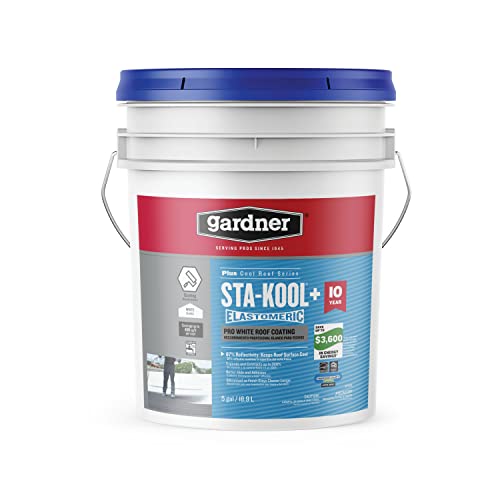
Best for: DIYers with a big flat roof, a roller and a plan for a uniform coat.

Our take

The label directs a uniform roller coat.

Why it made the shortlist

Sta-Kool is a flexible white acrylic latex spread by roller into a uniform coat, with an 87 percent reflective finish and stated stretch up to 300 times with the roof. It is simple enough for a homeowner who has painted before.

It sits below the BEEST and SENVEN pails on price, and the 5 gallon container keeps the cost per gallon low. The acrylic latex is a familiar chemistry for roofers, and the maker has served professionals since 1945.

What works

  • Lower cost than other pails
  • 87 percent reflective finish
  • Roller-ready and simple to apply
  • Long-standing roofing maker

Watch out for

  • Not RV-specific in the listing
  • Acrylic needs a dry window to cure
05
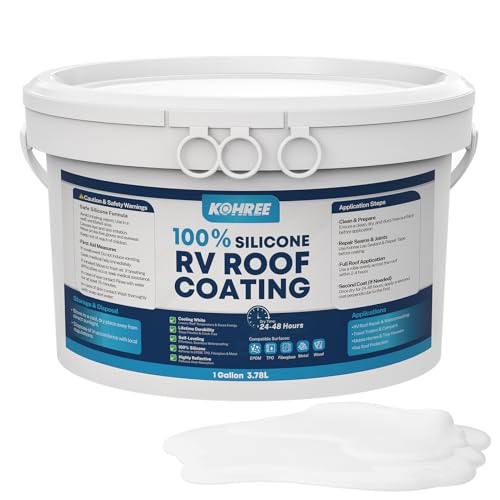
Best for: DIY owners with a small roof who want silicone with no primer step.

Our take

It applies by brush, roller or sprayer after cleaning the roof.

Why it made the shortlist

Kohree's 100 percent silicone coating is stated to need no primer, which trims a step from a DIY job. The barrel has a larger opening for more brush sizes and an inner bag that keeps the pail clean.

It costs noticeably less than the RV Roof Magic can and keeps a reflective, flexible film. The low-odor formula is harmless enough to use indoors and out.

What works

  • No primer step
  • Wide opening takes bigger brushes
  • Low-odor, harmless formula
  • Heat-reflective white film

Watch out for

  • Silicone limits later recoat options
  • One gallon covers limited area
06
Best for: First-time DIYers sealing a small roof or a leak with a trial-size can.

Our take

Zero VOC means low odor and soap-and-water cleanup.

Why it made the shortlist

The one gallon SENVEN is the entry pick and shares the water-based, zero-VOC formula of its 5 gallon sibling. It names EPDM, TPO, fiberglass and aluminum roofs, and rolls on like paint at one gallon per 50 square feet.

Choosing the can over the pail costs noticeably less up front and avoids carrying a heavy container, and it is the right way to learn the product on a patch. The cost per gallon is higher than the pail.

What works

  • Lowest outlay in this guide
  • Same formula as the pail
  • Names four roof materials
  • Zero-VOC with soap-and-water cleanup

Watch out for

  • Higher cost per gallon than pails
  • Covers only a small area

Methodology

How We Built This Shortlist

Each pick was assessed across 5 criteria weighted for real-world use.

01

Job arithmetic

We turned each listing's coverage rate into gallons for a typical roof. A one gallon per 50 square feet rule means a 200 square foot roof needs about four gallons. Pails versus cans was decided by that math.

02

Tools and kit

We noted which listings include applicators, gloves or cleaning cloths, and which expect you to buy them. A bundled roller and brush saves a trip. We counted kit extras as real value for a first-timer.

03

Coat and primer count

We checked whether each coating asks for a primer or a second coat, because each step adds time. One coat with no primer is the shortest weekend. The listing wording was our source.

04

Roof compatibility

We compared which roofs each coating names, from EPDM and TPO to fiberglass and metal. A DIYer should not discover an incompatibility halfway through. We took the surface lists from the listings.

05

Position on price

We placed each pick relative to the others without printing numbers. We then asked what each step up buys, whether that is pail economy, a one-coat method or a roller-ready acrylic.

Decision guide

Match a Budget DIY RV Roof Coating to Your RV

By Roof Length

Roof area drives the number of gallons and therefore the container.

RigBest pickWhy
Fifth wheel or Class ABEEST 5 Gallon250 sq ft in two coats from one pail
Mid-size travel trailerSENVEN 5 GallonPail economy and named roof types
Large flat roof, roller jobGardner Sta-KoolRoller-applied reflective acrylic
Small trailer or vanRV Roof MagicOne coat, one gallon, no primer
Pop-up or patchSENVEN 1 GallonTrial-size can at the lowest outlay

By Budget

Bands are relative to this shortlist, never printed figures.

BandPickWhat you get
Entry of this shortlistSENVEN 1 GallonA zero-VOC trial can
Low-midKohree SiliconeA no-primer silicone gallon
MidRV Roof MagicA one-coat, no-primer gallon
Upper-midGardner Sta-KoolA roller-ready 5 gallon pail
TopBEEST 5 GallonA 250 sq ft pail in two coats

Pail vs Single Can

The container decision is also a cost-per-gallon decision.

5 gallon pails

BEEST 5 Gallon, SENVEN 5 Gallon and Gardner Sta-Kool spread cost over many gallons and keep one batch for the whole roof. They suit a roof of about 200 square feet or more.

One gallon cans

RV Roof Magic, Kohree Silicone and SENVEN 1 Gallon are easy to carry and suit patches or small rigs. They cost more per gallon, and multiples add up quickly.

If your roof needs four or more gallons, buy a pail; otherwise a can keeps the job simple.

By Experience Level

How comfortable you are with a roof job shapes the choice.

ExperienceBest pickWhy
First roof jobSENVEN 1 GallonCheap trial, simple water-based formula
Wants fewest stepsRV Roof MagicOne coat and no primer
Comfortable with a rollerGardner Sta-KoolUniform roller coat
Prefers siliconeKohree SiliconeNo-primer silicone with easy pour
Experienced, full roofBEEST 5 GallonBrush, roller or sprayer at scale

For a Full-Roof Weekend Job Specifically

A whole-roof coat needs planning more than skill.

Look for

A pail with a stated square-foot coverage, a coat count you can finish in two days and a clear recoat interval.

In this comparison

BEEST 5 Gallon states 250 square feet in two coats, SENVEN 5 Gallon follows one gallon per 50 square feet, and Gardner Sta-Kool is roller-applied.

When to Spend More

Spending more helps most when volume is the issue.

Spend more if

The roof is large and you want it done in one batch, where BEEST 5 Gallon or SENVEN 5 Gallon wins.

Save if

The roof is small or the job is a patch, where SENVEN 1 Gallon and Kohree Silicone are the lowest outlay.

FAQ

Before You Bring One Home

How many gallons do I need for my RV roof?

Several makers state one gallon per 50 square feet at finished thickness. Multiply roof length by width, divide by 50 and round up. A 25 foot by 8 foot roof is about 200 square feet, so around four gallons.

Is a pail really cheaper than cans?

Per gallon, yes, by a wide margin, which is why four or more gallons points to a pail. For a small roof the extra volume goes to waste. Match the container to the area.

Do I need a primer for a DIY job?

RV Roof Magic and Kohree say no primer is needed, and SENVEN lists several roof types without one. A rubber roof may still call for a primer, so read your membrane maker's guidance. Clean and dry the roof either way.

What tools should I have ready?

A brush, a roller with a good cover, gloves and a cleaning cloth cover most jobs, and the listings say brush, roller or sprayer all work. Some kits include them. Buy extras of the roller cover.

How long does a DIY roof coat take?

A one-coat system like RV Roof Magic can be done in a day, while two-coat jobs need a recoat interval of hours. Plan a weekend with a dry forecast. Water-based coatings need that dry window.

Can I do this alone?

Yes, most of these are rolled on like paint and describe a DIY-friendly process. Work in sections and keep a margin of product. A second person helps with moving a heavy pail.

Bottom line

The short version

Browse more budget diy rv roof coatings on Amazon →
Bowen Higgins, RV Editor at RV Gear Lab

About the author

Bowen Higgins

RV Editor at RV Gear Lab

Bowen covers RV power, water systems, towing and leveling, upkeep and interior comfort, with a focus on matching gear to the rig, the hookups and the way you actually travel.

More from Bowen →Editorial standards

Keep reading

Related guides