

We research everything we recommend. When you buy through our links, we may earn a commission. Learn more

Buying guide · 11 min read · Updated October 2, 2026

6 Best Budget Silicone RV Roof Coatings in 2026: A Practical RV Guide

Six silicone RV roof coatings compared on solids, primer rules and size, so you know which gallon suits a roof that pools water and which one needs a primer.

Bowen HigginsBy Bowen HigginsRV Editor at RV Gear Lab6 products comparedSpec-sheet researched

At a glance

Our top picks

Silicone earns its place on one problem: roofs that hold water. Where an acrylic can soften and wash away under a standing puddle, a silicone film is generally described as holding up better, which is why owners of flat, low-spot roofs look here first.

The trade is a one-way door. Roofs coated in silicone generally have to be recoated with silicone, and a tape or a different coating will struggle to grip it later. Anyone who picks silicone is committing to that chemistry for the life of the roof.

Picks were compared on how each describes its silicone content, whether it asks for a primer, and what container size suits which roof. The Henry and the Dicor sit at the top of the price range; the Countryman quart and the Gociean gallon are the lower-cost ways in.

RV Gear Lab field notes

The Rig Fit Check

Start with the job
Henry Coating ROOF Silicone WHT .90G HE887HS042 leads this shortlist for Owners who trust an established roofing brand and just need a silicone coat.. Use that fit as a reference point, then compare the alternatives against your own space and workload.
Specs that separate the picks
The first details to compare are Silicone roof coating, white, 1 gallon silicone, white, 1 gallon, 100% silicone. Confirm the exact model and included components before ordering.
Trade-off to plan for
Listing gives almost no detail

Before you buy

What Matters Before You Choose a Budget Silicone RV Roof Coating

Key buying criteria so you get the right fit the first time.

  1. 01

    Ponding water resistance

    Silicone is chosen because it generally holds up under standing water where acrylic can soften and wash out. Roof manufacturers still caution that silicone is not meant for permanent ponding on a weak membrane. Fix drainage where you can, and treat silicone as the better option for occasional puddles, not a cure for a sagging roof.

  2. 02

    Recoat lock-in

    A silicone-coated roof generally has to be recoated with silicone, because other coatings struggle to bond to it later. That is a decision you make once at purchase. If you might switch to an acrylic or apply tape later, think carefully before committing the whole roof to silicone.

  3. 03

    Solids and coat count

    Solids are the share of the can that stays on the roof after the carrier evaporates. A high-solids silicone such as Countryman's leaves a thicker film per coat and can meet the maker's single-coat claim. Lower-solids products need more coats for the same thickness, so compare the coat count.

  4. 04

    Primer requirement

    Dicor expects its own primer, and the Dicor TPO primer exists for silicone on TPO, while Countryman, Kohree and Gociean state that none is required on prepared surfaces. A primer can add a meaningful share of the total spend. Read your membrane maker's guidance before skipping it.

  5. 05

    Finish color

    White reflects the most sun and cools the roof, while light gray reflects less, and some silicones cure to a finish that differs from the can. If heat is the reason you are coating, white is the better choice. Check the color in the title.

  6. 06

    Pack size

    A quart, a 0.9 gallon container and a one gallon pail are very different amounts of roof. A thick, single coat at the recommended rate may cover only about 50 square feet per gallon on some products. Work out your area and round up so you do not run out partway through.

Our standards

Why You Can Trust RV Gear Lab

At RV Gear Lab, we compare products based on rig fit and power or hookup compatibility, verified specifications, usability, setup requirements, weight, durability, and real-world trade-offs. We do not rank products purely on marketing claims or commission rates.

We have not personally tested every product listed. Where hands-on testing is not available, recommendations are based on verified manufacturer specifications, product documentation, use-case fit, and comparative research.

How we review RV gear →

Detailed reviews

The 6 best budget silicone rv roof coatings, explained

01
Henry Coating ROOF Silicone WHT .90G HE887HS042
  • Silicone roof coating, white
  • About 0.9 gallon container
  • Established roofing brand
Check price on Amazon for Henry Coating ROOF Silicone WHT .90G HE887HS042 (opens in a new tab)
Best for: Owners who trust an established roofing brand and just need a silicone coat.

Our take

As a silicone it is chosen for roofs that collect water.

Why it made the shortlist

Henry is a long-standing roofing coatings name, and this white silicone roof coating comes in a just-under-one-gallon container. The title identifies the product by its silicone chemistry and white finish, which keeps the buying decision simple.

It sits at the top of the price range alongside the Dicor, and the extra outlay buys the recognizable name more than any extra feature spelled out in the listing. Next to the Countryman gallon, it relies on brand trust.

What works

  • Silicone suits ponding roofs
  • Established roofing brand name
  • White finish for heat reflection
  • Simple one-product purchase

Watch out for

  • Listing gives almost no detail
  • Container is under a full gallon
02
Best for: EPDM roof owners following Dicor's primer-plus-silicone system.

Our take

A one gallon size suits a travel trailer or a small motorhome.

Why it made the shortlist

Dicor's Signature Extended Life is a silicone RV roof coating described as permanently flexible and unaffected by sun rays or temperature extremes. Maintenance is where it fits, when used with Dicor's primer, per the listing.

As an RV-specific system it sits at the top of the price range with Henry, and it improves the look of an old, worn roof. The system approach is the point: the primer and coating are designed together.

What works

  • RV-specific two-part system
  • Permanently flexible, stated
  • Refreshes a worn roof's look
  • Known RV roof brand

Watch out for

  • Needs the maker's primer
  • One of the pricier gallons
03
Best for: Owners of metal, EPDM or fiberglass roofs wanting a primer-light silicone coat.

Our take

The single-coat claim at the recommended coverage rate cuts labor, and it is made in the USA.

Why it made the shortlist

Ponding water, UV and extreme weather are resisted without brittleness, the listing says.

Countryman's gallon lands mid-pack on price, noticeably below Henry and Dicor, and it states that it bonds without primer in most applications to prepared metal, EPDM, fiberglass, spray foam, modified bitumen and existing silicone. That list is broader than most.

What works

  • High-solids formula, fewer coats
  • Primer-free on most prepared surfaces
  • Resists ponding water and UV
  • Made in the USA

Watch out for

  • Silicone limits later recoat options
  • One gallon covers limited area
The catch
Countryman's gallon is a high-solids 100 percent silicone coating that leaves more protective film after curing, with fewer coats.
04
Best for: DIY owners who want a no-primer silicone with an easy-pour bucket.

Our take

It applies by brush, roller or quality sprayer after cleaning the roof and has a low-odor, harmless formula usable indoors and outdoors.

Why it made the shortlist

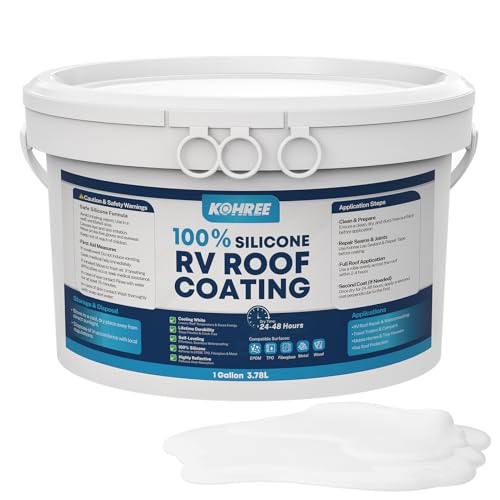
Kohree's 100 percent silicone coating builds a rubber surface with heat-reflective properties and good elasticity. Breathable and not easy to crack, it needs no primer, the listing says.

Kohree costs noticeably less than the Countryman gallon while keeping the silicone chemistry, and the barrel has a larger opening to accept more brush sizes, with an inner bag that keeps the pail clean. These small details help a first-timer.

What works

  • Primer-free per the listing
  • Wide-mouth barrel fits big brushes
  • Low-odor, harmless formula
  • Lower outlay than Countryman

Watch out for

  • Newer brand with limited history
  • Silicone locks in future recoats
05
Best for: Owners filling seams, edges and small cracks with a self-leveling silicone.

Our take

Gociean applies by brush, roller or sprayer, and the listing says it suits common RV roof materials.

Why it made the shortlist

Gociean's gallon is a 100 percent silicone coating that forms a thick, flexible barrier over seams, edges and small cracks. The formula is solvent-free, water-free and asphalt-free, with a self-leveling character that spreads smoothly.

Gociean lands just under the Kohree on price and adds a foil bag inside the bucket to keep the plastic pail cleaner. The self-leveling behavior helps fill low spots instead of leaving brush ridges.

What works

  • Self-leveling fills low spots
  • Solvent-free, asphalt-free formula
  • Clean foil bag packaging
  • Brush, roller or sprayer application

Watch out for

  • Few specs on coverage rate
  • Self-leveling can run on slopes
06
Best for: Owners testing silicone on a patch or a tiny roof before buying more.

Our take

Single-coat application at the recommended rate and the same made-in-the-USA assurance carry over.

Why it made the shortlist

The Countryman quart shares the high-solids 100 percent silicone formula of the gallon, in light gray and a quarter of the volume. Lowest outlay in this guide goes to this entry pick.

The step down from the gallon buys a small container for patches, vents and trial areas, and it keeps the stated primer-free bonding to prepared metal, EPDM and fiberglass. Light gray is a choice, since it reflects less than white.

What works

  • Same formula as the gallon
  • Lowest outlay in this guide
  • Primer-free on prepared surfaces
  • Right size for patches

Watch out for

  • Quart covers very little area
  • Light gray reflects less than white

Methodology

How We Built This Shortlist

Each pick was assessed across 5 criteria weighted for real-world use.

01

Silicone content

We read each listing for how it describes the silicone, separating 100 percent silicone from products that only say silicone in the title. Content matters because it drives ponding resistance. A vague claim earned less weight.

02

Primer rules

We checked whether each maker says no primer is needed or pairs the coating with its own primer. Dicor expects its primer, while Countryman, Kohree and others say none for prepared surfaces. That changes the real cost of the job.

03

Water behavior

We looked for ponding and standing-water language, since that is the reason to choose silicone. Self-leveling and high-solids claims were weighed as they affect how the film settles in low spots. These are maker claims.

04

Pack size and finish

We compared container sizes from a quart to a gallon and noted finish color. A quart is a repair size, a gallon is a small-roof size, and light gray reflects less than white.

05

Position on price

We placed each pick relative to the others without printing numbers. We then asked what the step up buys, whether that is a known brand, a system primer or extra solids.

Decision guide

Match a Budget Silicone RV Roof Coating to Your RV

By Roof Membrane

Substrate sets whether a primer comes with the purchase.

MembraneBest pickWhy
EPDM, maker-matched systemDicor Extended LifeSilicone with the maker's primer
Metal, fiberglass or EPDM, preparedCountryman GallonPrimer-free on prepared surfaces
Mixed RV materials, easy DIYKohree SiliconeNo primer, wide-mouth barrel
Seams, edges and cracksGociean SiliconeSelf-leveling fill
Trusted-brand flat roofHenry SiliconeKnown roofing coatings maker

By Budget

Bands are relative to this shortlist, never printed figures.

BandPickWhat you get
Entry of this shortlistCountryman QuartA quart of high-solids silicone
Low-midGociean SiliconeA self-leveling gallon
MidKohree SiliconeA no-primer gallon with a wide-mouth barrel
Upper-midCountryman GallonA high-solids, broad-surface gallon
TopHenry SiliconeA trusted roofing name

System Primer vs Primer-Free Silicone

The two paths differ in cost and in risk.

Primer-matched system

Dicor Extended Life is sold as part of a primer and silicone system for EPDM. You pay more up front and gain a maker-tested pairing.

Primer-free silicone

Countryman Gallon, Kohree Silicone and Gociean Silicone say no primer is needed on prepared surfaces. You save a purchase but rely on careful cleaning.

On a known EPDM roof you plan to keep, the matched Dicor Extended Life system is the cautious pick; otherwise go primer-free with Countryman Gallon.

By Roof Drainage

Water behavior is the reason to choose silicone at all.

DrainageBest pickWhy
Occasional puddlesCountryman GallonStated ponding water resistance
Low spots needing fillGociean SiliconeSelf-leveling flow
Mostly drained flat roofHenry SiliconeStandard silicone coat
Patch near a ventCountryman QuartSmall amount for a trouble spot
Worn EPDM with puddlesDicor Extended LifeFlexible film plus primer

For Flat Camper Roofs Specifically

Flat roofs collect water more than pitched ones.

Look for

100 percent silicone, a high solids content, stated ponding resistance and a single-coat claim at the recommended coverage.

In this comparison

Countryman Gallon, Kohree Silicone and Gociean Silicone all list 100 percent silicone, and Countryman Gallon adds high solids.

When to Spend More

A higher spend buys a system or a name.

Spend more if

You want a maker-matched EPDM system with Dicor Extended Life or a trusted roofing brand with Henry Silicone.

Save if

You want silicone's water behavior at the lowest outlay, where Kohree Silicone, Gociean Silicone and Countryman Quart fit.

FAQ

Before You Bring One Home

Can I put acrylic over silicone later?

Generally no. Silicone-coated roofs are normally recoated with silicone, because other coatings struggle to stick to the cured film. Decide before the first coat, since the choice sticks to the roof.

Does silicone fix a roof that always has standing water?

It copes with puddles better than an acrylic, but roof makers still caution against regular ponding on a weak membrane. Improve drainage first. Silicone is for occasional water, not a permanent pond.

Do these silicones need a primer?

Dicor expects its own primer, and a Dicor TPO primer exists for silicone on TPO. Countryman, Kohree and Gociean say none is required on prepared surfaces. Follow your membrane maker where they differ.

Why would I buy the quart?

A quart suits a patch, a vent or a trial area, using the same formula as the gallon. It keeps the outlay lowest. A quart will not cover a whole roof.

How many coats does silicone take?

A high-solids product like Countryman states a single coat at the recommended coverage, while others describe building thickness in a few coats. Follow the label rate rather than the minimum.

Is light gray worse than white?

Light gray reflects less sun than white, so a gray coat runs somewhat warmer. If cooling is your goal, choose white. Gray is fine for a patch.

Bottom line

The short version

Browse more budget silicone rv roof coatings on Amazon →
Bowen Higgins, RV Editor at RV Gear Lab

About the author

Bowen Higgins

RV Editor at RV Gear Lab

Bowen covers RV power, water systems, towing and leveling, upkeep and interior comfort, with a focus on matching gear to the rig, the hookups and the way you actually travel.

More from Bowen →Editorial standards

Keep reading

Related guides