

We research everything we recommend. When you buy through our links, we may earn a commission. Learn more

Buying guide · 10 min read · Updated October 2, 2026

6 Best Reflective RV Roof Coating in 2026: A Practical RV Guide

Compare white reflective RV roof coatings by solar reflectivity, coverage per gallon and substrate fit, from 1 gallon pails to 5 gallon kits for TPO and EPDM.

Bowen HigginsBy Bowen HigginsRV Editor at RV Gear Lab6 products comparedSpec-sheet researched

At a glance

Our top picks

A reflective white coating can cut the heat soaking into an RV roof, but the claim only helps if the product also sticks to your roof type. This guide treats reflectivity as a decision filter and checks it against coverage, film build and substrate.

Six white coatings are compared, from a named 88 percent reflectivity figure to cool-core pigment systems. Read the substrate and coat count notes before you pick, since a coating is not a repair for soaked decking or failed seams.

RV Gear Lab field notes

The Rig Fit Check

Start with the job
Tenee RV Roof Coating leads this shortlist for Heat-focused owners. Use that fit as a reference point, then compare the alternatives against your own space and workload.
Specs that separate the picks
The first details to compare are 88% solar reflectivity, Cool-core pigments, 5 gallon white kit. Confirm the exact model and included components before ordering.
Trade-off to plan for
Needs careful surface prep on EPDM

Before you buy

What Matters Before You Choose a Reflective RV Roof Coating

Key buying criteria so you get the right fit the first time.

  1. 01

    Stated solar reflectivity

    Solar reflectivity is the share of sunlight a coating bounces away, so a higher number means a cooler roof surface. Marketing words like cool roof tell you little without a number. Look for a percentage in the title or bullets, as Tenee 88% does.

  2. 02

    Substrate compatibility

    EPDM, TPO and fiberglass bond differently, and the wrong coating can peel. Some listings name every material while others name only some. Match the roof type you own to the listing text.

  3. 03

    Coverage per gallon

    Coverage depends on the thickness the maker asks for, often 1 gallon per 50 square feet. A small pail may not finish a full roof. Measure your roof, divide by the rate and buy enough with a margin.

  4. 04

    Coat count and recoat time

    Heavy coats build the membrane, and a short recoat window saves days. Weather decides how long you wait. Compare the recoat time on the listing against your weather window.

  5. 05

    Elongation and flexibility

    Elongation tells how far a cured film stretches before it tears. Roofs expand and contract daily, so a flexible film resists cracking. Look for a percentage figure such as 1000 percent.

  6. 06

    Underlying roof condition

    A coating is not a repair for soaked decking or failed seams. Fix structural problems first. Inspect seams and soft spots before buying.

Our standards

Why You Can Trust RV Gear Lab

At RV Gear Lab, we compare products based on rig fit and power or hookup compatibility, verified specifications, usability, setup requirements, weight, durability, and real-world trade-offs. We do not rank products purely on marketing claims or commission rates.

We have not personally tested every product listed. Where hands-on testing is not available, recommendations are based on verified manufacturer specifications, product documentation, use-case fit, and comparative research.

How we review RV gear →

Detailed reviews

The 6 best reflective rv roof coating, explained

01

Best Documented Reflectivity · 1 of 6

Tenee RV Roof Coating

Tenee RV Roof Coating
  • 88% solar reflectivity
  • 1000%+ elongation
  • 50 sq ft per gallon
Check price on Amazon for Tenee RV Roof Coating (opens in a new tab)
Best for: Heat-focused owners

Our take

Choose it for a small to mid-size roof where reflectivity is the main goal.

Why it made the shortlist

The Tenee 1 gallon coating lists 88 percent solar reflectivity along with UV resistance and 1000 percent plus elongation. It is listed for TPO directly and for EPDM, fiberglass and other roofs with proper surface preparation, and covers up to 50 square feet per gallon.

The elongation figure also tells you how much the membrane can stretch with roof movement.

It suits owners who want measurable numbers rather than general cool-roof language.

What works

  • States 88 percent reflectivity
  • 1000 percent plus elongation listed
  • Works on TPO, with prep on others
  • Clear coverage rate

Watch out for

  • Needs careful surface prep on EPDM
  • 1 gallon covers only 50 sq ft
02
Best for: Fast single-day jobs

Our take

It fits owners who must finish a roof in a single day.

Why it made the shortlist

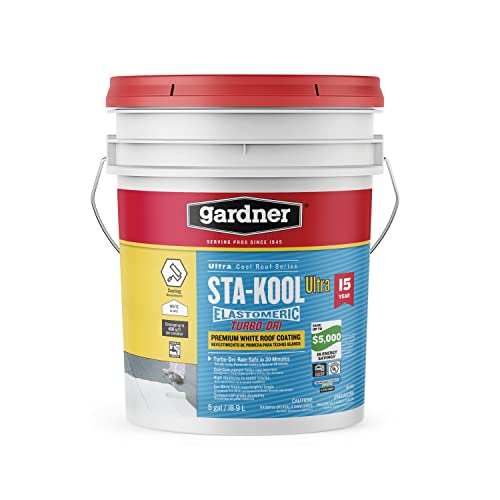
The Gardner-Gibson Sta-Kool 5 gallon coating is a white elastomeric roof coating with cool-core pigments that repel heat gain. It is rain safe in 30 minutes and recoatable in three hours, and carries a 15-year label.

Its short recoat window is its strongest advantage over the slower water-based kits in this list. That lets a single dry day cover two coats on a good weather window.

It also works for large roofs that need a 5 gallon pail.

What works

  • Rain safe in 30 minutes
  • Recoat after three hours
  • 5 gallons covers a large roof
  • Cool-core heat repelling pigment

Watch out for

  • RV substrates are not named
  • Roller application only listed
03

Best Large Roof Kit · 3 of 6

RV Roof Sealant 5 Gallon

RV Roof Sealant 5 Gallon
  • 5 gallon white kit
  • EPDM, TPO, fiberglass, aluminum
  • 1 gal per 50 sq ft
Check price on Amazon for RV Roof Sealant 5 Gallon (opens in a new tab)
Best for: Full roof recoats

Our take

Choose it for a full roof recoat across mixed materials.

Why it made the shortlist

The SENVEN 5 gallon kit is a white waterproof, solar reflective coating for EPDM, TPO, fiberglass and aluminum roofs, skylights and vent covers. It rolls on like paint at 1 gallon per 50 square feet.

Compared with the SENVEN 1 Gal, this is the same coating in a pail large enough for a full RV roof.

It also suits owners who want to buy once and finish.

What works

  • Covers EPDM, TPO, fiberglass, aluminum
  • Rolls on like paint
  • 5 gallons suits full roofs
  • Also seals skylights and vents

Watch out for

  • No reflectivity figure listed
  • Higher up-front cost
The catch
Next to Tenee 88%, it lacks a named reflectivity number but covers more substrates.
04

Best Weekend Project · 4 of 6

Liquid Rubber RV Roof Sealant

Liquid Rubber RV Roof Sealant
  • 1 gallon white membrane
  • 3-step weekend system
  • Multi-surface roofs
Check price on Amazon for Liquid Rubber RV Roof Sealant (opens in a new tab)
Best for: Small camper repair

Our take

Pick it for a small camper or a patch job where a branded system matters.

Why it made the shortlist

The Liquid Rubber 1 gallon coating is a flexible waterproof membrane with heat-reflecting behavior for roofs of EPDM, TPO, fiberglass or aluminum. Its listing describes an easy 3-step system for a weekend repair.

It is the brand-name 1 gallon option, a step above generic pails on documentation. It targets spot repair or small roofs, not full coverage.

What works

  • Easy 3-step system listed
  • Works on four roof types
  • Flexible waterproof membrane
  • Heat reflective properties

Watch out for

  • 1 gallon covers a small area only
  • No reflectivity number listed
05
Best for: Small partial recoat

Our take

It is for a small or partial recoat on a limited budget.

Why it made the shortlist

The SENVEN 1 gallon pail offers the same white waterproof, solar reflective formula as the 5 gallon, with EPDM, TPO, fiberglass and aluminum compatibility. It lists 1 gallon per 50 square feet for the final thickness.

It costs a fraction of the 5 gallon and covers a patch or a pop-up camper. It makes the most sense next to SENVEN 5 Gal for trying the product first.

On reflective rv roof coating, small partial recoat is where it fits.

What works

  • Low cost for a branded-style pail
  • Four roof types listed
  • Same formula as 5 gallon
  • Solar reflective white

Watch out for

  • Covers only about 50 sq ft
  • No reflectivity figure
06

Best Water-Based Budget · 6 of 6

CUKWUYBY RV Roof Sealant White

CUKWUYBY RV Roof Sealant White
  • Water-based, no solvents
  • Brush, roller or sprayer
  • Flexible white finish
Check price on Amazon for CUKWUYBY RV Roof Sealant White (opens in a new tab)
Best for: Tight budget patches

Our take

Choose it for a small repair on a tight budget.

Why it made the shortlist

The CUKWUYBY 1 gallon coating is a water-based, solvent-free white reflective coating that stays flexible without shrinking. It applies with a roller, brush, squeegee or sprayer after cleaning, and builds with heavy coats.

What works

  • Water-based and solvent-free
  • Applies by brush, roller or sprayer
  • Stays flexible without shrinking

Watch out for

  • Little brand documentation
  • Covers a small area only
The catch
It is the lowest-priced pick here and the only one that names sprayer application directly.

Methodology

How We Built This Shortlist

Each pick was assessed across 5 criteria weighted for real-world use.

01

Reflectivity evidence

We looked for a stated reflectivity figure rather than general cool roof language.

02

Substrate fit

We compared which roof types each listing names, such as EPDM, TPO, fiberglass and aluminum.

03

Coverage and coats

We compared square feet per gallon and the number of coats listed.

04

Cure and recoat time

We noted rain safe and recoat windows where stated.

05

System completeness

We checked whether a primer or cleaner step is named.

Decision guide

Match a Reflective RV Roof Coating to Your RV

By Roof Material

Your situationRecommended pickWhy
TPO roof, reflectivity firstTenee 88%Names TPO and 88 percent reflectivity
Mixed EPDM, fiberglass, aluminumSENVEN 5 GalLists four roof types
Small camper or patchLiquid Rubber 1 Gal3-step small system
Fast one-day finishGardner Sta-KoolRain safe in 30 minutes
Tight budget with sprayerCUKWUYBYNames sprayer use

By Budget

BudgetRecommended pick
$40 to $50CUKWUYBY or SENVEN 1 Gal
$40 to $80Tenee 88% or Liquid Rubber 1 Gal
$100 to $170Gardner Sta-Kool or SENVEN 5 Gal

Water-Based Membrane vs Elastomeric Pail

Water-based membranes

Tenee 88%, Liquid Rubber 1 Gal, SENVEN 1 Gal and CUKWUYBY spread thin and cure as flexible films.

Elastomeric pail

Gardner Sta-Kool and SENVEN 5 Gal come in 5 gallon pails for large areas.

Most RV owners should start with Tenee 88% for a small roof or SENVEN 5 Gal for a full roof.

By Budget

PickRecommended pick
Under $50CUKWUYBY, SENVEN 1 Gal or Tenee 88%
$80Liquid Rubber 1 Gal
$100Gardner Sta-Kool
$170SENVEN 5 Gal

For Heat-Prone Climates Specifically

Look for

A stated reflectivity percentage plus a flexible film.

In this comparison

Tenee 88% lists 88 percent reflectivity and 1000 percent plus elongation.

When to Spend More

Spend more if

Spend more on SENVEN 5 Gal or Gardner Sta-Kool when a full roof is needed.

Save if

Save with SENVEN 1 Gal or CUKWUYBY for small patches.

FAQ

Before You Bring One Home

Does a white coating really cool an RV?

A reflective surface sends more sunlight away. The size of the benefit depends on the number listed and your roof. Compare stated reflectivity percentages, not general claims.

Is 5 gallons worth it over 1 gallon?

For a full roof, yes. At 1 gallon per 50 square feet, a 5 gallon pail covers about 250 square feet. A 1 gallon pail fits a patch or small camper.

What is the most common mistake?

Skipping cleaning and prep. Dirt and chalk block adhesion, so clean and dry the roof first.

How do I apply a roof coating?

Clean, repair seams, then roll on heavy coats according to the label. Allow each coat to dry before recoating.

How often should I recoat?

Inspect yearly for thinning or cracks. Recoat when the film wears, following the maker's guidance.

Bottom line

The short version

Browse more reflective rv roof coating on Amazon →
Bowen Higgins, RV Editor at RV Gear Lab

About the author

Bowen Higgins

RV Editor at RV Gear Lab

Bowen covers RV power, water systems, towing and leveling, upkeep and interior comfort, with a focus on matching gear to the rig, the hookups and the way you actually travel.

More from Bowen →Editorial standards

Keep reading

Related guides