

We research everything we recommend. When you buy through our links, we may earn a commission. Learn more

Buying guide · 10 min read · Updated October 2, 2026

5 Best Insulated Sleeping Pad in 2026: A Practical Camping Guide

Five insulated sleeping pads compared on stated R-value, thickness and weight, with a note on which numbers cite ASTM and which come from other labs.

Danny WalkerBy Danny WalkerCamping Editor at RV Gear Lab5 products comparedSpec-sheet researched

At a glance

Our top picks

A sleeping pad is what keeps the cold ground from drawing heat out of your body, and its R-value is the number that measures that. A pad with a higher R-value resists heat flow better, and since about 2020 the industry standard for measuring it is ASTM F3340, so a number labeled ASTM is comparable across brands in a way that an unlabeled number is not. Pads can also stack, adding their R-values, with a small loss from air gaps. On a cold night, the pad matters more than the bag, because your weight crushes the insulation underneath you.

The five picks here span an ultralight foil mat to a 4 inch inflatable. Only one states an ASTM R-value directly, which is 4.2, while others cite an SGS-tested or certified figure of 5.5 or 9, and one states a 5.2 figure with no named test, and the foil mat gives no R-value at all. We report each as the listing states it and flag the source. Because naming conventions vary, the comparison below always says who measured the number.

We evaluated each listing for the stated R-value and how it is certified, thickness, weight, packed size, inflation method and fabric. As a rule of thumb from outdoor guidance, R-1 to R-2 suits summer, R-3 to R-4 suits three seasons and R-5 or higher suits winter, so we used those bands to explain what each number is for.

RV Gear Lab field notes

The Campsite Fit Check

Start with the job
Klymit Insulated Static V Peak Sleeping Pad leads this shortlist for Cool-night camping with a comparable R-value. Use that fit as a reference point, then compare the alternatives against your own space and workload.
Specs that separate the picks
The first details to compare are ASTM R-value 4.2, SGS-certified R 5.5, Stated R 5.2, 22 oz. Confirm the exact model and included components before ordering.
Trade-off to plan for
Most expensive pick in this guide

Before you buy

What Matters Before You Choose an Insulated Sleeping Pad

Key buying criteria so you get the right fit the first time.

  1. 01

    R-value and ASTM F3340

    R-value measures a pad's resistance to heat flow, and a higher number means more warmth from the ground. Since about 2020 the ASTM F3340 standard has made values comparable across brands, so look for ASTM next to the number. R-1 to R-2 suits summer, R-3 to R-4 suits three seasons and R-5 or more suits winter. Only the Klymit Static V Peak states ASTM on its listing. If you camp in a range of seasons, a pad with an R of 4 to 5 covers most trips.

  2. 02

    Certification source

    Some makers cite SGS, an independent lab, and others give a number with no named test. An SGS figure is still better than no source, but it may not follow the ASTM method. Be cautious with very high numbers, and read how the value was obtained. Check the listing for the test named. Check the pad length, since a short pad leaves legs on the cold ground.

  3. 03

    Thickness and sleep position

    A thicker pad, such as 4 inches, keeps a side sleeper's hips and shoulders off the ground. A thin foam or foil mat compresses and adds little comfort. Thickness and R-value are related but not the same. Check the stated thickness in inches. Foam and foil layers add R-value but not much comfort.

  4. 04

    Weight and packed size

    Pads range from a 120 g foil mat to a 2.2 lb thick inflatable. Higher R-values usually add weight and bulk. A pad that packs to a bottle size saves room. Compare stated weights and packed dimensions. Thin ripstop fabrics need a ground cloth on sharp terrain.

  5. 05

    Inflation and valve

    A flip valve or a pump sack saves time and breath. Inflating by mouth adds moisture inside the pad, which can matter in the cold. A wide valve deflates quickly. Look for the valve type and the stated breath count. Keep your pad away from the stove, since heat can damage TPU and nylon.

  6. 06

    Fabric and puncture resistance

    A 20D to 40D nylon with a TPU layer resists punctures, and a thicker denier is tougher. A pad that loses air at night loses its insulation. Bring a repair patch. Check the fabric denier and coating. If you plan to stack pads, put the foam pad on the ground and the inflatable on top.

Our standards

Why You Can Trust RV Gear Lab

At RV Gear Lab, we compare products based on campsite fit, verified specifications, usability, setup requirements, weight, durability, and real-world trade-offs. We do not rank products purely on marketing claims or commission rates.

We have not personally tested every product listed. Where hands-on testing is not available, recommendations are based on verified manufacturer specifications, product documentation, use-case fit, and comparative research.

How we review camping gear →

Detailed reviews

The 5 best insulated sleeping pad, explained

01

Best Stated ASTM R-Value · 1 of 5

Klymit Insulated Static V Peak Sleeping Pad

Klymit Insulated Static V Peak Sleeping Pad
  • ASTM R-value 4.2
  • Klymalite insulation, V-chamber design
  • Flip valve, about 10 breaths
Check price on Amazon for Klymit Insulated Static V Peak Sleeping Pad (opens in a new tab)
Best for: Cool-night camping with a comparable R-value

Our take

It suits campers who want a recognized brand with an R-value they can compare directly.

Why it made the shortlist

The Klymit Insulated Static V Peak is the one pick that states an ASTM R-value, 4.2, from its Klymalite synthetic insulation. It is described as a 4-season pad with a patented V-chamber body mapping design that supports side, stomach or back sleeping.

Compared with the TREKOLOGY and Elegear pads, it adds side rails built into the structure to keep you centered, deep weld zones and a flip valve that inflates in as few as 10 breaths and opens wide to deflate. The V-shaped chambers also reduce air movement under you. The V-chambers also reduce air movement under you, which keeps the pad feeling stable.

An R of 4.2 covers three-season trips into cool nights. The rails help keep you centered if you toss in your sleep.

What works

  • States an ASTM R-value of 4.2
  • Side rails keep you centered on the pad
  • Flip valve inflates in about 10 breaths
  • V-chambers support any sleep position

Watch out for

  • Most expensive pick in this guide
  • R-value is lower than the 5.2 and 5.5 pads
02
Trekology Insulated Sleeping Pad Backpacking Ultralight
  • SGS-certified R 5.5
  • 4 inch thick, 28 oz
  • 75 by 25 inch rectangular shape
Check price on Amazon for Trekology Insulated Sleeping Pad Backpacking Ultralight (opens in a new tab)
Best for: Cold sleepers and side sleepers backpacking

Our take

It suits backpackers who sleep cold and want a thick, wide pad.

Why it made the shortlist

The TREKOLOGY Insulated Sleeping Pad is SGS-certified at R 5.5 using heat-reflective layers and a 4 inch (10 cm) cloud-loft that eases pressure points for side sleepers. The 190 by 63 cm (75 by 25 inch) rectangular envelope shape stops you slipping off narrow mats.

It weighs just 790 g (28 oz) and supports up to 150 kg (330 lbs), with a 40D ripstop nylon that is puncture-resistant and waterproof. Compared with the Klymit Static V Peak, it has a higher stated R-value at a lower price, with an SGS certification instead of ASTM. The wider rectangular shape is easier to live with than a narrow mummy cut.

R 5.5 sits in the winter band. Four inches of loft is the main reason it feels like a mattress in the backcountry.

What works

  • Stated R-value of 5.5 for four-season use
  • Four inches of loft for side sleepers
  • Wide rectangular shape stops sliding off
  • Supports up to 330 lbs at 28 oz

Watch out for

  • R-value is SGS-certified, not ASTM
  • Thick pad takes longer to inflate
03
Best for: Cold-weather pads without blowing by mouth

Our take

It suits campers who dislike blowing up a pad in the cold.

Why it made the shortlist

The Gear Doctors ApolloAir is a 22 oz inflatable pad rated at R 5.2 on the listing, with a 3.2 inch horizontal insulated design. It packs to 8.5 inches in height, small enough for a bottle-size spot in a pack.

It comes with a pump sack that has a matched valve so you can inflate it without using your lungs in about 90 seconds, which neither the TREKOLOGY 5.5 nor the Klymit Static V Peak offers. Seams are engineered for durability and the fabric is water-resistant. The pump sack saves your breath and keeps moisture from it out of the pad.

The 90 second inflate is the kind of detail that matters at the end of a long day.

What works

  • Light at 22 oz with a stated R 5.2
  • Pump sack inflates without breath
  • Packs to about 8.5 inches in height
  • Water-resistant, durable seams

Watch out for

  • The test behind R 5.2 is not named
  • Thinner than the 4 inch pads
04
Best for: Winter camping needing a high stated R-value

Our take

It suits mountaineers and winter campers who want the largest R-value on paper.

Why it made the shortlist

The Elegear 4 inch pad states an R-value of 9, built from a 9-layer insulation system and described as independently SGS tested. It is a mummy-shaped single pad weighing 2.2 lbs, made from 20D tear-resistant nylon with a TPU layer.

It states the highest R-value in the guide and is 4 inches thick, thicker than a standard 3.2 inch camping mat. The higher stated number comes with a mummy shape that saves weight.

It also suits backpackers who prize low pack weight. A high number paired with low weight is a strong reason to buy for winter.

What works

  • Highest stated R-value at 9
  • 4 inch thickness for comfort
  • 2.2 lbs for a thick winter pad
  • 20D nylon with a reinforced TPU layer

Watch out for

  • R 9 is SGS tested, not ASTM
  • Mummy shape is narrower at the feet
05
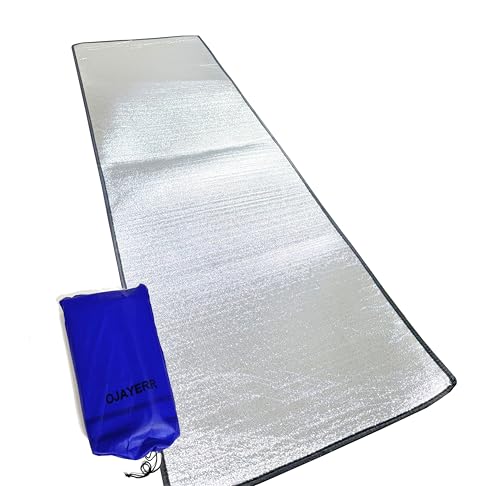
Camping Mat Insulated Sleeping Pad 78" x 39" Tent Floor Thermal Blanket
  • Foil and EPE mat, 78 by 39 inches
  • About 120 g, 0.078 inches thick
  • Carry pack included
Check price on Amazon for Camping Mat Insulated Sleeping Pad 78" x 39" Tent Floor Thermal Blanket (opens in a new tab)
Best for: A cheap thermal layer under another pad

Our take

It suits campers who want a cheap thermal layer under another pad.

Why it made the shortlist

It is very thin at about 0.078 inches and weighs about 120 g (4.23 oz).

It is the lowest priced pick in the guide and the lightest by far, and it is meant to act as a thermal layer protecting a sleeping bag from cold ground. It can also work as a tent floor mat, a picnic mat or a thermal blanket, and folds into an included carry pack. The thin foil layer packs into a pocket and adds almost no weight.

It can sit on top of a pad to add a bit of warmth in the cold.

What works

  • Only about 120 g and very thin
  • Reflective foil adds a thermal layer
  • Doubles as a tent floor mat or picnic mat

Watch out for

  • No R-value is stated
  • Too thin for comfort on its own
The catch
It does not list an R-value, so it works as an add-on and not a stand-alone winter pad.

Methodology

How We Built This Shortlist

Each pick was assessed across 5 criteria weighted for real-world use.

01

R-value and its source

We recorded each stated R-value and who certified it, ASTM, SGS or no named test, because an unlabeled number cannot be compared fairly. Numbers labeled ASTM were separated from numbers labeled SGS or unlabeled.

02

Thickness and comfort

We compared thickness, from a thin foil mat to 4 inches of loft, since thicker pads suit side sleepers. Thicker pads were compared against lighter ones for each season.

03

Weight and packed size

We noted weights from about 120 g to 2.2 lbs and packed sizes where listed. Weight was compared with R-value to judge warmth per ounce.

04

Inflation method

We looked at valves, breath counts and pump sacks, which decide how easy the pad is to set up in the cold. Pump sacks and flip valves were counted as practical features.

05

Fabric and durability

We checked nylon denier, TPU layers and waterproofing, which govern how well the pad resists punctures. Fabric deniers and TPU layers were compared for durability.

Decision guide

Match an Insulated Sleeping Pad to Your Camp Setup

By season and R-value

Your situationRecommended pickWhy
Cool nights with a comparable numberKlymit Static V PeakAn ASTM R-value of 4.2 with V-chambers
Winter nights below freezingTREKOLOGY 5.5SGS-certified R 5.5 with 4 inches of loft
Cold nights without blowing by mouthGear Doctors ApolloAirA stated R 5.2 with a pump sack
Extreme cold needing a big numberElegear R9A stated R 9 from a 9-layer insulation system
A thermal add-on under another padOJAYERR Foil MatA thin foil and EPE layer at about 120 g

By Budget

BudgetRecommended pick
Entry of this shortlistOJAYERR Foil Mat or TREKOLOGY 5.5
Mid of this shortlistGear Doctors ApolloAir or Elegear R9
Top of this shortlistKlymit Static V Peak

ASTM-labeled vs other certification

ASTM-labeled

An ASTM number can be compared across brands. The Klymit Static V Peak is the one pick that states it.

SGS or unnamed test

An SGS or maker figure may run higher but is harder to compare. The TREKOLOGY 5.5, Elegear R9 and Gear Doctors ApolloAir state these.

Choose the Klymit Static V Peak for a clean comparison, or the TREKOLOGY 5.5 for a higher stated number.

By sleeping style

If you areRecommended pick
A side sleeper wanting 4 inchesTREKOLOGY 5.5
A restless sleeper needing railsKlymit Static V Peak
A backpacker counting ouncesGear Doctors ApolloAir
A winter camper wanting a high figureElegear R9

For Winter Camping Specifically

Look for

A stated R-value of 5 or higher, a named certification and a durable fabric

In this comparison

The TREKOLOGY 5.5 states an SGS-certified R 5.5, and the Elegear R9 states an SGS-tested R 9.

When to Spend More

Spend more if

Spend more on the Klymit Static V Peak for the ASTM-labeled R 4.2, rails and flip valve.

Save if

Save with the OJAYERR Foil Mat, the lowest priced pick here, as a thermal add-on, or the TREKOLOGY 5.5 for a high stated R-value at a modest price.

FAQ

Before You Bring One Home

What R-value do I need?

Use R-1 to R-2 for summer, R-3 to R-4 for three seasons and R-5 or more for winter. The Klymit Static V Peak states an ASTM R of 4.2, which suits cool nights. The TREKOLOGY 5.5 states R 5.5 for colder weather. Remember that your sleeping bag and clothing also affect warmth, not just the pad.

Can I stack two pads to add R-value?

Yes, R-values add when pads are stacked, with a small loss from air gaps. A cheap foam or foil layer like the OJAYERR Foil Mat under an inflatable adds insulation and protects it from punctures. Do not expect a perfect sum. A foil layer on the ground adds a thin thermal barrier but does not replace a pad.

Is an R-value of 9 realistic?

The Elegear R9 states it as SGS tested, but it is not an ASTM figure. Read it as a very warm pad and not a precise number. Be cautious with very high numbers and always read the named test.

How do I inflate a pad without moisture from my breath?

Use a pump sack, as the Gear Doctors ApolloAir includes, so you avoid warm breath inside. A flip valve such as the Klymit Static V Peak inflates in about 10 breaths. In very cold weather, a pump sack is the better choice. Inflating with a pump sack also keeps moisture from your breath out of the pad.

How do I repair or care for a pad?

Find a leak by listening or with soapy water, then patch it with a repair kit. Store the pad loosely with the valve open. The TREKOLOGY 5.5 uses 40D nylon that resists punctures. Pack a patch kit in the stuff sack so a leak does not end a trip.

How do I choose between a thick pad and a high R-value pad?

Thickness and R-value are related but not the same, and both matter. A 4 inch pad such as the TREKOLOGY 5.5 cushions a side sleeper, while a pad with a higher R-value resists the cold ground better. The Klymit Static V Peak combines a stated ASTM R-value with chamber support. Pick the number that matches your coldest night and the thickness that matches your sleep style.

Bottom line

The short version

Browse more insulated sleeping pad on Amazon →
Danny Walker, Camping Editor at RV Gear Lab

About the author

Danny Walker

Camping Editor at RV Gear Lab

Danny covers camping gear, campsite setup, outdoor power, sleep systems and practical camping advice, with a focus on helping campers make better gear decisions.

More from Danny →Editorial standards

Keep reading

Related guides