

We research everything we recommend. When you buy through our links, we may earn a commission. Learn more

Buying guide · 10 min read · Updated October 2, 2026

5 Best Internal TPMS For RV in 2026: A Practical RV Guide

Compare five RV TPMS kits for internal sensor owners: install effort, valve stem fit, psi range and repeaters, plus two screw-on options for easier setup.

Bowen HigginsBy Bowen HigginsRV Editor at RV Gear Lab5 products comparedSpec-sheet researched

At a glance

Our top picks

Internal TPMS sensors live inside the wheel, which keeps them hidden but makes installation a shop job. This guide is for owners deciding whether that trade is worth it.

Three of the five kits here name internal sensors in their titles. The other two are included as honest comparison points, and we say plainly where the product page leaves the sensor style unstated.

RV Gear Lab field notes

The Rig Fit Check

Start with the job
Truck System Technologies TST 507 Series 6 Internal Sensor TPMS System Color Display and Repeater leads this shortlist for Heavy rigs wanting expandable internal sensors. Use that fit as a reference point, then compare the alternatives against your own space and workload.
Specs that separate the picks
The first details to compare are Six internal sensors, repeater, Six internal sensors, solar monitor. Confirm the exact model and included components before ordering.
Trade-off to plan for
Needs a tire shop for sensor installation

Before you buy

What Matters Before You Choose an Internal TPM For RV

Key buying criteria so you get the right fit the first time.

  1. 01

    Internal sensor installation

    An internal TPMS sensor mounts inside the wheel, usually strapped to the rim or clamped to a valve stem, so the tire must be dismounted to fit it. That adds a tire shop visit per wheel and the same visit again when a sensor battery dies. Ask your shop for its labor price before you buy the kit, and confirm the sensors suit your rim type.

  2. 02

    Valve stem size and metal

    Internal sensors pull on the stem, so a stem that does not fit the valve hole or is made of weak rubber can fail. Some kits include metal stems at a stated diameter, such as 0.453 inch, so you know what to match. Measure your valve hole or ask a shop, and prefer metal stems on a heavy rig.

  3. 03

    Maximum psi reading

    Heavy motorhome and trailer tires can run 80 to 125 psi, and sensors need headroom above the tire's cold pressure. Ranges seen here go from 87 PSI on external kits to 203 and 218 psi on the larger internal systems. Read the exact range in the title or bullet list and choose one comfortably above your tire's maximum.

  4. 04

    Repeater for long rigs

    A repeater picks up sensor signals and relays them to the display. Internal sensors sit inside a steel wheel that can weaken the radio link, so a repeater helps on motorhomes with a toad. Check whether the kit includes one in the title or kit contents rather than assuming it does.

  5. 05

    Spare tire monitoring

    A flat spare matters when a tire fails miles from a shop. Some systems offer dedicated spare tire positions and can track over 100 tires in total, while smaller kits only handle four or six. Look for the words spare position on the display description if you want your spares watched.

  6. 06

    Sensor battery access

    Internal sensors usually need a tire shop visit when the battery runs out, while external ones can be swapped by hand. The listings do not always say how long a sensor battery lasts, so ask. Check whether the battery is replaceable or sealed before you buy.

Our standards

Why You Can Trust RV Gear Lab

At RV Gear Lab, we compare products based on rig fit and power or hookup compatibility, verified specifications, usability, setup requirements, weight, durability, and real-world trade-offs. We do not rank products purely on marketing claims or commission rates.

We have not personally tested every product listed. Where hands-on testing is not available, recommendations are based on verified manufacturer specifications, product documentation, use-case fit, and comparative research.

How we review RV gear →

Detailed reviews

The 5 best internal tpms for rv, explained

01
Best for: Heavy rigs wanting expandable internal sensors

Our take

It suits a motorhome or heavy trailer owner who wants internal sensors and room to grow.

Why it made the shortlist

The Truck System Technologies 507 Series kit is sold with six internal sensors, a color display and a repeater. The system can monitor up to 115 tires, including spares, with a range of 1 to 218 psi.

The RecPro's 203 PSI ceiling is also high, so the decision comes down to how much display flexibility you want.

Because internal sensors sit inside the rim, installation and later battery work require a tire shop, so price that service in.

What works

  • Internal sensors sit inside the wheel
  • Reads up to 218 psi
  • Brighter color display with spare positions
  • Audible, visible and text alerts

Watch out for

  • Needs a tire shop for sensor installation
02
Best for: Six-wheel trailers on a mid budget

Our take

The metal stems are the real selling point, because internal sensors depend on a stem that can take the sensor load.

Why it made the shortlist

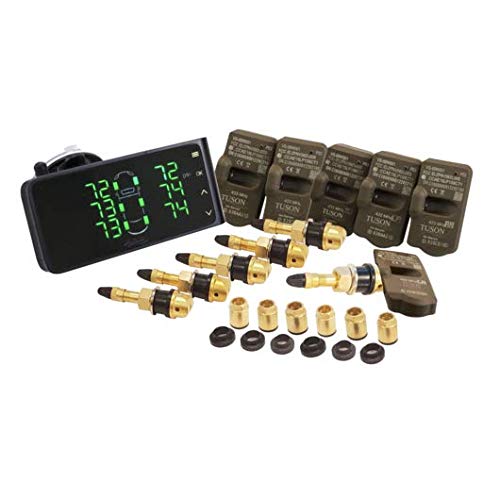
The RecPro Tuson kit includes six internal sensors, one receiver and display, one RF repeater and six metal valve stems at 0.453 inch diameter. It reads pressure up to 203 PSI.

Compared with the Keenso Internal below, it adds a repeater and metal valve stems, which matter on a long, heavy rig.

It fits a six-wheel trailer or motorhome, and the 0.453 inch stem size must match your wheel's valve hole.

What works

  • Six metal valve stems are included
  • RF repeater helps on long rigs
  • Pressure range tops out at 203 PSI
  • Designed for six wheels

Watch out for

  • Stem size must fit your wheels
  • Sensor installation needs tire dismounting
03

Best Budget Internal · 3 of 5

Keenso Tire Pressure Monitoring System

Keenso Tire Pressure Monitoring System
  • Six internal sensors, solar monitor
  • 3.5 inch LCD, two brightness levels
  • Front and rear thresholds
Check price on Amazon for Keenso Tire Pressure Monitoring System (opens in a new tab)
Best for: Short trailers on a tight budget

Our take

The low-power mode drops in after five minutes of inactivity and wakes within one second of vibration.

Why it made the shortlist

The Keenso kit is listed with six internal sensors and a solar-powered monitor with a 3.5 inch LCD. You can set separate pressure thresholds for front and rear tires, and a blue backlight shifts to red flashing lights and audible alerts when a limit is crossed.

The RecPro is the safer pick for a long trailer because it ships with a repeater and metal stems.

What works

  • Solar panel keeps the monitor charged
  • Front and rear thresholds can differ
  • Blue light switches to red alert
  • Mounts to the dash with tape

Watch out for

  • PSI range is not stated in the listing
  • No repeater is named in the title
The catch
It undercuts the RecPro Tuson dramatically on price, but the title names no repeater and the listing does not state a PSI range.
04

Best High-Capacity Alternative · 4 of 5

GUTA GT30 Trailer Tire Pressure Monitoring System

GUTA GT30 Trailer Tire Pressure Monitoring System
  • Ten sensors, ten tires per page
  • Fast leak and missing sensor alerts
  • Rechargeable monitor battery
Check price on Amazon for GUTA GT30 Trailer Tire Pressure Monitoring System (opens in a new tab)
Best for: Large rigs not requiring internal sensors

Our take

Choose it if you want one screen for a large rig and are happy to skip tire dismounting.

Why it made the shortlist

The GUTA GT30 is listed with ten sensors and a large screen that shows up to 10 tires on one page.

Against the TM2, it adds six more sensors and a built-in lithium battery in the monitor that lasts 12 to 14 days after a four hour charge.

What works

  • Shows ten tires on one page
  • Alerts for fast leak and low sensor battery
  • Monitor battery runs 12 to 14 days
  • Wireless sensor programming

Watch out for

  • Sensor style is not named
05

Best External Alternative · 5 of 5

Tymate TM2 RV Tire Pressure Monitoring System

Best for: Light trailers wanting easy installation

Our take

Do not choose it for tires running above about 80 PSI cold.

Why it made the shortlist

The Tymate TM2 set of four uses external sensors with low power draw and a color LCD with automatic backlight. It reads 0 to 87 PSI and charges by solar or USB.

It is the easiest install in this list, since the sensors screw on and no tire needs to come off the rim.

What works

  • No tire dismounting needed for install
  • Solar and USB charging
  • Auto-adjusting color backlight
  • Six alarm modes

Watch out for

  • 87 PSI ceiling is low for heavy rigs
  • Only four sensors
The catch
The tradeoff against the internal kits above is a lower 87 PSI ceiling and four sensors instead of six.

Methodology

How We Built This Shortlist

Each pick was assessed across 5 criteria weighted for real-world use.

01

Sensor mounting

We sorted the kits by whether their titles state internal sensors, since that decides who has to install them and who can swap a battery.

02

Pressure ceiling

We compared the stated maximum PSI of each kit against heavy trailer and motorhome tire pressures.

03

Valve stem fit

We looked for stem size and material details, because internal sensors depend on the stem to hold them in place.

04

Signal reach

We checked which kits include a repeater and how many tires each can display.

05

Installation burden

We weighed the shop time an internal sensor needs against the simplicity of screw-on sensors.

Decision guide

Match an Internal TPM For RV to Your RV

By Sensor Mounting

Your situationRecommended pickWhy
Want internal sensors and a repeater on a heavy rigTST 507 InternalIncludes a repeater and reads to 218 psi
Want internal sensors with metal stems, mid budgetRecPro TusonSix metal 0.453 inch stems come in the box
Want internal sensors at the lowest costKeenso InternalSix internal sensors at a fraction of the others
Do not want tire dismountingTymate TM2External sensors screw on by hand

By Budget

BudgetRecommended pick
$60 to $80Tymate TM2 or Keenso Internal
$260 to $480GUTA GT30 or RecPro Tuson
$660 to $670TST 507 Internal

Internal vs External Sensors

Internal sensors

Sensors sit inside the wheel, so they are protected from road debris and cannot be unscrewed by a thief. The TST 507 Internal, RecPro Tuson and Keenso Internal use them, but each tire must be dismounted to fit them.

External sensors

Sensors thread onto the valve stem, so you install them in minutes without a shop. The Tymate TM2 uses them, and the GUTA GT30 should be treated the same way until its product page says otherwise.

Most owners should default to external sensors unless a shop is already changing their tires, and then the RecPro Tuson is the sensible internal choice.

By Display Size and Count

Rig sizeRecommended pick
Four-tire trailerTymate TM2
Six-wheel trailer or motorhomeRecPro Tuson
Motorhome plus toad and sparesTST 507 Internal
Large rig, ten tires on one pageGUTA GT30

For Motorhomes With a Toad Specifically

Look for

A repeater in the box, a pressure range above your tire's maximum, and room for extra tire positions.

In this comparison

The TST 507 Internal includes a repeater and can track up to 115 tires. The RecPro Tuson also ships with one and covers six wheels.

When to Spend More

Spend more if

Spend more if you run a motorhome with spares to watch: the TST 507 Internal adds a 218 psi ceiling and dedicated spare positions beyond what the RecPro Tuson offers.

Save if

Save if your trailer is light: the Keenso Internal or the Tymate TM2 gets you pressure and temperature alerts for under a hundred dollars.

FAQ

Before You Bring One Home

Do internal TPMS sensors need a tire shop?

Yes, in nearly every case. The sensor mounts inside the rim, so the tire must be dismounted to fit it. Plan the same visit again when a sensor battery needs replacing.

Can I mix internal sensors with a different display?

No. Sensors are paired to the monitor they ship with, and each brand uses its own radio protocol. Buy the sensors and display as a complete kit such as the TST 507 Internal.

Is an internal kit worth the extra cost over the Tymate TM2?

Only if protection from theft and debris, or a higher pressure range, matters to you. For a light trailer on moderate pressure, the Tymate TM2 gives the same alerts without tire shop labor.

How do I check my valve stem size?

Measure the valve hole diameter on your wheel or ask a tire shop, then compare it with the stem listed for the kit. The RecPro Tuson lists 0.453 inch stems. A mismatch can leave a leak, so confirm before buying.

What if an internal sensor battery fails?

Sensors usually send a low battery alert to the display first. Replacement means dismounting the tire again, so check whether the battery or the whole sensor is replaced and what the labor costs.

Bottom line

The short version

Browse more internal tpms for rv on Amazon →
Bowen Higgins, RV Editor at RV Gear Lab

About the author

Bowen Higgins

RV Editor at RV Gear Lab

Bowen covers RV power, water systems, towing and leveling, upkeep and interior comfort, with a focus on matching gear to the rig, the hookups and the way you actually travel.

More from Bowen →Editorial standards

Keep reading

Related guides