

We research everything we recommend. When you buy through our links, we may earn a commission. Learn more

Buying guide · 10 min read · Updated October 2, 2026

6 Best Sway Control Hitch in 2026: A Practical RV Guide

A type-by-type look at sway control hitches: all-in-one weight distribution kits, bolt-on friction bar kits and the small parts that go with them.

Bowen HigginsBy Bowen HigginsRV Editor at RV Gear Lab6 products comparedSpec-sheet researched

At a glance

Our top picks

Sway control comes in three different forms, and most shopping mistakes start by comparing them as if they were the same thing. A full weight distribution hitch with sway control, a stand-alone friction bar kit and a loose ball plate all appear under one search term, yet they solve different parts of the problem.

This list is organized so you can see one example of each form. The first two picks are complete hitch systems, the middle two are bolt-on bar kits, and the last two are adapters or parts that only work as add-ons to something you already own.

RV Gear Lab field notes

The Rig Fit Check

Start with the job
MaxxHaul 51191 Weight Distribution Hitch leads this shortlist for Boxed all-in-one kit. Use that fit as a reference point, then compare the alternatives against your own space and workload.
Specs that separate the picks
The first details to compare are 11,500 lb capacity listed, 1,500 lbs capacity listed, One kit under 10K trailers. Confirm the exact model and included components before ordering.
Trade-off to plan for
Sway mechanism type is not named

Before you buy

What Matters Before You Choose a Sway Control Hitch

Key buying criteria so you get the right fit the first time.

  1. 01

    Know which type you need

    Sway control hardware falls into complete weight distribution hitches, stand-alone friction bar kits and loose parts such as ball plates. A complete hitch levels the truck and trailer while resisting sway, but a bar kit only adds resistance to side-to-side movement. Look at the title to see whether the word weight distribution appears, because many bar kits are sold under similar sway control names.

  2. 02

    Tongue weight comes first

    Tongue weight is the downward force the trailer puts on the hitch ball, normally about 10 to 15 percent of the loaded trailer weight. Too little tongue weight is a common root cause of sway, and no hitch hardware fully fixes a badly loaded trailer. Weigh your loaded trailer or check the sticker, then compare it with the tongue weight rating on the listing.

  3. 03

    Check the mounting method

    Some kits clamp onto the trailer frame while others need drilling or a ball mount that already has a sway tab. This matters because a kit that does not fit your ball mount forces you to buy an adapter or a new mount. Read the install notes on the listing and look for words like clamp-on, tab, self-tapping or drilling.

  4. 04

    Shank size and drop

    A 2 inch shank fits a 2 inch receiver, and the drop or rise sets how level the trailer rides. A trailer that nose-dives or tilts up behind a lifted truck needs a longer drop than the standard one. Measure the receiver height with the trailer level, then compare it against the drop listed on the shank.

  5. 05

    Side and adjustability

    Single-bar kits are often sold as left-hand or right-hand, and some are adjustable while others are fixed. A bar that cannot be released also matters, because friction bars generally need to be loosened for backing up and slick roads. Look for an on and off feature or a crank handle on the listing before you buy.

Our standards

Why You Can Trust RV Gear Lab

At RV Gear Lab, we compare products based on rig fit and power or hookup compatibility, verified specifications, usability, setup requirements, weight, durability, and real-world trade-offs. We do not rank products purely on marketing claims or commission rates.

We have not personally tested every product listed. Where hands-on testing is not available, recommendations are based on verified manufacturer specifications, product documentation, use-case fit, and comparative research.

How we review RV gear →

Detailed reviews

The 6 best sway control hitch, explained

01
MaxxHaul 51191 Weight Distribution Hitch
  • 11,500 lb capacity listed
  • 8.5 inch deep-drop shank
  • Clamp-on brackets, no drilling
Check price on Amazon for MaxxHaul 51191 Weight Distribution Hitch (opens in a new tab)
Best for: Boxed all-in-one kit

Our take

Best for a travel trailer owner who wants one boxed system and drives a truck that needs a deep drop.

Why it made the shortlist

The MaxxHaul 51191 is a complete weight distribution system sold as a sway control kit, with a 2 inch solid steel shank, a 2-5/16 inch ball and an 11,500 lb capacity in the title. The listing also mentions tapered spring bars, control brackets and a lift-assist bar, so it is one of the few picks here that arrives ready to hook up.

Next to the VEVOR below it, the MaxxHaul advertises a far higher capacity figure and an 8.5 inch deep-drop shank for taller trucks.

What works

  • Complete system with ball and pin included
  • Deep-drop shank suits taller trucks
  • Clamp-on brackets fit frames up to 7 inches wide
  • Powder-coat finish resists corrosion

Watch out for

  • Sway mechanism type is not named
  • Costs far more than bolt-on kits
The catch
The listing does not state the sway mechanism type, so confirm how the control brackets work before assuming a specific style.
02
VEVOR Sway Control Weight Distribution Hitch
  • 1,500 lbs capacity listed
  • Tilt-head for height setup
  • Forged alloy steel parts
Check price on Amazon for VEVOR Sway Control Weight Distribution Hitch (opens in a new tab)
Best for: Budget all-in-one

Our take

Best for a first-time buyer who wants an all-in-one hitch for less.

Why it made the shortlist

The VEVOR is another weight distribution hitch with sway control, listed with a 1,500 lbs capacity, a 2 inch solid steel shank and a 2-5/16 inch alloy steel ball. The listing describes a four-way dynamic stability system and a tilt-head design for quick height calibration.

Compared with the Shocker kit below, it is a full leveling system rather than a single bar.

What works

  • Includes shank and 2-5/16 inch ball
  • Tilt-head makes height adjustment simpler
  • Weight distribution and sway control in one kit

Watch out for

  • Capacity figure is not clearly defined
  • Four-way system wording is vague
03
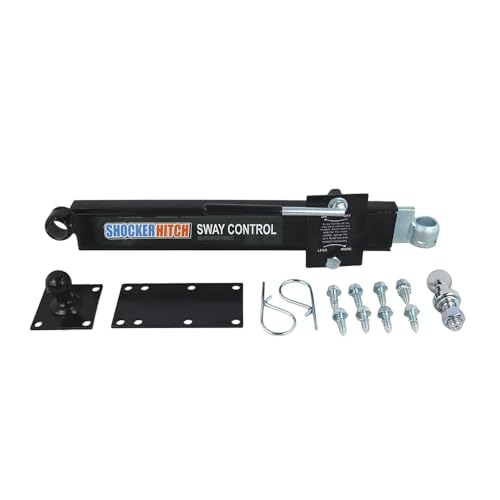
Shocker Sway Control Friction Arm Bar & Ball Kit
  • One kit under 10K trailers
  • Adjustable friction bar
  • Includes both balls
Check price on Amazon for Shocker Sway Control Friction Arm Bar & Ball Kit (opens in a new tab)
Best for: Tabbed ball mounts

Our take

Best for a trailer owner whose mount already has sway tabs.

Why it made the shortlist

The Shocker Sway Control Friction Arm Bar and Ball Kit is a stand-alone adjustable friction bar with a trailer-mounted ball and a mini hitch ball. The listing says to use one system for trailers under 10K and two systems for trailers over 10K.

The listing says it is used with Shocker hitches that have mounting tabs and can work with other mounts that have tabs.

If your ball mount has no tab, you will need an adapter, so check that before you order.

What works

  • Adjustable friction bar
  • Includes trailer ball and hitch ball
  • Two kits can cover trailers over 10K
  • Listed for travel and cargo trailers

Watch out for

  • Needs mounting tabs on the ball mount
  • Does not distribute weight
04
RVGUARD Adjustable Sway Control Kit Right Handed
  • Right-handed bar kit
  • Crank handle adjustment
  • Includes friction plate
Check price on Amazon for RVGUARD Adjustable Sway Control Kit Right Handed (opens in a new tab)
Best for: Budget bar kit

Our take

Best for a budget buyer who wants a complete bar for a single driver-side mount.

Why it made the shortlist

The RVGUARD Adjustable Sway Control Kit is a right-handed bar kit that includes a slide bar, crank handle, spring clips, a friction plate, a tongue ball plate, self-tapping screws and a tongue ball. The listing highlights adjustment for different trailer weights and towing conditions.

What works

  • Includes crank handle and spring clips
  • Self-tapping screws and tongue ball included
  • Adjustable for different trailer weights
  • Low cost for a complete bar

Watch out for

  • No trailer weight limit is listed
  • Right-handed only
05
Anti Sway Trailer Hitch Ball Mount Adapter
  • Replaces part 26003
  • Fits 2 inch square mounts
  • No welding required
Check price on Amazon for Anti Sway Trailer Hitch Ball Mount Adapter (opens in a new tab)
Best for: Adding a tab to mounts

Our take

Best for someone who already owns a bar and needs a place to mount it.

Why it made the shortlist

The JIANBENKJ is a ball mount adapter listed as a replacement for part number 26003, made for Class III and Class IV 2 inch square ball mounts. It lets a friction bar attach to a ball mount that has no tab of its own.

It pairs with a bar kit like the RVGUARD or Shocker, and the listing says no welding is needed.

What works

  • No welding needed for installation
  • Fits Class III and IV 2 inch square ball mounts
  • Thick steel construction listed
  • Very low cost

Watch out for

  • Needs a separate friction bar
  • Not a full sway control system
06
CURT 17201 Trailer-Mounted Sway Control Ball
  • Trailer frame mount ball
  • Four self-tapping bolts
  • Powder coat finish
Check price on Amazon for CURT 17201 Trailer-Mounted Sway Control Ball (opens in a new tab)
Best for: Frame-side replacement

Our take

Best for someone who already runs a CURT 17200 bar and needs a replacement or second frame ball.

Why it made the shortlist

The CURT 17201 is a trailer-mounted sway control ball that attaches to the trailer frame so a CURT 17200 sway control unit has something to connect to. It comes with four self-tapping bolts and a powder coat finish, and the listing says some drilling is required.

Compared with the JIANBENKJ above, which sits on the tow vehicle side, this part sits on the trailer side, so the two are complementary. It is the cheapest and least complete pick on the list.

Anyone building a new setup should buy the bar first.

What works

  • Strong steel construction
  • Four self-tapping bolts included
  • Powder coat finish for outdoor use

Watch out for

  • Some drilling is required
  • Does nothing without sway control unit #17200

Methodology

How We Built This Shortlist

Each pick was assessed across 5 criteria weighted for real-world use.

01

Hitch form

We compared each listing by what it actually is: a full system, a bar kit or a loose part. This keeps complete hitches from being judged against adapters.

02

What the kit includes

We evaluated what ships in the box, such as balls, brackets, hardware and handles, since missing pieces change the real cost.

03

Stated capacity

Where a listing gives a weight figure, we noted it and flagged where the wording is unclear about tongue weight versus trailer weight.

04

Install effort

We weighed clamp-on versus drill-on mounting and whether the part needs a tabbed ball mount.

05

Value for the job

Price was judged against what the item does on its own, not against the whole list.

Decision guide

Match a Sway Control Hitch to Your RV

By Hitch Form

Your situationRecommended pickWhy
You want one boxed system for a travel trailerMaxxHaul 51191It is a complete system with shank, ball, brackets and lift-assist bar.
You want an all-in-one system for lessVEVOR Sway WDFull weight distribution kit at a lower price than the MaxxHaul.
Your ball mount already has sway tabsShocker Friction KitA bar kit built around tab mounts, with a two-kit option for heavier trailers.
You want a low-cost adjustable bar with the plates includedRVGUARD KitShips with crank handle, friction plate and tongue ball.
You own a bar but your mount has no tabJIANBENKJ AdapterAdds a mounting point for 2 inch square mounts without welding.

By Budget

BudgetRecommended pick
$10 to $30CURT 17201 Ball or JIANBENKJ Adapter
$40 to $100RVGUARD Kit or Shocker Friction Kit
$260 to $320VEVOR Sway WD or MaxxHaul 51191

Full Hitch vs Bar Kit

Full hitch system

A full hitch shifts some tongue weight to the truck's front axle and the trailer axle, then adds sway control. Examples here are MaxxHaul 51191 and VEVOR Sway WD.

Bar kit

A bar kit only adds resistance to side movement and is cheaper and simpler. Examples here are Shocker Friction Kit and RVGUARD Kit.

Most owners of a travel trailer should start with MaxxHaul 51191 unless the truck already squats under load, in which case a bar kit alone is not enough.

By How Much You Want to Install

PreferenceRecommended pick
Ready to tow out of the boxMaxxHaul 51191
Quick height calibrationVEVOR Sway WD
Bolt-on with spring clipsRVGUARD Kit
Drill a frame ball and keep your barCURT 17201 Ball

For Mixed-Hardware Setups Specifically

Look for

A matching trailer-side ball plate and a tow-side mounting point, since the two halves must pair.

In this comparison

CURT 17201 Ball covers the trailer side for a CURT 17200 bar, and JIANBENKJ Adapter covers the tow side for 2 inch square mounts.

When to Spend More

Spend more if

Spend more if your truck sits low when loaded or your trailer is heavy, since MaxxHaul 51191 also redistributes weight and includes a deep-drop shank.

Save if

Save if your truck rides level and you only want extra damping, since RVGUARD Kit or Shocker Friction Kit cost a fraction of a full system.

FAQ

Before You Bring One Home

Is a sway control hitch the same as a weight distribution hitch?

No. Weight distribution moves load back to the front axle, while sway control resists side-to-side motion. Many products combine both, like MaxxHaul 51191, but a stand-alone bar such as the Shocker Friction Kit only does the second job.

Can I fix sway with hardware alone?

Not completely. Low tongue weight, high speed, crosswinds and low tire pressure all cause sway. Hardware helps contain it, but loading the trailer with about 10 to 15 percent tongue weight is the first fix.

Is the VEVOR Sway WD worth it over the MaxxHaul 51191?

It costs less and includes the same kind of parts, but the capacity wording on the listing is harder to interpret. If your trailer is near the limit of either, the MaxxHaul's higher stated capacity is the safer reading.

How do I install a friction bar kit?

Mount the trailer-side ball plate on the frame, attach the tow-side ball to a ball mount with a tab, then connect the bar and tighten it. Kits like RVGUARD Kit include the plate and screws, so follow the listing's installation notes.

Do I need to remove a friction bar when backing up?

Friction bars generally need to be loosened or removed when backing up tight or on slick roads. Bars with an on and off feature, such as the RVGUARD Kit, are easier to release without tools.

Bottom line

The short version

Browse more sway control hitch on Amazon →
Bowen Higgins, RV Editor at RV Gear Lab

About the author

Bowen Higgins

RV Editor at RV Gear Lab

Bowen covers RV power, water systems, towing and leveling, upkeep and interior comfort, with a focus on matching gear to the rig, the hookups and the way you actually travel.

More from Bowen →Editorial standards

Keep reading

Related guides