

We research everything we recommend. When you buy through our links, we may earn a commission. Learn more

Buying guide · 10 min read · Updated October 2, 2026

6 Best Tire Pressure Gauge For RV in 2026: A Practical RV Guide

Six tire pressure gauges for RV owners, chosen for 150 psi range, dually inner-wheel reach and cold-pressure checks before every trip.

Bowen HigginsBy Bowen HigginsRV Editor at RV Gear Lab6 products comparedSpec-sheet researched

At a glance

Our top picks

An RV tire is only at its correct pressure when you read it cold, before the rig rolls, and the gauge you use has to cover the whole range. A 60 psi gauge is no help on an 80 psi tire, and a stubby chuck cannot reach the inner valve of a dually motorhome. Cold pressure is the number printed on the sidewall, and the only way to read it is with a gauge you trust. Checking before every trip catches the slow leak that would otherwise show up as a blowout at highway speed.

These six gauges are ranked on range above typical RV pressures, reach to inner dual valves, readability and build. Dual-head pencil styles and a dial-and-bleeder model each get a place, because they suit different habits in a pre-trip routine. A gauge also has to physically reach the valve, which is a real issue on dual-wheel motorhomes. Range, reach and readability are the three things separating a keeper from a drawer gauge.

RV Gear Lab field notes

The Rig Fit Check

Start with the job
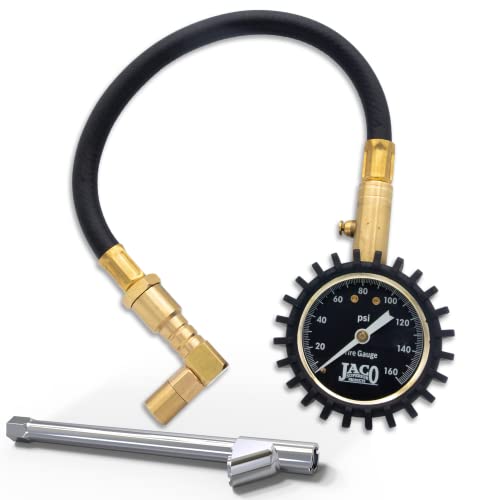
JACO EliteProPlus Tire Pressure Gauge with Dually Air Chuck leads this shortlist for Dually motorhomes. Use that fit as a reference point, then compare the alternatives against your own space and workload.
Specs that separate the picks
The first details to compare are 160 psi glow dial, 10 to 150 psi, 2 psi steps, 12 in dual-head, 10 to 150 psi. Confirm the exact model and included components before ordering.
Trade-off to plan for
Dial body is bulkier than a slim pencil gauge

Before you buy

What Matters Before You Choose a Tire Pressure Gauge For RV

Key buying criteria so you get the right fit the first time.

  1. 01

    Range above max psi

    The gauge's top reading has to clear the tire's maximum cold pressure, ideally by about 25 percent. A 60 psi gauge is useless on an 80 psi tire, and a 100 psi gauge leaves little margin on a motorhome tire at 100 psi or more. Read the range on the listing and compare it to the sidewall. A gauge that stops at 100 psi leaves no margin on a motorhome tire inflated to 100 psi or more. Look for 150 psi or higher on the listing if your rig is a dually.

  2. 02

    Dual-wheel chuck reach

    Inner dually valves sit behind the outer wheel, so a standard chuck cannot get on them. A straight foot plus a 30 degree reverse chuck, or a dually air chuck, lets you reach both. Look for dual-head, reverse chuck or dually wording and a body length of 12 inches. Typical trailer tires run 50 to 80 psi, so a 160 psi gauge sits comfortably above them. A shorter body wastes your time, so confirm the length too.

  3. 03

    Scale increment

    Increments are the steps between marks, and 2 psi steps mean you estimate between lines. For a rig that should be at 65 psi, a single psi increment resolves a difference that matters. Check the stated increment before you choose a pencil style. On a 65 psi tire, a 2 psi step can hide a deviation that raises heat and wear. Choose a single psi scale if you want finer reading.

  4. 04

    Dial versus pencil

    Dial gauges are easy to read and some lock the reading, while pencil gauges are slim, battery-free and cheap. In low light or while crouched at a wheel, a glow dial wins. Pick the format you will actually read comfortably at a wheel. If you plan to check at dawn or crouched under a wheel well, a glow dial is easier on the eyes. Pencil gauges are lighter and fit in a pocket.

  5. 05

    Materials and seal

    A brass core and zinc or brass chuck resist wear and hold a seal on a Schrader valve. A leaky chuck bleeds air and shows a reading that is low. Look for brass, a rubber seal and a stated calibration standard on the listing. A leaky chuck is the most common cause of a low reading. Look for brass, a rubber seal and a stated calibration standard, such as plus or minus 1.5 percent.

  6. 06

    Cold-pressure habit

    Pressure rises as tires heat up while driving, so a reading after a drive is not the sidewall number. Check before the rig rolls, in the morning or after it has sat for three hours. A gauge with a bleeder, like the JACO models, lets you trim an overfilled tire on the spot. Pressure climbs several psi after a drive, so a warm reading is misleading. Check before driving, after the rig sat for about three hours, and record the numbers for each wheel.

Our standards

Why You Can Trust RV Gear Lab

At RV Gear Lab, we compare products based on rig fit and power or hookup compatibility, verified specifications, usability, setup requirements, weight, durability, and real-world trade-offs. We do not rank products purely on marketing claims or commission rates.

We have not personally tested every product listed. Where hands-on testing is not available, recommendations are based on verified manufacturer specifications, product documentation, use-case fit, and comparative research.

How we review RV gear →

Detailed reviews

The 6 best tire pressure gauge for rv, explained

01
Best for: Dually motorhomes

Our take

It is the right gauge for a motorhome owner who wants a calibrated dial, headroom over 110 psi tires and a bleeder to trim pressure on the spot.

Why it made the shortlist

The JACO EliteProPlus reads to 160 psi on a 2 inch glow-in-the-dark dial, calibrated to ANSI standards within plus or minus 1.5 percent. It has a dually air chuck, a 360-degree swivel chuck and a built-in air bleeder valve, all in solid brass with a shock-resistant rubber guard.

Where the pencil gauges rely on a sliding scale, the JACO holds the reading on the dial until you press the reset button on the neck. That lock makes it easier to read an inner dual valve once you pull the gauge out.

The glow-in-the-dark dial also helps for early morning departures before sunrise.

What works

  • 160 psi range covers every RV tire
  • Reading holds on the dial until reset
  • Dually chuck and swivel reach inner valves
  • Warranty backs the gauge for any reason

Watch out for

  • Dial body is bulkier than a slim pencil gauge
  • Heavier than a slim pencil gauge
02

Best Dual-Head Pencil · 2 of 6

LUMITECO 12'' Dual Head Tire Pressure Gauge

LUMITECO 12'' Dual Head Tire Pressure Gauge
  • 10 to 150 psi, 2 psi steps
  • Straight and 30 degree chucks
  • Four spare valve caps
Check price on Amazon for LUMITECO 12'' Dual Head Tire Pressure Gauge (opens in a new tab)
Best for: Quick dual-wheel checks

Our take

It fits owners with a dually or tight wheel well who want a simple tool for a pre-trip check.

Why it made the shortlist

The LUMITECO 12 inch gauge pairs a straight foot chuck with a 30 degree reverse chuck on an extended reach body, reading 10 to 150 psi in 2 psi steps. It uses a zinc alloy chuck, solid brass core and matte steel body with a hanging ring, and includes four spare valve caps.

Compared with the EVOULTES Dual Head, it carries a dual-sided ABS scale in both psi and bar and the same reach, making it a close match for dually work. Against the JACO EliteProPlus, it is a battery-free pencil style that rides in a pocket.

Four spare valve caps also mean a lost cap on the road is a non-event.

What works

  • 150 psi range clears all common RV tires
  • Two chucks reach tight inner dual valves
  • Four spare valve caps are included
  • No batteries to run down

Watch out for

  • Pencil scale is harder to read in low light
  • 2 psi steps limit fine reading
03

Best Value Pencil · 3 of 6

EVOULTES Heavy Duty Tire Pressure Gauge

EVOULTES Heavy Duty Tire Pressure Gauge
  • 12 in dual-head, 10 to 150 psi
  • 30 degree reverse chuck
  • Four valve caps included
Check price on Amazon for EVOULTES Heavy Duty Tire Pressure Gauge (opens in a new tab)
Best for: Single-rig glove box tool

Our take

It is a good fit for a single-rig owner who wants one dependable dual-head gauge in the glove box.

Why it made the shortlist

The EVOULTES gauge is a 12 inch heavy-duty pencil with an integrated straight foot chuck and a 30 degree reverse chuck. It reads 10 to 150 psi in 2 psi increments, with an ABS indicator rod, zinc alloy chuck and solid brass core.

It shares the reach and range of the LUMITECO 12-Inch, with a hanging loop and four valve caps in the box. Against the Tallew 10-Pack it is a single well-built gauge rather than a bulk set.

The hanging loop also keeps it visible next to the air compressor in the garage.

What works

  • Reaches inner dual valves with two chucks
  • 150 psi range leaves headroom for RV tires
  • Battery-free design needs no power to read
  • Hanging loop keeps it handy in the garage

Watch out for

  • No dial or hold feature
  • 2 psi increments are coarse
04
LUMITECO 2-Pack Dual Head Tire Pressure Gauge
  • Two gauges, 10 to 150 psi
  • 12.3 inch extended reach
  • Valve cores and caps included
Check price on Amazon for LUMITECO 2-Pack Dual Head Tire Pressure Gauge (opens in a new tab)
Best for: Tow vehicle plus trailer

Our take

It is ideal for owners with a truck and a motorhome or trailer who want a gauge stored in each.

Why it made the shortlist

The LUMITECO 2-Pack gives two dual-head gauges reading 10 to 150 psi in 2 psi steps. It uses a stainless steel body with brass core and zinc alloy chucks, plus valve cores and valve caps in the kit, and a 12.3 inch extended reach.

Compared with the LUMITECO 12-Inch, you get a second gauge, one for the tow vehicle and one for the trailer. The straight and 30 degree angled chucks reach both inner and outer dual valves.

The included valve cores and caps also make it a handy spares kit.

What works

  • Two gauges means one stays with each vehicle
  • Stainless body resists rust and drops
  • Valve cores and caps are included
  • Works in rain, dust and cold

Watch out for

  • Two units may be more than a single rig needs
  • Same coarse 2 psi scale as other pencils
05
Best for: Fleets and club members

Our take

It suits a fleet owner, a club leader or anyone who wants a gauge in every tool bag.

Why it made the shortlist

Tallew supplies ten dual-head gauges, each about 12 inches long and stretching to 16 inches, reading 10 to 150 psi on both sides in 2 psi steps. The zinc alloy dual chucks, solid brass body and aluminum slide are meant for inner wheels and hard-to-reach valves.

Against the LUMITECO 2-Pack, it is a bulk option: enough gauges for a shop, a camping club or every vehicle in the household. Each gauge has a hanging ring for storage.

The scale on both sides of the slide also helps anyone reading at an awkward angle.

What works

  • Ten gauges cover every vehicle and bag
  • Dual-head chucks reach inner wheels
  • Scale printed on both sides
  • Hanging ring for easy storage

Watch out for

  • Ten gauges is far more than one rig needs
  • More gauges than most single-rig owners need
06

Best Single-Wheel Dial · 6 of 6

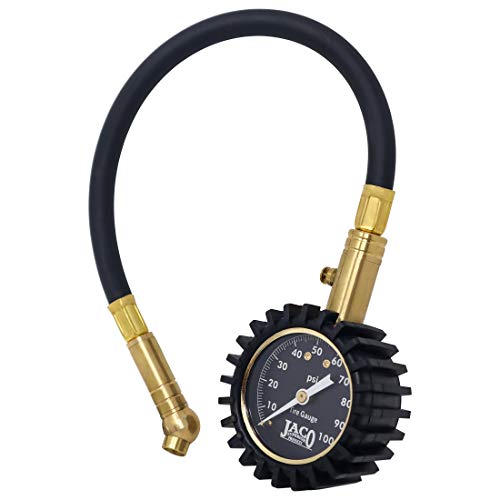
JACO ElitePro Tire Pressure Gauge

JACO ElitePro Tire Pressure Gauge
  • 100 psi glow dial, 1 psi steps
  • 360-degree swivel chuck
  • Leak-proof HybridFlex hose
Check price on Amazon for JACO ElitePro Tire Pressure Gauge (opens in a new tab)
Best for: Trailer tires up to 80 psi

Our take

It suits a trailer owner running 50 to 80 psi tires who wants a calibrated dial and a lifetime warranty.

Why it made the shortlist

The JACO ElitePro reads to 100 psi on a 2 inch glow dial in single increments, calibrated to within 1.5 percent. It uses solid brass with a shock-resistant guard, a HybridFlex leak-proof hose, a 360-degree swivel chuck and a bleeder valve.

Compared with the JACO EliteProPlus, it keeps the dial and the lock-in reading in a 100 psi version. The single-increment scale gives finer readings than any pencil gauge here.

The leak-proof hose also helps keep air from escaping at the connection.

What works

  • Single psi increments for fine readings
  • Calibrated within 1.5 percent of ANSI standards
  • Bleeder valve trims overinflated tires
  • Lifetime warranty backs it up

Watch out for

  • 100 psi range is tight for big motorhome tires
  • No dually chuck for inner wheels

Methodology

How We Built This Shortlist

Each pick was assessed across 4 criteria weighted for real-world use.

01

Range versus RV pressures

We compared each gauge's maximum psi to trailer tires at 50 to 80 psi and motorhome tires that run higher. Together these factors describe how a gauge performs in a real pre-trip walk-around.

02

Dually reach

We looked at chuck design and body length to see which gauges reach the inner valves on dual wheels. A gauge with an impressive range but no way to reach inner valves ranked lower for dually owners.

03

Readability

We compared dial and sliding scale formats, increments and any hold feature for pre-trip checks. Build quality mattered because gauges get dropped on pavement and gravel.

04

Build and accuracy claims

We weighed brass and zinc construction and stated calibration against how much a gauge will be handled. The result is a list that serves both single-wheel trailers and dually motorhomes.

Decision guide

Match a Tire Pressure Gauge For RV to Your RV

By Tire Pressure Range

Your situationRecommended pickWhy
Trailer tires at 50 to 65 psiJACO ElitePro 100Single psi steps on a calibrated dial
Trailer tires up to 80 psiLUMITECO 2-Pack150 psi range with dual-head chucks
Motorhome tires at 100 psi or moreJACO EliteProPlus160 psi range is the highest here
Dually inner valvesLUMITECO 12-InchStraight and 30 degree chucks on a long body

By Budget

BudgetRecommended pick
Entry of this shortlistEVOULTES Dual Head or LUMITECO 12-Inch
Mid of this shortlistLUMITECO 2-Pack or JACO ElitePro 100
Top of this shortlistJACO EliteProPlus or Tallew 10-Pack

Dial vs Pencil

Dial gauge

A glow dial with a lock-in reading is easier to read at a wheel and often calibrated. The JACO EliteProPlus and JACO ElitePro 100 are built this way.

Pencil gauge

A slim, battery-free pencil style fits a pocket and reaches inner valves with dual heads. The LUMITECO 12-Inch, EVOULTES Dual Head, LUMITECO 2-Pack and Tallew 10-Pack are pencils.

For a dually rig, the JACO EliteProPlus is the top choice; for a pocket tool, the LUMITECO 12-Inch.

By Quantity Needed

Best matchRecommended pick
One gauge for one rigEVOULTES Dual Head
One gauge for the truck, one for the trailerLUMITECO 2-Pack
Enough gauges for a club or shopTallew 10-Pack

For Dually Inner Wheels Specifically

Look for

A dual-head or dually chuck, a 12 inch body and a range of 150 psi or more.

In this comparison

The JACO EliteProPlus has a dually air chuck, while the LUMITECO 12-Inch and EVOULTES Dual Head use straight plus 30 degree chucks.

When to Spend More

Spend more if

Spend more on the JACO EliteProPlus if you run a dually motorhome or high-pressure tires and want a calibrated dial that holds its reading.

Save if

Save with the EVOULTES Dual Head or Tallew 10-Pack if you only need a reliable pencil gauge for pre-trip checks.

FAQ

Before You Bring One Home

What gauge range do I need for an RV?

Choose a gauge with a top reading comfortably above your tire's maximum cold pressure. Trailer tires run 50 to 80 psi, so the 150 psi pencils work well, while motorhome tires at 100 psi or more call for the 160 psi JACO EliteProPlus. A 60 psi gauge will not serve. Fit the gauge to the highest pressure on your rig, not the lowest.

Do I need a dual-head chuck?

If you have dual rear wheels, yes, because the inner valve sits behind the outer wheel. A dual-head gauge such as the LUMITECO 12-Inch reaches both valves. Single-wheel trailers can use the simpler JACO ElitePro 100. Dual-wheel motorhomes are the main reason these dual-head designs exist.

Is a dial gauge worth it over a pencil gauge?

A dial like the JACO EliteProPlus reads more clearly and holds the number, while a pencil like the EVOULTES Dual Head is slimmer and cheaper. If your checks are quick and in daylight, a pencil is enough. If you check at dusk or want finer resolution, a dial pays off. Decide based on how often you check and in what light.

When should I check pressure?

Check cold, before the rig has been driven or after it has sat for about three hours. Compare the reading to the sidewall pressure for the load range. Skip hot readings, which run higher after driving. Record the cold numbers in a notebook so a slow leak shows up as a trend.

How do I keep a gauge accurate?

Store it dry with the chuck capped, avoid dropping a dial gauge and replace the gauge if it reads oddly. Cross-check against a second gauge once a season. Spare valve caps, such as those in the LUMITECO 2-Pack, keep dirt out of the valve. Store the gauge in a dry bay and keep its chuck capped.

Bottom line

The short version

Browse more tire pressure gauge for rv on Amazon →
Bowen Higgins, RV Editor at RV Gear Lab

About the author

Bowen Higgins

RV Editor at RV Gear Lab

Bowen covers RV power, water systems, towing and leveling, upkeep and interior comfort, with a focus on matching gear to the rig, the hookups and the way you actually travel.

More from Bowen →Editorial standards

Keep reading

Related guides