We research everything we recommend. When you buy through our links, we may earn a commission. Learn more

Buying guide · 10 min read · Updated October 2, 2026

5 Best Wheel Chocks For Motorhome in 2026: A Practical RV Guide

Five rubber wheel chocks for motorhomes, from a 10 inch MaxxHaul pair to a 20,000 lb SECURITYMAN set, compared on size, weight, grip and price from $22.99.

Bowen HigginsBy Bowen HigginsRV Editor at RV Gear Lab5 products comparedSpec-sheet researched

At a glance

Our top picks

A motorhome is the heaviest thing most RV owners will ever park, and the only part of it that touches the ground is four to six tires. When the coach is level and the parking brake is set, wheel chocks are the extra margin that keeps a loaded Class A or Class C from creeping on a slope, a soft shoulder or a driveway with a hidden grade. They cost a fraction of what the coach costs, which is exactly why it is worth buying ones that match the weight and tire size of the vehicle they are protecting.

Size matters more with a motorhome than with a small trailer. A chock that is only a few inches tall can be pushed up and over by a heavy tire, and a chock with a narrow base can skate across wet concrete under load. Solid rubber is the usual material because it grips by flexing against the pavement, resists oil and weather, and does not rust. Bigger, heavier rubber blocks usually hold better, and the tradeoff is carrying them around. A good set balances holding power with a weight you can lift without strain, because chocks that stay in the bay protect nothing.

This guide compares five rubber chock sets for motorhomes. We evaluated them on dimensions, weight, grip design, how the set is packaged, extras such as eyebolts, ropes and reflective strips, and price, weighed on published specifications and what owners report. They range from a pair of oversized 10 inch chocks to a four-pack of compact blocks rated for vehicles up to 8 tons, and prices run from $22.99 to $49.95.

Pay attention to how each listing states its rating. One set lists a 20,000 pound figure, another lists an 8 ton gross vehicle weight rating, and others give dimensions and weight without a stated limit. Those numbers are not directly comparable, because they are measured different ways, so a rating is best used as a check against your coach's gross weight rather than as a ranking tool. The sections below use named picks to cover the situations that matter most, with concrete answers for coach weight, budget, retrieval and dual-axle layouts.

One more consideration is how you plan to use and store them. Chocks live in a bay, a tongue box or a bag, and a set that is too heavy or awkward gets left behind. A rope, handle or eyebolt makes pulling a chock out from under a tight tire much easier, especially when the coach has settled onto it overnight. Decide how you will carry and retrieve the chocks, then match the set to that habit and to the weight of your coach. Chocks are a backup to the parking brake and transmission lock, not a replacement for them.

RV Gear Lab field notes

The Rig Fit Check

Start with the job
ROBLOCK 2 Pack Wheel Chocks Rubber Heavy Duty Black with Eyebolt leads this shortlist for Heavy coaches needing planted rubber chocks. Use that fit as a reference point, then compare the alternatives against your own space and workload.
Specs that separate the picks
The first details to compare are 9 x 7.1 x 5.5 inch, 10 x 8 x 6 inch, 4 chocks per pack. Confirm the exact model and included components before ordering.
Trade-off to plan for
Heavy to carry around

Before you buy

What Matters Before You Choose a Wheel Chock For Motorhome

Key buying criteria so you get the right fit the first time.

  1. 01

    Size and height against the tire

    A chock stops a tire by blocking its lower curve, and a taller, longer chock holds more of the tire. A small block can be pushed up and over by a heavy coach. Compare the dimensions in the listing, such as 10 by 8 by 6 inches, with your tire diameter, and avoid blocks that look tiny next to your tires. If you carry a tape measure, hold the chock against a tire and picture how much of the curve it would block.

  2. 02

    Material and weather resistance

    Solid rubber grips by flexing against pavement and does not rust or crack easily. Look for words such as oil-resistant, weather-resistant or dense rubber in the listing. Cheaper plastic or hollow chocks may slide or crumble, so check that the material is rubber and not a coated foam. A rubber smell out of the box is normal and fades with airing, so it is not a reason to return a set.

  3. 03

    Stated weight rating

    A rating tells you the vehicle weight the maker designed the chock to hold. The SECURITYMAN lists 20,000 pounds, and the AFA lists up to 8 tons gross vehicle weight. Compare the rating with your coach's gross weight from the sticker, and be wary of sets that give no rating at all. A larger tire and a heavier coach call for a rating with margin, since a chock is only as good as the weight it was designed for.

  4. 04

    Weight of the chock

    A heavier chock stays put on its own, while a light one relies on grip. But heavier chocks are harder to carry. Check the weight in the listing, such as 13.2 pounds for a pair, and decide whether you can comfortably carry and place that every day. Heavier rubber is a benefit on slopes, but only if you actually set the chocks every time you park.

  5. 05

    Retrieval features

    Handles, ropes and eyebolts let you pull a chock out after the coach has settled onto it. A rope can fray over time and an eyebolt can rust. Look at which retrieval feature the listing names and choose one you will actually use. Check the rope or handle after each season, since a fraying rope is easier to replace than a lost chock.

  6. 06

    Grip surface and base

    Treads, textured surfaces and ribs help the chock bite into wet or loose pavement. A smooth bottom slides more easily. Look for non-slip, textured or treaded wording in the listing, and read buyer feedback about performance on wet concrete. Sweeping gravel and grit out from under a chock before you place it also improves grip on any surface.

Our standards

Why You Can Trust RV Gear Lab

At RV Gear Lab, we compare products based on rig fit and power or hookup compatibility, verified specifications, usability, setup requirements, weight, durability, and real-world trade-offs. We do not rank products purely on marketing claims or commission rates.

We have not personally tested every product listed. Where hands-on testing is not available, recommendations are based on verified manufacturer specifications, product documentation, use-case fit, and comparative research.

How we review RV gear →

Detailed reviews

The 5 best wheel chocks for motorhome, explained

01
Best for: Heavy coaches needing planted rubber chocks

Our take

The strongest case for ROBLOCK 2 Pack Wheel Chocks Rubber Heavy Duty Black with Eyebolt is heavy rubber stays put under big tires.

Why it made the shortlist

The ROBLOCK pair measures 9 by 7.1 by 5.5 inches and weighs 13.2 pounds for the set. The blocks are made from durable, weather-resistant, oil-resistant rubber and include a steel eyebolt for a chain or rope. At $39.99 it is the best all-round choice for a heavy coach.

What works

  • Heavy rubber stays put under big tires
  • Steel eyebolt for chain or rope
  • Weather-resistant, oil-resistant rubber

Watch out for

  • Heavy to carry around
  • Higher cost than small chocks
The catch
At 13.2 pounds, it is the heaviest set in this comparison, and that mass is the point: a heavy rubber block stays put under a big tire in a way a light plastic one does not.
02
Best for: Big tires on a budget

Our take

MaxxHaul Rubber Wheel Chock 2 Pack is the better fit when big tires on a budget.

Why it made the shortlist

The MaxxHaul large pair measures 10 by 8 by 6 inches in dense, oil-resistant rubber with a textured non-slip surface. A steel eyebolt supports a rope or chain. At $22.99 it is the lowest priced set that still offers a large footprint.

Larger than the ROBLOCK in every dimension, it gives the most contact area against the tire, which spreads the load and helps resist movement. Compared with the SECURITYMAN, it focuses on size and texture rather than a stated weight rating, and it costs less than every other set in this guide.

What works

  • Largest footprint in this list
  • Textured grip on gravel and pavement
  • Rubber resists oil and weather

Watch out for

  • Bulky for small storage bays
  • Heavier than plastic chocks
The catch
It is the pick for owners of big-tire motorhomes who want the largest block and the best price, and who have room in a bay for a bulkier pair.
03

Best Four-Pack · 3 of 5

Wheel Chocks for Cars

Wheel Chocks for Cars
  • 4 chocks per pack
  • Up to 8 ton GVW
  • Handles and rope ties
Check price on Amazon for Wheel Chocks for Cars (opens in a new tab)
Best for: Chocking multiple tires on a slope

Our take

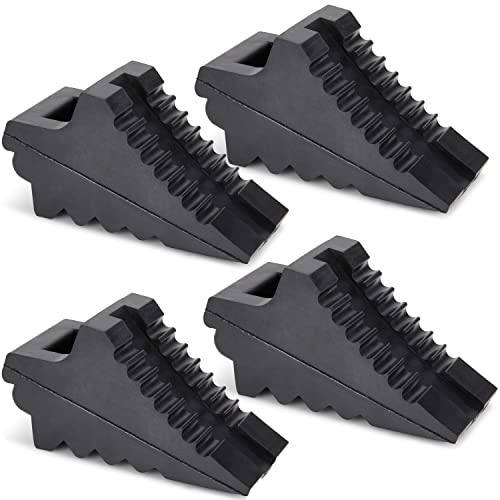
It is the pick for owners who want to chock multiple tires, owners of dual-axle motorhomes and anyone who parks on a regular slope.

Why it made the shortlist

The AFA set includes four chocks, each 9.1 by 3.7 by 4.7 inches and 3.4 pounds, rated for vehicles up to 8 tons gross weight. Handles and rope ties take the place of eyebolts.

Compared with the ROBLOCK and MaxxHaul pairs, each AFA chock is narrower and lighter, while the set gives more total coverage and the handles avoid rusting eyebolts.

What works

  • Four chocks cover both sides of an axle
  • Rated up to 8 ton GVW
  • Handles avoid rusting eyebolts

Watch out for

  • Narrow 3.7 inch width
  • Smaller than single large chocks
04

Best Rated Load · 4 of 5

SECURITYMAN Heavy Duty Wheel Chocks

Best for: Buyers comparing capacity, compatibility, included components and storage needs

Our take

It is the pick for owners of heavy trailers and larger motorhomes who want a stated load rating, treaded grip and an easy-to-carry handle at a mid-range price.

Why it made the shortlist

SECURITYMAN's solid rubber chocks are listed to hold up to 20,000 pounds, with a treaded grip, a predrilled hole for rope or chain and a molded grab handle. At $37.99 the set carries the highest stated load figure in this comparison.

The treaded surface grips on slippery ground, and the molded handle gives a way to lift and pull the chock without a separate rope.

What works

  • Listed to hold up to 20,000 pounds
  • Treaded grips work on slippery surfaces
  • Molded handle and predrilled hole

Watch out for

  • Size not shown in the title
  • Rubber smell may linger
The catch
The listed 20,000 pound figure is the highest here, which gives owners of heavier coaches a clearer number to compare against their gross weight.
05
Best for: Night visibility and easy retrieval

Our take

It is the pick for owners who park in the dark, want reflective strips for visibility and prefer a lighter set with a long pull rope.

Why it made the shortlist

OULEME's pair is 8.3 by 4.4 by 4 inches each, with a 52 inch nylon rope and three reflective strips. The rubber is waterproof and non-slip, and the pair weighs 7.5 pounds. It costs $36.99.

The long rope makes pulling the chocks out easier than eyebolt designs, since you can reach under a big tire without crawling.

What works

  • 52 inch rope reaches under large trucks
  • Reflective strips help at night
  • Pair weighs 7.5 pounds

Watch out for

  • Smaller than other motorhome chocks
  • Rope may fray over time
The catch
Against the ROBLOCK and MaxxHaul pairs, the OULEME is smaller and about half the weight, which makes it easier to store and carry.

Methodology

How We Built This Shortlist

Each pick was assessed across 5 criteria weighted for real-world use.

01

Size and tire contact

A chock has to meet the tire high enough to hold it. We compared the 10 by 8 by 6 inch MaxxHaul and 9 by 7.1 by 5.5 inch ROBLOCK with the smaller 8.3 by 4.4 by 4 inch OULEME and 9.1 by 3.7 by 4.7 inch AFA chocks.

02

Weight and stability

Heavier rubber tends to stay put. We compared the 13.2 pound ROBLOCK pair, the 7.5 pound OULEME pair and the 3.4 pound AFA chocks, and considered the tradeoff between holding power and carrying effort. A chock you leave in the bay because it is awkward to lift does not protect anything, so we gave credit to sets that balance the two.

03

Stated load rating

Ratings help match a chock to a coach. We looked at the SECURITYMAN's 20,000 pound figure and the AFA's 8 ton gross vehicle weight rating, and noted that other sets list no rating at all. Ratings are measured different ways, so we used them as a sanity check against coach weight rather than a ranking.

04

Grip and surface design

Texture and treads decide how a chock behaves on wet or loose surfaces. We compared the non-slip texture on the MaxxHaul, the treaded grip on the SECURITYMAN and the non-slip rubber on the OULEME.

05

Retrieval and visibility

Pulling a chock from under a settled tire is a real chore. We compared eyebolts, handles, the 52 inch OULEME rope and its reflective strips, along with the price of each set. A set that is cheap but impossible to pull out from under a heavy tire is not a bargain, so retrieval counted for more than its price suggests.

Decision guide

Match a Wheel Chock For Motorhome to Your RV

By Coach Weight And Tire Size

A heavier coach with larger tires calls for larger, heavier chocks. Match the block to the tire before you look at features, and remember that the heaviest coach on the biggest tires deserves the biggest block you can comfortably carry.

Your coachRecommended pickWhy
Heavy Class A on big tiresMaxxHaul Rubber Wheel Chock 2 PackThe 10 by 8 by 6 inch blocks give the largest footprint.
Heavy coach, planted placementROBLOCK 2 Pack Wheel ChocksAt 13.2 pounds the pair is the heaviest set here.
Heavy trailer or coach with a stated limitSECURITYMAN Heavy Duty Wheel ChocksListed to hold up to 20,000 pounds.
Smaller Class C or camper vanOULEME Rubber Wheel Chocks with Rope8.3 by 4.4 by 4 inch size is easy to handle.

By Budget

The five sets cost between $22.99 and $49.95, and the price differences reflect size, quantity and extras. A four-pack costs more up front but covers twice as many tires, which can make it the better value on a slope.

BudgetRecommended pick
About $23MaxxHaul 2 Pack at $22.99 for the largest rubber footprint.
About $37 to $40SECURITYMAN at $37.99, OULEME at $36.99 or ROBLOCK at $39.99.
About $50 for four chocksAFA four-pack at $49.95 with handles and rope ties.

Pair of Large Chocks vs Four-Pack

You can buy a pair of big blocks or a set of four smaller ones. The choice changes how many tires you can secure.

Pair of large chocks

The MaxxHaul, ROBLOCK, SECURITYMAN and OULEME are sold as pairs. A heavier, larger block gives more holding power per chock and is simple to place on one axle. This suits owners who chock one pair of tires and rely on the parking brake for the rest.

Four-pack

The AFA set gives four 9.1 by 3.7 by 4.7 inch chocks rated for up to 8 tons gross weight. Four chocks cover both sides of an axle or two axles. This suits owners who park on a slope or have dual axles.

Most motorhome owners should start with a large pair, and add a second set only if they park on a regular slope or have dual axles that need extra coverage.

By How You Retrieve Chocks

Pulling a chock out from under a settled tire can be hard. The retrieval method matters as much as the rubber, especially after a night of settling or a wet morning when the chock is stuck in mud.

Your preferenceRecommended pick
A long rope you can pull from standingOULEME, with a 52 inch nylon rope.
An eyebolt for chain or ropeROBLOCK or MaxxHaul, each with a steel eyebolt.
A molded handle you can grabSECURITYMAN, with a molded handle and predrilled hole.
Handles and rope ties to avoid rusting hardwareAFA four-pack with handles and rope ties.

For Dual-Axle Motorhomes Specifically

A coach with tandem rear axles has more tires to hold and less space between them. Chock placement and size both matter, and a chock that fits snugly between two tires is better than one that sits loosely beside them.

Look for

Enough chocks to cover more than one tire, a size that fits the gap between tires, a stated rating that suits the gross weight and grip that works on your parking surface.

In this comparison

The AFA four-pack covers multiple tires with chocks that are 3.7 inches wide, so they fit tight gaps. The SECURITYMAN pair adds a 20,000 pound listed rating for heavier coaches.

When to Spend More

Chocks are inexpensive safety gear. The extra money buys quantity, rating and convenience, and for a vehicle this heavy those are worth paying for.

Spend more if

Spend $49.95 on the AFA four-pack if you want to chock multiple tires, or $39.99 on the ROBLOCK if you want the heaviest pair and a steel eyebolt for a heavy coach.

Save if

Save with the MaxxHaul at $22.99 if you want large rubber blocks at the lowest price and you mainly park on level ground.

FAQ

Before You Bring One Home

How many chocks does a motorhome need?

At least two, placed against the same tire on the downhill side, with more if you park on a slope or have dual axles. The AFA set includes four chocks for that purpose. Always combine chocks with the parking brake and leveling jacks as directed by your coach manual. On a steep grade, add chocks on both sides of the tire and turn the front wheels toward the curb where that applies.

Are rubber chocks better than plastic for a motorhome?

Usually, yes. Rubber is heavier and grips by flexing against the pavement, and it resists oil and weather. Plastic chocks are lighter but can slide or crack under heavy tires. For a coach, a rubber set such as the ROBLOCK or MaxxHaul is the safer match.

Is the SECURITYMAN worth it over the MaxxHaul?

It is worth it if you want a stated rating. At $37.99 the SECURITYMAN lists 20,000 pounds, a treaded grip and a molded handle. The MaxxHaul at $22.99 gives the largest footprint but no rating, so choose by whether you need that number. If your coach is on the heavier side, the stated rating is a helpful reference point when you compare it with the weight on your gross vehicle rating sticker.

Where should I place the chocks?

Place them snug against the tires on the downhill side, and on both sides if the ground is flat. Push them firmly so no gap remains. Set them before you unhitch, level or run slides, and remove them last when you are ready to leave. Walk around the coach once more before driving off so no chock is left behind.

How do I remove chocks that are stuck?

Pull the rope, eyebolt or handle straight out, or drive the coach gently off the chock. Do not crawl under the coach to pull one out. A rope or handle on the chock makes this easier, so choose a set with a feature you can reach.

How should I store rubber chocks?

Keep them dry and out of direct sun when possible, and wipe off oil or road grime. Rubber can dry out over years, so check for cracks. Replace any chock with deep splits, crumbling edges or a damaged eyebolt. Store them in a bay or bag where they will not slide around while you drive.

Bottom line

The short version

For most motorhome owners, the ROBLOCK pair at $39.99 is the best overall choice, with a 13.2 pound weight, oil-resistant rubber and a steel eyebolt. The MaxxHaul at $22.99 is the value pick with the largest footprint, and the SECURITYMAN at $37.99 is the right one if you want a stated 20,000 pound rating.

Choose the AFA four-pack at $49.95 if you park on slopes or have dual axles, and the OULEME at $36.99 for a long rope and reflective strips. RV Gear Lab suggests checking your coach's gross weight and always pairing chocks with the parking brake.

A last tip: practice placing the chocks at home before your first trip, and make it part of your parking routine. Set the brake, place the chocks against the tires, then level and unhitch. A habit that takes under a minute every stop is the best protection a motorhome owner can add for the price of a set of rubber blocks.

Browse more wheel chocks for motorhome on Amazon →
Bowen Higgins, RV Editor at RV Gear Lab

About the author

Bowen Higgins

RV Editor at RV Gear Lab

Bowen covers RV power, water systems, towing and leveling, upkeep and interior comfort, with a focus on matching gear to the rig, the hookups and the way you actually travel.

More from Bowen →Editorial standards

Keep reading

Related guides