

We research everything we recommend. When you buy through our links, we may earn a commission. Learn more

Buying guide · 11 min read · Updated October 2, 2026

6 Best Budget RV Water Filters for City Water in 2026: A Practical RV Guide

City hookups are already treated, so the job is chlorine taste, odor and old park pipes. Budget RV filters ranked by how cheaply each handles that.

Bowen HigginsBy Bowen HigginsRV Editor at RV Gear Lab6 products comparedSpec-sheet researched

At a glance

Our top picks

Municipal water has been through a treatment plant before it reaches a campground spigot, which changes what an RV filter has to do. Bacteria are mostly handled upstream. What remains is chlorine taste, odor, and whatever sediment the park's older pipes shed on the way to your hose.

That makes city hookups the friendliest place to run a budget filter. A simple KDF and carbon unit threaded onto the hose does most of the job, and the stage to spend on is whichever one keeps flow high. Heavy systems pay off only if you want a finer element than carbon.

The six picks run from a three-stage system with a 0.2 micron element down to a two-pack of basic hose filters. We read them for the claims that matter on treated water: chlorine reduction, flow at the spigot and hose-end strain, and we left bacteria claims for guides that deal with untreated sources.

RV Gear Lab field notes

The Rig Fit Check

Start with the job
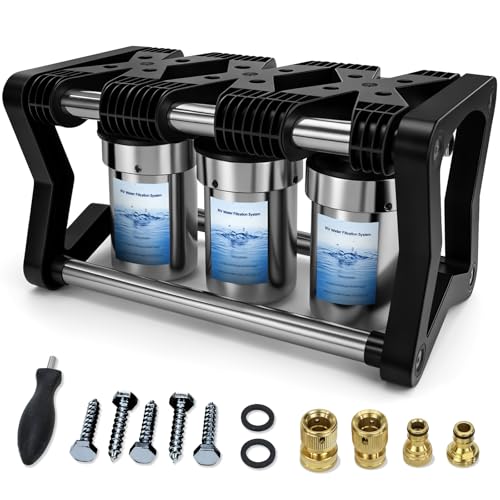
3-Stage RV Water Filter System with 0.2 Micron Filter leads this shortlist for Owners who want a finer element and brass quick connects at a city hookup.. Use that fit as a reference point, then compare the alternatives against your own space and workload.
Specs that separate the picks
The first details to compare are Three stages with 0.2 micron filter, Four KDF and GAC filters, XL body, six-step Hex-Flow. Confirm the exact model and included components before ordering.
Trade-off to plan for
Most expensive pick in this guide

Before you buy

What Matters Before You Choose a Budget RV Water Filter for City Water

Key buying criteria so you get the right fit the first time.

  1. 01

    Chlorine versus chloramine

    Most municipal systems use chlorine, which carbon removes easily, but some use chloramine, which is harder for plain carbon to remove. If the water tastes of pool even after a carbon filter, chloramine may be the cause, and catalytic carbon is the better tool. Your park office can usually tell you which disinfectant the supply uses.

  2. 02

    Park pipe sediment

    Older campground plumbing sheds rust and scale. Rust and scale flakes get stopped by a sediment layer or a pleated stage before faucets clog. Basic KDF and carbon filters include some sediment capture, but large particles shorten their life.

  3. 03

    Hookup speed

    If you move often, the time spent attaching a filter adds up. Brass quick connects and flexible hose protectors speed hookup and protect threads. Look for them in the kit contents, not just the filter media.

  4. 04

    Flow and shower pressure

    Small inline filters restrict flow, with stated service flow as low as 0.5 gpm on one pack. A system with 3 GPM or better preserves shower pressure. Compare the figure with your pump and fixtures.

  5. 05

    Certification worth paying for

    NSF/ANSI 42 covers chlorine, taste and odor, which is exactly what a city hookup needs. 53 covers lead and cysts. For treated water, a filter with 42 is enough, so skip paying more for health claims you do not need.

  6. 06

    Pressure regulator pairing

    A filter housing can be damaged by high park pressure. Pair the filter with a pressure regulator at the spigot, especially on inline units rated to 60 psi. It protects the rig and the filter at once.

Our standards

Why You Can Trust RV Gear Lab

At RV Gear Lab, we compare products based on rig fit and power or hookup compatibility, verified specifications, usability, setup requirements, weight, durability, and real-world trade-offs. We do not rank products purely on marketing claims or commission rates.

We have not personally tested every product listed. Where hands-on testing is not available, recommendations are based on verified manufacturer specifications, product documentation, use-case fit, and comparative research.

How we review RV gear →

Detailed reviews

The 6 best budget rv water filters for city water, explained

01
3-Stage RV Water Filter System with 0.2 Micron Filter
  • Three stages with 0.2 micron filter
  • Brass garden hose quick connects
  • Polycarbonate and carbon fiber frame
Check price on Amazon for 3-Stage RV Water Filter System with 0.2 Micron Filter (opens in a new tab)
Best for: Owners who want a finer element and brass quick connects at a city hookup.

Our take

Sitting as the most expensive pick here, it spends on the fine element and quick connects, a good match for owners who connect and disconnect often.

Why it made the shortlist

This three-stage system includes a 0.2 micron high-flow filter, and brass garden hose quick connects make hookup fast. A lightweight polycarbonate and carbon fiber frame keeps the whole assembly easy to carry between sites.

The maker describes the three filters as long-lasting, and the 0.2 micron stage adds a finer barrier than a plain carbon filter. Hookup takes minutes, and the quick connects replace fiddly threading.

What works

  • 0.2 micron high-flow stage
  • Brass quick connects speed hookup
  • Lightweight frame
  • Three-stage coverage

Watch out for

  • Most expensive pick in this guide
  • Overkill for already-treated water
02
RV Inline Water Filter 4 Pack with Hose Protector
  • Four KDF and GAC filters
  • 1,350 gallons or three months each
  • Hose protector included
Check price on Amazon for RV Inline Water Filter 4 Pack with Hose Protector (opens in a new tab)
Best for: Owners who prefer cheap swaps and a year of filters in one box.

Our take

It sits second on price, below the 0.2 micron system, with four filters covering a full year of regular travel.

Why it made the shortlist

A four-pack of KDF and granular activated carbon filters, each stated for up to 1,350 gallons or three months, with a flexible hose protector. It threads to any standard garden hose connection.

No tools are needed, so swapping is a two-minute job at the spigot. City water is gentle on filters, which means the stated three-month life is realistic here.

What works

  • A year of filters in one box
  • Tool-free swaps
  • Works on any standard hose
  • Hose protector included

Watch out for

  • Quarterly swaps are a chore
  • Inline units restrict flow
03

Best Certified · 3 of 6

Camco Tastepure XL RV Water Filter

Camco Tastepure XL RV Water Filter
  • XL body, six-step Hex-Flow
  • NSF/ANSI 42 and 53 listed
  • Flexible hose protector included
Check price on Amazon for Camco Tastepure XL RV Water Filter (opens in a new tab)
Best for: Buyers who want named NSF listings in a larger inline body.

Our take

Priced just above the budget packs, it brings paperwork and a larger body to a city hookup where chlorine taste is the main complaint.

Why it made the shortlist

Camco's Tastepure XL uses the six-step Hex-Flow process with GAC and KDF and states a stronger filtration load than standard filters. Independent testing lists it to NSF/ANSI 42 and 53, with CSA lead-free credentials.

It reduces taste, odor, chlorine and sediment and comes with a flexible hose protector. Made in the USA, it threads onto any garden or drinking water hose.

What works

  • NSF 42 and 53 listed
  • Larger body than standard
  • Made in the USA
  • Hose protector included

Watch out for

  • Single filter, no spare
04
Hourleey 2 Pack RV Inline Water Filter with Hose Protectors
  • Two GAC and KDF filters
  • Two hose protectors
  • Up to three months per filter
Check price on Amazon for Hourleey 2 Pack RV Inline Water Filter with Hose Protectors (opens in a new tab)
Best for: Season-long city stays where one spare filter is enough.

Our take

At a price near the low end of the group, it is a practical pair for a camper who stays at campgrounds with treated water.

Why it made the shortlist

Hourleey includes two inline filters and two flexible hose protectors, with GAC and KDF handling taste, odor, rust, chlorine and sediment. The housing is food-grade plastic reinforced against rupture.

Each filter lasts up to three months, so the pair covers a long city-hookup season. It installs with no tools and fits any standard garden hose.

What works

  • Spare filter in the pack
  • Hose protector for each filter
  • Reinforced housing

Watch out for

  • No certification stated
  • Modest flow for showers
05

Best Easy Install · 5 of 6

Muphop RV Water Filter 2 Pack

Muphop RV Water Filter 2 Pack
  • Two GAC inline filters
  • NSF tested and lead-free
  • Tool-free hose connection
Check price on Amazon for Muphop RV Water Filter 2 Pack (opens in a new tab)
Best for: First-time buyers who want a certified two-pack with simple setup.

Our take

Priced second from the bottom, it gives first-time buyers a certified set at a very friendly cost.

Why it made the shortlist

Muphop supplies a two-pack with a flexible hose protector, built on granular activated carbon and listed as NSF tested and lead-free. Installation takes seconds with no tools.

It reduces chlorine, sediment and unpleasant tastes, and it also suits plant watering, pools and pet bowls, since it threads to any standard hose. NSF certification gives it a named standard.

What works

  • NSF tested materials
  • Two filters per pack
  • Seconds to install
  • Works for gardens and pets too

Watch out for

  • Only one hose protector
  • Limited media detail
06

Cheapest Way In · 6 of 6

RVGUARD Inline RV Water Filter 2 Pack

RVGUARD Inline RV Water Filter 2 Pack
  • Two KDF and GAC filters
  • 15,000 gallon stated capacity
  • 34 to 100 degrees Fahrenheit range
Check price on Amazon for RVGUARD Inline RV Water Filter 2 Pack (opens in a new tab)
Best for: Treated-water hookups where a basic filter is all you need.

Our take

The cheapest pick in the guide pairs well with a city hookup, the easiest water to treat, so a basic pair is a sensible match.

Why it made the shortlist

RVGUARD supplies two KDF and GAC filters with IAPMO R&T certification to NSF/ANSI 42 for material safety and aesthetic chlorine reduction. On a city supply, that chlorine reduction is the job.

Specs are spelled out, including 0.5 gpm service flow, 15,000 gallons capacity, 60 psi maximum pressure and a range of 34 to 100 degrees Fahrenheit.

What works

  • Clear spec sheet
  • NSF 42 aesthetic certification
  • Two filters per pack

Watch out for

  • Modest 0.5 gpm service flow
  • Carbon flush on first use

Methodology

How We Built This Shortlist

Each pick was assessed across 5 criteria weighted for real-world use.

01

Chlorine and taste

City water is already disinfected, so chlorine taste and odor are the main targets. We looked for stated chlorine reduction and NSF 42 listings, because those speak to the real task on treated supplies.

02

Flow at the spigot

Park pressure is usually fine, so the filter decides flow. We compared stated GPM and service flow, preferring filters that do not pinch showers.

03

Hook-up convenience

Quick connects, hose protectors and tool-free installs save time. We credited hardware that makes daily hooking up simple.

04

Replacement rhythm

We compared stated lifespans and pack sizes, because treated water is gentle on media. This is based on product specs and our analysis, not hands-on trials.

05

Where extra filtering helps

A 0.2 micron stage is a luxury on city water. We noted which picks add it and judged whether the extra cost matched a real benefit for treated supplies.

Decision guide

Match a Budget RV Water Filter for City Water to Your RV

By Hookup Habit

How often you connect decides what to buy.

HabitPick and why
Connect and disconnect often3-Stage 0.2 Micron has brass quick connects
Stay a season at one parkHourleey 2-Pack gives two filters for a long stay
Want a year of swaps readyInline 4-Pack supplies four filters in one box
Want named certificationTastepure XL carries NSF 42 and 53 listings
First filter, lowest riskRVGUARD 2-Pack is the entry pick

By Budget

Treated water makes cheap filters reasonable.

BandPick and what it buys
Entry of this shortlistRVGUARD 2-Pack buys two filters with clear specs
LowMuphop 2-Pack adds NSF tested materials
Low-midHourleey 2-Pack adds protectors for both filters
MidTastepure XL adds a larger certified body
UpperInline 4-Pack buys a year of filters, and 3-Stage 0.2 Micron buys a finer system

Inline Carbon vs 3-Stage System

Treated water makes the system choice optional.

Inline carbon

Inline 4-Pack, Tastepure XL, Hourleey 2-Pack, Muphop 2-Pack and RVGUARD 2-Pack cost little and handle chlorine taste.

Three-stage system

3-Stage 0.2 Micron adds a finer element and quick connects for owners who want more than taste improvement.

Treated hookup: inline is plenty. Extra caution: the system.

By Water Complaint

Pick by what bothers you at the tap.

ComplaintPick and why
Pool-like chlorine tasteTastepure XL and RVGUARD 2-Pack list chlorine reduction
Rusty particles from old pipes3-Stage 0.2 Micron adds sediment and fine filtering
Plastic or hose tasteMuphop 2-Pack lists NSF tested materials

For Drinking from the Tap Specifically

Look for

NSF 42 for chlorine and taste, a lead-free hose connection and a pair of filters so you always have a spare.

In this comparison

Tastepure XL and Muphop 2-Pack carry named standards, and RVGUARD 2-Pack lists NSF 42 for chlorine reduction.

When to Spend More

Spend more if

You hook up daily or want a finer element, which makes 3-Stage 0.2 Micron or Inline 4-Pack worth considering.

Save if

Your parks have treated water, where RVGUARD 2-Pack or Muphop 2-Pack handles the job.

FAQ

Before You Bring One Home

Do I need a filter on city water at all?

It is optional for safety and useful for taste. City water is already treated, but the chlorine flavor and campground pipe sediment are common complaints. A carbon filter at the hose fixes both for little money.

What is the difference between chlorine and chloramine?

Chloramine is a longer-lasting disinfectant that carbon removes less easily than chlorine. If a standard carbon filter leaves a pool taste, a catalytic carbon filter is the next step.

Will a filter reduce my water pressure?

Small inline filters can, depending on their flow rating. The RVGUARD states 0.5 gpm service flow, which is fine for drinking and tight for showers. A larger system keeps pressure better.

Should I use a regulator with these filters?

Yes. Park pressure can spike, and inline filters are rated to about 60 psi. A regulator at the spigot protects both the filter and your plumbing.

Is a 0.2 micron system worth it for city water?

Rarely for safety, since the water is already treated. It suits owners who want an extra barrier or finer particle control. For taste alone, an inline carbon filter is enough.

How do I know when to change the filter?

Change it when flow drops, taste returns, or the stated three months pass. Treated water is gentle on media, so the calendar is usually accurate.

Bottom line

The short version

Browse more budget rv water filters for city water on Amazon →
Bowen Higgins, RV Editor at RV Gear Lab

About the author

Bowen Higgins

RV Editor at RV Gear Lab

Bowen covers RV power, water systems, towing and leveling, upkeep and interior comfort, with a focus on matching gear to the rig, the hookups and the way you actually travel.

More from Bowen →Editorial standards

Keep reading

Related guides