We research everything we recommend. When you buy through our links, we may earn a commission. Learn more

Buying guide · 10 min read · Updated October 2, 2026

5 Best Composting Toilet For RV in 2026: A Practical RV Guide

Five urine-diverting composting toilets for boondocking RVs and vans without a black tank, compared on footprint, power, capacity and emptying routine.

Bowen HigginsBy Bowen HigginsRV Editor at RV Gear Lab5 products comparedSpec-sheet researched

At a glance

Our top picks

A composting toilet removes the black tank from the equation, which is the whole appeal for boondockers who are tired of hunting for dump stations. The trade is a routine: liquids come out every few days, solids every couple of weeks, and the footprint has to fit your bathroom. Urine-diverting designs keep the two streams apart, which is what keeps the solids dry and the smell low.

These five were sorted by how they suit a rig living off-grid, from a 12V fan-ventilated unit with an electric agitator down to bag-based portable options. Capacity, power need and size drove the order more than looks. Fixed units suit long stays, while the lighter portables fit weekend trips and temporary setups.

Because composting toilets vary so much in size and routine, the right pick depends on how many people use it and how long you stay between empties. Think through the liquids bottle first, since it is the part you handle most often.

RV Gear Lab field notes

The Rig Fit Check

Start with the job
OGO Origin Compact Composting Toilet leads this shortlist for Vans and tight builds. Use that fit as a reference point, then compare the alternatives against your own space and workload.
Specs that separate the picks
The first details to compare are 15 x 16 in footprint, Fan and filter system, LED liquid-full indicator. Confirm the exact model and included components before ordering.
Trade-off to plan for
Needs 12V power for the agitator and fan

Before you buy

What Matters Before You Choose a Composting Toilet For RV

Key buying criteria so you get the right fit the first time.

  1. 01

    Footprint and door swing

    Composting toilets vary widely in size, so a model that fits a van corner may not fit a trailer bath. Height, width, depth and door swing all matter, because the lid and a rear bin need clearance to open. A 15 by 16 inch unit leaves room in a wet bath that a larger one would swallow. Measure the space first and compare it with the dimensions in the title or bullets.

  2. 02

    Solids bin capacity

    Capacity sets how often you empty. The OGO Origin lists 25 to 30 uses per solids bin, and the Cuddy lists emptying every two to three weeks, depending on users. A smaller bin means more frequent trips for two people, which wears thin on a long stay. Look for a use count or time interval, not just a gallon figure.

  3. 03

    Liquids bottle size

    The liquids bottle is the usual source of odor and the part you empty most, typically every few days. A 2.4 gallon bottle lasts longer than a 1.2 gallon container for a couple. A full indicator, like the Cuddy Lite LED, prevents overflow. Check the gallon size on the listing and rinse the bottle regularly, with a small splash of vinegar to help control smell.

  4. 04

    Ventilation and power

    A fan and vent hose pull moisture and odor out, which is what keeps solids drying instead of souring. Fan units need 12V, and a house battery can supply that easily at low draw. If you boondock without solar, a no-power unit avoids any drain. Look for the fan and power details on the listing before you buy.

  5. 05

    Mixing method

    Some toilets need a hand crank after each visit, and others use a push-button 12V agitator. Frequent use makes the difference obvious, because a chore after every visit adds up fast. Bag-based units skip mixing and rely on separation and a composting medium instead. Look for the mixer type on the listing and match it to how often the toilet is used.

  6. 06

    Cleaning and maintenance

    Rinsing the liquids bottle every few days and adding a small splash of vinegar keeps odor under control. Removable bins with handles keep contact to a minimum, and a liner bag makes disposal cleaner. Disposal must follow local rules, which can differ from campground to campground. Check that the bin lifts out cleanly and that the listing names the routine.

Our standards

Why You Can Trust RV Gear Lab

At RV Gear Lab, we compare products based on rig fit and power or hookup compatibility, verified specifications, usability, setup requirements, weight, durability, and real-world trade-offs. We do not rank products purely on marketing claims or commission rates.

We have not personally tested every product listed. Where hands-on testing is not available, recommendations are based on verified manufacturer specifications, product documentation, use-case fit, and comparative research.

How we review RV gear →

Detailed reviews

The 5 best composting toilet for rv, explained

01
OGO Origin Compact Composting Toilet
  • 15 x 16 in footprint
  • 2.4 gal urine bottle
  • 25-30 uses per solids bin
Check price on Amazon for OGO Origin Compact Composting Toilet (opens in a new tab)
Best for: Vans and tight builds

Our take

It is the pick for Sprinter and Transit vans, tiny builds and rigs where floor space is the scarcest thing.

Why it made the shortlist

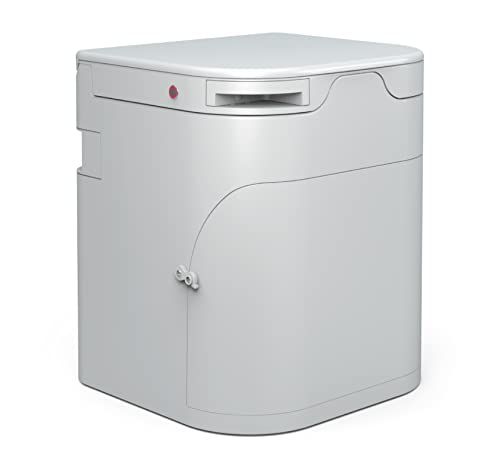
The OGO Origin Compact packs a urine-diverting design into a 15 by 16 inch footprint, built in the USA from durable polypropylene. Liquids drain to a 2.4 gallon bottle while solids stay dry in a rear bin rated for 25 to 30 uses. A clean Scandinavian look keeps it from reading like a camping toilet.

Where the Compo Closet Cuddy needs a hand crank, the OGO uses a push-button 12V electric agitator, so mixing is one tap. Its quiet fan ventilation and low 12V draw suit a rig that already runs a house battery. Serviceable parts keep it running season after season.

What works

  • Push-button agitator means no cranking
  • Smallest footprint on this list
  • Quiet fan with low 12V draw
  • Dry solids bin keeps sewage odor away

Watch out for

  • Needs 12V power for the agitator and fan
  • Bin capacity limits long stays for couples
02

Best Fan-Vented · 2 of 5

Compo Closet Cuddy Composting Toilet

Compo Closet Cuddy Composting Toilet
  • Fan and filter system
  • Manual handle mixer
  • 12V cable included
Check price on Amazon for Compo Closet Cuddy Composting Toilet (opens in a new tab)
Best for: Full-time off-grid couples

Our take

It suits a couple living full-time off-grid who want an installed-feeling toilet and a predictable emptying schedule.

Why it made the shortlist

The Compo Closet Cuddy is a self-contained composting toilet that fits flush or freestanding in RVs, vans and boats. A built-in fan and filter pull odors out, and a handle-operated mixer blends waste after each visit. You add composting material once before use and no water or chemicals are needed.

A removable solids bin with a bottom handle lets you empty it contact-free every two to three weeks, a longer interval than the portable units further down. It runs on included 12V power and keeps working when electricity drops out. A front container handles liquids with a design meant for easy cleaning.

The routine becomes second nature within a week.

What works

  • Solids bin empties every two to three weeks
  • Fan and filter actively remove odors
  • Bottom handle makes the bin contact-free
  • Works without power when needed

Watch out for

  • Manual mixing after every visit is a chore
  • Bigger than the OGO Origin Compact
03

Best Simple Setup · 3 of 5

Cuddy Lite Portable Compost Toilet

Cuddy Lite Portable Compost Toilet
  • LED liquid-full indicator
  • Two-plate drop zone
  • No power or plumbing
Check price on Amazon for Cuddy Lite Portable Compost Toilet (opens in a new tab)
Best for: Campervans, weekend rigs

Our take

It fits campervans and weekend RVs where the toilet gets used a few days at a time.

Why it made the shortlist

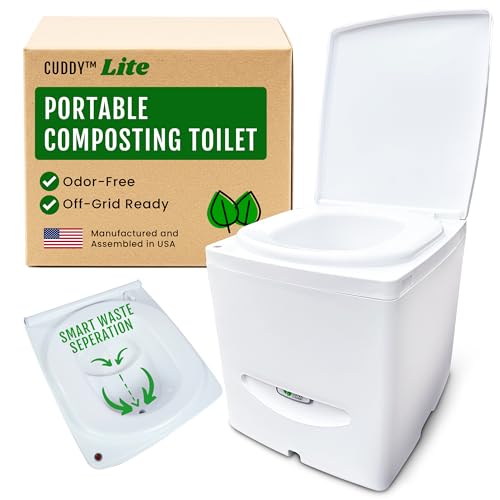
The Cuddy Lite is a portable composting toilet with a two-plate drop-zone cover that separates liquids from solids. An extra-large opening helps with clean aim, and a built-in LED shows when the liquid container is full. The LED runs on a standard 9V battery.

Against the full Cuddy it needs no 12V wiring, no plumbing and no chemicals, so there is nothing to install in the van. The removable solids bin can be lined with a bag, which keeps disposal simple and minimizes contact. Its compact footprint and flush-fit design suit campervans, boats and tiny houses.

Owners who dislike wiring will appreciate how little there is to set up.

What works

  • LED warns before the liquids bottle overflows
  • Bin accepts a liner bag for tidy emptying
  • No electricity, plumbing or chemicals
  • Compact flush-fit footprint

Watch out for

  • No fan means less odor control than the Cuddy
  • Not meant for heavy daily full-time use
04

Best Portable Capacity · 4 of 5

TRELINO Composting Toilet Evo S Gray

TRELINO Composting Toilet Evo S Gray
  • 1.2 gal urine, 1.6 gal solids
  • 330 lb capacity
  • Made in Germany
Check price on Amazon for TRELINO Composting Toilet Evo S Gray (opens in a new tab)
Best for: Van and tent campers

Our take

It suits van and tent campers who want a freestanding, European-built toilet that needs no hookups.

Why it made the shortlist

The TRELINO Evo S has a 1.2 gallon urine container and a 1.6 gallon solids container, giving space for 9 to 11 liquid visits per fill according to the listing. It is made in Germany from recyclable ABS and supports up to 330 pounds. The separation and drying function prevents odors without chemicals or water.

It also keeps you independent of dump stations. The sturdy, clean design looks at home in a van or car.

It is a comfortable fit for small spaces.

What works

  • Separation and drying function cuts odor
  • No chemicals, water or dump station needed
  • Sturdy ABS rated to 330 pounds
  • Fits vans, tents and cars

Watch out for

  • Small urine container needs frequent emptying
  • Smaller solids capacity than fixed units
05
OGO NOMAD Self-Contained Composting Toilet
  • Urine-diverting design
  • Works with 8-gallon bags
  • No power or plumbing
Check price on Amazon for OGO NOMAD Self-Contained Composting Toilet (opens in a new tab)
Best for: Weekend off-grid trips

Our take

It is the pick for weekend trips, temporary shelters and anyone trying off-grid toileting before committing to a fixed unit.

Why it made the shortlist

The OGO NOMAD is a self-contained, urine-diverting toilet that needs no power source and no plumbing. A proven separation design keeps liquids and solids apart to prevent odor without chemicals, black tanks or septic connections. It works with widely available 8-gallon bags, so no special liners are needed.

It sits at the low end of the shortlist in price and size next to the TRELINO Evo S, and it fits truck beds, car trunks, TentBox-style rooftop tents, rental camper vans, small boats and temporary field shelters. The made-for-rugged-environments build handles mud, dust and weather. The routine is add composting medium, use, tie off the bag and dispose per local guidelines.

What works

  • Uses common 8-gallon bags
  • No power, plumbing or chemicals
  • Fits truck beds and rooftop tents

Watch out for

  • Bag handling is less hygienic than a bin
  • Built for weekends, not full-time living

Methodology

How We Built This Shortlist

Each pick was assessed across 5 criteria weighted for real-world use.

01

Footprint and fit

We compared listed dimensions and mounting style, since a composting toilet has to clear the door swing in a small bathroom. The 15 by 16 inch OGO Origin Compact set the benchmark for tight builds.

02

Power and ventilation

We evaluated which units need 12V for a fan or agitator and which run with no power. Boondockers without solar benefit from a no-power option.

03

Emptying routine

We compared solids and liquids capacity and the stated emptying interval for each. Intervals such as 25 to 30 uses per bin or two to three weeks made planning easier.

04

Odor control approach

We evaluated how each unit separates liquids, ventilates and keeps solids dry. Fans, filters and drying functions were weighed against bag-only systems.

05

Setup effort

We compared installation and daily upkeep, from crank handles and electric agitators to bag liners. Less hands-on work scored higher for frequent users.

Decision guide

Match a Composting Toilet For RV to Your RV

By Rig Type

Your situationRecommended pickWhy
Sprinter or Transit van, tight cornerOGO Origin CompactIts 15 by 16 inch footprint is the smallest here and it uses a push-button 12V agitator.
Full-time off-grid coupleCompo Closet CuddyIts fan and filter plus a solids bin emptied every two to three weeks suit long stays.
Weekend camper van, no wiringCompo Closet Cuddy LiteIt needs no plumbing or power and uses a 9V battery for the full indicator LED only.
Tent or roof-top camperTRELINO Evo SIts freestanding 1.2 gallon urine and 1.6 gallon solids containers need no hookups.
Occasional use, lowest spendOGO NOMADIt is urine-diverting, needs no power or plumbing and works with common 8-gallon bags.

By Budget

BudgetRecommended pick
Entry of this shortlistOGO NOMAD or TRELINO Evo S
Mid of this shortlistCompo Closet Cuddy Lite or Compo Closet Cuddy
Top of this shortlistOGO Origin Compact

Powered vs No-Power

Powered

The OGO Origin Compact and Compo Closet Cuddy use 12V fans, and the OGO adds an electric agitator, giving stronger odor control.

No power

The Cuddy Lite, TRELINO Evo S and OGO NOMAD need no wiring, which suits weekend use and light rigs.

Choose the Compo Closet Cuddy for full-time use and the OGO NOMAD for occasional trips.

By Emptying Routine

Best pickRecommended pick
Longest solids intervalCompo Closet Cuddy
No crankingOGO Origin Compact
Warns before liquids overflowCompo Closet Cuddy Lite
Bag-and-go disposalOGO NOMAD

For Boondocking Without a Black Tank Specifically

Look for

A urine-diverting design, a stated bin capacity and a vent fan if you stay longer than a few days.

In this comparison

The Compo Closet Cuddy suits a rig that replaces its black tank, while the OGO Origin Compact does the same in the smallest footprint.

When to Spend More

Spend more if

Spend more on the OGO Origin Compact or Compo Closet Cuddy for fans, bins and a low-effort routine on long stays.

Save if

Save with the OGO NOMAD or Compo Closet Cuddy Lite when use is occasional and the rig has no 12V to spare.

FAQ

Before You Bring One Home

Do composting toilets need power?

It depends on the model. Fan-vented units like the Compo Closet Cuddy and OGO Origin Compact use 12V, and the OGO adds an electric agitator. The Cuddy Lite, TRELINO Evo S and OGO NOMAD need no power for use, apart from a 9V battery for the Cuddy Lite LED. Match the choice to whether your rig has a house battery.

What is the most common mistake?

Skipping the vent fan or mixing step, and neglecting the liquids bottle. The bottle is the usual odor source, so rinse it and add a small splash of vinegar. With the Compo Closet Cuddy, mix after every visit so waste dries evenly. Forgetting to add composting material at the start is another frequent error.

Is a fan-vented unit worth it over a portable one?

For stays longer than a few days, yes. The Compo Closet Cuddy pulls odor out with a fan and filter, while the Cuddy Lite relies on separation alone. For weekend trips the portable units save wiring and money. Think about how many nights you spend in one place.

How do I empty a composting toilet?

Empty liquids every few days and solids every couple of weeks, depending on users. With the OGO NOMAD, tie off the bag and dispose of it per local guidelines. A fixed unit like the OGO Origin Compact lets you lift out the rear bin after 25 to 30 uses. Rinse the liquids bottle each time.

Will it fit my bathroom?

Measure height, width, depth and door swing before buying. Footprint varies a lot, and the OGO Origin Compact is the smallest at 15 by 16 inches. Leave clearance for the lid and for lifting out the bin. A van wet bath may only fit the compact units.

Bottom line

The short version

Browse more composting toilet for rv on Amazon →
Bowen Higgins, RV Editor at RV Gear Lab

About the author

Bowen Higgins

RV Editor at RV Gear Lab

Bowen covers RV power, water systems, towing and leveling, upkeep and interior comfort, with a focus on matching gear to the rig, the hookups and the way you actually travel.

More from Bowen →Editorial standards

Keep reading

Related guides