

We research everything we recommend. When you buy through our links, we may earn a commission. Learn more

Buying guide · 10 min read · Updated October 2, 2026

6 Best Inline RV Water Pressure Regulator in 2026: A Practical RV Guide

Inline RV water pressure regulators thread between spigot and hose. Compare six, from a plain fixed brass unit to an angled 4-in-1 with a shutoff.

Bowen HigginsBy Bowen HigginsRV Editor at RV Gear Lab6 products comparedSpec-sheet researched

At a glance

Our top picks

An inline regulator is the simplest way to protect an RV: it screws onto the campground spigot, the hose screws onto it, and everything downstream sees a safer pressure. That also means the body hangs off the spigot, so its weight, length and the angle of the hose matter more than they do with a regulator installed at the coach inlet.

This list ranks inline units by how well they sit on a spigot and how much adjustment they give you, from compact screw-adjust bodies to a gauge-equipped model with an elbow. Where a listing is thin, the entry says so plainly rather than guessing.

RV Gear Lab field notes

The Rig Fit Check

Start with the job
Camco Adjustable RV Water Pressure Regulator leads this shortlist for Simple, compact inline setup. Use that fit as a reference point, then compare the alternatives against your own space and workload.
Specs that separate the picks
The first details to compare are 45 psi factory preset, Hand adjustment knob, Factory set at 45 psi. Confirm the exact model and included components before ordering.
Trade-off to plan for
No gauge, so no live pressure reading

Before you buy

What Matters Before You Choose an Inline RV Water Pressure Regulator

Key buying criteria so you get the right fit the first time.

  1. 01

    Spigot clearance and body size

    This is how far the regulator extends from the spigot and how tall it stands once the hose is attached. It matters because a heavy, tall body pulls on the spigot threads, and some campground spigots sit close to a wall or post. Check the listing for dimensions, and compare them to the gap you usually have at a hookup.

  2. 02

    Angled versus straight connection

    A straight inline unit leaves the hose pointing away from the spigot, while an elbow design turns it downward. Straight bodies are lighter, but the sideways pull can loosen or bend threads on long hoses. Look for a 90 degree housing in the title if your hose tends to droop.

  3. 03

    Preset psi and adjustability

    Preset units commit you to one number, usually 45 to 55 psi, while adjustable ones let you change it. A fixed 55 psi is fine for a 60 psi rated coach but leaves little margin. Read the listing for a stated output, and if it is adjustable, set it to about 50 psi with a faucet running.

  4. 04

    Gauge type and range

    A gauge shows static pressure, which reads higher than what flows during a shower. A 0 to 160 psi dial makes the 40 to 60 psi zone tiny, and a dry dial can fog or stick. Look for the words oil filled or liquid filled and check that the gauge sits at the outlet side.

  5. 05

    Lead-free proof on the listing

    Brass alone does not prove drinking water safety. NSF/ANSI 372 or CSA low lead wording is the real signal, and NSF/ANSI 61 is a separate material safety listing. Scan the bullet points for the exact standard name rather than just the phrase lead free.

  6. 06

    Thread fit and washers

    Nearly every regulator uses 3/4 inch garden hose thread, but the rubber washer and thread quality decide whether it leaks. Brass threads cross-thread easily if over-tightened. Look for included washers in the package list and tighten only hand tight plus a quarter turn.

Our standards

Why You Can Trust RV Gear Lab

At RV Gear Lab, we compare products based on rig fit and power or hookup compatibility, verified specifications, usability, setup requirements, weight, durability, and real-world trade-offs. We do not rank products purely on marketing claims or commission rates.

We have not personally tested every product listed. Where hands-on testing is not available, recommendations are based on verified manufacturer specifications, product documentation, use-case fit, and comparative research.

How we review RV gear →

Detailed reviews

The 6 best inline rv water pressure regulator, explained

01
Camco Adjustable RV Water Pressure Regulator
  • 45 psi factory preset
  • Screw adjustment under cap
  • CSA low lead, NSF/ANSI 372
Check price on Amazon for Camco Adjustable RV Water Pressure Regulator (opens in a new tab)
Best for: Simple, compact inline setup

Our take

It suits owners who want a compact inline unit with a recognizable name and a safe default.

Why it made the shortlist

The Camco Adjustable is a lead-free brass regulator with an adjustment screw under the cap, and it ships preset at 45 psi. That preset sits in the range most RV plumbing is happy with, so you can attach it and go without touching a tool.

What works

  • Ships at a safe 45 psi, ready to use
  • CSA low lead certified to NSF/ANSI 372
  • Slim body with no gauge to snag
  • Standard garden hose threads, simple hookup

Watch out for

  • No gauge, so no live pressure reading
  • Maker advises against settings above 60 psi
02
Best for: Frequent campsite changes

Our take

Best for frequent travelers who like to reset pressure at every stop.

Why it made the shortlist

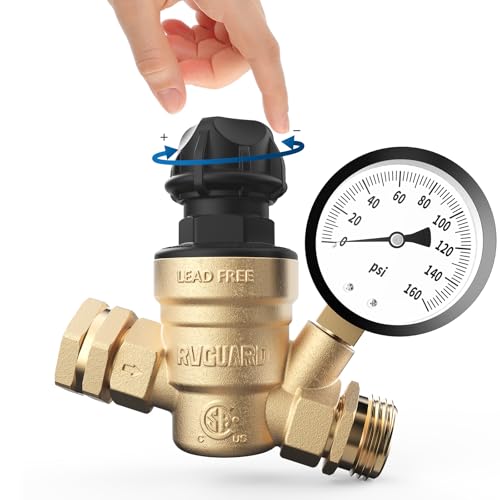
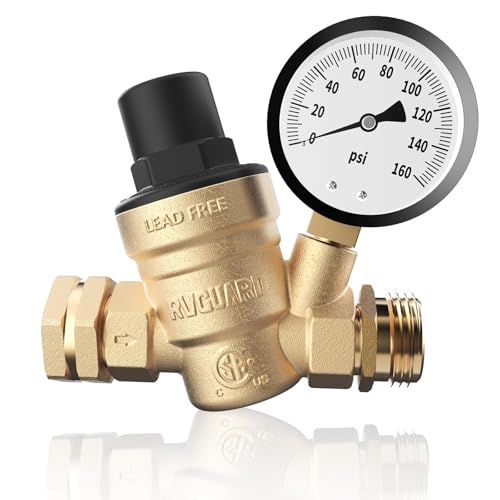
The RVGUARD Knob swaps the usual screwdriver slot for a hand knob, so you turn clockwise to raise pressure and counterclockwise to lower it. It also carries a gauge and an inlet screen, and the listing names NSF/ANSI 61 and 372 for the lead-free brass.

Against the RVGUARD Valve just below, the hardware is nearly identical; the difference is the knob. If you move between campsites often, adjusting by hand at a spigot is easier than hunting for a flat screwdriver.

The gauge and knob make the body taller, so check your spigot clearance and hose angle before assuming it will fit a tight wall hookup.

What works

  • No tool needed to change pressure
  • Gauge shows what the hose is seeing
  • Inlet screen catches sediment
  • Lists NSF/ANSI 61 and 372 for the brass

Watch out for

  • Taller body adds weight at the spigot
  • Knob can be bumped if the hose shifts
03
RVGUARD RV Water Pressure Regulator Valve
  • Factory set at 45 psi
  • Gauge and inlet screen
  • C46500 lead-free brass
Check price on Amazon for RVGUARD RV Water Pressure Regulator Valve (opens in a new tab)
Best for: Set-it-once owners

Our take

Choose RVGUARD RV Water Pressure Regulator Valve for gauge confirms the actual psi.

Why it made the shortlist

The RVGUARD Valve is the screwdriver-adjust version of the same design: factory set to 45 psi, with a gauge, an inlet screen, and C46500 lead-free brass tested to under 0.13 percent lead. Turning the screw clockwise raises pressure.

Compared with the Camco Adjustable above it, you gain a gauge for a modest step up in bulk.

What works

  • Gauge confirms the actual psi
  • Screw setting stays put once adjusted
  • Lead content tested under 0.13 percent

Watch out for

  • Needs a screwdriver for every change
  • No flow rate listed
04
Best for: First-time buyers

Our take

Best for first-time buyers who want everything in one box.

Why it made the shortlist

The Morvat Kit is a nickel-plated lead-free brass regulator with a silicone oil filled gauge, a screwdriver, washers and a roll of Teflon tape in the box. Its screw adjusts across a 0 to 160 psi range, and it comes with a one year manufacturer warranty.

Where the RVGUARD Valve gives you the regulator, this one hands you the install supplies too, which matters if you have misplaced a hose washer before. The oil filled gauge also damps needle bounce better than a dry dial.

The wide gauge range means the useful 40 to 60 psi zone is a small part of the dial, so read it with a steady hand.

What works

  • Silicone oil filled gauge steadies the needle
  • Washers and tape included in box
  • Rust-free nickel-plated brass body
  • One year manufacturer warranty

Watch out for

  • 0 to 160 range makes small changes hard to read
  • Gauge adds bulk at the spigot
05
Best for: Camco ecosystem owners

Our take

Best for owners who already run Camco filters or hoses and want one tidy, strain-relieved connection.

Why it made the shortlist

The Camco Tastepure packs a 90 degree housing, a pressure gauge, an adjustable regulator and a shutoff valve into one body measuring roughly 5 5/16 by 2 5/8 by 4 13/16 inches. It is meant to pair with the Tastepure and Tastepure XL filters and Camco or EvoFlex hoses.

Unlike every straight pick above, the elbow turns the hose down right at the spigot, which cuts the sideways strain that bends brass threads over time.

If your hose already drops straight from the spigot, you are paying for an elbow you may not need.

What works

  • Angled body reduces hose strain at the spigot
  • Built-in shutoff valve saves a fitting
  • Gauge and adjuster in a single unit
  • Works with Camco and EvoFlex hoses

Watch out for

  • Large body for tight spigots
The catch
The tradeoff is size and cost, since it is the second most expensive pick here.
06
Best for: Fixed-pressure simplicity

Our take

Best for owners who want zero fuss and a stronger stream.

Why it made the shortlist

The Baagialdic Fixed is a brass inline regulator that outputs a fixed 55 psi, listed as the Fairview WR-RV55 and described as lead free.

Its 55 psi sits at the upper end of the safe range, higher than the 45 psi presets on the Camco Adjustable and RVGUARD units.

What works

  • Nothing to adjust or knock out of place
  • Higher output than 45 psi presets
  • Compact, plain inline body
  • Fairview WR-RV55 model is easy to cross-check

Watch out for

  • No gauge, and no certification named on the listing

Methodology

How We Built This Shortlist

Each pick was assessed across 5 criteria weighted for real-world use.

01

Spigot load and fit

We compared body size, gauge and knob height, and weight hanging off the spigot, since an inline regulator sits at the cantilevered end of the connection.

02

Output pressure

We checked each listing's preset or adjustment range against the 40 to 60 psi band most RV plumbing prefers.

03

Adjustment style

We compared screwdriver, knob and fixed designs on how easy they are to set at a campsite.

04

Lead-free and certification claims

We noted which listings name NSF/ANSI 372, NSF/ANSI 61 or CSA and which only say lead free.

05

Extras in the box

We counted included washers, tape, elbows and shutoff valves as real value, not padding.

Decision guide

Match an Inline RV Water Pressure Regulator to Your RV

By Hookup Situation

Your situationRecommended pickWhy
Tight wall or post hookupCamco AdjustableSlimmest body with no gauge, so least overhang at the spigot.
Hose droops or kinks at the spigotCamco TastepureThe 90 degree elbow turns the hose down and relieves strain.
Move camp every nightRVGUARD KnobHand knob changes pressure without a screwdriver.
Want one box with sparesMorvat KitWashers, tape and screwdriver are included.
Set it once and forgetBaagialdic FixedNo adjustment, fixed 55 psi.

By Budget

BudgetRecommended pick
$20 to $30RVGUARD Knob or Morvat Kit
$20 to $40RVGUARD Valve or Camco Adjustable
$50 to $60Camco Tastepure or Baagialdic Fixed

Gauge vs No Gauge

With gauge

Gauge models show you the pressure the hose is seeing, which catches a failing seat or a spigot that jumps. They add height and weight at the spigot. Here that covers RVGUARD Knob, RVGUARD Valve, Morvat Kit and Camco Tastepure.

Without gauge

Gauge-free bodies are lighter and cheaper but leave you guessing, and they rely on the preset being right. This group is Camco Adjustable and Baagialdic Fixed.

Most buyers should lean toward a gauge model such as RVGUARD Valve unless clearance at the spigot is a real problem.

By Adjustment Style

PreferenceRecommended pick
Screwdriver adjust, hard to bumpRVGUARD Valve
Hand knob, no toolsRVGUARD Knob
Cap screw under a coverCamco Adjustable
Fixed output, nothing to adjustBaagialdic Fixed

For Spigots with Little Room Specifically

Look for

Check the body height in inches and whether the hose can leave sideways without hitting a wall. Compare the Camco Adjustable for the least overhang.

In this comparison

In this comparison, Camco Adjustable has no gauge dome and is the slimmest body, while Camco Tastepure turns the hose down with its angled housing if the spigot has clearance below it.

When to Spend More

Spend more if

Spend more on Camco Tastepure if your hose hangs from the spigot, or on Morvat Kit if you want an oil filled gauge and spare washers. Both give you something concrete beyond bare regulation.

Save if

Save with RVGUARD Valve or RVGUARD Knob, which give you a gauge, inlet screen and named lead-free standards for less money than Camco Tastepure or Baagialdic Fixed.

FAQ

Before You Bring One Home

Where does an inline regulator go?

Screw it onto the campground spigot, then attach your hose to the regulator outlet. Putting it at the spigot protects the hose and the coach plumbing together. Hand tighten, add a quarter turn, and check for drips.

Is it a mistake to set pressure while no water is running?

Yes, that is the usual setup error. A gauge reads static pressure, and flowing pressure runs about 15 to 20 psi lower. Open a faucet in the RV and set the regulator to about 50 psi while water is flowing.

Is a gauge model worth it over the Camco Adjustable or Baagialdic Fixed?

If your spigot has room, yes. A gauge such as the one on RVGUARD Valve shows if pressure creeps up over time, which signals a failing seat. If you just want protection at a tight hookup, the no-gauge bodies still do the job.

How do I fit an elbow regulator like the Camco Tastepure?

Thread it onto the spigot with a washer, rotate the housing so the outlet faces downward, then attach the hose. Check that the gauge face is readable from where you stand. Remove the whole unit if freezing weather is forecast.

Should I leave the regulator on the spigot all season?

Take it off in freezing weather, because trapped water can crack brass bodies and gauges. Also rinse or inspect the inlet screen from time to time, since sediment can cut flow. A regulator that creeps up toward campground pressure after setting is worn and should be replaced.

Bottom line

The short version

Browse more inline rv water pressure regulator on Amazon →
Bowen Higgins, RV Editor at RV Gear Lab

About the author

Bowen Higgins

RV Editor at RV Gear Lab

Bowen covers RV power, water systems, towing and leveling, upkeep and interior comfort, with a focus on matching gear to the rig, the hookups and the way you actually travel.

More from Bowen →Editorial standards

Keep reading

Related guides