

We research everything we recommend. When you buy through our links, we may earn a commission. Learn more

Buying guide · 10 min read · Updated October 2, 2026

6 Best RV Water Filter For Drinking Water in 2026: A Practical RV Guide

Best RV water filters for drinking water, compared by certification, capacity and format so you can pick one that fits how you fill and drink.

Bowen HigginsBy Bowen HigginsRV Editor at RV Gear Lab6 products comparedSpec-sheet researched

At a glance

Our top picks

Drinking water is where an RV filter earns its keep, because the tank, lines and water heater all sit between the hose and your glass. The useful question is not which filter is fanciest but which one lists a certification that matches what you want it to do about taste, odor and chlorine.

Here the order follows how clearly each listing documents its claims, then capacity per dollar, then convenience. Most picks are inline hose filters with GAC and KDF, plus one external canister system for people who want replaceable cartridges.

RV Gear Lab field notes

The Rig Fit Check

Start with the job
Camco Tastepure RV Water Filter leads this shortlist for Documented drinking-water filtering. Use that fit as a reference point, then compare the alternatives against your own space and workload.
Specs that separate the picks
The first details to compare are NSF/ANSI 42 and 53 listed, NSF/ANSI 42 and 372, 20-micron sediment stage. Confirm the exact model and included components before ordering.
Trade-off to plan for
Sold as a single filter, so spares cost extra

Before you buy

What Matters Before You Choose an RV Water Filter For Drinking Water

Key buying criteria so you get the right fit the first time.

  1. 01

    Which standard fits what you want

    NSF/ANSI 42 covers chlorine, taste and odor, while 53 covers health claims such as lead or cysts. A filter only reduces what its own listing certifies, so a drinking-water buyer should read which standards appear. Look for the standard numbers in the listing text, not just words like certified.

  2. 02

    Micron rating of the sediment stage

    Micron is the size of the smallest particle a stage blocks, and most hose filters sit near 20 microns. That is fine for sand and rust but does nothing for bacteria. Check the number on the listing.

  3. 03

    Stated capacity and months

    Capacity in gallons and a three-month life tell you when to swap. Carbon wears out without warning, so replace on schedule. Divide the price by the stated gallons to compare.

  4. 04

    Flow rate at the spigot

    Small hose filters often pass only around half a gallon per minute, which can slow a tank fill. A stated flow rate lets you judge. If the listing gives none, expect a slower fill.

  5. 05

    Hose protector and fittings

    A filter hanging off a spigot puts stress on the threads. A swivel hose with brass or copper ends reduces kinks. Check that the ends are 3/4 inch garden hose thread.

Our standards

Why You Can Trust RV Gear Lab

At RV Gear Lab, we compare products based on rig fit and power or hookup compatibility, verified specifications, usability, setup requirements, weight, durability, and real-world trade-offs. We do not rank products purely on marketing claims or commission rates.

We have not personally tested every product listed. Where hands-on testing is not available, recommendations are based on verified manufacturer specifications, product documentation, use-case fit, and comparative research.

How we review RV gear →

Detailed reviews

The 6 best rv water filter for drinking water, explained

01

Best Overall · 1 of 6

Camco Tastepure RV Water Filter

Camco Tastepure RV Water Filter
  • NSF/ANSI 42 and 53 listed
  • CSA lead-free to 372
  • GAC and KDF media
Check price on Amazon for Camco Tastepure RV Water Filter (opens in a new tab)
Best for: Documented drinking-water filtering

Our take

It suits anyone who fills a fresh tank from campground spigots and mainly wants better taste and a documented certification.

Why it made the shortlist

Camco's Tastepure is the pick that documents its claims most clearly. The listing states independent testing to NSF/ANSI 42 and NSF/ANSI 53, plus CSA lead-free content certification to NSF/ANSI 372, and it is built with GAC and KDF in a six-step design.

Against the AQUA CREST below it, the difference is the Standard 53 listing, which is the standard tied to health-related claims rather than just taste.

What works

  • Lists both NSF 42 and NSF 53 testing
  • Lead-free content certified to NSF/ANSI 372
  • Made in the USA with GAC and KDF
  • Fits standard garden hose connections

Watch out for

  • Sold as a single filter, so spares cost extra
  • Hose filters like this one need replacing each season
02

Best Certified Value · 2 of 6

AQUA CREST RV Inline Water Filter

AQUA CREST RV Inline Water Filter
  • NSF/ANSI 42 and 372
  • KDF plus activated carbon
  • 400 PSI pressure test
Check price on Amazon for AQUA CREST RV Inline Water Filter (opens in a new tab)
Best for: Certified filter with hose protector

Our take

Good for campers who want a certified filter plus a built-in hose protector and tool-free installation.

Why it made the shortlist

AQUA CREST is certified against NSF/ANSI 42 and 372, uses KDF with activated carbon, and ships with a rotating hose protector that has copper ends. The listing also describes pressure testing up to 400 PSI.

Against Kohree below, it has the stronger certification wording and sturdier fittings.

Its three-month service life is the stated figure, so plan to swap it each camping season.

What works

  • Certified to NSF/ANSI 42 and 372
  • Copper-ended hose protector rotates 360 degrees
  • Installs by hand without any tools
  • Listing describes a 400 PSI pressure test

Watch out for

  • No NSF 53 listing for health-based claims
  • Three-month service life means yearly re-buying
03

Best 2-Pack Value · 3 of 6

Kohree RV Water Filter

Kohree RV Water Filter
  • 20-micron sediment stage
  • 0.5 gpm stated flow
  • Up to 1,057 gallons
Check price on Amazon for Kohree RV Water Filter (opens in a new tab)
Best for: Two-pack on a budget

Our take

It is a sensible choice for a full season plus a spare.

Why it made the shortlist

Kohree sells a two-pack with a 20-micron sediment stage inside a five-layer GAC and KDF design. The listing states 0.5 gpm flow and up to 1,057 gallons of capacity, in a wider body meant to keep flow up.

Compared with AQUA CREST above, you get two filters instead of one at a similar spend.

The NSF wording on the listing is general, so look at the certification line before relying on it for specific claims.

What works

  • Two filters in the pack for one season plus spare
  • States a 0.5 gpm flow rate
  • Thicker food-grade housing with burst-tested design
  • 20-micron stage catches silt and sediment

Watch out for

  • Capacity figure is lower than some rivals
  • NSF wording is general rather than itemized
04
Best for: Budget spares for weekend trips

Our take

It works for weekend campers who want spares at a low cost.

Why it made the shortlist

Beckacher is another two-pack, built on GAC and KDF, with a stated 1,350 gallons over about three months. It reduces taste, odor, chlorine and sand, and it installs by hand in about five minutes.

Against Crystala below, it gives you two filters rather than three plus a different hose build.

No NSF certification is named, so it is a taste and sediment pick rather than a documented-claims pick.

What works

  • Highest stated gallon capacity among the inline filters
  • Lead-free and BPA-free materials are listed
  • Hand installation in about five minutes
  • Flexible hose protector included

Watch out for

  • No NSF certification named on the listing
05
Best for: Long seasons and full-timers

Our take

Best for full-timers or long seasons who go through filters regularly.

Why it made the shortlist

Crystala packs three inline filters with two flexible hoses, using GAC and KDF to cut chlorine, taste and odor. The hose ends are anti-rust copper and swivel 360 degrees, and the filters fit any 3/4 inch standard hose.

Against RANSOTO below, you stay in the cheap, replace-it-each-season format instead of a canister system.

What works

  • Three filters cover a long travel season
  • Copper-ended swivel hoses cut kinking
  • Fits standard 3/4 inch hoses with no tools
  • Reduces chlorine, taste and odor

Watch out for

  • No certification is named on the listing
  • Three-month life each, so storage of spares needed
06
Best for: Long stays with a fixed setup

Our take

Pick it if you camp in one spot for long stretches and want cartridges you can swap.

Why it made the shortlist

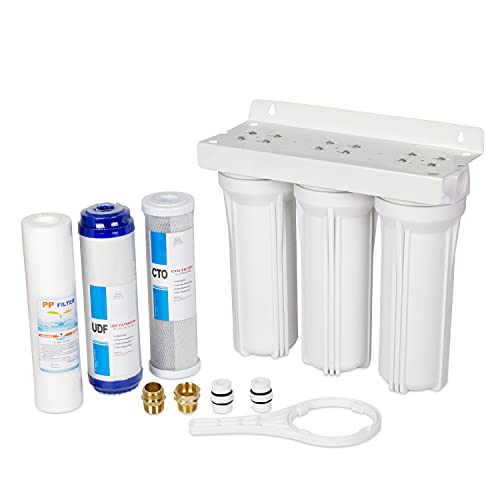
RANSOTO is the odd one out: an external three-stage system on a powder-coated steel stand, rather than a throwaway hose filter. The listing says it filters sediment and reduces odor in the drinking water, and it can be mounted or staked.

It costs several times more than any hose filter above, in exchange for replaceable cartridges and a sturdier setup. Beside Camco Tastepure, it states no certification, so its appeal is the format rather than the paperwork.

What works

  • Replaceable cartridges rather than disposable filter
  • Steel stand can be mounted or staked
  • Aimed at sediment and odor reduction
  • Works for RVs and boats

Watch out for

  • Costs far more than inline hose filters

Methodology

How We Built This Shortlist

Each pick was assessed across 5 criteria weighted for real-world use.

01

Certification wording

We compared which NSF/ANSI standards each listing names, and whether it separates taste claims from health claims.

02

Capacity and replacement cycle

We compared stated gallon and month figures to see what a season of drinking water really costs.

03

Media and stages

We compared GAC, KDF and sediment stages as described on each listing.

04

Hose and fittings

We compared hose protectors, ends and installation steps for leak risk.

05

Format value

We compared single, two-pack, three-pack and canister formats by what you get per season.

Decision guide

Match an RV Water Filter For Drinking Water to Your RV

By Drinking Habit

Your situationRecommended pickWhy
You want documented claims you can readCamco TastepureIt lists NSF/ANSI 42 and 53 plus 372 lead-free content.
You want certification and a swivel hoseAQUA CREST InlineLists NSF 42 and 372 and includes a copper-ended hose protector.
You fill a tank for a family for a seasonKohree 2-PackTwo filters and a stated 0.5 gpm flow.
You camp most of the yearCrystala 3-PackThree filters in one pack.
You want swappable cartridgesRANSOTO 3-StageExternal system with a steel stand.

By Budget

BudgetRecommended pick
$10 to $20Kohree 2-Pack or Beckacher 2-Pack
$20 to $30Camco Tastepure or AQUA CREST Inline
$30 to $70Crystala 3-Pack or RANSOTO 3-Stage

Hose Filter vs Canister System

Hose filter

A sealed unit with GAC and KDF that you throw away each season. Camco Tastepure, AQUA CREST Inline, Kohree 2-Pack, Beckacher 2-Pack and Crystala 3-Pack are all this type, which is cheap and tool-free.

Canister system

A housing with cartridges you swap, on a stand. RANSOTO 3-Stage is the example here. It costs more up front but you replace only cartridges.

Most RVers should default to Camco Tastepure unless they stay put long enough to justify RANSOTO 3-Stage.

By Pack Size

PreferenceRecommended pick
One filter, best paperworkCamco Tastepure
One filter plus hose protectorAQUA CREST Inline
Two spare filtersBeckacher 2-Pack
Two filters, stated flowKohree 2-Pack
Three filtersCrystala 3-Pack

For Campground Spigots Specifically

Look for

A named standard (NSF/ANSI 42 for taste and chlorine), a 3/4 inch hose thread and a hose protector so the filter does not hang from the spigot (as on Camco Tastepure).

In this comparison

Camco Tastepure lists 42 and 53, and AQUA CREST Inline adds the protector hose, so either suits a spigot hookup.

When to Spend More

Spend more if

Spend more on Camco Tastepure or AQUA CREST Inline if you want certification wording on the listing, or on RANSOTO 3-Stage if you stay parked and want cartridges.

Save if

Save with Kohree 2-Pack or Beckacher 2-Pack if you mainly want better taste and a spare, since both use GAC and KDF.

FAQ

Before You Bring One Home

Will these filters make any water safe to drink?

No. GAC and KDF filters reduce taste, odor and chlorine and catch sediment, but carbon and sediment filters do not make water microbiologically safe. Use a purifier or treatment if the source is doubtful.

What is the most common mistake with inline filters?

Leaving the filter in place all year and letting the carbon exhaust. Replace on the stated schedule even if flow looks fine, and avoid letting it sit wet in storage.

Is NSF 53 worth paying for over a basic filter?

If you care about documented claims, yes, because 53 covers health-related contaminants. Camco Tastepure lists it, but read the data sheet for what is covered, since the listing does not itemize it.

How do I install a hose filter?

Screw it on the spigot or after the regulator, in the flow direction marked on the housing, then attach your drinking hose. Flush it a minute first, since carbon dust may appear at first use.

Can I leave the filter on in freezing weather?

No. Water inside the housing can freeze and crack it. Drain and store it indoors, and replace it if it has frozen with water inside.

Bottom line

The short version

Browse more rv water filter for drinking water on Amazon →
Bowen Higgins, RV Editor at RV Gear Lab

About the author

Bowen Higgins

RV Editor at RV Gear Lab

Bowen covers RV power, water systems, towing and leveling, upkeep and interior comfort, with a focus on matching gear to the rig, the hookups and the way you actually travel.

More from Bowen →Editorial standards

Keep reading

Related guides