

We research everything we recommend. When you buy through our links, we may earn a commission. Learn more

Buying guide · 10 min read · Updated October 2, 2026

6 Best RV Water Filter For Well Water in 2026: A Practical RV Guide

Six RV water filters for well water hookups, compared on sediment handling, fine micron stages and capacity, with honest notes on iron, sulfur and bacteria.

Bowen HigginsBy Bowen HigginsRV Editor at RV Gear Lab6 products comparedSpec-sheet researched

At a glance

Our top picks

Well water is a different problem from city water. It can carry sand, silt, iron staining and a rotten-egg smell, and it often has no chlorine at all, so a chlorine-focused hose filter does not tackle the main issues.

None of the listings below claims to fix iron or sulfur, so this list is about the next best thing: how well each handles sediment first, how fine its last stage is, and how long it lasts before a loaded filter strangles your flow. Where a listing is silent on a well-water issue, we say so.

RV Gear Lab field notes

The Rig Fit Check

Start with the job
GoBluTech AR3 leads this shortlist for Premium well hookups. Use that fit as a reference point, then compare the alternatives against your own space and workload.
Specs that separate the picks
The first details to compare are 0.2 micron high-flow filter, 5 stages, 0.01 micron, KDF and GAC media. Confirm the exact model and included components before ordering.
Trade-off to plan for
Small 5 inch cartridges load quickly

Before you buy

What Matters Before You Choose an RV Water Filter For Well Water

Key buying criteria so you get the right fit the first time.

  1. 01

    Sediment capacity first

    Well water often carries sand and silt that loads a small filter fast. A canister with a sediment stage handles more than a hose filter. Look for a sediment stage with a micron rating.

  2. 02

    Iron and sulfur are separate problems

    Generic carbon has limited capacity for iron and rotten-egg smell. Those need specific media such as catalytic carbon or KDF-85. None of these listings claims them, so use the filter as a pre-stage.

  3. 03

    No chlorine to rely on

    Municipal water has residual chlorine, but a well does not. A chlorine-focused hose filter does not help there. Check the listing for what it targets.

  4. 04

    Fine stage and flow

    A 0.2 micron or 0.01 micron stage is finer but clogs faster. Confirm a sediment stage sits in front. Look for stage order.

  5. 05

    Capacity per cartridge set

    Gallon and month ratings are for typical city water. A dirty well shortens them. Check how often you change and keep spares.

  6. 06

    Bacteria need separate treatment

    Carbon and sediment do not make water microbiologically safe. For a private well, test the water and add UV or a purifier. No listing here promises pathogen removal.

Our standards

Why You Can Trust RV Gear Lab

At RV Gear Lab, we compare products based on rig fit and power or hookup compatibility, verified specifications, usability, setup requirements, weight, durability, and real-world trade-offs. We do not rank products purely on marketing claims or commission rates.

We have not personally tested every product listed. Where hands-on testing is not available, recommendations are based on verified manufacturer specifications, product documentation, use-case fit, and comparative research.

How we review RV gear →

Detailed reviews

The 6 best rv water filter for well water, explained

01

Best Premium · 1 of 6

GoBluTech AR3

GoBluTech AR3
  • 0.2 micron high-flow filter
  • Carbon plus sediment stage
  • 3 to 4 months per set
Check price on Amazon for GoBluTech AR3 (opens in a new tab)
Best for: Premium well hookups

Our take

Best for buyers who want a named well-water use and a fine 0.2 micron stage.

Why it made the shortlist

GoBluTech AR3 stacks a 0.2 micron high-flow filter, a charcoal and coconut shell carbon filter and a sediment filter that extends the life of the others, in compact 5 inch cartridges on a carbon fiber frame. The listing says the 0.2 micron stage reduces particulates commonly associated with well water and city water, and quotes 3 to 4 months per set.

The compact 5 inch cartridges are a trade for portability.

Expect to replace a set every 3 to 4 months.

What works

  • Listing names well water use
  • Sediment stage protects the fine filter
  • Stainless quick connects
  • Lightweight carbon fiber frame

Watch out for

  • Small 5 inch cartridges load quickly
02

Best Heavy Duty · 2 of 6

RV Water Filter System

RV Water Filter System
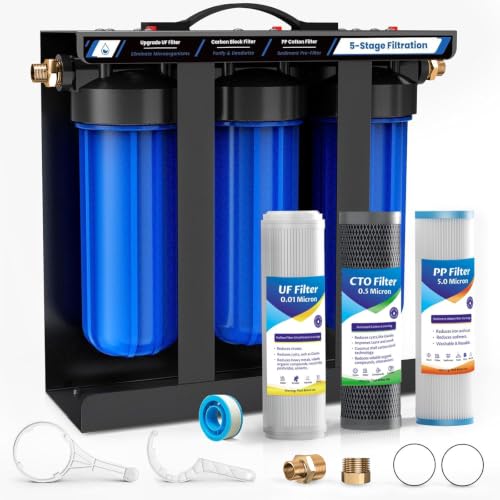
  • 5 stages, 0.01 micron
  • Up to 3,000 gallons
  • 1 inch and 3/4 inch fit
Check price on Amazon for RV Water Filter System (opens in a new tab)
Best for: Heavy sediment hookups

Our take

Best for heavy sediment loads where you want a full sediment, carbon and fine stage.

Why it made the shortlist

WLSINJL uses five stages with 0.01 micron filters and states that up to 3,000 gallons can be processed without clogging. It supports standard 1 inch and 3/4 inch connections and ships with one housing, three cartridges, a wrench and a detachable handle.

The 3,000 gallon figure is lower than a canister kit with large cartridges would typically give.

What works

  • Five-stage layout with large filtration area
  • Fits 1 inch or 3/4 inch plumbing
  • Detachable handle for transport
  • Wrench and O-ring included

Watch out for

  • No iron or sulfur claim
  • 3,000 gallon figure is moderate
03

Best Value Pack · 3 of 6

RV Water Filter

RV Water Filter
  • KDF and GAC media
  • 1,350 gallons or 3 months
  • 4 filters
Check price on Amazon for RV Water Filter (opens in a new tab)
Best for: Light use, backup

Our take

Best for light well use as a backup drinking filter.

Why it made the shortlist

Drupany ships four hose filters using KDF and GAC, each rated for up to 1,350 gallons or three months, with two hose protectors. The listing says it helps reduce chlorine, taste, odors and sediment.

Do not expect it to handle heavy sediment.

What works

  • Four filters for a long season
  • Stated gallon capacity
  • Tool-free hose install
  • Low cost per filter

Watch out for

  • Limited sediment capacity for wells
  • No named certification
04
Best for: Clear well water

Our take

Best for a well with fairly clear water that needs a certified chlorine and taste hose filter.

Why it made the shortlist

Stokk offers a 10 micron internal sediment filter with GAC and KDF, a 360 degree swivel hose protector and a wide body. The listing says it is independently tested to NSF/ANSI 42.

The 10 micron stage is finer than the 20 micron screens common in cheap hose filters, and it carries a named standard. It is still a taste filter rather than a well-water system.

Move to a canister system if the water carries visible silt.

What works

  • Finer 10 micron sediment stage
  • NSF/ANSI 42 named
  • Wide body for flow
  • Swivel protector reduces kinks

Watch out for

  • Not meant for heavy silt
  • No iron or sulfur claim
05

Best Brand Name · 5 of 6

Camco Tastepure RV Water Filter 2-pk

Best for: Tested, clear wells

Our take

Best for a well that is already tested and clear.

Why it made the shortlist

Camco's Tastepure 2-pack uses GAC and KDF, and the listing says they are independently tested and listed to NSF/ANSI 42 and 53 with CSA lead-free content certification. The listing gives no micron rating, so judge it on those certifications.

It is a good drinking hose filter, not a well-water solution.

Pair with a canister if there is sediment.

What works

  • NSF/ANSI 42 and 53 wording
  • Two filters per pack
  • Made in the USA
  • Simple hand install

Watch out for

  • Limited sediment capacity
06
Best for: Budget, clear water

Our take

Best for budget use on a well that is already clear.

Why it made the shortlist

WELLUCK uses KDF and GAC with five layers of fine filtration, according to the listing, with a three-month life and connects to any standard faucet or garden hose. It is a simple hose-end design with no brackets or housings.

It is a hose-end filter, so it will clog quickly on silty well water.

What works

  • Hand install on any hose
  • Two filters per pack
  • Three-month season life

Watch out for

  • No standard named
  • Clogs quickly on silty water

Methodology

How We Built This Shortlist

Each pick was assessed across 5 criteria weighted for real-world use.

01

Sediment handling

We looked at sediment stage ratings and cartridge size, since silt is a main well-water issue.

02

Finest stage

We compared the micron rating of the last stage.

03

Capacity and life

We used stated gallons or months where given.

04

Honesty on iron and sulfur

We noted that no listing names iron or sulfur removal, and ranked on what is stated.

05

Hookup flexibility

We compared port sizes and fittings for private well setups.

Decision guide

Match an RV Water Filter For Well Water to Your RV

By Sediment Load

Your situationRecommended pickWhy
Heavy sand and siltWLSINJL 5-StageFive stages and larger filtration area.
Moderate sediment, want a fine stageGoBluTech AR3Sediment stage plus 0.2 micron filter.
Light sediment, taste onlyStokk 2-Pack10 micron screen with NSF/ANSI 42.
Clear well, short tripWELLUCK 2-PackCheapest hose-end option.

By Budget

BudgetRecommended pick
$10 to $20WELLUCK 2-Pack or Stokk 2-Pack
$30 to $40Camco 2-Pack or Drupany 4-Pack
$250 to $500WLSINJL 5-Stage or GoBluTech AR3

Canister System vs Hose Filter

Canister system

WLSINJL 5-Stage and GoBluTech AR3 hold more media and a dedicated sediment stage, so they cope with a loaded well.

Hose filter

Drupany 4-Pack, Camco 2-Pack, Stokk 2-Pack and WELLUCK 2-Pack are cheap and light but clog quickly on silt.

Most well users should start with WLSINJL 5-Stage, and use a hose filter only on clear water.

By Budget

BudgetRecommended pick
Under $20WELLUCK 2-Pack
$30 to $40Camco 2-Pack
Around $260WLSINJL 5-Stage
Around $500GoBluTech AR3

For Private Well Hookups Specifically

Look for

A sediment stage ahead of the finest stage and a stated capacity, as on WLSINJL 5-Stage.

In this comparison

GoBluTech AR3 names well water use and a sediment stage, while WLSINJL 5-Stage states 3,000 gallons without clogging.

When to Spend More

Spend more if

Spend more on GoBluTech AR3 if you want a named well-water use and a 0.2 micron stage, since WLSINJL 5-Stage is aimed at heavy sediment capacity.

Save if

Save with Drupany 4-Pack or WELLUCK 2-Pack only if your well is clear, because Stokk 2-Pack and Camco 2-Pack still lack iron or sulfur claims.

FAQ

Before You Bring One Home

Will these filters remove iron or rotten-egg smell?

None of the listings claims it. Those problems usually need specific media such as catalytic carbon or KDF-85, so treat these as sediment and taste filters.

What mistake do people make on a well?

Using a chlorine-focused hose filter as the only treatment. A well has no chlorine, so you still need sediment control and perhaps testing.

Is GoBluTech AR3 worth it over WLSINJL 5-Stage?

Only if you want its named well-water wording and 0.2 micron stage. WLSINJL 5-Stage costs about half and handles heavy sediment.

How do I set up a canister on a well?

Connect a regulator, then the filter, then the hose, and place the housing on its stand. Flush new cartridges before drinking.

How should I handle bacteria on a well?

Test the well water and add UV or a purifier if needed. Carbon filters do not make water microbiologically safe.

Bottom line

The short version

Browse more rv water filter for well water on Amazon →
Bowen Higgins, RV Editor at RV Gear Lab

About the author

Bowen Higgins

RV Editor at RV Gear Lab

Bowen covers RV power, water systems, towing and leveling, upkeep and interior comfort, with a focus on matching gear to the rig, the hookups and the way you actually travel.

More from Bowen →Editorial standards

Keep reading

Related guides