

We research everything we recommend. When you buy through our links, we may earn a commission. Learn more

Buying guide · 10 min read · Updated October 2, 2026

6 Best RV Water Pressure Regulator For Travel Trailer in 2026: A Practical RV Guide

Travel trailer water pressure regulators picked for weekend hookups: six gauge-equipped adjustable units compared on dial type, support and build.

Bowen HigginsBy Bowen HigginsRV Editor at RV Gear Lab6 products comparedSpec-sheet researched

At a glance

Our top picks

A travel trailer spends most of its life being hooked up and unhooked, often by one person, often at a pedestal spigot that sits low to the ground. That makes the regulator a piece of kit you handle constantly, so ease of reading and adjusting it matters as much as the psi range.

These six all carry a gauge and adjust from a 45 psi preset, and they differ in dial style, support and how they cope with being tossed back in a bin. Picks are ordered by how well they suit a weekend setup routine.

RV Gear Lab field notes

The Rig Fit Check

Start with the job
Nilight RV Water Pressure Regulator Adjustable Handle Valve with Gauge leads this shortlist for Solo weekend setups. Use that fit as a reference point, then compare the alternatives against your own space and workload.
Specs that separate the picks
The first details to compare are Twist handle adjustment, Factory 45 psi, Liquid-filled stainless gauge. Confirm the exact model and included components before ordering.
Trade-off to plan for
Handle can shift in a cluttered bin

Before you buy

What Matters Before You Choose an RV Water Pressure Regulator For Travel Trailer

Key buying criteria so you get the right fit the first time.

  1. 01

    Where it connects on a trailer

    A trailer's city water inlet sits on the side of the coach and is fed by a hose from a spigot, so the best spot for the regulator is at the spigot. This protects the hose as well as the trailer plumbing. Look for 3/4 inch garden hose thread in the listing bullets, which matches both ends.

  2. 02

    Preset and range

    Most picks here are preset to 45 psi and adjust up to 160 psi. A 45 psi preset is safe for most trailers, but the 160 psi top makes the dial coarse. Look for a stated preset and check that the typical setting sits comfortably within the first third of the dial.

  3. 03

    Static versus flowing readings

    A gauge shows static pressure, while flowing pressure runs 15 to 20 psi lower. Set the regulator with a faucet running inside the trailer. A static reading that creeps up after setting points to a seat that is not holding.

  4. 04

    Gauge fill and durability

    Liquid or silicone oil filled gauges damp bounce and resist fogging, while dry gauges can fog or stick. Trailers bounce around in bins, so this matters. Look for the words oil filled or liquid filled in the listing.

  5. 05

    Lead-free proof

    Lead-free brass tested under 0.13 percent is a maker's claim, while NSF/ANSI 372 and 61 are named standards. For drinking water, prefer the named standards. Scan the bullets for the exact standard.

  6. 06

    Winter and storage

    Brass bodies and gauges can crack if water freezes inside them. Many trailer owners store or winterize their regulator. Plan to drain and remove it at the end of the season and keep it dry.

Our standards

Why You Can Trust RV Gear Lab

At RV Gear Lab, we compare products based on rig fit and power or hookup compatibility, verified specifications, usability, setup requirements, weight, durability, and real-world trade-offs. We do not rank products purely on marketing claims or commission rates.

We have not personally tested every product listed. Where hands-on testing is not available, recommendations are based on verified manufacturer specifications, product documentation, use-case fit, and comparative research.

How we review RV gear →

Detailed reviews

The 6 best rv water pressure regulator for travel trailer, explained

01
Best for: Solo weekend setups

Our take

Best for weekend towers who want to set pressure by hand and read it right away.

Why it made the shortlist

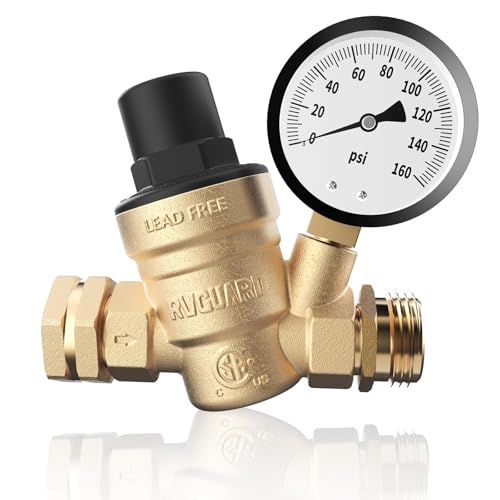
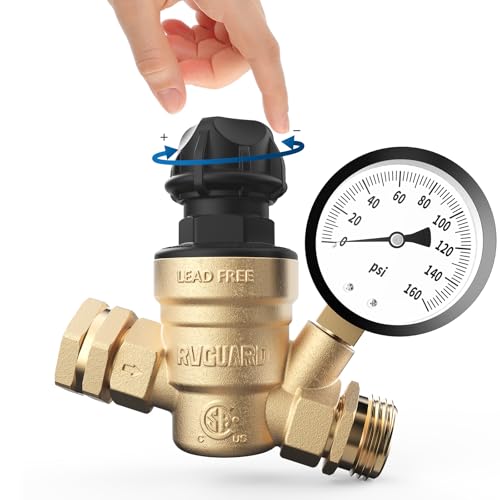
The Nilight Handle adjusts with a twist handle instead of a screwdriver, covers 0 to 160 psi, and is preset at 45 psi. It is lead-free brass tested to under 0.13 percent lead, and it carries a gauge so you can read pressure at the spigot.

Compared with the RVGUARD Valve below it, the difference is tool-free adjustment, which helps when you are setting up alone in fading light. It is a few dollars more and the handle can be nudged if the bin shifts in transit.

The wide gauge range makes small adjustments hard to read.

What works

  • Twist handle needs no screwdriver
  • Gauge reads pressure at the spigot
  • Lead tested under 0.13 percent
  • Preset 45 psi works out of the box

Watch out for

  • Handle can shift in a cluttered bin
  • Wide range makes fine changes hard to read
02

Best Certified Screwdriver Model · 2 of 6

RVGUARD RV Water Pressure Regulator Valve

Best for: Set-and-travel owners

Our take

Best for trailer owners who set pressure once and travel with it in a tote.

Why it made the shortlist

The RVGUARD Valve is set to 45 psi at the factory, adjusts with a screwdriver, and has a gauge and an inlet screen. The listing names NSF/ANSI 61 and 372 and C46500 lead-free brass.

It is the more locked-in version of the RVGUARD Knob below, since a screw slot is harder to knock than a knob.

What works

  • Names NSF/ANSI 61 and 372
  • Screw setting is hard to knock out
  • Gauge and inlet screen included
  • C46500 lead-free brass

Watch out for

  • Needs a screwdriver for adjustment
  • No flow rate listed
03
Best for: Gauge readability and support

Our take

Best for owners who value a steadier gauge and reachable support.

Why it made the shortlist

The Renator is a brass regulator with a stainless steel liquid-filled gauge, preset at 45 psi and adjustable up to 160 psi. The listing says it comes with U.S.-based phone and email support, with quality checks done in a Florida warehouse.

Compared with the Nilight Handle, you swap a hand handle for a liquid-filled stainless gauge that holds up to vibration. The inlet screen also filters debris, per the listing.

What works

  • Liquid-filled gauge steadies the needle
  • U.S.-based phone and email support
  • Inlet screen catches debris
  • Lead tested under 0.13 percent

Watch out for

  • No named certification standard
  • Screw adjust needs a tool
04
Best for: Frequent site changes

Our take

Best for trailer owners who adjust on arrival at each site.

Why it made the shortlist

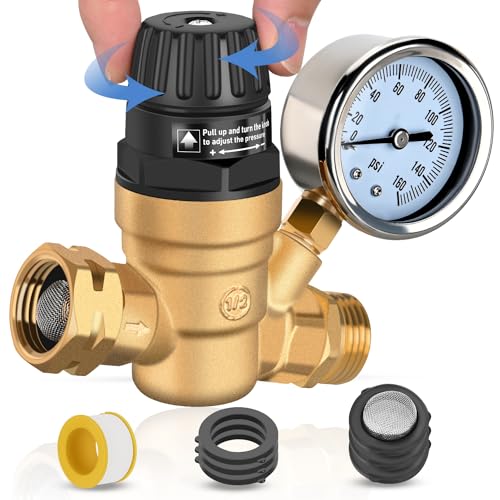
The RVGUARD Knob uses an adjustable knob, so you change pressure by hand without a tool, and it has a gauge and an inlet screen. It names NSF/ANSI 61 and 372 for the lead-free brass body.

Against the RVGUARD Valve it trades a locked-in screw for convenience.

The knob design and gauge together add bulk at the spigot.

What works

  • Tool-free knob adjustment
  • Names NSF/ANSI 61 and 372
  • Inlet screen filters sediment
  • Gauge shows live pressure

Watch out for

  • Knob can be nudged by the hose
  • Taller body at the spigot
05
Best for: Budget gauge buyers

Our take

Best for budget buyers who still want a gauge and a screened inlet.

Why it made the shortlist

The AOLINK is a lead-free brass regulator with a 0 to 160 psi gauge, manual adjustment, inlet screening and a comfortable grip. It uses standard 3/4 inch garden hose thread connections.

The grip makes it easy to thread on with wet hands.

What works

  • Gauge range up to 160 psi
  • Comfortable grip helps wet-hand hookup
  • Inlet screen filters debris
  • Standard 3/4 inch garden hose thread

Watch out for

  • No gauge fill or damping detail given
  • No named lead-free standard
06

Best Dial Design · 6 of 6

FOCSPROD RV Water Pressure Regulator

Best for: Dial-style adjusters

Our take

Best for owners who like a marked dial.

Why it made the shortlist

The FOCSPROD has a top-mounted graduated dial for presetting and adjusting pressure, a gauge factory set to 45 psi, and an inlet screen filter. It uses a hybrid build intended for harsh outdoor conditions.

Compared with the AOLINK Gauge above it, the graduated dial gives a visual reference for changes without a screwdriver. The hybrid construction is less defined than the brass of the other picks.

What works

  • Marked dial gives a visual reference
  • Preset to 45 psi at the factory
  • Inlet screen filter included
  • Built for outdoor temperature swings per listing

Watch out for

  • Hybrid build is less defined than brass
  • No flow or standard details on the listing

Methodology

How We Built This Shortlist

Each pick was assessed across 5 criteria weighted for real-world use.

01

Setup speed

We compared how quickly each regulator can be set up solo, including knob, handle, screw and dial adjustment.

02

Gauge usability

We compared gauge range, fill type and readability at a low spigot.

03

Trailer travel durability

We weighed construction and how well each design tolerates being stored in a bin between trips.

04

Certification and lead content

We checked for named standards, such as NSF/ANSI 61 and 372, against generic lead-free claims.

05

Support

We noted stated support, warranty or contact detail on each listing.

Decision guide

Match an RV Water Pressure Regulator For Travel Trailer to Your RV

By Setup Style

Your situationRecommended pickWhy
Solo, adjusts at every stopNilight HandleTwist handle, no tool.
Sets once, travels in a toteRVGUARD ValveScrewdriver slot is hard to knock out.
Wants a steadier gauge and supportRenator GaugeLiquid-filled gauge and U.S. support.
Needs a hand knob and named standardsRVGUARD KnobKnob plus NSF/ANSI 61 and 372.
Budget, wet-hand hookupAOLINK GaugeGauge and a comfortable grip.

By Budget

BudgetRecommended pick
$20 to $30FOCSPROD Dial or AOLINK Gauge
$20 to $30RVGUARD Knob or Renator Gauge
$20 to $40RVGUARD Valve or Nilight Handle

Hand Adjust vs Screwdriver Adjust

Hand adjust

A handle, knob or dial changes pressure quickly but can be bumped. Nilight Handle, RVGUARD Knob and FOCSPROD Dial use this approach.

Screwdriver adjust

A screw slot needs a tool but holds a setting through travel. RVGUARD Valve, Renator Gauge and AOLINK Gauge fall here.

Weekend owners who adjust often will like Nilight Handle; owners who set pressure once should choose RVGUARD Valve.

By Stored-in-Bin Tolerance

PreferenceRecommended pick
Gauge that handles vibrationRenator Gauge
Locked setting after travelRVGUARD Valve
Rugged outdoor build claimFOCSPROD Dial
Easy grab in a cluttered binAOLINK Gauge

For Boondocking-Then-Hookup Trips Specifically

Look for

Look for a regulator that can be stored dry, with a liquid-filled gauge and an adjustable setting you can reset for a new hookup. Check the gauge fill wording. Use Nilight Handle as a reference point.

In this comparison

In this comparison, Renator Gauge has a liquid-filled stainless gauge, and Nilight Handle can be reset by hand. FOCSPROD Dial offers a marked dial reference without a tool.

When to Spend More

Spend more if

Spend more on Nilight Handle for tool-free setting or on Renator Gauge for a liquid-filled gauge and U.S. support if you tow often.

Save if

Save with AOLINK Gauge or FOCSPROD Dial, which give a gauge and an inlet screen for less than Nilight Handle or Renator Gauge.

FAQ

Before You Bring One Home

Do I need a regulator for a travel trailer?

Yes, if you use campground hookups. Spigot pressure can run 80 to 100 psi or more, while most trailers are rated well below that. A regulator at the spigot protects the hose and the plumbing.

What is the most common installation mistake?

Setting the regulator without water flowing. Static pressure reads higher than flowing pressure by about 15 to 20 psi. Open a faucet in the trailer while you adjust.

Is Renator Gauge worth it over AOLINK Gauge?

If you want a liquid-filled gauge and reachable support, yes. AOLINK Gauge costs less and gives the same 0 to 160 range and an inlet screen. Neither lists a named lead standard, so check packaging.

How do I set the pressure on a travel trailer?

Hook up the regulator and hose, open a faucet inside, then turn the screw or handle until the gauge reads about 50 psi. Clockwise raises it. Recheck after the first fill.

How should I store it between trips?

Drain it, dry it, and keep it out of freezing temperatures. Water trapped in a brass body or gauge can crack it. Check the inlet screen for sediment before the next trip.

Bottom line

The short version

Browse more rv water pressure regulator for travel trailer on Amazon →
Bowen Higgins, RV Editor at RV Gear Lab

About the author

Bowen Higgins

RV Editor at RV Gear Lab

Bowen covers RV power, water systems, towing and leveling, upkeep and interior comfort, with a focus on matching gear to the rig, the hookups and the way you actually travel.

More from Bowen →Editorial standards

Keep reading

Related guides