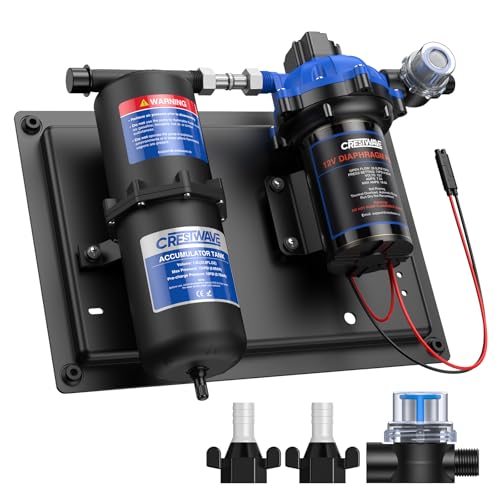
The water pump is the heart of an RV's plumbing. Every time you open a faucet or flush a toilet while off the city hookup, the pump spins up, pushes water through the lines and shuts off again when pressure is satisfied. A pump on its own does that job with a noisy, pulsing flow that cycles on and off at every drip. Add an accumulator tank and the system calms down: the tank holds a cushion of pressurized water, smooths the flow, reduces the pump's start and stop cycles and often makes a shower feel less like a series of surges.
A pump and accumulator combo is therefore a sensible upgrade for any rig, whether you are replacing a failed pump or fixing a loud, pulsing system. Buying them as a matched set saves hunting for compatible fittings, and it keeps the pump pressure and the tank rating in step. The choices that matter are simple: which power source you have, how much flow you need, what pressure your plumbing can safely take and how much noise you can tolerate under the floor or beside the bed.
We compared four sets from $99.99 to $139.99. Three come from CrestWave: a 12V 7 GPM set at $99.99, a 110V 7 GPM set at $129.99 and a quiet-documented 110V set at $139.99 that states 45 dB or less. The fourth is the SEAFLO 33-Series at $119.99, a 12V 3.0 GPM system with a 45 PSI shut-off, EPDM valves and a Santoprene diaphragm. Our research draws on the stated specifications and owner comments, and a number the listing omits is called out instead of assumed.
One caution applies before you shop. Many older RV plumbing systems, especially fittings and PEX or vinyl lines, were designed for roughly 40 to 55 PSI. A pump with a 70 PSI shut-off can exceed that rating and stress joints over time. Reading the PSI figure on the listing and matching it with your plumbing is the single most important step, far more than chasing the highest flow number.
Think also about where the pump lives. Most coaches tuck it into a basement compartment, under a dinette seat or beside the water heater, and access is often tight. A compact set with a short plumbing path is easier to install than a bigger one that needs new hose runs. Take a photo of your current pump, measure the space and count the fittings before ordering, and keep a few spare hose clamps and thread tape on hand. A weekend swap is realistic when the new set lines up with the old connections, and it becomes a frustrating project when it does not.
Our standards
Why You Can Trust RV Gear Lab
At RV Gear Lab, we compare products based on rig fit and power or hookup compatibility, verified specifications, usability, setup requirements, weight, durability, and real-world trade-offs. We do not rank products purely on marketing claims or commission rates.
We have not personally tested every product listed. Where hands-on testing is not available, recommendations are based on verified manufacturer specifications, product documentation, use-case fit, and comparative research.
How we review RV gear →