

We research everything we recommend. When you buy through our links, we may earn a commission. Learn more

Buying guide · 11 min read · Updated October 2, 2026

6 Best Budget Foldable Solar Panels in 2026: A Practical Camping Guide

Six budget foldable solar panels and kits compared by fold surface, controller, cable length and power station input limits, with where each price step leads.

Danny WalkerBy Danny WalkerCamping Editor at RV Gear Lab6 products comparedSpec-sheet researched

At a glance

Our top picks

Picture the campsite at noon. The trailer is parked under a pine, the battery bank is in the shade of the tongue box, and a foldable panel sits twenty feet away in full sun. That separation, panel in light and gear in shade, is the real selling point of a folding panel, and it is why this format outsells fixed roof panels for weekend rigs.

Foldables are not one product, though. Some surfaces are tempered glass with hinges, some are ETFE on canvas, and some listings are rigid kits with a folding label stuck on. Controller type, cable length and the power station input cap all change what a 100 or 200 watt rating is worth on the day.

We looked at six budget options and ranked them by what the listing tells a buyer about surface, regulation and wiring. Our entry pick is a 100 watt panel with a basic controller, the top of the list is a 200 watt panel with wide connector support, and each jump in price is explained by a named feature rather than a number.

RV Gear Lab field notes

The Campsite Fit Check

Start with the job
DOKIO 100W Portable Foldable Solar Panel Kit for 12V Battery Charging leads this shortlist for Weekend campers topping up a 12 volt battery with a light, standalone kit.. Use that fit as a reference point, then compare the alternatives against your own space and workload.
Specs that separate the picks
The first details to compare are 100W, folds to 19 x 26 inches, 100W tempered glass, IP68, 200W, 9.7 lb, 20 x 27 inches. Confirm the exact model and included components before ordering.
Trade-off to plan for
PWM controller wastes some energy

Before you buy

What Matters Before You Choose a Budget Foldable Solar Panel

Key buying criteria so you get the right fit the first time.

  1. 01

    Glass Face Versus ETFE Face

    Tempered glass is hard and scratch-resistant but adds weight and thickness, while ETFE is light and flexible but can mark more easily. A glass-faced folding panel survives gravel and drops better, and an ETFE panel packs thinner. The ZOUPW 100W uses 1.6 millimeter glass and the Twelseavan 200W uses ETFE. Look at the surface material and thickness in the spec bullets.

  2. 02

    Power Station Input Cap

    Most stations limit how much solar they accept, often between 100 and 400 watts, so a 200 watt panel into a station capped at 100 watts is clipped. The extra capacity is wasted rather than harmful. Check the station's maximum input in watts, volts and amps. Confirm the panel's open-circuit voltage stays below the voltage limit even in cold weather.

  3. 03

    Parallel Versus Series Wiring

    Panels wired in parallel keep the same voltage and add current, so a shaded section only trims output rather than collapsing it. Series wiring adds voltage, and shade on one cell group can drag down the whole string. The NaveiTech 200W advertises parallel wiring for partial shade. Search the listing for the word parallel or bypass diodes.

  4. 04

    Controller and Battery Match

    A PWM controller suits a 12 volt lead or lithium battery at modest wattage, while an MPPT controller recovers more from bigger arrays. A panel feeding a power station needs no external controller, because the station has one. Kits with controllers bundle the cost. Find the controller type and amp rating before comparing prices.

  5. 05

    Cable Length and Connectors

    That 9.84 foot cable lets you park the panel in sun and keep batteries in shade, where heat does less damage. Connector variety decides whether the panel plugs into your battery or station without adapters. An included multi-tip cable saves money. Confirm the plug type your equipment uses, such as XT60, Anderson or DC5521.

  6. 06

    Daily Energy Reality

    Your 200 watt panel in four hours of full sun makes roughly 800 watt-hours on paper, and losses from heat, angle and wiring trim that. That figure covers a few lights, a fan and phone charging, with a small fridge on a good day. Cloudy days can cut the total sharply. Size the panel to your daily use instead of the rating on the box.

Our standards

Why You Can Trust RV Gear Lab

At RV Gear Lab, we compare products based on campsite fit, verified specifications, usability, setup requirements, weight, durability, and real-world trade-offs. We do not rank products purely on marketing claims or commission rates.

We have not personally tested every product listed. Where hands-on testing is not available, recommendations are based on verified manufacturer specifications, product documentation, use-case fit, and comparative research.

How we review camping gear →

Detailed reviews

The 6 best budget foldable solar panels, explained

01
Best for: Weekend campers topping up a 12 volt battery with a light, standalone kit.

Our take

Anyone building a first battery charging setup at the lowest outlay finds it a sensible place to start.

Why it made the shortlist

Dokio ships this 100 watt panel with a standalone PWM controller that guards a 12 volt battery from reverse polarity, overcharge, overload and short circuits. In its folded state it measures about 19 by 26 inches and weighs roughly five to six pounds.

This entry pick on price here, it still includes dual USB ports.

A 9.84 foot cable lets the panel sit in sun while the controller stays in shade, and the USB ports run phones and lamps when attached to a battery.

Where many 100 watt kits skip the controller, this one includes it, which is the practical reason it leads the value tier.

Small campers, tents and emergency kits suit its weight and size, and the listing is candid about power station input caps of 60 watts and similar.

What works

  • Controller and USB ports included
  • Light enough to carry by hand
  • Long cable keeps gear in shade

Watch out for

  • PWM controller wastes some energy
  • One hundred watts is slow for fridges
02
Best for: Campers who want a tough glass-faced foldable that resists scratches and dents.

Our take

Buyers who expect rough handling, such as kids, dogs and gravel, get a surface built for it.

Why it made the shortlist

A 1.6 millimeter tempered glass surface gives this 100 watt foldable greater durability and impact resistance than a fabric face, and it carries an IP68 rating with 23.5 percent efficiency. Folded size is 27 by 17.9 by 1.77 inches.

It costs a bit more than the Dokio and sits in the lower middle.

Over the Dokio 100W, the step up buys glass instead of a laminate, a 20 amp PWM controller and a five-in-one cable with XT-60, Anderson, DC5521 and DC7909 ends. That plug range suits many stations and batteries.

Accessory hardware is tucked inside the fold, so check between the panels on opening.

What works

  • Glass face resists impact
  • Five-in-one connector cable
  • Controller built into the kit

Watch out for

  • Thicker fold than ETFE panels
  • Still PWM regulation
03
Best for: Owners of a 12 volt battery who want 200 watts and a controller in one carry-friendly kit.

Our take

DOKIO 200W Portable Foldable Solar Panel Kit for 12V Battery Charging is the better fit when owners of a 12 volt battery who want 200 watts and a controller in one carry-friendly kit.

Why it made the shortlist

This 200 watt kit weighs 9.7 pounds and folds to 20 by 27 by 1.1 inches, with a standalone PWM controller and dual USB ports. Mid-pack on price, it gives the lowest cost per watt in the group.

A 9.84 foot cable keeps the controller in shade.

A 12 volt battery bank is the natural partner, since the PWM controller is built for that voltage.

What works

  • Controller and USB ports included
  • Light for a 200 watt panel
  • Clear guidance on input caps

Watch out for

  • PWM leaves some power unused
  • Needs a 12 volt battery to shine
04
Best for: Campers parked under trees who want parallel wiring that survives partial shade.

Our take

Owners of power stations who camp in imperfect light are the ideal buyers.

Why it made the shortlist

A parallel wiring design lets this 200 watt panel keep producing when part of it is shaded by branches or clouds. A 25 percent A+ monocrystalline cell rating, 12.69 pounds of weight and sturdy kickstands round out the package.

On price, this pick sits in the upper middle on price.

Beside the Dokio 200W, the step up buys that shade-tolerant wiring and a higher efficiency claim, aimed at power stations rather than 12 volt batteries. An IP65 rating and a hail-resistant face handle rain and snow.

Tree-lined campsites and partly cloudy trips show off the design best.

What works

  • Parallel wiring tolerates partial shade
  • Strong efficiency claim
  • Sturdy kickstands for tilt
  • Rain and hail resistant face

Watch out for

  • No controller in the kit
  • Costs above the Dokio 200W
05
Best for: Buyers comparing capacity, compatibility, included components and storage needs

Our take

Whoever wants a fixed array on a camper, golf cart or marine project instead of a portable panel finds a complete package.

Why it made the shortlist

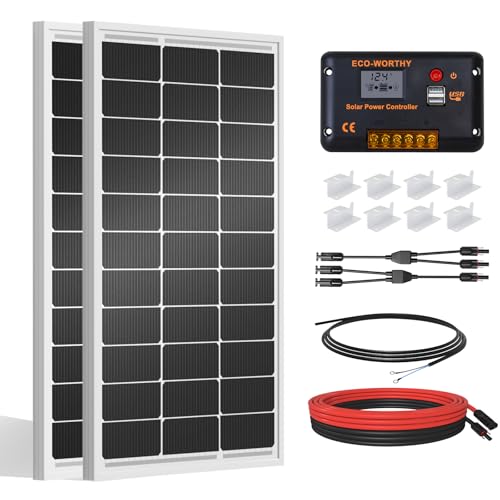
ECO-WORTHY supplies two rigid monocrystalline panels with a 30 amp PWM controller, wired in series for 24 volts or parallel for 12 volts. The listing quotes about 800 watt-hours a day under four hours of full sun.

Alongside the foldables, the step up buys a corrosion-resistant aluminum frame rated for 2400 pascal wind and 5400 pascal snow loads, pre-drilled mounting holes and plug-and-play cables.

A one-year warranty comes with 24/7 tech support through Amazon or a hotline.

What works

  • Complete kit with controller
  • Rated for strong wind and snow
  • Flexible 12 or 24 volt wiring
  • Pre-drilled frames and cables

Watch out for

  • Not foldable or portable
  • Short one year warranty
06
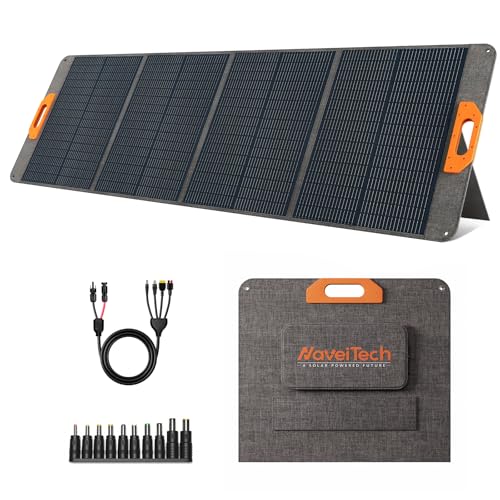
Best for: Power station owners who want MC4 plus USB-C 60W and a magnetic carry handle.

Our take

Buyers with a branded station and a laptop who want one panel for both are the best fit.

Why it made the shortlist

An eight-in-one adapter set, five MC4-style ends plus three DC adapters, gives this 200 watt panel the widest compatibility in the guide. A 60 watt USB-C port, an 18 watt QC3.0 port and a 5 volt 3 amp USB port serve gadgets directly.

Relative to the rest it is the most expensive pick here.

Over the NaveiTech 200W, the step up buys USB-C power delivery for laptops and a magnetic carry handle with four adjustable support angles. Cells are A+ grade monocrystalline at a 24 percent rating.

The weight is 15.7 pounds and the fold is 23 by 22 inches.

A polyester canvas back resists wear and dust, and ETFE faces the sun.

What works

  • Widest connector support here
  • USB-C 60W charges laptops
  • Magnetic handle and four angles
  • High rated cell efficiency

Watch out for

  • Most expensive in this guide
  • Heaviest foldable at 15.7 pounds

Methodology

How We Built This Shortlist

Each pick was assessed across 5 criteria weighted for real-world use.

01

Fold surface and build

We noted whether each panel uses glass, ETFE or a fixed aluminum frame, and any ingress rating. Glass resists scratches while ETFE saves weight. The build tells you how the panel will age after a few seasons of use.

02

Regulation included

A controller in the box changes the total cost of getting power into a battery. We marked each listing for PWM versus none and any stated amp rating. Kits that tell buyers how to pair with a power station got extra credit.

03

Cable and placement

Cable length decides whether the panel can sit in sun while the gear stays in shade. We compared listed cable lengths and connector ranges. A long cable and adapters saved buyers an extra purchase.

04

Weight and fold

Pounds and folded dimensions were compared per wattage. Each 200 watt panel at under ten pounds is easier to haul than one near sixteen. Handles and kickstands counted toward usability.

05

Position on price

We placed each pick relative to the rest and named what the step up buys, such as glass, parallel wiring, a rigid frame or USB-C. Picks that could not explain their position ranked lower.

Decision guide

Match a Budget Foldable Solar Panel to Your Camp Setup

By Size of Battery or Station

Match panel watts to what it will charge.

Battery or stationBest pickWhy
Small 12 volt battery top-upDokio 100WLight kit with controller
Rough-use camping batteryZOUPW 100WGlass face and IP68
12 volt RV or van batteryDokio 200W200 watts with controller at the lowest cost per watt
Station that takes 200 watts or moreNaveiTech 200WParallel wiring for shade
Station plus laptopTwelseavan 200WUSB-C 60W and wide connectors

By Budget

Price bands are relative to this shortlist.

BandPickWhat you get
Entry of this shortlistDokio 100WA controller and USB for the lowest spend
LowZOUPW 100WGlass face and a five-in-one cable
MidDokio 200WTwice the wattage with a controller
Upper-midNaveiTech 200WShade-tolerant wiring and a higher efficiency claim
TopTwelseavan 200WUSB-C 60W and the widest connector set

Folding Panel vs Fixed Rigid Kit

Portability and permanence pull in opposite directions.

Folding panel

Dokio 100W, Dokio 200W, NaveiTech 200W and Twelseavan 200W go where the sun is and tuck away for travel.

Fixed rigid kit

ECO-WORTHY 200W bolts on, takes harsh wind and snow, and runs without setup each day.

If you camp in one spot all season, ECO-WORTHY 200W is the durable choice.

By Shade and Light Conditions

Light quality varies, so pick for the site.

SitePickReason
Open desert sunDokio 200WStraightforward 200 watts and a long cable
Tree-lined campsiteNaveiTech 200WParallel wiring tolerates shade
Rough, rocky groundZOUPW 100WTempered glass face
Fixed site, all weatherECO-WORTHY 200WRated for wind and snow

For Weekend Camping Specifically

Short trips favor simple, light kits.

Look for

Light weight, a controller in the box and a cable long enough to separate panel from gear.

In this comparison

Dokio 100W and Dokio 200W match the brief, with ZOUPW 100W for tougher handling.

When to Spend More

Spend only where a feature changes your day.

Spend more if

You own a station and a laptop, which suits Twelseavan 200W, or camp in shade, which suits NaveiTech 200W.

Save if

You keep a 12 volt battery topped off, in which case Dokio 100W or Dokio 200W does the job.

FAQ

Before You Bring One Home

Do foldable panels need a charge controller?

If they charge a 12 volt battery directly, yes. The Dokio and ZOUPW kits include a PWM controller. Any power station already has its own controller, so a panel like the Twelseavan 200W plugs in without one. Match the setup to your equipment.

Why does my 200 watt panel only give 100 watts?

Some power stations cap their solar input. Even in full sun, the panel cannot exceed that cap. Heat, angle and cloud also trim output. Check the station's maximum input before buying a larger panel.

Is a glass foldable better than an ETFE one?

Glass resists scratches and impacts, so it suits rough handling. ETFE panels are lighter and thinner. Choose ZOUPW 100W for durability and an ETFE panel such as Twelseavan 200W for weight.

Can I use a foldable panel to charge my RV battery directly?

Yes, with a controller between the panel and battery. The Dokio 200W includes one and its cable lets the controller stay in shade. Observe polarity when clipping to the battery. Disconnect the panel before changing wiring.

Is the rigid ECO-WORTHY kit really a foldable alternative?

It solves the same job differently. It is a fixed array with a frame rated for wind and snow, not a carry-away panel. If you do not need to move it, it can be the sturdier long-term choice.

How many hours does a 200 watt panel need to charge a battery?

A figure of about 800 watt-hours per day under four hours of full sun appears in one listing. Real results are usually lower because of heat and angle. Divide your battery's watt-hours by the daily harvest for a rough estimate.

Bottom line

The short version

Browse more budget foldable solar panels on Amazon →
Danny Walker, Camping Editor at RV Gear Lab

About the author

Danny Walker

Camping Editor at RV Gear Lab

Danny covers camping gear, campsite setup, outdoor power, sleep systems and practical camping advice, with a focus on helping campers make better gear decisions.

More from Danny →Editorial standards

Keep reading

Related guides