

We research everything we recommend. When you buy through our links, we may earn a commission. Learn more

Buying guide · 11 min read · Updated October 2, 2026

6 Best Budget Foldable Solar Panels with USB Ports in 2026: A Practical Camping Guide

Six foldable solar chargers with built-in USB ports compared on port wattage, fold size and weatherproofing, for charging phones and laptops from the sun.

Danny WalkerBy Danny WalkerCamping Editor at RV Gear Lab6 products comparedSpec-sheet researched

At a glance

Our top picks

Built-in USB ports change what a folding panel is for. Instead of feeding a battery through MC4 plugs and a controller, the panel hands current directly to a phone, a tablet or a headlamp, with a small regulator in the junction box doing the safety work.

That convenience hides a mismatch many buyers miss. A 200 watt panel with a couple of 18 watt ports can only deliver those few watts to a device, and the rest of its capacity waits behind the MC4 jack for a power station. Port wattage and panel wattage are two separate numbers on the same listing.

We compared six options along that split, from a pocket panel to a boxed solar system that mostly leaves USB behind. Prices are described by rank within the group. The cheapest item is a pocket-sized sun charger, mid-pack pieces add laptop-level power delivery, and the top slot is a complete off-grid kit with an inverter.

RV Gear Lab field notes

The Campsite Fit Check

Start with the job
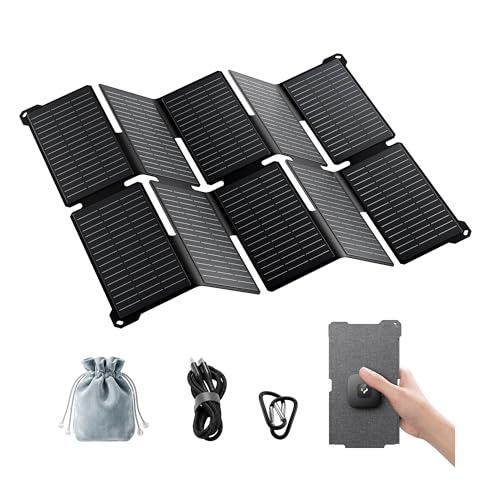
Holdwell S 30W Portable Solar Panel, Foldable ETFE, USB-C and QC3.0, IP65 leads this shortlist for Day hikers and campers who want a pocket-weight panel that charges a phone from the sun.. Use that fit as a reference point, then compare the alternatives against your own space and workload.
Specs that separate the picks
The first details to compare are 30W, 1.5 lb, IP65 ETFE, 35W combined USB output, 100W, USB-C PD 65W. Confirm the exact model and included components before ordering.
Trade-off to plan for
Thirty watts is slow for tablets

Before you buy

What Matters Before You Choose a Budget Foldable Solar Panel with USB Ports

Key buying criteria so you get the right fit the first time.

  1. 01

    USB Output Wattage Versus Panel Wattage

    A panel's headline wattage is its solar capacity, while the USB ports have their own limit and can be far lower. Any 200 watt panel may still deliver only a few tens of watts through USB, with the rest used through MC4. A phone-class charger needs 18 watts or so, and a laptop needs 45 to 65 watts. Find the USB port wattage in the spec list rather than inferring it from the panel size.

  2. 02

    Power Delivery Versus Quick Charge

    USB-C Power Delivery negotiates higher voltages for laptops and tablets, while QC3.0 is a faster phone standard on USB-A ports. A panel with only basic USB-A will charge a laptop very slowly or not at all. The MESUVIDA 100W lists a 65 watt PD port, which can top up a MacBook Air. Confirm the protocol name beside each port.

  3. 03

    Cloud and Shade Behavior

    A solar USB charger that drops out when a cloud passes can stop charging your device and need a manual restart. Auto-restart and smart chips help recover when light returns. Direct USB charging is more sensitive to dips than a battery buffer. Seek a mention of auto-reboot or constant-current regulation before buying.

  4. 04

    Fold Size and Pack Weight

    A 1.5 pound pocket panel travels everywhere but charges slowly, while a 14 pound six-fold panel collects serious power but belongs in a vehicle. The best panel is the one you will bring. Match the folded size to your bag or storage bay. Measure the stated folded dimensions against your pack.

  5. 05

    Ingress Rating Detail

    IP68 means sealed against dust and submersion, IP65 resists jets of water and IPX4 only handles splashes. A panel that rides outside a pack in rain should carry at least IP65. Stating where the rating applies matters, since a junction box rating is not the same as a whole panel. Read whether the figure refers to the surface or the box.

  6. 06

    Conversion Efficiency Claims

    Efficiency describes how much sunlight becomes electricity per area, and a few points of difference give a few more watts in the same footprint. Claims from 15 percent to 26 percent appear in this guide, so they are not equal. Real output is lower than rated in most conditions. Treat the number as a tie-breaker, and compare output per folded area instead.

Our standards

Why You Can Trust RV Gear Lab

At RV Gear Lab, we compare products based on campsite fit, verified specifications, usability, setup requirements, weight, durability, and real-world trade-offs. We do not rank products purely on marketing claims or commission rates.

We have not personally tested every product listed. Where hands-on testing is not available, recommendations are based on verified manufacturer specifications, product documentation, use-case fit, and comparative research.

How we review camping gear →

Detailed reviews

The 6 best budget foldable solar panels with usb ports, explained

01
Best for: Day hikers and campers who want a pocket-weight panel that charges a phone from the sun.

Our take

Weekend walkers and kayakers wanting the least spend for real solar phone charging will find it a clean fit.

Why it made the shortlist

Holdwell uses grid-free HPBC monocrystalline cells at a stated 24 percent efficiency, laminated under a four-fold ETFE face. Among these picks it is the entry pick here on price, and it weighs 1.5 pounds.

Opened it spans about 31 inches, and it folds down to 9.4 by 7.5 inches.

Three outputs cover a phone, a tablet and a headlamp at once: a 30 watt USB-C port at 12 volts and 2.5 amps, a QC3.0 USB-A and a standard USB-A. The listing says no charge controller is needed for direct USB use.

Four carabiners and a cable ship in the box.

An IP65 seal and a scratch-resistant surface let it ride on the outside of a pack through a trail day.

What works

  • Pocket-weight at 1.5 pounds
  • Direct USB, no controller needed
  • Carabiners included for pack mounting
  • Efficient HPBC cells with ETFE face

Watch out for

  • Thirty watts is slow for tablets
  • No MC4 output for stations
02
GEYOTO 35W Solar Charger 26% High Efficiency USB-A and USB-C
  • 35W combined USB output
  • 26% cells, IP68 laminate
  • 1.54 lb, 4.76 x 8.29 in folded
Check price on Amazon for GEYOTO 35W Solar Charger 26% High Efficiency USB-A and USB-C (opens in a new tab)
Best for: Travelers wanting a rugged IP68 panel that charges two devices at once from a bag.

Our take

One person with a phone and a power bank gets all the sunlight charging they need from it.

Why it made the shortlist

GEYOTO states a 26 percent conversion rate from monocrystalline cells and a 35 watt combined output through one USB-C and one USB-A port. Folded it measures 4.76 by 8.29 by 1.57 inches and weighs 1.54 pounds.

It sits second from the bottom on price.

Beyond the Holdwell 30W, the step up buys a higher efficiency claim, an IP68 laminated surface rated for water and dust, and a few more watts to share across two ports.

Automotive-inspired safety standards are cited for the engineering.

Camping, travel and an emergency kit are named uses, and the pocket size means it stays in the bag by default.

What works

  • Highest efficiency claim in this guide
  • Two ports charge two devices
  • Fits in a jacket pocket

Watch out for

  • Still a slow charger for laptops
  • No MC4 output for stations
03
Best for: Campers who want laptop-speed USB-C charging and MC4 output for a power station.

Our take

Buyers who want a single do-it-all foldable at a modest spend choose this one.

Why it made the shortlist

Five ports sit on this 100 watt panel: MC4 at 24 volts, a DC jack, two USB-A and a USB-C with 65 watt power delivery. A stated 24 percent A+ monocrystalline cell efficiency backs the rating.

It lands mid-pack on price, in the lower middle of the list.

Ahead of the GEYOTO 35W, the step up buys a USB-C port quick enough for a MacBook Air, a handle, an adjustable kickstand and the MC4 cable for power stations. The cable supports parallel or series connection with more panels.

When folded it measures about 22.8 by 19.7 inches and weighs 7.5 pounds.

Wide compatibility means one panel serves both the laptop on a camp table and the station in the tent, with no case needed to carry it.

What works

  • Laptop-speed 65W USB-C output
  • MC4 output feeds power stations
  • Built-in kickstand and handle
  • Parallel or series expandable

Watch out for

  • Bulkier than pocket panels
04
Best for: RV campers pairing a power station with a six-fold panel that also has USB and 12 volt ports.

Our take

Camper owners wanting one panel for both gadgets and a station get the most flexibility here.

Why it made the shortlist

Rated at 200 watts, this six-fold panel carries a stated 23 percent efficiency, USB-A, a Type-C PD port, a QC3.0 port, XT60 and MC4 outputs. It weighs 13.89 pounds and folds to 19.5 by 16 inches.

It sits in the upper third on price.

An adjustable kickstand sets the tilt, and an auto-reboot feature recovers after clouds pass.

IP65 sealing and an intelligent protection chip are listed.

Solar by day and battery by night is the pitch, with the USB ports covering small devices while MC4 fills a station.

What works

  • Most output of the folding panels
  • Auto-reboot after passing shade
  • XT60 port for 12V battery packs
  • Folds to laptop-bag size

Watch out for

  • Costs well above the small chargers
  • Weighs nearly 14 pounds
05
Best for: Beginners who want a station, a 60 watt folding panel and AC outlets together.

Our take

First-time solar buyers who want everything in one purchase will like the simplicity.

Why it made the shortlist

Takki bundles a 277.5 watt-hour power station with a 60 watt foldable panel rated up to 23 percent efficiency. The panel comes with ten different DC connectors for broad compatibility.

It sits near the top on price because it includes the battery.

Past the standalone panels, the step up buys storage, an AC outlet with 250 watts running and 450 watts peak, two QC 3.0 USB ports and further USB outputs, for eight ports in total.

Pure sine wave AC supports laptops and small appliances.

A two-level camping light is built in, and the station works for outages as well as camp trips.

What works

  • Station and panel in one kit
  • Pure sine wave AC outlet
  • Ten connector tips included
  • Built-in camp light

Watch out for

  • Panel is slow to refill the battery
06
Best for: DIY builders who want a panel, 50 amp controller and inverter in one box for a 12 volt battery.

Our take

Tinkerers who already own a 12 volt battery and want everything else in one package find it convenient.

Why it made the shortlist

This boxed system couples a 100 watt folding panel of low-iron tempered glass with a 12 volt 50 amp charge controller, an LED display and a modified wave inverter.

A cooling fan and built-in fuses protect the converter.

Beyond the Takki 277Wh, the step up buys a controller sized for a real battery bank and an inverter rated far above the panel. The controller adds two USB ports at up to 2.1 amps each for phones.

What works

  • Controller and inverter in the box
  • Glass panel with folding design
  • Two USB ports on the controller
  • Built-in fuses and cooling fan

Watch out for

  • Efficiency stated is low at 15 percent
  • Modified wave inverter is rough on electronics
The catch
In this shortlist it is the most expensive pick in this guide, and the only one built as a full off-grid system.

Methodology

How We Built This Shortlist

Each pick was assessed across 5 criteria weighted for real-world use.

01

Port wattage

We read the port list and rated wattage of each USB output, since that sets how quickly a phone or laptop charges. A panel with 65 watt power delivery is a different tool from one with a modest 2.1 amp port. We treated panel wattage and port wattage as separate scores.

02

Direct use versus station feed

Some picks charge devices directly, some feed power stations through MC4 and some do both. We checked which connectors each panel offers. Broad connector choice scored higher for buyers who might add a station later.

03

Fold size and carry weight

We compared folded dimensions and pounds, because a panel that stays in the bag gets used. Pocket-size pieces and laptop-bag-size pieces serve different people. Handles, carabiners and kickstands counted in the portability score.

04

Weather and surface

IP rating and surface material were noted from each listing. IP68 and IP65 mean more than an IPX4 splash rating. A laminated or ETFE face scored higher than a bare fabric panel.

05

Position on price

We placed each pick relative to the group and asked what the step up buys. Efficiency, port power, panel area, a battery or a full inverter each earned a different jump. A pick that could not justify its step ranked lower.

Decision guide

Match a Budget Foldable Solar Panel with USB Ports to Your Camp Setup

By What You Are Charging

The device on the other end of the cable picks the panel.

DeviceBest pickWhy
A phone and a headlampHoldwell 30WUSB-C plus QC3.0 in 1.5 pounds
Two small devices on a packGEYOTO 35WIP68 and 35 watts shared
A laptop and a phoneMESUVIDA 100W65 watt PD USB-C
A power station plus gadgetsCTOLITY 200WMC4, XT60 and USB together
A battery plus an inverterComplete Inverter KitController and inverter in the box

By Budget

These bands are relative to the shortlist.

BandPickWhat you get
Entry of this shortlistHoldwell 30WA pocket panel with direct USB
LowGEYOTO 35WIP68 and a higher efficiency claim
MidMESUVIDA 100WLaptop power delivery and MC4
UpperCTOLITY 200WTwice the panel area and XT60
TopComplete Inverter KitA full off-grid kit with an inverter

Direct USB Panel vs Panel plus Station

A direct-USB panel is simple, and a station adds a battery buffer.

Direct USB panel

Holdwell 30W, GEYOTO 35W and MESUVIDA 100W charge devices straight from the sun. They stop when the sun does.

Panel plus station

Takki 277Wh and CTOLITY 200W store energy or feed one, so you can charge at night.

For day trips choose MESUVIDA 100W, for nights choose Takki 277Wh.

By Weather Exposure

Wet trips need a higher ingress rating.

ConditionsPickReason
Rain on a hikeGEYOTO 35WIP68 laminated surface
Splashes at campMESUVIDA 100WIPX4 and a kickstand
Dust and windHoldwell 30WIP65 sealed ETFE face
Left on a campsiteCTOLITY 200WIP65 with auto-reboot

For Backpacking Specifically

Weight and pocket size lead the decision.

Look for

Under two pounds, a waterproof face and an attachment point for a pack.

In this comparison

Holdwell 30W and GEYOTO 35W both qualify, and GEYOTO 35W adds IP68 sealing.

When to Spend More

Climb the list only when you have the load to justify it.

Spend more if

You charge laptops or run a station, so MESUVIDA 100W or CTOLITY 200W pays back.

Save if

You only charge a phone, where Holdwell 30W or GEYOTO 35W is enough.

FAQ

Before You Bring One Home

Can a foldable USB solar panel charge a laptop?

Only if it has a USB-C Power Delivery port with enough watts. The MESUVIDA 100W lists 65 watt PD, which can charge a thin laptop. The small panels top out near 30 watts and will charge a laptop slowly. Sunlight and shade also limit output.

Why does my phone keep stopping on solar?

Clouds and shade drop the panel output below what the charger needs, and some panels do not resume on their own. Panels with auto-restart recover better. Plugging a power bank in between smooths the supply. Position the panel square to the sun.

Do I need a charge controller with these panels?

Not for direct USB use, since the junction box includes regulation. A panel feeding a battery through MC4 needs the controller built into a power station or a separate one. The Complete Inverter Kit includes a 50 amp controller. Use the controller that matches your battery.

Is the 200 watt panel worth it over the 100 watt one?

If you have a power station that accepts 200 watts, yes, since charge time drops sharply. For USB gadgets alone, the extra capacity goes unused. The CTOLITY 200W also weighs close to 14 pounds. Choose by what you plug it into.

What does IPX4 really protect against?

IPX4 covers splashing water from any direction, not heavy rain jets or immersion. MESUVIDA 100W is rated this way, so keep it from sitting in a puddle. IP65 and IP68 panels like the Holdwell 30W and GEYOTO 35W handle more water.

Is the complete inverter kit a good deal?

It bundles a controller and inverter, so it suits a DIY 12 volt battery build. The panel is only 100 watts, and the modified wave inverter can be rough on sensitive electronics. For gadgets alone it is overkill.

Bottom line

The short version

Browse more budget foldable solar panels with usb ports on Amazon →
Danny Walker, Camping Editor at RV Gear Lab

About the author

Danny Walker

Camping Editor at RV Gear Lab

Danny covers camping gear, campsite setup, outdoor power, sleep systems and practical camping advice, with a focus on helping campers make better gear decisions.

More from Danny →Editorial standards

Keep reading

Related guides