

We research everything we recommend. When you buy through our links, we may earn a commission. Learn more

Buying guide · 11 min read · Updated October 2, 2026

6 Best Budget LiFePO4 Camping Batteries in 2026: A Practical Camping Guide

Six budget LiFePO4 batteries for camping, from 10Ah gadget packs to 150Ah RV-class units, compared by BMS rating, cold charging, weight and size.

Danny WalkerBy Danny WalkerCamping Editor at RV Gear Lab6 products comparedSpec-sheet researched

At a glance

Our top picks

At a glance · 6 picks

Camping changes what a lithium iron phosphate battery has to do. A van or trailer wants a 100Ah or larger battery that runs lights, a pump and a fan for days. A tent camper wants a 10Ah or 20Ah pack that powers a fish finder, a lantern, a CPAP or a radio and fits in a daypack. Both are sold as 12V LiFePO4, and the label hides how different the jobs are. Matching the battery to the trip saves both money and weight. A tent camper and a van camper share a chemistry but little else about what they need.

Two numbers decide most of the buying. The first is capacity, which sets how long loads run: amp-hours multiplied by about 12.8 volts gives the watt-hours, so a 100Ah battery holds roughly 1,280Wh and a 12Ah battery holds about a tenth of that. The second is the BMS continuous amp rating, which sets what the battery can actually run, since a pack with a 10A BMS will trip long before a 100A one. Neither number appears on the front of the box, so look in the listing. These are the figures to find first.

Cycle counts need the same care. Listings quote anything from 3,000 to 15,000 cycles, and the figures are only comparable at the same depth of discharge. This guide ranks six budget batteries by capacity, BMS rating, cold-weather behavior, weight and size, and each entry says which kind of camper it fits and which jobs it will not manage. The goal is to match the right battery to the right camp. We rank each pick from its stated specs, and we do not print prices because they change daily. A short comparison of weight and cold limits follows for each battery, so you can pair the pack with your trip.

RV Gear Lab field notes

The Campsite Fit Check

Start with the job
SUPER EMPOWER 12V 100Ah LiFePO4 Battery Group 24 Deep Cycle for RVs and Trolling Motors 1280Wh Capacity 100A BMS Low-Temp Cutoff leads this shortlist for Van and trailer campers who want a drop-in Group 24 battery with clear cold limits.. Use that fit as a reference point, then compare the alternatives against your own space and workload.
Specs that separate the picks
The first details to compare are 12.8V 100Ah, 1,280Wh, 12V 150Ah, 1,920Wh. Confirm the exact model and included components before ordering.
Trade-off to plan for
Charging pauses below freezing

Before you buy

What Matters Before You Choose a Budget LiFePO4 Camping Battery

Key buying criteria so you get the right fit the first time.

  1. 01

    Capacity in amp-hours and watt-hours

    Amp-hours tell you how much charge a battery holds, and multiplying by the nominal voltage of about 12.8V gives watt-hours, the figure that compares with your loads. A 100Ah battery holds about 1,280Wh, enough for lights, a pump and a laptop for a weekend, while a 10Ah battery holds roughly a tenth of that. List your devices' watt draw and the hours you run them, then add them up. Choose a battery that covers a day or two of that total.

  2. 02

    BMS continuous amp rating

    The battery management system protects the cells and sets the maximum current the battery can deliver. With 100A on offer, a large inverter or compressor fridge is within reach, while a 10A BMS suits lights and a fish finder. Peak ratings last only seconds, so look for the continuous number in the listing. If a listing does not state the rating, assume a modest one and ask before buying.

  3. 03

    Cycle life and depth of discharge

    Cycle counts are comparable only at the same depth of discharge, and some brands quote cycles at partial depth, which inflates the figure. LiFePO4 is commonly rated around 3,000 to 4,000 cycles to 80 percent capacity, and claims of 15,000 cycles are far above that range. Scan for the depth of discharge next to any cycle number. Treat the biggest claims as marketing and rely on chemistry and BMS quality.

  4. 04

    Cold charging and temperature limits

    Lithium iron phosphate cells can be damaged by charging below freezing, so a good battery blocks charging in the cold. Listings that state a charge range, such as 0 to 45 degrees Celsius, and a discharge range tell you when the battery will work. If you camp in winter, look for low-temperature protection or a heater, and plan to keep the battery inside the cab or camper. A battery kept inside the heated cab or camper sidesteps the problem.

  5. 05

    Size, weight and terminals

    Group 24 and Group 31 are standard case sizes, and a battery that matches yours drops into an existing tray and cables. Weight matters on a trailer tongue or a truck bed, and a 20 pound battery is far easier than a 41 pound one. Terminal type decides which cable lugs you need, and M8 is common on larger packs. Compare the dimensions in the listing against your compartment.

  6. 06

    Expansion and charging compatibility

    Many LiFePO4 batteries support series and parallel connection, and the listing states how many you can link. Charging needs a lithium-compatible charger or a solar controller with a lithium mode, since lead-acid profiles can undercharge or stress the cells. A charge profile of about 14.4 to 14.6V is typical. Check both before you buy, and use matched batteries when you link them.

Our standards

Why You Can Trust RV Gear Lab

At RV Gear Lab, we compare products based on campsite fit, verified specifications, usability, setup requirements, weight, durability, and real-world trade-offs. We do not rank products purely on marketing claims or commission rates.

We have not personally tested every product listed. Where hands-on testing is not available, recommendations are based on verified manufacturer specifications, product documentation, use-case fit, and comparative research.

How we review camping gear →

Detailed reviews

The 6 best budget lifepo4 camping batteries, explained

01
Best for: Van and trailer campers who want a drop-in Group 24 battery with clear cold limits.

Our take

It leads the guide because capacity, a 100A BMS, familiar dimensions and published cold limits come together in one battery.

Why it made the shortlist

SUPER EMPOWER builds a 12.8V 100Ah LiFePO4 battery to BCI Group 24 dimensions, 6.49 by 10.24 by 8.98 inches, at 21.6 pounds with M8 terminals. That makes it a direct drop-in for the lead-acid battery in many campers, and 1,280Wh of capacity is enough for lights, a pump, a fan and a laptop through a weekend.

Continuous load falls to a 100A BMS, and the listing spells out cold behavior with unusual precision: charging pauses below 0 degrees Celsius and discharge stops at minus 20 degrees, with resumption above 5 degrees. A 12V LiFePO4 charger profile of 14.4 to 14.6V is specified, and solar MPPT or PWM controllers can be set to lithium mode. The charge profile guidance makes it simple to pair with a solar controller or a shore charger.

Up to four in series or parallel scale the system to 20.48kWh, which suits a camper who expects to grow the bank over several seasons. Series and parallel expansion leaves room to add batteries as the camper grows, up to the platform's stated 20.48kWh ceiling.

What works

  • Group 24 drop-in for lead-acid trays
  • 100A BMS runs real loads
  • Cold charging limits clearly stated
  • Expands in series or parallel

Watch out for

  • Charging pauses below freezing
02
Best for: Campers who need 100Ah in the lightest Group 24 body for a truck or small trailer.

Our take

It sits in the middle of this shortlist on price and costs less than the SUPER EMPOWER 100Ah, with the savings coming from a plainer cold-weather spec sheet.

Why it made the shortlist

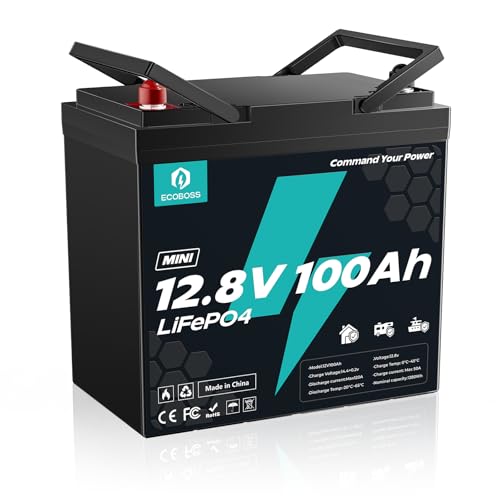
ECOBOSS weighs 20.3 pounds in a standard Group 24 size, which the listing calls 60 percent lighter than lead-acid counterparts. A 120A smart BMS protects against overcharge, over-discharge, short circuit and overheating with low-temperature protection, which gives it the highest continuous rating among the 100Ah batteries here. The standard Group 24 footprint means it drops into most existing battery trays.

Its 1,280Wh capacity matches the other 100Ah pick, and IP65 sealing guards against dust and splashes. The pack supports 4S4P expansion, up to 16 batteries to reach 51.2V and 400Ah or 20.48kWh, which signals that the BMS and cells are designed for bigger banks. The sealed case also resists the dust of a gravel road.

Truck campers and small trailers that count every pound of tongue weight will value the highest BMS rating at this size. It is also a sound base for building a larger bank later.

What works

  • Lightest 100Ah battery in this guide
  • 120A BMS, highest at this capacity
  • IP65 sealed case
  • Supports 4S4P expansion

Watch out for

  • 15,000 cycle claim lacks a stated depth of discharge
  • Cold limits are not spelled out
03
Best for: Full-time and long-stay campers needing 1,920Wh in a Group 31 body.

Our take

At the top of this shortlist on price, it delivers the most capacity per battery, so a single unit covers what two small batteries would.

Why it made the shortlist

DUMFUME stores 1,920Wh in a Group 31 body measuring 10.04 by 7.68 by 9.84 inches and weighing 41.03 pounds. That is 50 percent more capacity than a 100Ah battery in a case you can still lift, which suits a camper whose daily loads include a compressor fridge, lights and device charging. The Group 31 size is a familiar fit for deep-cycle battery compartments.

IP65 sealing, a 100A BMS and low-temperature protection guard the cells, and the battery supports series and parallel connection up to 4S4P. The listing describes operation across a wide temperature range and a long cycle life, backed by the cell chemistry. Together those features make it a dependable house battery. The BMS shields the cells from overcharge, deep discharge and short circuits, which is the main reason to buy lithium over a plain cell.

One larger battery in place of two paralleled ones means less cabling and a short list of connections to manage. That also means one set of terminals to inspect instead of two.

What works

  • 1,920Wh in a single battery
  • 100A BMS with low-temp protection
  • IP65 sealed case
  • Supports series and parallel expansion

Watch out for

  • 41 pounds needs a secure mount
  • Cycle claim lacks a stated depth of discharge
04
Best for: Tent and car campers running a radio, lights or a fish finder.

Our take

It sits in the lower middle of the price ladder and doubles the capacity of each 10Ah pack in this guide.

Why it made the shortlist

ECO-WORTHY packs 20Ah into a battery weighing 4.85 pounds, light enough to carry in a daypack or kayak hatch. The listing quotes more than 3,000 deep cycles and a built-in BMS that guards against overcharge, over-discharge and short circuit and balances the cells. It carries easily to a campsite or a boat ramp. Neat and compact, it carries gear easily.

Up to four identical batteries can be connected in series or parallel, which turns a small pack into a modest bank for a ham radio, LED lighting or a fish finder. The size and weight make it a sensible stand-in for a sealed lead-acid battery in lighting and electronics projects. The BMS keeps the cells in balance as they cycle. Wiring several in parallel lengthens the runtime without changing the chemistry.

A long weekend of low-draw gear is covered without moving up to a 100Ah battery. It also costs less than any of the 100Ah batteries. It pairs well with a small solar panel and charges quickly from a matched lithium charger.

What works

  • Light enough for a daypack
  • Cell-balancing BMS built in
  • Expands up to four batteries
  • Suits radios, lights and fish finders

Watch out for

  • Too small for a fridge or CPAP all week
05
Best for: Campers wanting two small packs for lights, a fish finder or a backup radio.

Our take

Near the entry end of this shortlist, the two-pack makes the cost per battery low.

Why it made the shortlist

KUNLUN ships two 12V 10Ah batteries in one box, each with a 10A built-in BMS, 10A continuous discharge and a 20A peak for five seconds. Automotive-grade cells carry a stated 5,000 deep cycles, and the IP67 rating suits a boat, a kayak or a tent porch in the rain. Together they hold roughly 256Wh of energy. Each pack carries its own protection circuit.

A smart low-temperature cutoff gives specific limits: charging between 0 and 45 degrees Celsius and discharging between minus 20 and 60 degrees. Two packs let you run one while the other charges, or wire them in series or parallel for higher voltage or capacity. The printed ranges make planning simple. Each pack stays inside its own temperature window. Swapping between them keeps small gear running.

Small, steady loads such as a lantern, a fish finder or a radio suit it, and a spare pack in the bag adds comfort. That pairs well with a small solar charger for a long weekend. Spare capacity is a comfort on remote trips.

What works

  • Two batteries in one box
  • Stated charge and discharge temperatures
  • Series or parallel expansion

Watch out for

  • 10A BMS limits what it can run
  • Small capacity for long trips
06
Best for: Budget campers powering lights, a radio or small 12V gadgets.

Our take

At the entry end of the shortlist and far cheaper than the 100Ah batteries, it earns a place as the lowest-cost way into LiFePO4 for camping.

Why it made the shortlist

GOLDENMATE delivers 12Ah in a lightweight IP67-rated pack with a smart BMS and a stated 5,000 cycles. Capacity of 12Ah at 12.8V is roughly 154Wh, which runs LED lights, a small radio or a USB-fed set of devices through an evening. It fits easily in a pack or a boat locker. It makes a good first lithium battery.

The listing says it recharges from a LiFePO4-compatible charger, an MPPT solar controller or a generator system, and it supports series and parallel connection for custom voltages or capacities. The sealed IP67 build handles damp tents, boat decks and trail use. It simply needs a lithium-compatible source to recharge. Simple to live with, it needs little attention.

Light, tough and sized for small gear, it leaves room to grow later. Its small size keeps the whole kit light. It is also light enough to carry in one hand.

What works

  • Light enough for a daypack
  • Charges from solar or a generator

Watch out for

  • Capacity suits small loads only

Methodology

How We Built This Shortlist

Each pick was assessed across 5 criteria weighted for real-world use.

01

Capacity and real runtime

We converted each battery's amp-hours to watt-hours using the listed nominal voltage, then matched that to camping loads. A 100Ah battery and a 10Ah battery do different jobs, so we ranked within the job as well as across the shortlist. Runtime depends on your loads, so we do not quote hours.

02

BMS rating and what it can run

We read the stated BMS continuous and peak amp ratings. The BMS limit decides the largest load the battery can serve, and a 10A unit trips on loads a 100A unit handles easily. Listings that omit the rating were marked as such, and cycle claims were treated with the depth-of-discharge caveat in mind.

03

Cold and temperature limits

We looked for stated charge and discharge temperature ranges and low-temperature cutoffs. Lithium iron phosphate cells should not be charged below freezing, so a battery that states its limits is easier to plan around. These are listing claims, not measured values.

04

Size, weight and mounting

We compared listed dimensions, weights and standard case sizes such as Group 24 and Group 31. A drop-in size spares you a new tray, and a light pack carries on a hike. Weight per amp-hour was a useful cross-check.

05

Price position and expansion

We placed each pick on a relative ladder from entry to top and asked what each step buys. Support for series and parallel expansion earned credit, since camping setups grow. We do not print prices because they change daily.

Decision guide

Match a Budget LiFePO4 Camping Battery to Your Camp Setup

By What You Will Power

Choose the battery size from the heaviest load you plan to run.

Camp loadBest matchWhy
Lights, pump and fan for a weekendSUPER EMPOWER 100Ah1,280Wh with a 100A BMS
Compressor fridge and devicesDUMFUME 150Ah1,920Wh in a single battery
Truck camper with weight limitsECOBOSS 100Ah Mini20.3 pounds with a 120A BMS
Radio, fish finder and lanternsECO-WORTHY 20AhLight pack for low-draw gear
Small gadgets and backup lightsKUNLUN 10Ah 2-PackTwo packs for steady small loads

By Budget

The ladder runs from gadget packs to RV-class batteries, and the steps are large.

Budget bandPickWhat the money buys
Entry of this shortlistGOLDENMATE 12AhThe lowest-cost IP67 LiFePO4 pack
Mid of this shortlistECO-WORTHY 20AhDouble the capacity of the 10Ah packs
Mid of this shortlistECOBOSS 100Ah Mini100Ah with a 120A BMS in a light body
Top of this shortlistSUPER EMPOWER 100AhPublished cold limits and Group 24 fit
Top of this shortlistDUMFUME 150AhThe most capacity in a single battery

Small Pack vs RV-Class Battery

The decision is between a battery you carry and one you install.

Small pack

The ECO-WORTHY 20Ah, KUNLUN 10Ah 2-Pack and GOLDENMATE 12Ah weigh little and suit tents, kayaks and gadgets. Their BMS ratings and capacities limit them to small loads.

RV-class battery

The SUPER EMPOWER 100Ah, ECOBOSS 100Ah Mini and DUMFUME 150Ah power real appliances and need a mount, cables and a proper charger. They suit vans and trailers.

Pick the SUPER EMPOWER 100Ah for a van or trailer, and the ECO-WORTHY 20Ah for tent gear.

By Cold and Temperature Needs

A second axis is where and when you camp.

ConditionBest matchWhy
Winter van campingSUPER EMPOWER 100AhCharging pauses below 0 C, discharge to minus 20 C
Cold weekends with small gearKUNLUN 10Ah 2-PackCharging from 0 to 45 C, discharge to minus 20 C
Low-temperature protection on a big packDUMFUME 150AhLow-temperature protection in the BMS
Wet camps and boatsGOLDENMATE 12AhIP67 sealed pack
Light-weight winter truck camperECOBOSS 100Ah MiniSmart BMS with low-temperature protection

For Weekend Camping Specifically

Weekend trips need enough power for two nights without a charger.

Look for

At least 100Ah if you run a pump and lights, a BMS of 100A or more for an inverter, a lithium charging setup and published temperature limits.

In this comparison

The SUPER EMPOWER 100Ah and ECOBOSS 100Ah Mini cover that need, with the ECO-WORTHY 20Ah for tent and car camping.

When to Spend More

A bigger battery buys time between charges, and it is worth it only when you use it.

Spend more if

You run a fridge, an inverter or a CPAP every night. The DUMFUME 150Ah and SUPER EMPOWER 100Ah offer the capacity and the BMS rating for that.

Save if

You power lights and a radio. The GOLDENMATE 12Ah, KUNLUN 10Ah 2-Pack or ECO-WORTHY 20Ah does that at the lowest entry cost.

FAQ

Before You Bring One Home

How big a LiFePO4 battery do I need for camping?

Add up the watt-hours your devices use per day, then choose a battery that covers a day or two of that total. A 100Ah battery holds about 1,280Wh, and a 10Ah battery holds roughly a tenth of that. Lights, a fan and a phone fit a small pack, and a fridge needs a 100Ah or larger battery.

What does the BMS amp rating mean?

That figure is the continuous current the battery can deliver before the management system cuts it off. With 100A available, an inverter or a compressor will run, while a 10A BMS suits lights and small gadgets. Check the continuous figure, since peak ratings last only seconds.

Are 15,000 cycle claims believable?

Treat them with caution. LiFePO4 is commonly rated around 3,000 to 4,000 cycles to 80 percent capacity, and a 15,000 figure usually assumes shallow discharge. Seek the depth of discharge next to the number, and compare batteries at the same depth.

Can I charge LiFePO4 in freezing weather?

Not safely, since charging below 0 degrees Celsius can damage the cells. Batteries like the SUPER EMPOWER 100Ah and KUNLUN 10Ah 2-Pack state cold cutoffs, which pause charging. Keep the battery inside a heated space or use a pack with a built-in heater.

Is the SUPER EMPOWER worth it over the ECOBOSS?

Cold-weather camping, published temperature limits and a familiar Group 24 fit make the case for it. The ECOBOSS 100Ah Mini is lighter and has a 120A BMS at a lower position on the price ladder. Choose by weight and cold needs.

What charger do I need for LiFePO4?

Use a charger with a lithium profile, usually 14.4 to 14.6V, or a solar controller with a lithium mode. Lead-acid profiles can undercharge or stress the cells. Match chargers to the battery's stated charging voltage.

Bottom line

The short version

Browse more budget lifepo4 camping batteries on Amazon →
Danny Walker, Camping Editor at RV Gear Lab

About the author

Danny Walker

Camping Editor at RV Gear Lab

Danny covers camping gear, campsite setup, outdoor power, sleep systems and practical camping advice, with a focus on helping campers make better gear decisions.

More from Danny →Editorial standards

Keep reading

Related guides