

We research everything we recommend. When you buy through our links, we may earn a commission. Learn more

Buying guide · 11 min read · Updated October 2, 2026

6 Best Budget LiFePO4 Solar Generators in 2026: A Practical Camping Guide

Six budget LiFePO4 solar generators and battery kits compared by cycle life, capacity retention, outputs and what ships in the box, from camp-light to 1,000 Wh.

Danny WalkerBy Danny WalkerCamping Editor at RV Gear Lab6 products comparedSpec-sheet researched

At a glance

Our top picks

Chemistry is the whole argument for buying LiFePO4. A lithium iron phosphate cell is usually rated for thousands of full charge cycles before it falls to 70 or 80 percent of its original capacity, so a station used every weekend can still be useful a decade on. Spend a little more for it up front and the cost per cycle drops sharply.

The six options below make that claim in different ways. One listing says a battery keeps over 70 percent after 4,000 cycles, another promises 80 percent after 3,000, and a kit-style entry quotes a range of 2,500 to 7,000. Each maker defines end-of-life differently, so the numbers are not directly comparable, and we say so where it matters.

Our evaluation weighed cycle claims, capacity, outputs, recharge routes and bundled hardware. Here, the entry pick is a small camp-light station, the mid-pack includes two DIY solar and battery kits, and the most expensive pick is a 1,024 Wh unit with a 200 watt panel in the box. Positions stand in for prices.

RV Gear Lab field notes

The Campsite Fit Check

Start with the job
200W Portable Power Station, 192Wh LiFePO4 Solar Generator (Powkey) leads this shortlist for buyers comparing capacity, compatibility, included components and storage needs. Use that fit as a reference point, then compare the alternatives against your own space and workload.
Specs that separate the picks
The first details to compare are 192Wh LiFePO4, 200W AC, 12V 20Ah LiFePO4 battery, 292Wh LiFePO4, 300W AC. Confirm the exact model and included components before ordering.
Trade-off to plan for
Solar panel not included

Before you buy

What Matters Before You Choose a Budget LiFePO4 Solar Generator

Key buying criteria so you get the right fit the first time.

  1. 01

    Cycle Life and the Threshold Behind It

    A cycle is one full discharge and recharge, and makers quote how many cycles a battery survives before it drops to a set share of original capacity. One listing here says over 70 percent after 4,000 cycles, and another says at least 80 percent after 3,000. These are not the same bar, so the larger number is not automatically better. Find the capacity threshold written beside the cycle count.

  2. 02

    Depth of Discharge in the Fine Print

    A cycle rating at 80 percent depth of discharge describes a shallower use than a full 100 percent cycle. The ECI Power Kit quotes 2000 cycles at 80 percent DOD. Using only part of the battery each time usually extends its life, so a smaller battery used deeply wears faster. Read the DOD figure and size the battery for the routine, not the rating.

  3. 03

    Inverter or No Inverter

    A station has an AC inverter built in and runs household plugs, while a 12 volt kit delivers DC and needs your own inverter for AC loads. Lights, fans and USB charging run directly from the DC kits. A laptop brick or a CPAP usually wants AC or a DC adapter. Check the outlet list for AC sockets before you pick a kit.

  4. 04

    Solar Input and What Is Included

    Some picks include panels and some leave them out, which shifts the real cost. The UDPOWER S1200 includes two 120 watt panels and states a 400 watt solar input limit. Panels not included must match the station's voltage and wattage range. Search the box contents and the input spec for the exact limit.

  5. 05

    Controller and Monitoring

    In a kit, the controller decides how well the battery is protected. A display that shows state of charge saves guesswork. PWM controllers are simple and cheap, while stations use built-in MPPT. Look for amp rating, display and temperature compensation in the controller line.

  6. 06

    Weight Against Capacity

    A 4.7 pound station is easy to carry but holds little, and a 1,000 watt-hour unit is a workhorse that rarely leaves the vehicle. Watt-hours per pound gives a rough sense of how efficient a unit is. Decide how far you will carry it. Find the weight and the dimensions in the spec list.

Our standards

Why You Can Trust RV Gear Lab

At RV Gear Lab, we compare products based on campsite fit, verified specifications, usability, setup requirements, weight, durability, and real-world trade-offs. We do not rank products purely on marketing claims or commission rates.

We have not personally tested every product listed. Where hands-on testing is not available, recommendations are based on verified manufacturer specifications, product documentation, use-case fit, and comparative research.

How we review camping gear →

Detailed reviews

The 6 best budget lifepo4 solar generators, explained

01
200W Portable Power Station, 192Wh LiFePO4 Solar Generator (Powkey)
  • 192Wh LiFePO4, 200W AC
  • 4.7 lb, 7.1 x 5.3 x 5.5 inches
  • Six ports plus LED flashlight
Check price on Amazon for 200W Portable Power Station, 192Wh LiFePO4 Solar Generator (Powkey) (opens in a new tab)
Best for: Buyers comparing capacity, compatibility, included components and storage needs

Our take

Shoppers who want to try lithium iron phosphate without committing to a big unit will find the lowest cost doorway here.

Why it made the shortlist

Powkey fits a 192 watt-hour LiFePO4 pack and a 200 watt AC outlet into a 4.7 pound body that measures 7.1 by 5.3 by 5.5 inches. By position it is the entry pick here on price, and the foldable handle makes it easy to carry.

Six ports include an AC outlet, two USB, a USB-C and DC outputs.

A dual-white-light LED flashlight and emergency modes make it a tent companion.

Recharge arrives from wall, car or a solar panel bought separately.

Battery management covers voltage and temperature, with layered safety protection.

What works

  • Weighs under five pounds
  • Built-in LED flashlight modes
  • Charges from wall, car or solar

Watch out for

  • Solar panel not included
  • Small capacity limits runtime
02
ECI Power 100W 12V Solar Power Kit with 12V 20Ah LiFePO4 Battery
  • 12V 20Ah LiFePO4 battery
  • 100W panel, 10A PWM controller
  • 2000 cycles at 80% DOD
Check price on Amazon for ECI Power 100W 12V Solar Power Kit with 12V 20Ah LiFePO4 Battery (opens in a new tab)
Best for: Tinkerers building a small 12 volt system for a trailer, shed or camper with lighting loads.

Our take

ECI Power 100W 12V Solar Power Kit with 12V 20Ah LiFePO4 Battery is the better fit when tinkerers building a small 12 volt system for a trailer, shed or camper with lighting loads.

Why it made the shortlist

This kit bundles a 12 volt 20 amp-hour LiFePO4 battery, a 100 watt rigid monocrystalline panel, a 10 amp PWM controller and a pair of 10 foot 12 gauge MC4 cables. Price-wise, this one sits second from the bottom on price.

A minimum of 2000 cycles at 80 percent depth of discharge is guaranteed.

Above the Powkey 192Wh, the step up buys a fixed 12 volt system with a real solar panel included, rather than a portable box with AC. The controller detects 12 or 24 volt systems and adjusts charging for lithium life.

Lighting, a vent fan and phone charging fit comfortably, since the 20 amp-hour pack holds about 256 watt-hours.

What works

  • Battery, panel and controller together
  • Cable and controller already matched
  • Guaranteed cycle count stated
  • Controller adjusts for temperature

Watch out for

  • No AC outlet or inverter
  • Ten amps limits panel growth
03
Best for: Campers wanting a trusted-name 300 watt station that carries easily and lasts for years.

Our take

Travelers wanting one polished station for a CPAP, a laptop and lights choose it without worry about compatibility.

Why it made the shortlist

Jackery packs 292 watt-hours into a 7.5 pound body with a 300 watt rated output and a 600 watt peak surge. LiFePO4 chemistry is listed for over 4,000 cycles before capacity falls to 70 percent.

Cost-wise, this pick sits in the middle of the pack on price, alongside the ExpertPower kit.

Ahead of the Powkey 192Wh, the step up buys a pure AC performance upgrade, a 100 watt USB-C PD port, two AC outlets, a 120 watt car port and a handle that makes it easy to lift. The brand's own panels recharge it to 80 percent in about 2.8 hours with a 100 watt panel.

A runtime of more than eleven years is cited under daily use.

What works

  • Over 4,000 cycles quoted
  • Light for 292 watt-hours
  • 100 watt USB-C PD output
  • Fast solar to 80 percent

Watch out for

  • Solar panel sold separately
  • Three hundred watts rules out heaters
04
Best for: Owners wiring a trailer system who want twice the solar and a display controller.

Our take

Trailer owners who want to see what the system is doing at a glance get the clearest dashboard of the kits.

Why it made the shortlist

ExpertPower provides two 100 watt monocrystalline rigid panels, a 12 volt 20 amp-hour LiFePO4 battery and a 30 amp PWM controller with a digital display. In price order, this one sits mid-pack on price, level with the Jackery 300.

Ten foot 12 gauge cables come in the box.

Over the ECI Power Kit, the step up buys a second 100 watt panel and a 30 amp controller that shows state of charge and battery health on a screen.

Cycle life is quoted from 2,500 to 7,000 and a ten year lifetime.

Automatic 12 or 24 volt detection simplifies setup, and ambient temperature regulation guards the battery.

What works

  • Twice the solar of the other kit
  • Digital display shows battery health
  • Auto 12 or 24 volt detection
  • Wide cycle life range quoted

Watch out for

  • No inverter for AC loads
  • Battery capacity is modest
05
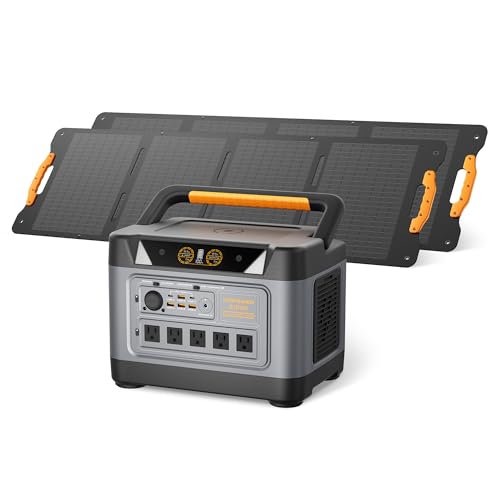
UDPOWER S1200 Portable Power Station with 2 x 120W Solar Panels
  • 1,191Wh LiFePO4, 1,200W output
  • Two 120W panels included
  • 14 outputs with UPS backup
Check price on Amazon for UDPOWER S1200 Portable Power Station with 2 x 120W Solar Panels (opens in a new tab)
Best for: Home-backup and RV owners wanting a 1,191 watt-hour station with panels in the box.

Our take

People who want to run a router, laptop and small appliances during an outage find the capacity makes sense.

Why it made the shortlist

UDPOWER offers a 1,191 watt-hour LiFePO4 battery, a 1,200 watt pure sine wave output and two 120 watt solar panels for 240 watts combined. For price position, this pick sits in the upper third on price.

The battery retains at least 80 percent after 3,000 charge cycles.

Against the Jackery 300, the step up buys roughly four times the stored energy, five AC outlets and 14 outputs in total, with USB-C supporting PD and PPS up to 100 watts combined. A UPS function backs up sensitive devices.

Solar input supports up to 400 watts with a compatible setup.

Wall charging reaches 800 watts, so a refill is quick between trips.

What works

  • Panels included in the bundle
  • Five AC outlets for many devices
  • 800 watt wall recharging
  • UPS backup for sensitive gear

Watch out for

  • Costly compared with small stations
  • Panel output is modest for the battery
06
Jackery Solar Generator 1000 v2 and 200W Solar Panel, 1024Wh LiFePO4
  • 1,024Wh LFP, 1,500W AC
  • 3,000W surge, 200W panel
  • 50 minute fast charge, app control
Check price on Amazon for Jackery Solar Generator 1000 v2 and 200W Solar Panel, 1024Wh LiFePO4 (opens in a new tab)
Best for: Owners who want fast charging and app control from a name-brand 1,500 watt station.

Our take

Homeowners who want one machine for outages and the RV, and want polish, will find the experience rewarding.

Why it made the shortlist

Jackery delivers 1,500 watts of AC output and a 3,000 watt surge from a 1,024 watt-hour LFP battery, bundled with a 200 watt solar panel. Price-wise it is the most expensive pick here, and the output is high enough for fridges and some AC units.

The battery keeps over 70 percent after 4,000 cycles.

Against the UDPOWER S1200, the step up buys a 10 millisecond UPS switchover, 50 minute emergency charging from empty and app control with a 30 decibel quiet overnight charge mode.

Two pure sine wave AC ports, two USB-C ports and a car port are provided.

A ten year lifespan is cited, and the app lets owners switch charge modes on the fly.

What works

  • High 1,500 watt output with surge headroom
  • Panel included in the bundle
  • Fast 50 minute emergency charging
  • App control and quiet charging mode

Watch out for

  • Most expensive pick here
  • Hefty to carry far

Methodology

How We Built This Shortlist

Each pick was assessed across 5 criteria weighted for real-world use.

01

Cycle life claims

We compared the cycle counts and end-of-life definitions in each listing. A figure with a stated capacity threshold carries more meaning than a bare cycle count. We treated all numbers as maker claims and compared them within that limit.

02

Capacity and output

Watt-hours and watts were read side by side, because a high output with small capacity empties fast. We matched each pick to the loads it can realistically run. Surge ratings were noted separately.

03

Station or kit

Some picks are plug-and-play stations with AC outlets, and others are 12 volt kits with a battery, panels and a controller. We compared them on what they can run and what they need added. A kit without an inverter is a different tool.

04

Recharge speed and routes

We noted wall input, solar input limits and car charging on each listing. Fast recharge matters for short stops, and solar input matters for off-grid stays. Included panels were credited.

05

Position on price

We placed each pick relative to the rest and asked what the extra spend buys, such as capacity, panels, a display or app control. A pick that could not justify its step down ranked lower.

Decision guide

Match a Budget LiFePO4 Solar Generator to Your Camp Setup

By Load You Need to Run

Start with the device that draws the most.

LoadBest pickWhy
Phones, a light and a tabletPowkey 192WhLight, low-cost LiFePO4
Laptop, CPAP and fan overnightJackery 300292 watt-hours with PD USB-C
Cabin lights and vent fan on 12VECI Power KitBattery, panel and controller bundled
Router, laptop and small appliancesUDPOWER S12001,200 watt output, panels included
Fridge or small AC unitJackery 1000 v21,500 watts with surge headroom

By Budget

Bands are relative to the shortlist.

BandPickWhat you get
Entry of this shortlistPowkey 192WhA small LiFePO4 station
LowECI Power KitA 12 volt battery, panel and controller
MidJackery 300Name-brand 300 watt station
MidExpertPower KitTwice the solar and a display
UpperUDPOWER S12001,191 watt-hours with panels
TopJackery 1000 v2Fast charging and app control

Plug-and-Play Station vs 12V DIY Kit

A station gives AC outlets, and a kit gives system control.

Plug-and-play station

Powkey 192Wh, Jackery 300, UDPOWER S1200 and Jackery 1000 v2 have AC outlets and run right away.

12 volt DIY kit

ECI Power Kit and ExpertPower Kit supply DC power and a controller, and need an inverter for AC.

For flexibility choose Jackery 300, and for a fixed trailer system choose ExpertPower Kit.

By Recharge Plan

How you refill should shape the pick.

Recharge planPickReason
Wall and car onlyPowkey 192WhSimple routes, panel optional
Solar-only, off gridUDPOWER S1200Panels in the box, up to 400 watt input
Fast top-ups between stopsJackery 1000 v250 minute emergency charge
Fixed roof panelsExpertPower KitTwo panels and a 30 amp controller

For Boondocking Specifically

Off-grid stays reward capacity and solar.

Look for

Large watt-hours, included panels, a high solar input limit and a long stated cycle life.

In this comparison

UDPOWER S1200 and Jackery 1000 v2 lead, with ExpertPower Kit for a fixed 12 volt system.

When to Spend More

Step up only if the extra capacity pays for itself.

Spend more if

You run appliances or work from the rig, which points to UDPOWER S1200 or Jackery 1000 v2.

Save if

You need lights and phones, where Powkey 192Wh or ECI Power Kit is plenty.

FAQ

Before You Bring One Home

Is LiFePO4 worth it over cheaper lithium?

For regular use, yes. LiFePO4 cells are quoted for thousands of cycles, so a station used weekly can last many years. For rare use, the longer life matters less. The Powkey 192Wh is the lowest cost way to get the chemistry.

Why do cycle ratings differ so much?

Makers measure to different end-of-life thresholds and depths of discharge. One says 70 percent after 4,000 cycles and another says 80 percent after 3,000. Compare only like with like and treat the figures as claims, not guarantees.

Can the 12 volt kits run AC appliances?

Not without an inverter, which neither kit includes. They suit lights, fans and USB charging. If you need AC, pick a station like the Jackery 300 or add an inverter sized to your load.

How big a battery do I need for a weekend?

Add up the watts of each device and the hours you use it. A laptop at 50 watts for four hours is about 200 watt-hours. A CPAP and lights add more. Choose capacity above your total with margin.

Are bundled solar panels enough to refill the battery?

They are a helpful start. Two 120 watt panels on the UDPOWER S1200 give about 240 watts in ideal sun, which refills a large battery over a couple of days. Cloud and angle reduce that. Add panels if you can.

Is the most expensive unit overkill for an RV?

Not if you run a fridge, microwave or a small AC. The Jackery 1000 v2 has 1,500 watts and a 3,000 watt surge. If you only charge devices, a smaller unit does the job for less.

Bottom line

The short version

Browse more budget lifepo4 solar generators on Amazon →
Danny Walker, Camping Editor at RV Gear Lab

About the author

Danny Walker

Camping Editor at RV Gear Lab

Danny covers camping gear, campsite setup, outdoor power, sleep systems and practical camping advice, with a focus on helping campers make better gear decisions.

More from Danny →Editorial standards

Keep reading

Related guides