


We research everything we recommend. When you buy through our links, we may earn a commission. Learn more

Buying guide · 10 min read · Updated October 2, 2026

6 Best Deep Cycle Batteries Under 200 in 2026: A Practical Camping Guide

Best deep cycle batteries under $200: six 12V lithium, AGM and gel batteries from 75Ah to 120Ah compared on capacity, cranking power and weight.

Danny WalkerBy Danny WalkerCamping Editor at RV Gear Lab6 products comparedSpec-sheet researched
Dome tent and hammock at a forest campsite at golden hour

At a glance

Our top picks

Two hundred dollars is the first price where a deep cycle battery can store over 1000Wh. The six picks here range from a 120Ah lithium marine battery to 75Ah gel and AGM units and two dual-purpose AGMs that can also start an engine.

The list is ranked by stored energy per dollar and by how many jobs a battery can do. A lithium leads, and the dual-purpose AGMs show when a battery that starts an engine and runs a trolling motor is worth the extra weight.

RV Gear Lab field notes

The Campsite Fit Check

Start with the job
12V 120Ah LiFePO4 Marine Battery with Bluetooth APP leads this shortlist for Boats and camper banks. Use that fit as a reference point, then compare the alternatives against your own space and workload.
Specs that separate the picks
The first details to compare are 12.8V 120Ah, 1536Wh, 12V 75Ah sealed AGM, 12V 75Ah sealed gel. Confirm the exact model and included components before ordering.
Trade-off to plan for
Needs a lithium charger

Before you buy

What Matters Before You Choose a Deep Cycle Battery Under 200

Key buying criteria so you get the right fit the first time.

  1. 01

    What $200 buys

    At this price a lithium battery of 120Ah now competes with lead-acid at 75 to 90Ah. That means you can store about 1536Wh instead of about 900Wh, with less weight. Decide whether you need cranking power before choosing, since lithium here is deep-cycle only, and note that the lithium pick here has no cranking rating at all so you can compare the two chemistries fairly.

  2. 02

    Deep cycle vs dual-purpose

    A deep cycle battery tolerates repeated deep drains, while a dual-purpose battery trades some of that for starting power. Draining a dual-purpose battery below 50 percent shortens its life. Check whether the battery lists cold cranking amps, which signals a starter, and treat those as the batteries to avoid draining deeply before you buy.

  3. 03

    Cold cranking and reserve

    Cold cranking amps (CCA) show how hard a battery can crank an engine in cold, and reserve capacity shows how many minutes it can run a 25A load. A 550 CCA battery starts most outboards up to 350 horsepower. Check CCA against your engine's requirement.

  4. 04

    Charger and cycle life

    Lithium needs a lithium profile at about 14.4 to 14.6V, AGM needs an AGM profile and gel needs a lower gel one. A wrong profile cuts the life of any battery. Check what your charger and solar controller support and the cycle claim that sits beside it in the specifications, since lead-acid and lithium need different voltages.

  5. 05

    Weight and Group size

    Group size, such as 24M or 27M, defines the case footprint and fits standard trays. A 90Ah lead-acid battery weighs around 55 to 65 lb, while a 120Ah lithium weighs far less. Measure your tray before you order and allow room for terminal clearance and a strap or hold-down.

  6. 06

    Monitoring

    A Bluetooth app that shows voltage, current and state of charge helps avoid draining a battery too far. It also helps find a parasitic load. Check whether the app exists for your phone, and whether it works without a subscription since some brands lock features behind an account.

Our standards

Why You Can Trust RV Gear Lab

At RV Gear Lab, we compare products based on campsite fit, verified specifications, usability, setup requirements, weight, durability, and real-world trade-offs. We do not rank products purely on marketing claims or commission rates.

We have not personally tested every product listed. Where hands-on testing is not available, recommendations are based on verified manufacturer specifications, product documentation, use-case fit, and comparative research.

How we review camping gear →

Detailed reviews

The 6 best deep cycle batteries under 200, explained

01
Best for: Boats and camper banks

Our take

The most stored energy and monitoring under $200.

Why it made the shortlist

GOKWH is a 12.8V 120Ah LiFePO4 marine battery that stores 1536Wh. It has a Bluetooth 5.0 app, a 100A BMS and low-temperature protection, in a Group 24 case.

At about $171 it stores 60 percent more than the 75Ah VEVOR AGM for about the same money.

It suits a boat, camper or van that needs real capacity and monitoring. It is the best amp-hour value here.

What works

  • Stores 1536Wh
  • App tracks charge and current
  • Low-temperature protection
  • Group 24 size

Watch out for

  • Needs a lithium charger
  • Heavier packs of 120Ah need a sturdy tray
The catch
A lithium-compatible charger is required.
02

Best AGM Pick · 2 of 6

VEVOR 12V 75Ah Deep Cycle Battery

Best for: Cold-climate camping

Our take

A conventional AGM that is easy to charge.

Why it made the shortlist

VEVOR is a 12V 75Ah sealed AGM battery rated for 300 to 1500 cycles between 30 and 100 percent depth of discharge. It accepts a maximum charge current of 15A and includes low-temperature protection for use from -4F to 140F.

At about $170 it costs about the same as the GOKWH 120Ah and stores 45Ah less. It keeps up to 65 percent of its charge after 12 months, so it stores better than a flooded battery.

It suits a tight budget that needs a standard lead-acid charger. It is also easier to charge in cold weather.

What works

  • Wide temperature range
  • Low self-discharge in storage
  • Sealed and maintenance-free
  • Works with standard AGM chargers

Watch out for

  • Less capacity than the lithium
  • Heavy for its size
The catch
Cycle life is a fraction of lithium.
03
Best for: Solar and boat kits

Our take

A rugged gel battery for vibrating installs.

Why it made the shortlist

ExpertPower is a sealed 12V 75Ah gel battery with an impact-resistant housing and a standard terminal layout. The gel electrolyte prevents spills, so it can be mounted in several orientations.

At about $170 it costs the same as the VEVOR 75Ah AGM and tolerates vibration better. It trails the GOKWH 120Ah on capacity.

It suits a solar kit or boat where vibration and orientation matter. It arrives ready to install.

What works

  • Mounts in several orientations
  • Handles shock and vibration
  • Spill-proof sealed gel
  • Ready to install

Watch out for

  • Needs a gel-safe charger
  • Less capacity than lithium
The catch
Do not charge it with an AGM profile.
04
Best for: Single-battery boats

Our take

One battery that starts the motor and runs the gear.

Why it made the shortlist

UPLUS is a Group 24M dual-purpose AGM marine battery rated 12V 79Ah with 550 cold cranking amps and 150 reserve capacity. It starts engines up to 350 horsepower and resists vibration.

It suits a boat with one battery doing both jobs. Space-saving is its main point.

What works

  • Starts engines and runs electronics
  • Resists wave pounding
  • Thick cast plates
  • Saves a second battery

Watch out for

  • Less deep-cycle life than a true deep cycle
  • Heavy lead-acid weight
The catch
Dual-purpose batteries do not like deep drains.
05
Banshee Group 27M AGM Marine Deep Cycle Battery
  • 12V 90Ah AGM, 600 CCA
  • 185 minute reserve capacity
  • Carry handle, SAE terminals
Check price on Amazon for Banshee Group 27M AGM Marine Deep Cycle Battery (opens in a new tab)
Best for: Boats and larger campers

Our take

A start-capable 90Ah AGM at the top of the budget.

Why it made the shortlist

Banshee is a Group 27M AGM marine battery rated 12V 90Ah with 600 cold cranking amps and a 185 minute reserve capacity. It has a carry handle and SAE terminals.

At about $200 it is at the cap and stores 15Ah more than the VEVOR 75Ah.

It suits a boat or camper that needs 90Ah and a start-capable battery. It is sealed and needs no watering.

What works

  • 600 cold cranking amps
  • Sealed AGM, no watering
  • Carry handle
  • 185 minute reserve capacity

Watch out for

  • Costs the full budget
  • Heavy lead-acid weight
The catch
Lead-acid weight adds up at 90Ah.
06

Best Cranking Power · 6 of 6

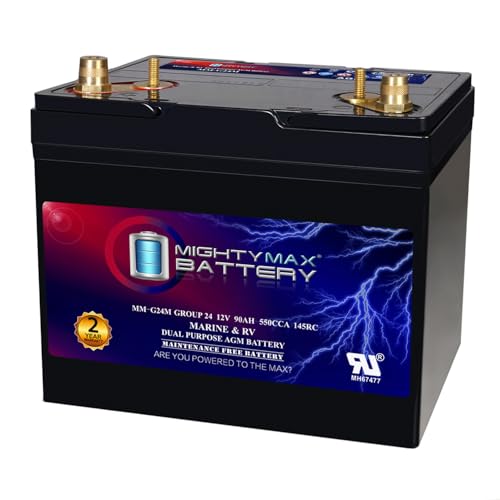
Mighty Max Battery MM-G24M

Mighty Max Battery MM-G24M
  • 12V 90Ah AGM, 550 CCA
  • 700 CA and 700 MCA
  • Group 24M dual-purpose
Check price on Amazon for Mighty Max Battery MM-G24M (opens in a new tab)
Best for: Boats that need hard starts

Our take

A powerful dual-purpose AGM for a boat.

Why it made the shortlist

Mighty Max MM-G24M is a 12V 90Ah Group 24M deep-cycle marine AGM that delivers 550 CCA, 700 CA and 700 marine cranking amps. It is dual-purpose, so it can start an engine and power electronics.

At about $200 it matches the Banshee 27M in price and capacity and trades 50 CCA for higher marine cranking amps.

It suits a boat that needs strong starts and deep cycling from one battery. It handles cold well.

What works

  • Strong marine cranking amps
  • Dual-purpose design
  • Group 24M size
  • Sealed AGM

Watch out for

  • Costs the full budget
  • Heavy lead-acid weight
The catch
Do not drain a dual-purpose battery to zero.

Methodology

How We Built This Shortlist

Each pick was assessed across 5 criteria weighted for real-world use.

01

Capacity per dollar

Amp-hours from 75Ah to 120Ah were set against the price of each battery.

02

Chemistry

LiFePO4, AGM and gel were compared for weight, cycle life and charger needs.

03

Cranking power

Cold cranking and marine cranking amps were compared for the dual-purpose picks.

04

Monitoring and protection

The Bluetooth app, BMS and low-temperature protection were compared.

05

Price against the cap

Every pick is at or under $200, and the top pick offers the most stored energy for the money.

Decision guide

Match a Deep Cycle Battery Under 200 to Your Camp Setup

By what you run

Your situationRecommended pickWhy
House battery with monitoringGOKWH 120Ah LiFePO41536Wh with an app.
Cold-climate AGMVEVOR 75Ah AGM-4F to 140F range.
Vibration-heavy solar or boatExpertPower 75Ah GelRugged sealed gel.
One battery that starts and runs gearUPLUS 24M Dual550 CCA.
Larger AGM, 90AhBanshee 27M AGM600 CCA and 185 minutes.
Hard marine startsMighty Max MM-G24M700 marine cranking amps.

By Budget

BudgetRecommended pick
$160 to $170VEVOR 75Ah AGM or ExpertPower 75Ah Gel
$170 to $190GOKWH 120Ah LiFePO4 or UPLUS 24M Dual
$190 to $200Banshee 27M AGM or Mighty Max MM-G24M

Lithium vs lead-acid

Lithium

The GOKWH 120Ah LiFePO4 stores the most, weighs the least and has an app, but needs a lithium charger.

Lead-acid

The VEVOR 75Ah AGM, ExpertPower 75Ah Gel, UPLUS 24M Dual, Banshee 27M AGM and Mighty Max MM-G24M work with common chargers and offer cranking power on the dual-purpose ones.

Most buyers who only need house power should take the GOKWH 120Ah LiFePO4.

By budget

Price tierRecommended pick
About $170GOKWH 120Ah LiFePO4
About $170VEVOR 75Ah AGM
About $170ExpertPower 75Ah Gel
About $190UPLUS 24M Dual
About $200Banshee 27M AGM
About $200Mighty Max MM-G24M

For a trolling motor and boat accessories specifically

Look for

Look for a Group 24 or 27 size, enough amp-hours for a day of motor use and cranking power if one battery must start the engine.

In this comparison

The GOKWH 120Ah LiFePO4 gives the longest runtime. The Mighty Max MM-G24M adds 700 marine cranking amps if the same battery must start the engine.

When to Spend More

Spend more if

Spend more if you need cranking power: the Mighty Max MM-G24M and Banshee 27M AGM both start engines, and the UPLUS 24M Dual adds a 24M size.

Save if

Save if you only need house power: the GOKWH 120Ah LiFePO4 gives the most capacity, and the VEVOR 75Ah AGM is the budget lead-acid choice.

FAQ

Before You Bring One Home

Can a dual-purpose battery run a trolling motor?

Yes, but not as long as a true deep cycle of the same size. The Mighty Max MM-G24M, Banshee 27M AGM and UPLUS 24M Dual handle moderate cycling. Do not drain them below 50 percent and a lithium option is better for that duty.

How long will a 120Ah lithium battery run a fridge?

A 12V compressor fridge uses about 40 to 60 watt-hours a day in mild weather, so a 120Ah lithium holds about 1536Wh and can run one for several days. Weather and door openings change the figure. Add lights and a pump for a shorter time.

Is the GOKWH 120Ah worth more than the VEVOR 75Ah?

Yes for house use, because it stores 60 percent more and weighs far less for about the same money. It also comes with an app. Choose the VEVOR 75Ah AGM only if your charger cannot be changed.

Does a lithium battery work in the cold?

It can, but charging below freezing can damage the cells unless the battery has low-temperature protection. The GOKWH 120Ah LiFePO4 includes it. Lead-acid like the VEVOR 75Ah AGM tolerates cold charging better before relying on it.

How do I connect two batteries?

Wire them in parallel with matched cables of equal length, and use batteries of the same type and age. Never mix lithium and lead-acid. Fuse each battery separately so that one weak battery does not drag the other down.

Bottom line

The short version

Browse more deep cycle batteries under 200 on Amazon →
Danny Walker, Camping Editor at RV Gear Lab

About the author

Danny Walker

Camping Editor at RV Gear Lab

Danny covers camping gear, campsite setup, outdoor power, sleep systems and practical camping advice, with a focus on helping campers make better gear decisions.

More from Danny →Editorial standards

Keep reading

Related guides