


We research everything we recommend. When you buy through our links, we may earn a commission. Learn more

Buying guide · 10 min read · Updated October 2, 2026

6 Best Deep Cycle Batteries Under 500 in 2026: A Practical Camping Guide

Best deep cycle batteries under $500: six 12V and 6V batteries from 100Ah to 300Ah compared on chemistry, expandability and cold-weather behavior.

Danny WalkerBy Danny WalkerCamping Editor at RV Gear Lab6 products comparedSpec-sheet researched
Dome tent and hammock at a forest campsite at golden hour

At a glance

Our top picks

Five hundred dollars buys either a 300Ah lithium battery or a 200Ah AGM with room to spare. The six picks here mix three lithium batteries with two 200Ah and 225Ah AGMs and one dual-purpose 100Ah, so chemistry is the real decision.

Few good options sit between $300 and $500, so the extra money mostly buys lead-acid weight or a bit more lithium capacity. The list shows when each is worth it.

RV Gear Lab field notes

The Campsite Fit Check

Start with the job
GSIKE IX 12.8V 300Ah LiFePO4 Battery leads this shortlist for Boondocking banks. Use that fit as a reference point, then compare the alternatives against your own space and workload.
Specs that separate the picks
The first details to compare are 12.8V 300Ah, 4019Wh, 12V 200Ah, 2560Wh, 12V 200Ah, 200A BMS. Confirm the exact model and included components before ordering.
Trade-off to plan for
100A BMS limits big inverters

Before you buy

What Matters Before You Choose a Deep Cycle Battery Under 500

Key buying criteria so you get the right fit the first time.

  1. 01

    What $500 buys

    The extra money over $300 buys a wide temperature range, lead-acid options and a 6V bank, not much more lithium capacity. The GSIKE 300Ah already costs about $300. Decide whether you want chemistry choice or more energy, and keep a share of the budget for cable, fuses and a battery monitor that makes the bank easier to read.

  2. 02

    6V vs 12V batteries

    Two 6V batteries wired in series make 12V at the same amp-hours, and each is easier to lift than a 12V of the same size. A single 6V cannot power a 12V system alone. Check you are buying two, and match both batteries by age and brand so one does not carry the other.

  3. 03

    Temperature range

    A lithium battery that works from -20C to 65C tolerates cold, but charging below freezing still needs protection. Lead-acid holds capacity worse in cold but charges more safely. Check both the discharge and charge limits and look for a stated cold-charge cutoff in the specifications rather than assuming one exists.

  4. 04

    BMS and inverter size

    A 200A BMS supports about 2560W at 12V, and a 100A BMS about 1280W. Match the BMS to the largest inverter you plan to run. Check the continuous rating in the specifications, which is often printed next to the voltage and capacity near the top of the specifications.

  5. 05

    Self-discharge

    A lead-acid battery loses charge in storage, and AGM loses less than flooded. Under 3 percent a month means it holds for a season. Check the rate if you store your RV, and top up lead-acid every few months if the RV sits unused for a long time.

  6. 06

    Parallel limits

    Linking batteries in parallel multiplies capacity, but some batteries cap the count. An 800Ah figure means four 200Ah units. Check the limit before you plan growth and remember that mixing batteries of different ages shortens the life of the whole bank, and write the allowed number of units on the box before you place the order.

Our standards

Why You Can Trust RV Gear Lab

At RV Gear Lab, we compare products based on campsite fit, verified specifications, usability, setup requirements, weight, durability, and real-world trade-offs. We do not rank products purely on marketing claims or commission rates.

We have not personally tested every product listed. Where hands-on testing is not available, recommendations are based on verified manufacturer specifications, product documentation, use-case fit, and comparative research.

How we review camping gear →

Detailed reviews

The 6 best deep cycle batteries under 500, explained

01

Best Value Under $500 · 1 of 6

GSIKE IX 12.8V 300Ah LiFePO4 Battery

Best for: Boondocking banks

Our take

The most stored energy for the money.

Why it made the shortlist

GSIKE stores 4019Wh in a single 12.8V 300Ah LiFePO4 case and claims 6000 cycles at 80 percent discharge. Cell protection comes from a 100A smart BMS, and a 4P4S layout allows growth.

At about $300 it holds 50 percent more than the Rvpozwer and costs $6 less. It is cheaper than the AGM picks and stores more.

It suits a van or RV that wants a large bank without paying lead-acid prices. Its weight is the trade.

What works

  • Largest capacity under the cap
  • 6000 cycles at 80 percent depth
  • Smart BMS protects the cells
  • Expands to larger banks

Watch out for

  • 100A BMS limits big inverters
  • Heavy single battery
The catch
A large inverter needs a stronger BMS.
02

Best Wide Temperature Range · 2 of 6

12V 200Ah LiFePO4 Lithium Battery

Best for: Cold-climate bank builders

Our take

A 200Ah lithium that handles cold and big loads.

Why it made the shortlist

Rvpozwer is a 12V 200Ah LiFePO4 battery that stores 2560Wh and claims 15,000 cycles. It has a 200A smart BMS and works from -20C to 65C, and it expands to 800Ah in parallel.

At about $306 it costs $36 more than the ECOBOSS and offers a wider stated temperature range. It also lists lifetime technical support.

It suits cold-climate campers and anyone planning a bigger bank. The 200A BMS handles a 2000W inverter.

What works

  • 200A BMS for big inverters
  • Expands up to 800Ah
  • Lifetime technical support

Watch out for

  • No monitoring app
The catch
Add a shunt if you want monitoring.
03
Best for: Budget full-time RVs

Our take

A strong 200Ah lithium at the lowest price.

Why it made the shortlist

ECOBOSS offers 200Ah at 12V with IP65 sealing, a 200A BMS and a charging cutoff at 32F. Its 4S4P rating covers later expansion.

At about $270 it is the cheapest 200Ah here, $36 below the Rvpozwer.

It suits a full-time RV on a budget. The IP65 rating helps in exposed compartments.

What works

  • 200A BMS
  • Cold charge cutoff

Watch out for

  • Fewer features than the Rvpozwer
  • Heavy for a single lift
The catch
Check the cold-charge cutoff in winter.
04

Best Lead-Acid Capacity · 4 of 6

Renogy 12 Volt 200Ah Deep Cycle AGM Battery

Best for: Cold-climate lead-acid fans

Our take

The lead-acid choice that holds charge in storage.

Why it made the shortlist

Renogy is a 12V 200Ah deep cycle AGM with a self-discharge of under 3 percent a month. It keeps working below 32F and is sealed, so it needs no water.

At about $396 it costs $90 more than the Rvpozwer and weighs far more. It stores the same 200Ah and lets you use a standard AGM charger.

It suits those who prefer lead-acid for cold climates or familiar charging. It sits fine in storage.

What works

  • Low self-discharge in storage
  • Sealed and maintenance-free
  • Works below 32F
  • Standard AGM charging

Watch out for

  • Heavy single battery
  • Costs far more than lithium
The catch
Weight is the cost of the chemistry.
05
Best for: Traditional RV banks

Our take

A 6V option for building a classic RV bank.

Why it made the shortlist

Go Power GP-AGM-225-6V is a 6V AGM rated 225Ah at the C20 rate, with carry handles. It is sealed and built for RV, solar and inverter banks.

At about $396 it matches the Renogy on price and stores a bit more. Two in series give 12V at 225Ah.

It suits a traditional RV bank built from two 6V batteries. Each is easier to lift than a 12V of the same size.

What works

  • Handles ease lifting
  • Sealed, no maintenance
  • 6V pairs form a 12V bank
  • Made for RV and solar banks

Watch out for

  • Need two for 12V
  • Costs a lot for lead-acid
The catch
Buy two and wire in series.
06

Best Dual-Purpose · 6 of 6

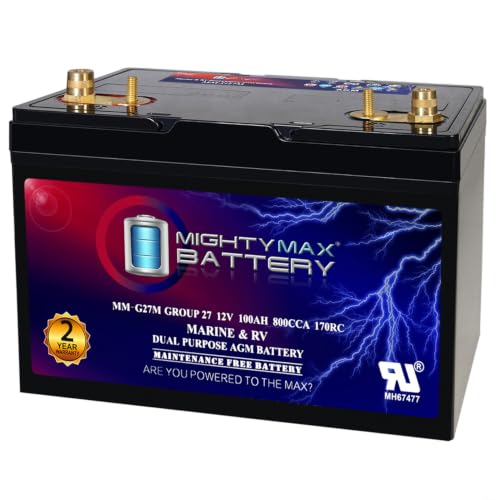
Mighty Max Battery MM-G27M

Mighty Max Battery MM-G27M
  • 12V 100Ah, Group 27M
  • 800 CCA, 850 MCA
  • 700 cycles at 50% DoD
Check price on Amazon for Mighty Max Battery MM-G27M (opens in a new tab)
Best for: Boats that start and cycle

Our take

A start-capable AGM for boats.

Why it made the shortlist

Mighty Max MM-G27M brings 100Ah in a Group 27M case, 800 CCA and 850 MCA. Its cycle rating is 700 at half discharge.

It stores half as much as the 200Ah packs.

A boat that wants starting and cycling from one case is the natural home. Sealed construction means no watering.

What works

  • Strong cranking amps
  • Sealed and maintenance-free
  • Dual-purpose use

Watch out for

  • Half the capacity of the 200Ah
  • Lead-acid weight
The catch
Dual-purpose batteries dislike deep drains.

Methodology

How We Built This Shortlist

Each pick was assessed across 5 criteria weighted for real-world use.

01

Capacity per dollar

Amp-hours from 100Ah to 300Ah were set against the price of each battery.

02

Chemistry

LiFePO4 and AGM were compared for weight, charger needs and cold-weather behavior.

03

Expandability

Series and parallel limits were compared.

04

Cold performance

Temperature range and low-temperature protection were compared.

05

Price against the cap

Every pick is at or under $500, and the top pick gives the most stored energy for the money.

Decision guide

Match a Deep Cycle Battery Under 500 to Your Camp Setup

By what you run

Your situationRecommended pickWhy
Largest bank, modest inverterGSIKE 300Ah LiFePO44019Wh.
Cold climate, 2000W inverterRvpozwer 200Ah LiFePO4-20C to 65C.
Budget 200AhECOBOSS 200Ah LiFePO4Lowest 200Ah price.
Lead-acid, storageRenogy 200Ah AGMUnder 3% self-discharge.
Classic RV bankGo Power 6V 225AhBuy two.
Boat with a startMighty Max MM-G27M800 CCA.

By Budget

BudgetRecommended pick
$220 to $270Mighty Max MM-G27M or ECOBOSS 200Ah LiFePO4
$290 to $310GSIKE 300Ah LiFePO4 or Rvpozwer 200Ah LiFePO4
$390 to $400Renogy 200Ah AGM or Go Power 6V 225Ah

Lithium vs lead-acid

Lithium

The GSIKE 300Ah LiFePO4, Rvpozwer 200Ah LiFePO4 and ECOBOSS 200Ah LiFePO4 weigh less and last longer.

Lead-acid

The Renogy 200Ah AGM, Go Power 6V 225Ah and Mighty Max MM-G27M suit familiar chargers and boats.

Most buyers should take the GSIKE 300Ah LiFePO4.

By budget

Price tierRecommended pick
About $230Mighty Max MM-G27M
About $270ECOBOSS 200Ah LiFePO4
About $300GSIKE 300Ah LiFePO4
About $306Rvpozwer 200Ah LiFePO4
About $396Renogy 200Ah AGM
About $396Go Power 6V 225Ah

For a cold-climate van specifically

Look for

Look for a stated low temperature range and cold-charge protection.

In this comparison

The Rvpozwer 200Ah LiFePO4 lists -20C to 65C. The Renogy 200Ah AGM keeps working below 32F.

When to Spend More

Spend more if

Spend more if you want a wide temperature range or lead-acid: the Rvpozwer 200Ah LiFePO4 and Renogy 200Ah AGM both add that.

Save if

Save if you only need a 200Ah bank: the ECOBOSS 200Ah LiFePO4 is $36 cheaper than the Rvpozwer 200Ah LiFePO4.

FAQ

Before You Bring One Home

Is lithium or AGM better under $500?

Lithium wins for most campers: the GSIKE 300Ah LiFePO4 stores 50 percent more than the Renogy 200Ah AGM for $90 less and weighs far less. AGM wins if your charger cannot change profile. Check your charger first, and also compare the cost of any charger changes you would need to make.

Do I need two 6V batteries?

Yes, one 6V battery cannot power a 12V system. Wire two Go Power 6V 225Ah units in series, which keeps 225Ah at 12V. Buy identical units and replace them in pairs and use short, thick cable of equal length between them and the load.

Can I charge lithium in freezing weather?

Not safely without low-temperature protection. The ECOBOSS 200Ah LiFePO4 pauses at 32F, and the Rvpozwer 200Ah LiFePO4 lists a range down to -20C. Check the charge limit, not just the discharge limit and consider a heater pad or insulated box if you winter in the cold.

How big an inverter can the GSIKE run?

About 1000W continuous because of the 100A BMS. A larger load trips the BMS, so choose the Rvpozwer 200Ah LiFePO4 with a 200A BMS for a 2000W inverter. Check the continuous limit and the 200Ah lithium has the stronger BMS for that job.

How do I store batteries over winter?

Charge lead-acid fully, since the Renogy 200Ah AGM self-discharges under 3 percent a month. Store lithium around half charge in a dry place. Disconnect loads and recharge lead-acid every few months to prevent sulfation and keep the terminals clean.

Bottom line

The short version

Browse more deep cycle batteries under 500 on Amazon →
Danny Walker, Camping Editor at RV Gear Lab

About the author

Danny Walker

Camping Editor at RV Gear Lab

Danny covers camping gear, campsite setup, outdoor power, sleep systems and practical camping advice, with a focus on helping campers make better gear decisions.

More from Danny →Editorial standards

Keep reading

Related guides