

We research everything we recommend. When you buy through our links, we may earn a commission. Learn more

Buying guide · 10 min read · Updated October 2, 2026

5 Best Portable Solar Panels For Home in 2026: A Practical Camping Guide

Best portable solar panels for home use: five foldable panels from 10W to 150W for outage backup, compared on watts, weight and what they plug into.

Danny WalkerBy Danny WalkerCamping Editor at RV Gear Lab5 products comparedSpec-sheet researched
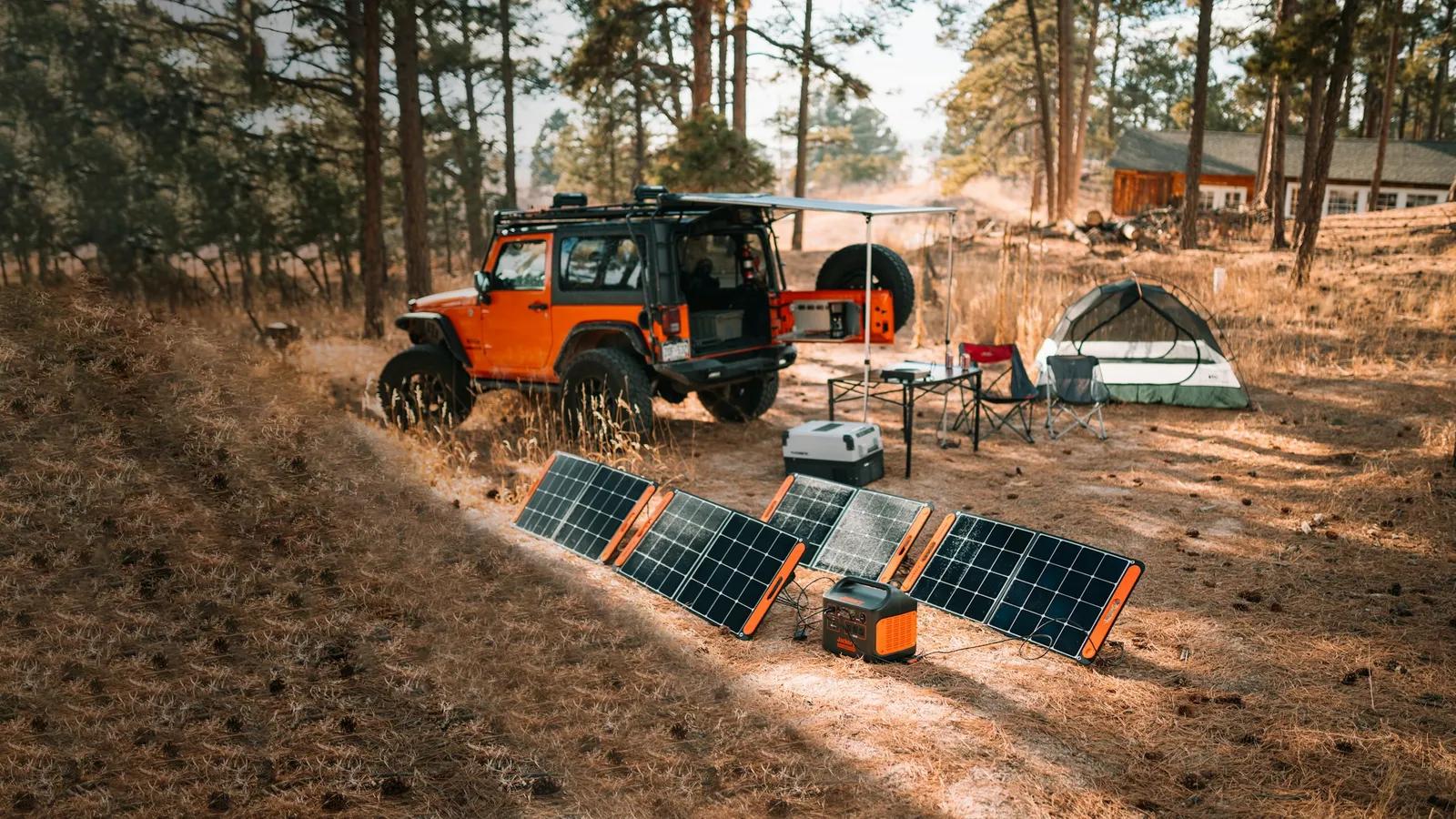
Jeep camp with a tent, solar panels and a portable power station at a pine forest campsite

At a glance

Our top picks

Portable panels earn a spot at home when the power goes out. A foldable panel plus a power station keeps phones, lights and a router running, and it stores in a closet until you need it.

The five panels here run from a 150W kit to a 10W phone charger. They are ordered by how much real charging they can feed a home backup battery, with weight and connectors as tie-breakers.

RV Gear Lab field notes

The Campsite Fit Check

Start with the job
DOKIO 150W Portable Foldable Solar Panel Kit with Charge Controller leads this shortlist for 12V battery backup. Use that fit as a reference point, then compare the alternatives against your own space and workload.
Specs that separate the picks
The first details to compare are 150W foldable, 7.3 lbs, 100W, 23.5% efficient cells, 100W, 4.1 lbs, 0.59 inch thin. Confirm the exact model and included components before ordering.
Trade-off to plan for
PWM controller is basic

Before you buy

What Matters Before You Choose a Portable Solar Panel For Home

Key buying criteria so you get the right fit the first time.

  1. 01

    Panel wattage versus station input

    A 150W panel does not charge faster than your station allows. Many portable stations cap solar input at 60 to 100W, so a bigger panel can waste capacity. Check your station's maximum solar input before buying.

  2. 02

    Connector compatibility

    Panels and stations use different plugs, such as DC8020, XT60 and Anderson. A 5-in-1 cable covers more cases than a 4-in-1 cable. Check your station's input port name and the connectors in the panel's listing.

  3. 03

    Weight and fold size

    A panel you can lift with one hand is a panel you will actually deploy. A 4 lb panel feels easy, while a 9 lb panel is a chore for some. Check weight and folded size.

  4. 04

    Weather rating

    IP67 means the panel resists dust and brief immersion, which handles rain. A rating without a number is not a guarantee. Look for the IP number and the surface material, such as ETFE.

  5. 05

    Charge controller

    A panel that connects straight to a power station does not need a separate controller. A 12V battery does need one. Check whether a PWM or MPPT controller is included.

  6. 06

    Realistic output at home

    Panels rarely produce their rated watts, since angle, shade and clouds cut output. Plan on about half in typical use. Place the panel in direct sun and tilt it toward the sun.

Our standards

Why You Can Trust RV Gear Lab

At RV Gear Lab, we compare products based on campsite fit, verified specifications, usability, setup requirements, weight, durability, and real-world trade-offs. We do not rank products purely on marketing claims or commission rates.

We have not personally tested every product listed. Where hands-on testing is not available, recommendations are based on verified manufacturer specifications, product documentation, use-case fit, and comparative research.

How we review camping gear →

Detailed reviews

The 5 best portable solar panels for home, explained

01
Best for: 12V battery backup

Our take

The most power here and a controller in the box. Good for a 12V battery setup.

Why it made the shortlist

The DOKIO 150W kit folds to 19.3 x 20.9 x 1.1 inches at 7.3 lbs and includes a standalone PWM charge controller with reverse polarity, overcharge, overload and short-circuit protection. A 9.8 foot cable lets the panel sit in sun while the controller stays in shade.

It carries the most wattage of the five, and the separate controller suits 12V battery setups, which the ZOUPW and FlexSolar do not list. It also adds USB ports for direct phone top-ups.

It fits homeowners who keep a 12V battery or RV-style backup. The long cable makes it practical to set up in a yard.

What works

  • Highest wattage of the group
  • Standalone PWM controller included
  • 9.8 foot cable for shade placement
  • USB ports for quick top-ups

Watch out for

  • PWM controller is basic
  • Some power stations cap solar input at 60 to 100W
The catch
Check your power station input limit first, since many cap at 100W.
02

Best Universal Connectors · 2 of 5

ZOUPW 100W Portable Solar Panel for Power Station

ZOUPW 100W Portable Solar Panel for Power Station
  • 100W, 23.5% efficient cells
  • 5-in-1 universal connector cable
  • IP67 ETFE, 9.48 lbs
Check price on Amazon for ZOUPW 100W Portable Solar Panel for Power Station (opens in a new tab)
Best for: Home backup with Jackery-style stations

Our take

It fits the widest range of power stations. A good choice if you are unsure of your plug.

Why it made the shortlist

The ZOUPW is a 100W foldable panel with 23.5% efficient Grade A+ monocrystalline cells, an IP67 ETFE coating and a 5-in-1 universal connector cable. It weighs 9.48 lbs and folds to 24.13 x 21.06 x 1.77 inches.

Compared with the FlexSolar, it carries a built-in charge hub with USB-C PD 15V/3A and two USB-A ports. The five-connector cable fits more power stations than a typical 4-in-1 cable.

It suits households with a Jackery or similar station where connector fit is the main worry. The magnetic carry handle helps with storage.

What works

  • Five connectors fit many stations
  • Direct USB-C and USB-A charging hub
  • IP67 waterproof ETFE coating
  • Magnetic carry handle

Watch out for

  • 9.48 lbs is heavier than the FlexSolar
  • Needs a sunny open spot
The catch
Heavier than the FlexSolar, so storage space matters.
03
FlexSolar 100W Foldable Portable Solar Panel Charger IP67 Waterproof
  • 100W, 4.1 lbs, 0.59 inch thin
  • PD 3.0 45W USB-C, 18W USB-A
  • IP67, 23%+ monocrystalline
Check price on Amazon for FlexSolar 100W Foldable Portable Solar Panel Charger IP67 Waterproof (opens in a new tab)
Best for: Easy storage and setup

Our take

The lightest 100W panel here. Ideal for quick setup on a patio.

Why it made the shortlist

Outputs include PD 3.0 45W USB-C, 18W USB-A and a 100W DC port.

At less than half the weight of the ZOUPW, it is the easiest panel to carry out and set up on a porch. Its 23%+ efficiency matches the other 100W options.

It fits older owners, apartment dwellers and anyone who wants a panel that is easy to move in and out of a closet. The 100W DC output feeds most stations directly.

What works

  • Only 4.1 lbs for 100W
  • USB-C PD 3.0 45W output
  • IP67 waterproof and dustproof
  • Slim 0.59 inch profile

Watch out for

  • No separate charge controller
  • Fewer connector adapters listed
The catch
Match its DC plug to your power station first.
04

Best Mid-Size Charger · 4 of 5

60W Portable Solar Panels Charger with USB-C

60W Portable Solar Panels Charger with USB-C
  • 60W foldable, 23% conversion
  • USB-C, USB-A and 5A DC outputs
  • Kickstand, IP67 water resistance
Check price on Amazon for 60W Portable Solar Panels Charger with USB-C (opens in a new tab)
Best for: Phones and small electronics

Our take

A balanced panel for small loads. It is easy to prop up and carry.

Why it made the shortlist

The MHPOWOS 60W panel folds to briefcase size with a kickstand and has three outputs: a 5A DC port, a USB-C port and a USB-A port. It lists 23% conversion with IP67 water resistance.

It sits between the 100W panels and the 10W BLAVOR, enough for phones, power banks, speakers and small electronics. Compared with the FlexSolar, it trades wattage for a lower price.

It is easy to prop up with the kickstand.

What works

  • Three output ports
  • Kickstand for easy setup
  • IP67 water resistance
  • Folds to briefcase size

Watch out for

  • Only 60W of input
  • Slow for a large station
The catch
60W takes a long day to refill a big battery.
05

Best Phone Charger · 5 of 5

BLAVOR 10W Portable Solar Charger

BLAVOR 10W Portable Solar Charger
  • 10W, 5V/2A max, 2 USB ports
  • 0.81 lbs, folds small
  • 24% efficiency listed
Check price on Amazon for BLAVOR 10W Portable Solar Charger (opens in a new tab)
Best for: Phones in a go bag

Our take

A tiny backup charger for phones. Light enough to leave in any bag.

Why it made the shortlist

The BLAVOR 10W is a small foldable solar charger with 5V/2A max output and two USB outputs, listing up to 24% efficiency with ETFE lamination. It weighs 0.81 lbs and folds to 7.4 x 7.5 x 1 inches, with carabiners and a USB-A to USB-C cable included.

It is meant for phone-sized loads, and it clips onto a pack with the two carabiners.

It suits a go bag, a window ledge or a car dashboard during an outage. Two USB outputs mean two phones can charge at once.

What works

  • Weighs only 0.81 lbs
  • Two USB outputs for two devices
  • Oxford cloth with ETFE panel
  • Carabiners and cable included

Watch out for

  • Phone-sized charging only
  • Slow in cloud or shade
The catch
It cannot run a laptop or a station.

Methodology

How We Built This Shortlist

Each pick was assessed across 5 criteria weighted for real-world use.

01

Watts

Panel output.

02

Connectors

Plug fit.

03

Weight

Pounds.

04

Weather

IP rating.

05

Controller

Built-in or separate.

Decision guide

Match a Portable Solar Panel For Home to Your Camp Setup

By Backup Goal

Your situationRecommended pickWhy
Keep a 12V battery topped upDOKIO 150W Panel KitPWM controller in the box
Jackery-style power stationZOUPW 100W Foldable5-in-1 connector cable
Easy carry and storageFlexSolar 100W Ultralight4.1 lbs for 100W
Phones and small devicesMHPOWOS 60W PanelUSB-C and USB-A outputs
Go bag chargingBLAVOR 10W Charger0.81 lbs

By Budget

BudgetRecommended pick
$30 to $70BLAVOR 10W Charger or MHPOWOS 60W Panel
$80 to $100FlexSolar 100W Ultralight or DOKIO 150W Panel Kit
$90 to $100ZOUPW 100W Foldable

Panel With Controller vs Plug-In Panel

With Controller

A separate controller is needed for 12V batteries. DOKIO 150W Panel Kit includes one.

Plug-In

Connects straight to a station or a device. ZOUPW 100W Foldable, FlexSolar 100W Ultralight, MHPOWOS 60W Panel and BLAVOR 10W Charger.

Most homeowners with a power station should choose ZOUPW 100W Foldable or FlexSolar 100W Ultralight.

By Storage Space

PreferenceRecommended pick
Closet shelfFlexSolar 100W Ultralight
Garage or binDOKIO 150W Panel Kit
BackpackBLAVOR 10W Charger
Mid-size bagMHPOWOS 60W Panel

For Power Outages Specifically

Look for

A panel that matches your station plug and rated at the station's solar input limit.

In this comparison

ZOUPW 100W Foldable and FlexSolar 100W Ultralight both list 100W with IP67 ratings.

When to Spend More

Spend more if

Spend more on DOKIO 150W Panel Kit or ZOUPW 100W Foldable if you rely on a bigger battery.

Save if

Save with BLAVOR 10W Charger or MHPOWOS 60W Panel if you only keep phones and lights going.

FAQ

Before You Bring One Home

How many watts do I need to charge a power station at home?

A 100W panel refills a small station over a few sunny days. Bigger stations need more panels or a longer wait.

Can I plug a portable panel into any power station?

Not always. Match the connector and the station's maximum solar input. ZOUPW 100W Foldable includes a 5-in-1 cable to cover many plugs.

Is a 150W panel worth it over a 100W panel?

Only if your station accepts more than 100W of input. DOKIO 150W Panel Kit lists a note that many stations cap at 60 to 100W.

How do I set up a portable panel during an outage?

Place it in direct sun, angle it toward the sun and connect it to the station. FlexSolar 100W Ultralight sets up in moments on a porch or in a yard.

How do I store a portable solar panel?

Fold it flat, keep it dry and store it away from sharp objects. A slim panel like FlexSolar 100W Ultralight slides into a closet.

Bottom line

The short version

Browse more portable solar panels for home on Amazon →
Danny Walker, Camping Editor at RV Gear Lab

About the author

Danny Walker

Camping Editor at RV Gear Lab

Danny covers camping gear, campsite setup, outdoor power, sleep systems and practical camping advice, with a focus on helping campers make better gear decisions.

More from Danny →Editorial standards

Keep reading

Related guides