

We research everything we recommend. When you buy through our links, we may earn a commission. Learn more

Buying guide · 11 min read · Updated October 2, 2026

5 Best Budget Long-Range RV WiFi Boosters in 2026: A Practical RV Guide

Five long-range WiFi extenders for RV campsites, compared on antenna type, stated range, weather rating and power method. They need an existing network.

Bowen HigginsBy Bowen HigginsRV Editor at RV Gear Lab5 products comparedSpec-sheet researched

At a glance

Our top picks

Long range in a WiFi booster comes from the antenna, not from a bigger number on the box. A parabolic dish aimed at a distant access point grabs a signal that an omnidirectional antenna on the same roof never hears, while four short antennas spread coverage around you instead. The right pick depends on whether the network you want is in one direction, a half mile away, or all around the campsite. Knowing that before you shop keeps you from paying for gain you cannot aim, or for coverage you do not need.

Every pick in this shortlist is a WiFi extender, repeater or access point, which means it needs an existing WiFi network to work with. None of them is a cell signal booster, and none helps at a boondock with no park or neighbor network. They suit a long-stay site, a seasonal pad or a campground where the office WiFi sits across the field, and they solve a distance problem rather than a coverage-from-nothing problem. That also means the guide cannot promise a signal that is not there, and it says so for every pick.

For the five picks we read listing specs, comparing antenna design, stated reach, weather ratings, power method and how many devices each supports. The cheapest options trade a weaker radio standard for a lower position on price, and the dish is the only one built to pick up a far-off network rather than extend a nearby one. Each pick is described from what its listing states, and every step up the shortlist is tied to an antenna or a rating you can look up. The aim is to show which unit fits a given site rather than to crown one winner for everyone.

RV Gear Lab field notes

The Rig Fit Check

Start with the job
C.Crane CC Vector Extended Long Range WiFi Receiver System, Works with All Devices leads this shortlist for Pulling a distant campground network into one rig from a fixed mount.. Use that fit as a reference point, then compare the alternatives against your own space and workload.
Specs that separate the picks
The first details to compare are 15 dBi directional parabolic antenna, WiFi 6 AX3000, four 8 dBi antennas, Dual-band WiFi 6, up to 3000 Mbps. Confirm the exact model and included components before ordering.
Trade-off to plan for
Mast is not included

Before you buy

What Matters Before You Choose a Budget Long-Range RV WiFi Booster

Key buying criteria so you get the right fit the first time.

  1. 01

    This is an extender, not a cell booster

    Every unit here repeats or creates a WiFi network from an existing source, such as a campground router or a neighbor's access point. None of them boosts a cellular signal, so none helps at a boondock with no WiFi. Buying the wrong type is the most common mistake in this category. Confirm that a network exists within reach of your site before ordering, and treat the unit as a distance solver instead of a cure for no coverage.

  2. 02

    Directional dish versus omni antennas

    A directional antenna concentrates reception toward one tower or access point, which makes it far better at catching a distant signal but only while aimed. Omnidirectional designs spread coverage in every direction, which is better for a rig that serves many devices around a site. The C.Crane Vector is the directional pick, and the WAVLINK and CINAMON units use omni antennas. Match the antenna to the shape of your problem.

  3. 03

    Stated range and what it means

    A range number comes from the maker's best conditions. A figure such as a half mile to a distant network, or a 200 to 300 meter radius, assumes open ground and a clear line of sight. Trees, other rigs and metal roofs cut it down. Look for a range stated with a distance, and treat a headline figure as an upper limit rather than a promise at your site.

  4. 04

    Radio class and device load

    WiFi 6 radios handle many devices more smoothly than older standards, and the AX3000 and AX1800 labels are shorthand for maximum combined speed on two bands. In practice the speed you receive depends on the source network, because an extender cannot exceed what it receives. Check the connection ceiling, such as 128 or 256 devices, against the size of your household. Read the label as a class marker, not a promise.

  5. 05

    Weather rating and lightning protection

    A unit mounted on a pole sees rain, sun and storms, and the housing rating tells you how it copes. IP67 means dust-tight and tolerant of temporary immersion, while IP65 covers dust and water jets. Lightning and ESD protection figures show extra care. A pole is the tallest thing at many sites, so these ratings are worth reading closely.

  6. 06

    Power over Ethernet and mounting

    Power over Ethernet carries data and power on one cable, so the extender can sit on a pole far from an outlet. Look for the standard named, such as 802.3af or 802.3at, and whether the injector comes in the box. Check whether a mast or mounting bracket is included, since the C.Crane Vector, for example, leaves the mast out. A missing mast is an easy extra purchase, and an easy one to forget until install day.

Our standards

Why You Can Trust RV Gear Lab

At RV Gear Lab, we compare products based on rig fit and power or hookup compatibility, verified specifications, usability, setup requirements, weight, durability, and real-world trade-offs. We do not rank products purely on marketing claims or commission rates.

We have not personally tested every product listed. Where hands-on testing is not available, recommendations are based on verified manufacturer specifications, product documentation, use-case fit, and comparative research.

How we review RV gear →

Detailed reviews

The 5 best budget long-range rv wifi boosters, explained

01
C.Crane CC Vector Extended Long Range WiFi Receiver System, Works with All Devices
  • 15 dBi directional parabolic antenna
  • Receives about half a mile away
  • Two Ethernet jacks, 30 ft cable
Check price on Amazon for C.Crane CC Vector Extended Long Range WiFi Receiver System, Works with All Devices (opens in a new tab)
Best for: Pulling a distant campground network into one rig from a fixed mount.

Our take

On price this tops the shortlist, and the step up buys a true directional receiver, which no omni extender here can match.

Why it made the shortlist

The C.Crane CC Vector system pairs a directional 15 dBi parabolic antenna with a repeater, and that pairing is what earns the long-range label. The listing says the dish receives a distant WiFi signal about half a mile away, with a maximum range near three miles, and the narrow beam reduces interference from other networks.

Inside the box are the CC DX Mile Long Range receiver, the CC Vector repeater, an AC power adapter, a 30 foot USB split cable and stainless hardware for mounting, plus sealant and silicone grease. It repeats a new WiFi signal inside your rig and offers two Ethernet jacks for wired devices such as a streaming box or a laptop.

The system supports two users watching standard-definition video or several people browsing at once, so it suits a long-stay site where one household uses one aimed connection. It also bundles the cable and the sealant.

What works

  • Directional dish reaches distant networks
  • Narrow beam cuts nearby interference
  • Two Ethernet jacks for wired devices
  • Mounting hardware and sealant in the box

Watch out for

  • Mast is not included
  • Must be aimed and left in place
02
WAVLINK AX3000 Outdoor WiFi 6 Extender, Outdoor WiFi Repeater, IP67, Long Range
  • WiFi 6 AX3000, four 8 dBi antennas
  • 200 to 300 m coverage, 256 devices
  • IP67, active and passive PoE
Check price on Amazon for WAVLINK AX3000 Outdoor WiFi 6 Extender, Outdoor WiFi Repeater, IP67, Long Range (opens in a new tab)
Best for: Covering a whole site with fast WiFi 6 and many connected devices.

Our take

Power over Ethernet, active 802.3af and 802.3at as well as passive, means one cable carries data and power to a pole or a roof, which simplifies a mounted install.

Why it made the shortlist

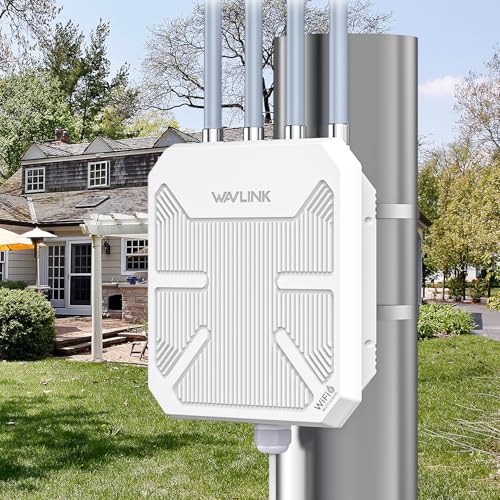
This outdoor WiFi 6 extender combines four detachable 8 dBi omnidirectional fiberglass antennas with two built-in amplifiers. The listing states coverage of 200 to 300 meters in radius and up to 256 connections, which makes it the broadest-reach omnidirectional pick of this shortlist. The detachable antennas also make replacements simple. Its detachable fiberglass design lets a damaged antenna be swapped out, and the amplifiers add reach at the edge of coverage.

Speeds reach 2402 Mbps on 5 GHz and 573 Mbps on 2.4 GHz at the standard's maximum, so the dual-band radio has room for a crowd of phones, laptops and streaming sticks. An IP67 enclosure with 15 kV ESD and 6 kV lightning protection is built to run in rain, snow, wind and thunder. Weather protection of this kind keeps the amplifiers dry.

It sits mid-pack to upper on price, a clear step above the AX1800 models, and it earns it with a faster radio and a bigger antenna set. That makes cable routing tidy.

What works

  • Four 8 dBi omni antennas cover all directions
  • Handles up to 256 connections
  • IP67 with lightning and ESD protection
  • One PoE cable carries power and data

Watch out for

  • Omni antennas gain less than a dish
  • Needs a PoE power source
03
CINAMON AX3000 Outdoor WiFi Extender, Dual Band 5G and 2.4G with PoE, Wi-Fi 6
  • Dual-band WiFi 6, up to 3000 Mbps
  • IP67 enclosure, PoE power
  • Extender, AP and router modes
Check price on Amazon for CINAMON AX3000 Outdoor WiFi Extender, Dual Band 5G and 2.4G with PoE, Wi-Fi 6 (opens in a new tab)
Best for: Owners who want an extender that can also act as an access point.

Our take

It sits just under the WAVLINK AX3000 on price and gives similar headline speeds with a plainer feature sheet.

Why it made the shortlist

The CINAMON AX3000 is a dual-band WiFi 6 outdoor extender with combined speeds up to 3000 Mbps under ideal conditions. It is designed to bring an existing network out to a patio, workshop or yard, which carries over to an RV campsite where the signal needs to reach an awning or a picnic table. The dual-band split lets nearby devices ride the faster band.

An IP67-rated enclosure protects against dust and water jets when the unit is mounted properly, and PoE power lets you place it where no outlet is nearby. Operating modes include extender, access point and router, so the same box can join a campground network or build one of its own. That rating suits a pole or an eave mount.

It is a practical choice when the plan is a fixed outdoor mount, because flexible modes let one purchase serve both as a range extender and later as a hard-wired access point. That flexibility is the point of the unit.

What works

  • Dual-band WiFi 6 radio
  • Extender, access point and router modes
  • IP67 enclosure for outdoor mounting
  • PoE placement away from outlets

Watch out for

  • Antenna details are less specific
  • Written around yard and patio use
04
INEAUTO AX1800 Outdoor WiFi 6 Extender, High Power Long Range Outdoor Access Point
  • WiFi 6 AX1800, dual Gigabit ports
  • IP65, supports 128 devices
  • PoE with complete mounting kit
Check price on Amazon for INEAUTO AX1800 Outdoor WiFi 6 Extender, High Power Long Range Outdoor Access Point (opens in a new tab)
Best for: Wiring a router, camera or TV while also extending WiFi outside.

Our take

PoE support and a complete mounting kit cover installation on a pole or a wall.

Why it made the shortlist

The INEAUTO AX1800 is an outdoor WiFi 6 extender with dual-band speeds up to 1800 Mbps, and it carries two Gigabit Ethernet ports for wired devices. Those ports matter in a rig because a smart TV, a laptop or a small router can plug in without sharing the radio airtime. A wired run is steadier than WiFi for a television.

An IP65 waterproof housing with lightning protection is built for rain, snow and wind, and the unit supports up to 128 devices. Modes include access point, router and repeater, and the WPA and WPA3 security options protect a shared campsite network from the neighbors. That ceiling is generous for a single camper with a family of phones, a tablet or two and a laptop, and the security options keep guests off the connection.

Within this shortlist it sits in the lower middle of the price range, below both AX3000 models, and the saving comes from the AX1800 radio class and a lower device ceiling. It suits a moderate household in a single rig.

What works

  • Two Gigabit Ethernet ports for wired gear
  • WPA3 security options
  • Mounting kit included
  • Handles up to 128 devices

Watch out for

  • Slower radio than the AX3000 models
05
Best for: Lowest-cost long-range omni extender with IP67 weatherproofing.

Our take

Against the WAVLINK AX3000 it keeps the same antenna count and the IP67 rating, at the lowest position on price.

Why it made the shortlist

The WAVLINK AX1800 is the entry pick of this shortlist, with four 8 dBi omnidirectional high-gain antennas aimed at covering outdoor spaces. Its WiFi 6 radio delivers up to 1201 Mbps on 5 GHz and 574 Mbps on 2.4 GHz, which is ample for streaming and video calls from a single rig. The simple layout keeps setup short.

An IP67 sealed, heat-resistant casing is built to thrive in harsh weather, and the listing calls it Starlink compatible, a handy note for owners who pair it with a satellite dish. Active 802.3af and 802.3at PoE and passive PoE let you power and connect the unit through a single Ethernet cable. That pairing is common at long-stay sites.

That makes it the sensible default for a campsite where the radio standard matters less than weatherproofing and a simple pole mount, and where the household is small. The detachable antenna design stays too, which allows a replacement after storm damage.

What works

  • Four 8 dBi omni antennas
  • IP67 with flexible PoE power
  • Listed as Starlink compatible

Watch out for

  • Slower radio than the AX3000
  • Shorter stated coverage than the AX3000

Methodology

How We Built This Shortlist

Each pick was assessed across 5 criteria weighted for real-world use.

01

Antenna design and stated reach

We compared directional dishes with omnidirectional antenna sets and read each stated range. A parabolic dish reaches a single far network, while four 8 dBi antennas cover a wide circle. Listings that stated a distance or a radius earned credit over those that used a vague long-range phrase.

02

Radio class and device capacity

We read the stated WiFi standard, the dual-band speeds and the number of connections each unit supports. Speed figures are maximums under ideal conditions, so they were used for comparison within the shortlist, not as promises. Device ceilings mattered for households with many gadgets.

03

Weather rating and protection

We evaluated IP65 and IP67 ratings along with the stated ESD and lightning protection. An outdoor unit lives through rain and storms, and an IP67 housing is a clearer commitment than a general weather-resistant claim. Based on product specs, higher ratings earned more credit.

04

Power method and mounting

We looked at PoE support, included hardware and mast requirements. A single cable for data and power simplifies a pole install, and a kit that arrives with mounting parts saves a trip. Whether a mast or injector is included was noted for each pick.

05

Price position inside the shortlist

We ranked the five relative to each other and tied each step to an antenna, a radio class or a rating. Scores are editorial assessments from structured criteria, not measurements. Our wider approach is explained on the How We Review page.

Decision guide

Match a Budget Long-Range RV WiFi Booster to Your RV

By Distance to the Network

How far away the source network sits decides which antenna you need.

Distance to the sourceRecommended pickWhy
Across the field, half a mileC.Crane Vector15 dBi dish aimed at one network
Several hundred meters, all aroundWAVLINK AX3000Four 8 dBi antennas, 200 to 300 m radius
Nearby network, many devicesCINAMON AX3000WiFi 6 dual-band with PoE
Short hop, wired gearINEAUTO AX1800Two Gigabit Ethernet ports
Small rig, tight budgetWAVLINK AX1800Same antennas at the lowest price

By Budget

Position inside this shortlist, with no price figures, so the comparison stays true when prices move.

Price bandRecommended pickWhat the money buys
Entry of this shortlistWAVLINK AX1800Four 8 dBi antennas and an IP67 housing
Entry to midINEAUTO AX1800Dual Gigabit ports and a mounting kit
Mid of this shortlistCINAMON AX3000A WiFi 6 radio class with flexible modes
Upper of this shortlistWAVLINK AX3000The widest omni reach and 256 connections
Top of this shortlistC.Crane VectorA directional dish for distant networks

Directional Dish vs Omni Antennas

This is the core tradeoff for distance, and the shortlist splits cleanly.

Directional dish

The C.Crane Vector aims a 15 dBi parabolic antenna at one distant network. It reaches farthest, but it only helps in the direction it points and stays mounted where you aim it.

Omni antennas

The WAVLINK AX3000, CINAMON AX3000, INEAUTO AX1800 and WAVLINK AX1800 cover a circle around the unit. They serve many devices from one point and need no aiming.

For one distant network choose the C.Crane Vector; for site-wide coverage choose the WAVLINK AX3000.

By Power and Mounting

Where the unit goes and how it is powered matter as much as range.

Mounting situationRecommended pickWhy
Fixed mast at a long-stay siteC.Crane VectorStainless hardware, 30 ft cable included
Pole far from an outletWAVLINK AX3000Active and passive PoE on one cable
Kit with brackets in the boxINEAUTO AX1800Complete mounting kit
Satellite dish setupWAVLINK AX1800Listed as Starlink compatible

For a Long-Stay Site Specifically

Staying put changes the calculation, because a fixed mount becomes practical.

Look for

A directional or high-gain antenna, an IP67 rating, PoE power and a stated range with a distance, since a unit that stays up all season needs to survive weather.

In this comparison

The C.Crane Vector brings the dish, while the WAVLINK AX3000 brings 256 connections and lightning protection for a busy household.

When to Spend More

Spending up buys reach and capacity, so decide which one you are short of.

Spend more if

The source network is far away or many devices connect, which is where the C.Crane Vector and the WAVLINK AX3000 justify the step up the shortlist.

Save if

The network is close and the household is small, so the WAVLINK AX1800 or INEAUTO AX1800 already cover the job.

FAQ

Before You Bring One Home

Will a long-range WiFi booster work where there is no WiFi?

No. Every pick here repeats or extends an existing WiFi network and cannot create one. If you camp where no park or neighbor network exists, a cell signal booster or a cellular router is the right category instead. Confirm a source network is within reach before you buy any of these.

Is a dish better than four antennas for distance?

For one distant network, yes. The C.Crane Vector uses a 15 dBi parabolic antenna that the listing says receives a signal about half a mile away. The WAVLINK AX3000 uses four 8 dBi antennas to cover a wide circle, which suits many devices around a site better than a single distant source.

What does Power over Ethernet do for me?

It sends power and data down one cable, so the extender can sit on a pole or roof without a nearby outlet. Listed support on the WAVLINK AX3000 covers active 802.3af and 802.3at plus passive PoE. Look for an injector or a PoE switch in your setup, because that is the part that supplies the power.

Do speeds like AX3000 mean I get 3000 Mbps?

No. The number is the combined maximum across two bands under ideal conditions. The speed you get depends on the network you extend, because the extender cannot exceed what it receives. Use the label to compare radio classes rather than to predict real throughput.

Do I need IP67 for a pole mount?

It is a sensible target. IP67 means dust-tight and tolerant of temporary immersion, and several picks pair it with lightning and ESD protection. The INEAUTO AX1800 is IP65, which handles dust and water jets and suits a sheltered mount. A pole is exposed, so the higher rating is worth the small step up.

Can I use these while driving?

They are built for a fixed mount at a stationary site. A dish like the C.Crane Vector needs to be aimed, and the outdoor extenders are designed to stay in place. For connectivity while moving, a cell booster certified for in-motion use is the better category.

Bottom line

The short version

Browse more budget long-range rv wifi boosters on Amazon →
Bowen Higgins, RV Editor at RV Gear Lab

About the author

Bowen Higgins

RV Editor at RV Gear Lab

Bowen covers RV power, water systems, towing and leveling, upkeep and interior comfort, with a focus on matching gear to the rig, the hookups and the way you actually travel.

More from Bowen →Editorial standards

Keep reading

Related guides