
Practical Camping Guide · 13 min read
Lumens Explained: How Bright Should Camping Lights Be?
Learn what lumens really measure and how bright camping lanterns and tent lights should be, with use-by-use guidance on color, runtime and red light.

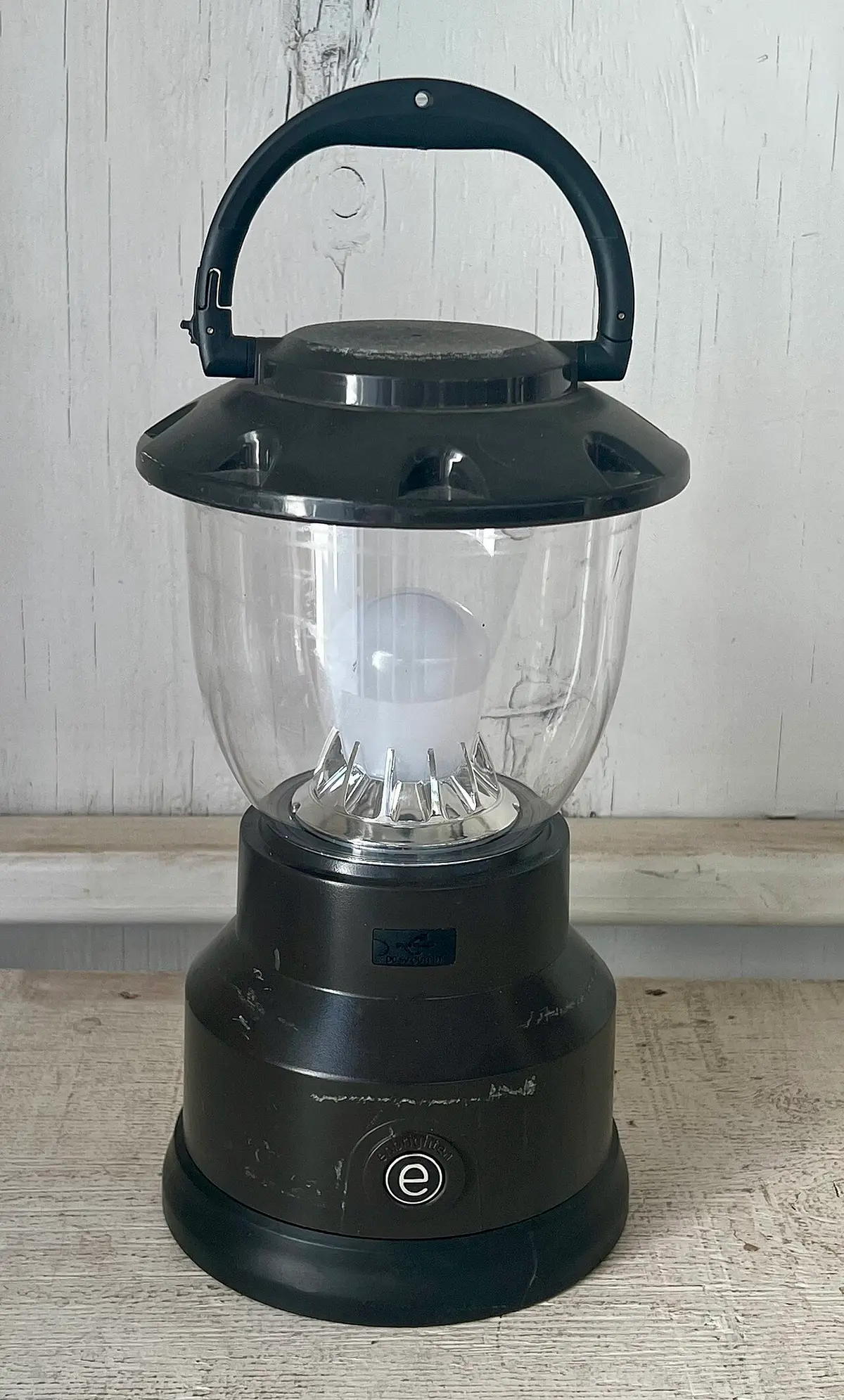
For most campsite jobs you need far fewer lumens than the box suggests: 20 to 50 lumens is plenty inside a tent, 100 to 300 lumens lights a picnic table or camp kitchen, and 300 to 600 lumens is the realistic ceiling for a single lantern that has to light a wide area. Lumens measure total light output, not how far a beam reaches or how comfortable the light is, so the best camp light is the lowest setting that does the job, with a warm color and a red mode for night vision.
Because lumens are the number printed in the biggest type, shoppers chase them. A 1,000 lumen lantern sounds better than a 300 lumen one, but at a campsite it often just blinds your neighbors, drains the battery in an hour or two and attracts more bugs. Below is what lumens mean, what other numbers matter, and a use-by-use guide to how bright your lights should be.
What a lumen actually measures
A lumen (lm) is a unit of luminous flux, the total amount of visible light a source emits in all directions, weighted by the sensitivity of the human eye. A bare bulb that radiates light all around has the same lumen total as that bulb with a reflector that concentrates the light into a beam. The difference shows up in other units.
- Lux is lumens per square meter, a measure of how bright a surface looks. Light that is concentrated on a small area has a high lux, and the same lumens spread over a larger area have a low lux.
- Candela (cd) is luminous intensity in a particular direction, important for spotlights and headlamps because it determines beam reach.
- Beam distance is the distance at which a flashlight's beam falls to a low standard level of brightness, typically 0.25 lux, roughly the brightness of full moonlight.
So a lantern with 300 lumens spread evenly in all directions lights a wide area softly, while a headlamp with 300 lumens focused into a tight beam throws far but lights a narrow spot. Two products with the same lumen count can feel completely different, and the lumen number alone says nothing about which you will like.
How we perceive brightness
Human vision does not scale evenly with light. Doubling lumens does not make a light look twice as bright. Perceived brightness grows more slowly, roughly with the cube root or a similar compressive curve, so going from 100 to 200 lumens is a noticeable step, but going from 400 to 800 lumens feels like a moderate bump rather than a doubling. Your eyes also adapt. After 20 to 30 minutes in the dark, your pupils open and your retinas become far more sensitive, and a light that seemed dim in the car can seem harsh at midnight.
This is why campers are often surprised that a modest 100 lumen lantern lights a picnic table well after dark, while the same light seems feeble at dusk. It is also why the first rule of camp lighting is to start low and add light only if you need it.
How bright for each camp job
| Use | Lumens that works | Notes |
|---|---|---|
| Inside a tent for reading or finding things | 20 to 80 | Warm color, dimmable, a diffused lantern or small clip light |
| Late-night bathroom walk | 20 to 100 | Red or low-white mode preserves night vision |
| Picnic table and camp kitchen | 100 to 300 | Hung overhead, diffused to avoid glare |
| Cooking and cleanup at a larger site | 300 to 500 | One lantern at the table, or two at 200 lumens |
| Wide group gathering area | 400 to 800 total | Use several lights, not one, to avoid harsh shadows |
| Walking the trail at night with a headlamp | 100 to 300 | Spot for distance, flood for nearby |
| Navigation in unfamiliar terrain | 300 to 600 | Use briefly, then drop to a lower mode |
| Emergency signaling or searching | 600 to 1,000+ | Short bursts, stronger beam |
The key insight is distribution. Several 150 lumen lights placed at different heights light a site more pleasantly than a single 800 lumen light, because shadows soften and glare drops. If you need to light the whole site for a gathering, a string of low-output LED lights or a pair of lanterns on opposite sides of the table does a better job than a single floodlight.
What affects usable light more than lumens
Beam pattern and diffusion
A lantern with a clear tube and exposed LEDs produces sharp glare, while a frosted or fabric diffuser spreads the light evenly and reduces eye strain. For tent use and tables, diffusion is more comfortable than raw output. Our guide to rechargeable versus battery lanterns discusses how design interacts with the power source.
Color temperature
Color temperature is measured in kelvin (K). Warm light, around 2,700 to 3,000 K, looks yellowish like an incandescent bulb and is easier on the eyes at night. Neutral white, around 4,000 K, is a middle ground, and cool white, around 5,000 to 6,500 K, looks bluish and is crisp but harsh in the dark. Cool light also tends to attract more insects and disrupts the body's night-time adjustment. Many lanterns offer an adjustable temperature, and the warm setting is often the one you will use most.
Color rendering
The color rendering index (CRI) describes how accurately a light shows colors. A CRI of 80 or above is decent, and 90 or above is excellent. For camp cooking, a higher CRI helps you see whether chicken is cooked through and whether a cut is clean. Cheap LEDs often skip this spec.
Red and green modes
Red light has a long wavelength that does not constrict the pupil, so it preserves night vision and is less likely to bother other campers. It also does not attract many insects. A lantern or headlamp with a red mode is useful for stargazing, reading maps at night and moving around the site. Green light is a middle option favored by some hunters and anglers. Check the best camping lanterns with red light to see how that feature appears in practice. A tiny red setting is a good thing to have even if you never use it for anything else.
Runtime and the way it is measured
Every light loses brightness as the battery drains. The standard ANSI/PLATO FL1 test for flashlights and headlamps defines runtime as the time until output drops to 10 percent of the initial level, and it measures initial output after 30 seconds. That means a headline "100 hour" runtime may refer to a dim glow at the end of the test. Check for the runtime on the setting you will actually use, and for a regulated output that holds steady rather than fading continuously. The standard also describes impact resistance and water resistance tests, which are reported by makers who choose to follow it. A light that states a standard is giving you something checkable.
Power source, battery life and brightness
Brightness and battery life trade off directly. A rule of thumb for LED lanterns is that each lumen costs about 0.01 to 0.02 W, so 300 lumens draws about 3 to 6 W. A 5,000 mAh battery (about 18 Wh) therefore runs a 300 lumen lantern for roughly 3 to 6 hours at full output, and 20 to 40 hours at 50 lumens. If you run a light at one third of its maximum, runtime usually triples or better, because LEDs are more efficient at lower current.
| Lantern output | Approx. power draw | Runtime on 18 Wh battery |
|---|---|---|
| 50 lumens | 0.5 to 1 W | 18 to 36 hours |
| 150 lumens | 1.5 to 3 W | 6 to 12 hours |
| 300 lumens | 3 to 6 W | 3 to 6 hours |
| 600 lumens | 6 to 12 W | 1.5 to 3 hours |
| 1,000 lumens | 10 to 20 W | 1 to 2 hours |
These are planning estimates, since real efficiency varies by LED, driver and optics. If your lantern is USB rechargeable, you can top it up from a power bank. For help sizing a power bank, check how to choose a headlamp for rechargeable lights and how output and runtime interact in head-worn lights. Browse the best USB-C camping lanterns and the best battery-powered camping lanterns for the main power formats.
Water and dust resistance
Camp lights get rained on, dropped and dunked. The IP rating tells you how well the housing resists dust and water. IPX4 handles splashes, IPX5 resists jets of water, and IP67 can survive brief immersion. See IP ratings explained for outdoor gear for what each digit means. For a tent lantern, IPX4 is a reasonable minimum. For a lantern that will hang outside in the weather, IPX5 or better is more comfortable.
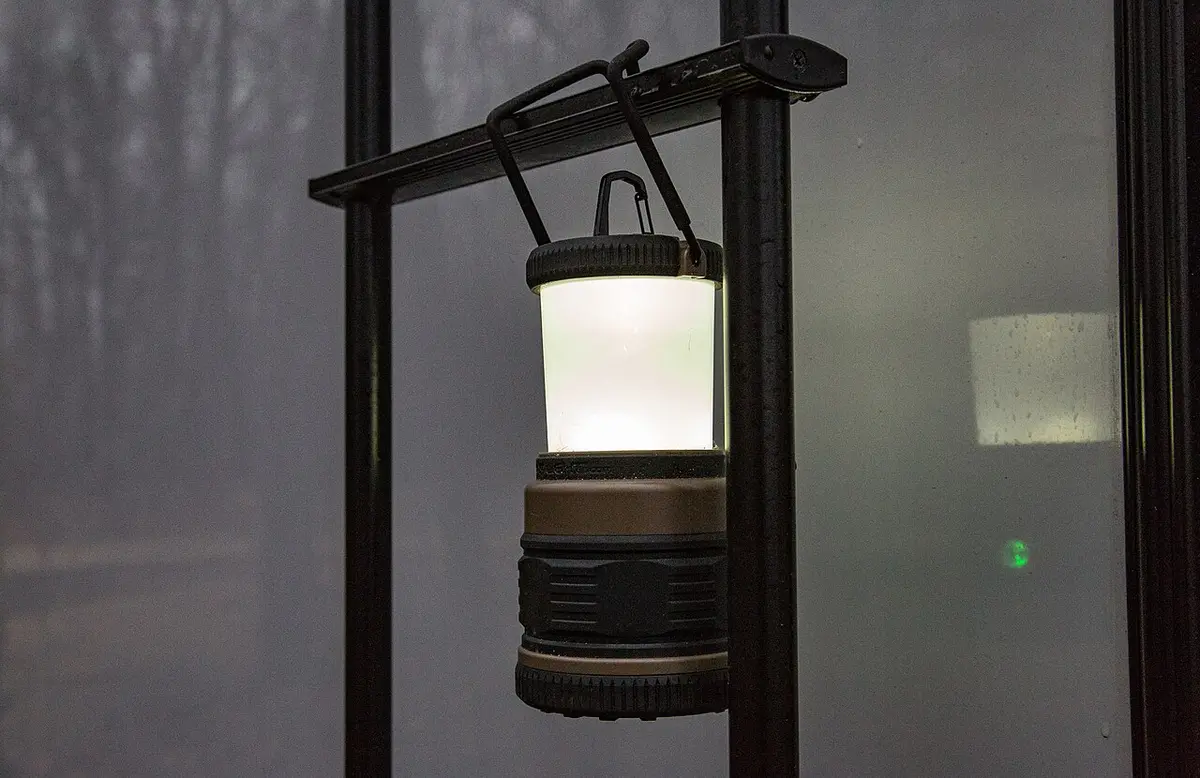
Special features that matter at camp
- Fan lanterns. A built-in fan helps in a hot tent, but the fan uses battery. The best camping lanterns with fans list shows how the trade-off looks.
- Speaker lanterns. Combined lights and Bluetooth speakers are popular but drain the battery faster. See the best camping lanterns with speakers.
- Power outage readiness. A rechargeable lantern doubles as home emergency lighting, and the best rechargeable lanterns for power outages are chosen with long runtime and a power-bank function in mind.
- 12 V lighting for RVs and vans. Fixed LED strips and puck lights run from the house battery. The best 12V LED camping lights overview shows how they differ from portable lanterns, since their lumens come with a steady supply.
- Battery-powered LED lights. Simple string lights and puck lights on AA or AAA batteries suit tents, as the best battery-powered LED camping lights show.
- Hang points and stability. A lantern that hangs from the tent ceiling spreads light more evenly than one sitting on the ground.
- Dimming. A smooth dimmer is more useful than three fixed levels.
A worked lighting plan for a family campsite
Consider a family of four at a drive-in site for three nights, with a tent, a picnic table, a small camp kitchen and a fire ring. A lighting plan built around lumens rather than gadgets might look like this.
Tent interior. One small lantern or clip light at 30 to 60 lumens, warm white, hung from the center loop. This is enough for card games and finding socks, and it is dim enough to sleep next to. Add a second, even dimmer red light near the door for midnight trips. Total: about 60 to 100 lumens, drawing around 1 W.
Picnic table. One diffused lantern at 200 to 300 lumens, hung from a pole or a tree branch above the table, so the light falls evenly on food and hands. If the lantern has a dimmer, run it at about 150 lumens during dinner and bump up to 300 only for cleanup.
Kitchen prep area. A second lantern or a clip-on light at 150 to 200 lumens, placed so that it shines onto the stove and cutting board without putting your own shadow on the work. Two softer lights beat one harsh one.
Paths and the bathroom walk. Each adult carries a headlamp with a 100 to 200 lumen mode and a red mode. A small solar stake light or two at tent corners at 10 to 20 lumens each helps people avoid guy lines without lighting up the whole site.
Around the fire. Often nothing. A fire gives enough light for conversation, and a lantern next to it competes with the flames and ruins night vision. Keep a dim light handy for adding wood safely.
Adding it up, the whole site runs on about 600 to 800 lumens at peak, spread across five or six sources, and during most of the evening the total is nearer 300. Battery use is modest: at an average of 4 W for four hours, the evening uses about 16 Wh, which a single small power bank can cover. Compare that with one 1,500 lumen floodlight hung over the site, which would use more power in an hour, create deep shadows and light up the neighbors.
Solar and hand-crank lights: what the lumens really mean
Small solar lanterns and stake lights usually list impressive lumen numbers, but the useful figure is how much energy they can store. A solar lantern with a 1,000 mAh battery holds about 3.7 Wh, enough for roughly 4 hours at 1 W (around 50 to 100 lumens) after a full day of sun. In shade or on a cloudy day, the panel on a lantern may add only a small fraction of that. Think of solar lanterns as free, dim background lighting that tops up during the day, and carry a rechargeable or battery light for the main work. Hand-crank lights deliver a minute of dim light per minute of cranking at best, so treat them as emergency backups, not camp lights.
Respecting your neighbors and the night sky
Bright camp lights are a common source of friction between campers. A white 800 lumen floodlight pointed at a neighboring site is as annoying as loud music. Good practice includes:
- Aim lights down and inward toward your own site.
- Use warm or red light after dark.
- Turn lights off when you are not using them, especially when you head to bed.
- Use a shade or a low-hanging lantern, so light does not spill into the sky.
- Let your eyes adapt, since a few minutes in the dark reveal the stars and make dim lights feel sufficient.
Lower light also saves battery and reduces insects, an honest benefit of restraint.
How to read a product listing
- Find the maximum lumens and the lumens at each mode. If only the maximum is listed, runtime claims are suspect.
- Look for runtime per mode, with the test standard if given.
- Check color temperature and CRI. Warm and above 80 is a sensible target.
- Look for diffusion or a frosted lens for lanterns used at a table or in a tent.
- Check the power source and charging port. USB-C is the most flexible, and removable batteries give an option for swapping.
- Check the water rating and the drop resistance.
- Check the weight if you carry it, since a lantern that weighs a pound feels heavy in a pack.
- Look for a red or low mode for night use.
Beware of vague claims such as "super bright", "military grade" and "up to 10,000 lumens" on a pocket lantern. If a tiny lantern claims thousands of lumens, treat it with skepticism, because a small battery cannot sustain that output for long and the LED cannot dissipate the heat.
Common mistakes to avoid
- Buying the highest lumen number. It rarely improves comfort and often hurts battery life.
- Using one bright light instead of several soft ones. Shadows and glare make it less pleasant.
- Ignoring color temperature. A cool, bluish light feels harsh at night.
- Skipping a red mode. You lose a way to keep your night vision.
- Forgetting the battery. A bright light with a tiny battery runs out quickly.
- Trusting runtime claims at maximum output. Check the actual number on each mode.
- Hanging a lantern at eye level. Glare is worse. Hang it above or diffuse it.
Frequently asked questions
How many lumens do I need for a tent?
Between 20 and 80 lumens is comfortable for reading and finding gear inside a tent. A dimmable lantern with warm light is best. Higher output makes the tent glow and wastes battery, and it is uncomfortable at close range.
Is 1,000 lumens too bright for a camping lantern?
For most campsites, yes. A thousand lumens can light a large area, but it is harsh up close, drains batteries in an hour or two and annoys neighbors. Use it for short tasks, and keep a lower mode for everyday use.
What is better for camping, warm or cool white light?
Warm white (2,700 to 3,000 K) is generally more comfortable at night and attracts fewer insects. Cool white is crisper, helpful for tasks like fixing gear. Many lanterns let you switch, which is the best option.
Do lumens matter more than battery capacity?
They go together. A bright light with a small battery runs briefly, and a dim light with a big battery runs for days. Look at runtime at the brightness you will actually use, not at maximum.
What does ANSI FL1 mean on a flashlight or headlamp?
ANSI/PLATO FL1 is a standard that defines how makers measure and report output, runtime, beam distance, impact resistance and water resistance. A light that cites it provides numbers that are comparable across brands. Not every maker follows it, and it applies to portable lights such as flashlights and headlamps.
Why does my lantern look dimmer after an hour?
Many lights are unregulated and fade as the battery voltage drops. Regulated lights hold steady output until the battery is nearly empty, then drop sharply. A lantern that dims slowly may be unregulated, while a sudden drop signals a regulated design running out of charge.
Sources & further reading
- Mechanical-engineering.com: IP ratings and IEC 60529 overview
- Tameson: IP rating chart and definitions
- Anker: battery capacity and Wh basics
Image credits
- "Enbrighten LED Camping Lantern" by TaurusEmerald, CC BY-SA 4.0, via Wikimedia Commons.
- "Streamlight LED Camping Lantern - The Siege (41339394074)" by Tony Webster from Minneapolis, Minnesota, United States, CC BY 2.0, via Wikimedia Commons.


Ready to buy?
Compare the gear: Campsite Gear
4 Best USB C Camping Lanterns in 2026
Best USB-C camping lanterns compared on lumens, battery size and Type-C charging or power bank output, for campers who live on one cable.
3 Best Battery Powered Camping Lanterns in 2026
Best battery-powered camping lanterns compared on lumens, D-cell runtime, modes and weather rating for campers who want light that never needs a charger.
4 Best Rechargeable Lanterns For Power Outages in 2026
Best rechargeable lanterns for power outages compared on battery size, USB power bank output, runtime and modes for storm-prep and camping.
5 Best 12v Led Camping Lights in 2026
Best 12V LED camping lights compared on lumens, power draw, mounting and weather rating for van, RV and battery-powered campsite lighting.
4 Best Battery Powered Led Camping Lights in 2026
Best battery-powered LED camping lights compared on lumens, battery type, runtime and weather rating for tent, table and awning lighting.
6 Best Camping Lanterns With Fans in 2026
Best camping lanterns with fans compared on light output, battery or solar power, runtime and size for tent campers who want light and air together.
4 Best Camping Lanterns With Red Light in 2026
Best camping lanterns with red light compared on red modes, brightness, battery and size for campers who protect night vision and avoid glare.
4 Best Camping Lanterns With Speakers in 2026
Best camping lanterns with speakers compared on sound, light modes, battery and weather rating for campers who want music and light from one unit.
Keep reading